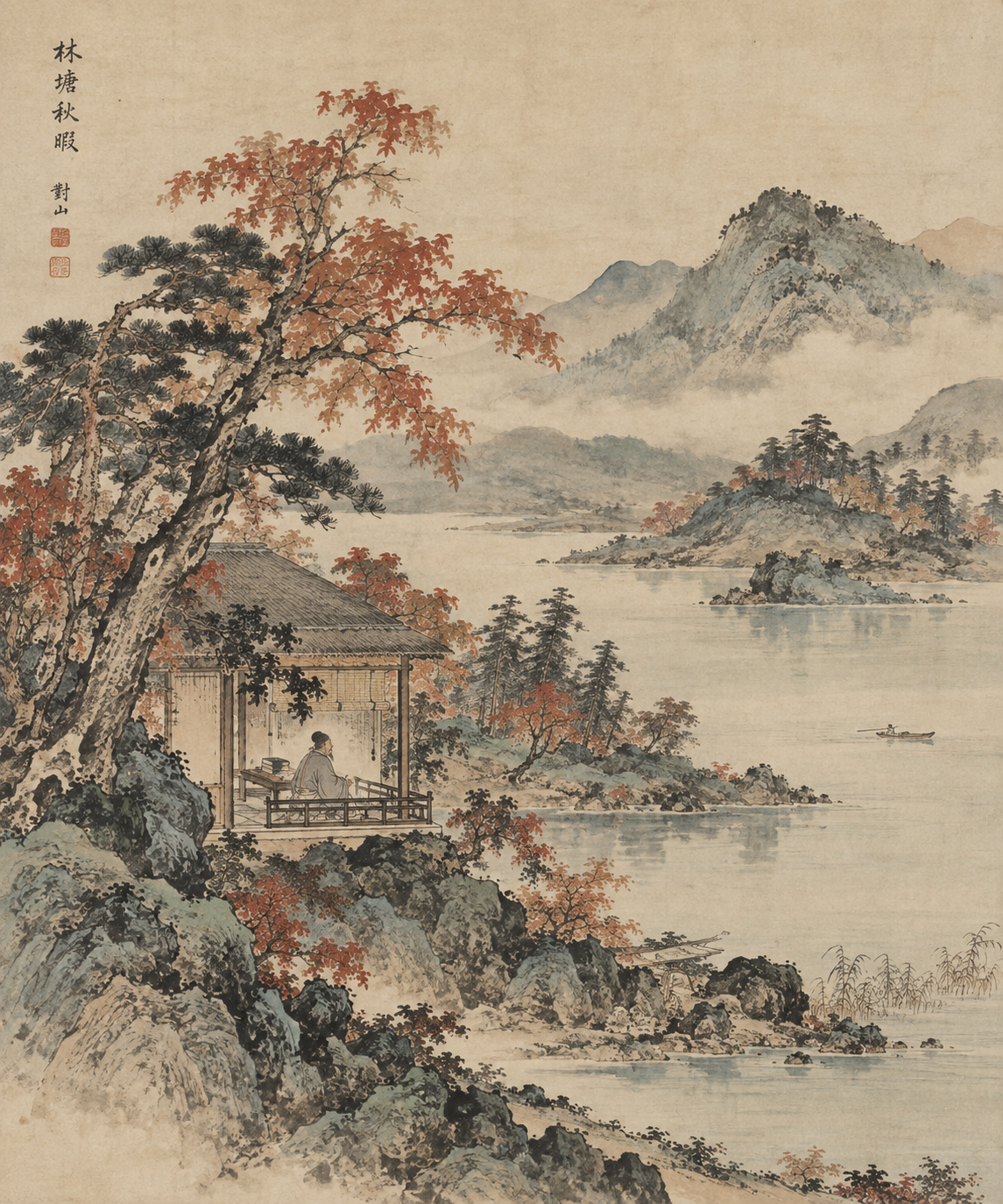
A scholar sits in a modest retreat above a lake. Autumn has begun to move through the trees. Mountains recede into pale distance, and the human figure is deliberately small inside the landscape.
Hine Taizan’s 1850 two-panel screen is recorded by The Metropolitan Museum of Art under the Japanese title Rintō Shūka in kanji, 林塘秋暇, and the English title At leisure in a lakeside grove in autumn. The Met classifies the image as Public Domain and makes it available through its Open Access program. The painted image measures 60 by 60 inches, or 152.4 centimeters square. Florence and Herbert Irving gave the screen to the museum in 2019.[1]
The museum describes a scholar in his hermitage overlooking an autumn lake. The location is not identified; instead, it evokes Chinese precedents. The controlled, precise handling, the Met notes, is characteristic of Taizan’s landscape painting.[1]
Taizan is not a household name even among people familiar with Japanese art. Yet his career opens a remarkably wide view onto late-Edo culture: the maritime communities of Izumi Province, Osaka and Kyoto literati networks, Chinese-inspired Nanga painting, and a line of students who carried his methods into the Meiji era.
A title built around leisure
The Met’s object record gives the Japanese title as 「林塘秋暇」 alongside the English At leisure in a lakeside grove in autumn.[1]
Japan.co.jp found no authoritative Japanese institutional source giving a standard kana reading for the four-character title, so this report does not invent one. The meaning, however, is unusually well matched to the image: autumn leisure beside water and trees.
The screen is meant to be read from right to left. Rock and foliage establish the foreground. The hermitage and scholar appear within that structure. Water then opens the space toward the distant mountains. The human presence does not dominate nature; it gives the viewer a scale from which to enter it.
Born in Izumi Province in 1813
Izumisano City, Taizan’s home municipality, records that Hine Taizan was born in 1813 in Minato, Nakashō village, Hine district of Izumi Province—today part of Izumisano, Osaka Prefecture. His father was Hine Matazaemon. The city notes that sources disagree on whether Taizan was his second or third son.[2]
Showing talent from childhood, he studied painting with Momoda Eiun in Kishiwada. Another decisive figure was Satoi Fukyū, a shipping merchant and local official from the same community. Izumisano says Fukyū recognized the young artist’s ability, showed him works from his own collection and introduced him to artists including the Osaka Nanga painter Okada Hankō.[2]
The Met likewise identifies Fukyū and Hankō as important early connections and notes traditions that Taizan studied painting and calligraphy for a time with Nukina Kaioku.[1]
Kyoto at 24
Izumisano City believes Taizan moved to Kyoto around age 24, corresponding to 1837. He changed residences several times in the capital but remained active there until his death in 1869.[2]
Kyoto was an essential center for Nanga. The Kyoto National Museum describes Japanese Nanga as a tradition that developed in the 18th century from Chinese Southern-school painting, reaching one of its great early achievements in Ike Taiga.[3]
The Met similarly explains that Japanese artists responded to Chinese literati culture by developing what came to be called bunjinga, or literati painting, and nanga, literally “Southern painting.” These modes flourished beside other Edo-period traditions rather than replacing them.[4]
From “Daizan” to “Taizan”
Izumisano’s biography contains a useful detail often absent from short English summaries. The painter initially used the art name 台山 and changed it at age 28 to 対山, Taizan. The city says his earlier work was often more naturalistic and that he appears to have turned more decisively toward literati painting around age 30.[2]
It also characterizes the works up to roughly age 41 as comparatively meticulous Nanga painting. After that, his output increased and fewer works show the same degree of fine detail.
At leisure in a lakeside grove in autumn was painted in 1850, when Taizan was about 37. It therefore falls directly inside the period Izumisano identifies with his especially refined literati landscapes. The Met’s description of the screen as controlled and precise reinforces that chronology.
Chinese landscape as a Japanese interior world
Nanga should not be understood as a simple attempt to copy Chinese scenery. Japanese artists studied imported painting manuals, inscriptions, poems and older compositions, then combined those models with travel, local landscapes, calligraphy and personal networks.
In Chinese literati culture, landscape could represent more than a physical place. A mountain retreat offered an imagined distance from official life—a place for reading, painting, poetry, friendship and cultivated withdrawal.
Japanese Nanga artists adapted that ideal. Small huts, bridges, boats, distant waterfalls and tiny figures created landscapes that could function as imagined states of mind.
Taizan’s scholar belongs to that world. We are not asked primarily to identify him. We are invited to share the act of looking outward from his retreat.
Why autumn?
This is not a spectacular autumn picture. Taizan does not overwhelm the viewer with brilliant red foliage. Color is restrained, atmosphere matters, and the changing season is felt as a shift in the air.
Seasonal landscape was one of his repeated concerns. Japan’s Cultural Heritage Online database lists Taizan’s four Landscapes of the Four Seasons at the Yamatane Museum of Art, together with Autumn Colors across the Stream. Kyoto National Museum holds his Summer Mountains in Misty Rain.[5][6]
The seasons gave literati painters a vocabulary for time and feeling. Autumn could be clarity, ripeness, distance or reflection without being reduced to a single fixed symbol.
More visible in collections than in popular memory
The Met itself owns more than this one Taizan work. Its collection includes an accordion album of fifteen ink landscapes, dated around 1850, titled Taizan Sensei Sansui Gafu, as well as a later landscape known in English as The Deep Green of Summer Mountains.[7]
In Japan, his works are held by Kyoto National Museum, Tokyo University of the Arts, Kishiwada Castle and the Yamatane Museum of Art, among others. Cultural Heritage Online records his 1860 Spring Valley Fishing at Kishiwada Castle and identifies him as a literati painter from Minato in Hine district.[8]
Taizan is therefore not forgotten because his art disappeared. The objects survive. What has faded is the breadth of public familiarity with his name.
His students carried Nanga into the Meiji era
Izumisano City names Inose Tōnei, Noguchi Shōhin, Atomi Kakei and Nakamaru Kinpō among Taizan’s pupils.[2]
Noguchi Shōhin became one of the leading Nanga painters of the Meiji period. The Tokyo National Museum records that she studied with Hine Taizan and later became, in 1904, the first woman appointed an Imperial Household Artist.[9]
Atomi Kakei became both an artist and an important educator. Atomi Gakuen’s institutional history says that after going to Kyoto as a teenager she studied painting with Maruyama Ōryū and Nakajima Raishō and further expanded her artistic range under Hine Taizan. She later founded Atomi School in Tokyo.[10]
That lineage makes Taizan more than a late-Edo landscape specialist. He became one of the teachers through whom Nanga methods moved into the careers of prominent Meiji women in art and education.
Death at 57 in 1869
Taizan died on the 13th day of the third month of Meiji 2, corresponding to April 24, 1869, at age 57. Izumisano says he was buried at Konkaikōmyō-ji in Kyoto’s Kurodani district.[2]
Kyoto Prefecture’s historical chronology independently records his death on that date and his burial at Kurodani.[11]
He died just as the political and institutional world of Edo Japan was being remade under the new Meiji government. His pupils would live much further into that new age and carry parts of his artistic inheritance with them.
Looking at leisure from 2026
There is something quietly provocative about an artwork centered on “leisure” today.
The scholar in Taizan’s hermitage does not appear productive. He is not traveling, trading, performing or making anything visible. He is sitting inside a landscape and looking.
The social ideals of 19th-century literati culture cannot simply be imported into modern life. But the screen’s proposition still feels legible: distance can sharpen attention. Making the human figure smaller can make the world larger.
You do not need to leave a city or become a recluse to understand the attraction. Sometimes the radical act is simply to stop arranging every minute around output and let the eye travel farther than the next task.
Today’s Art Choice
Japan.co.jp chose Taizan for October 1 not only because this is an autumn painting.
He is exactly the kind of artist worth rediscovering: accomplished, historically connected, well represented in major collections, yet much less familiar than the canonical names surrounding him.
His path ran from Izumi Province to Osaka literati circles and then Kyoto; from careful observation toward Nanga; from his own landscapes to the work of students who would matter in Meiji art and education.
The tiny scholar in At leisure in a lakeside grove in autumn asks nothing dramatic of us.
He simply gives us a place to sit for a while.
