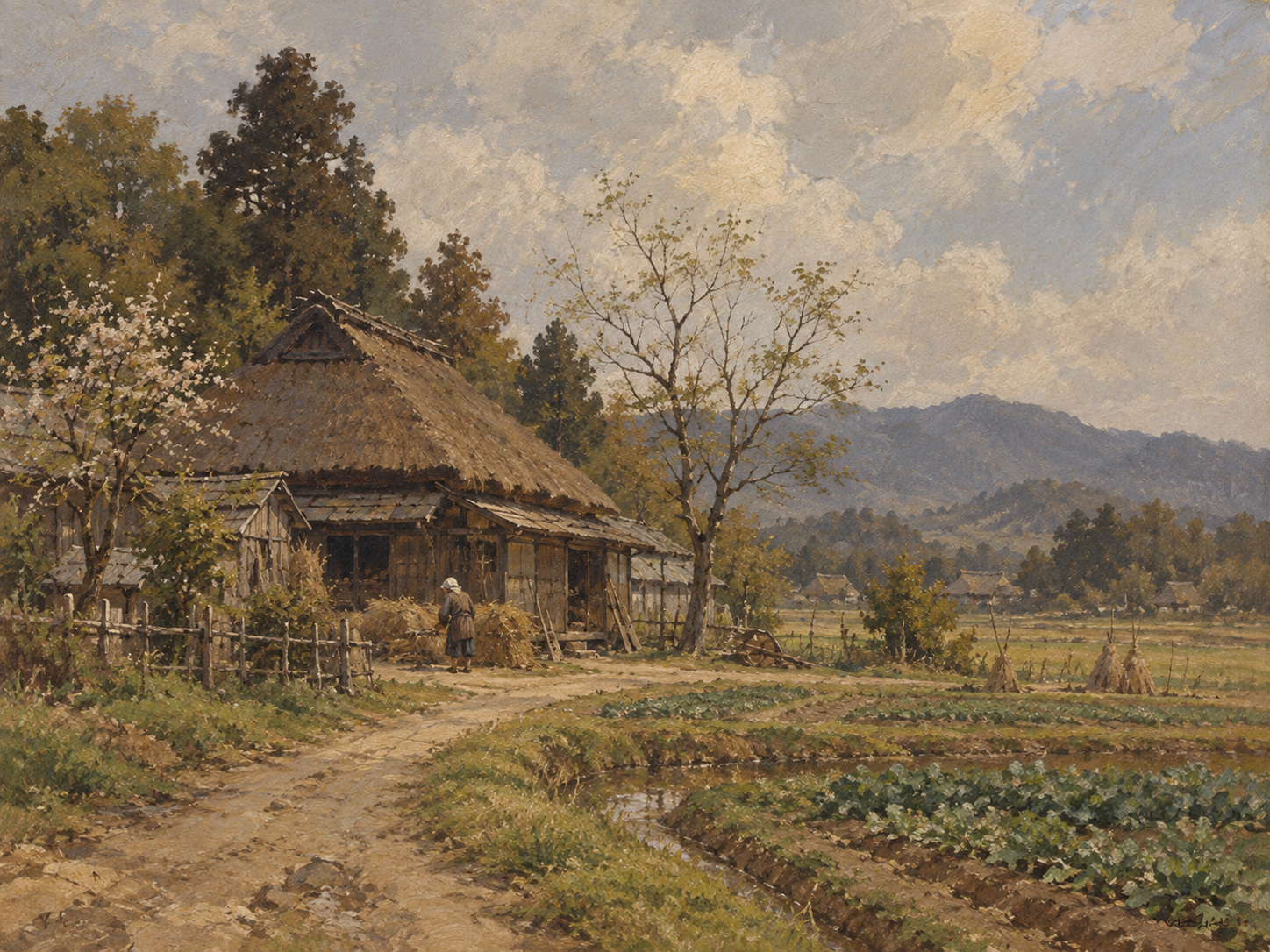
There is almost nothing theatrical about Chū Asai’s Straw-Thatched Roof.
A low farmhouse fills much of the canvas. A yard opens in front. Trees, soil and two small human figures hold the composition together. Chiba Prefectural Museum of Art dates the oil painting to around 1887 and gives its size as 48.9 by 71.0 centimeters.
The subject is quiet. The historical problem behind it is not. Japan in the early Meiji period was trying to decide what it meant to make “Western painting” into Japanese art, and Asai stood near the center of that experiment.
Born in Edo, formed in Sakura
Asai was born in 1856 inside the Sakura domain’s Edo residence, the eldest son of Sakura retainer Asai Iori Tsuneaki. His childhood name was Chūnojō.
After his father’s death, the family moved to Sakura in 1863. He studied at the domain school and learned Japanese painting from Kurokawa Kaizan, another Sakura retainer.
Sakura City now presents Asai as a pioneer of modern Japanese Western-style painting and one of the city’s central artists.
His Chiba connection is therefore not a later museum association. His formative childhood and first artistic education were rooted in Sakura.
The Technical Fine Arts School and Antonio Fontanesi
In 1876, Asai entered the newly established painting department of the Technical Fine Arts School, one of Meiji Japan’s first government institutions for systematic Western-art education.
There he studied under Italian painter Antonio Fontanesi.
Chiba Prefecture describes Fontanesi as an artist who introduced Barbizon-influenced landscape painting into Italy and who favored natural landscapes shaped by everyday human activity. Asai absorbed that sensibility and repeatedly painted villages, farms and fishing communities.
Straw-Thatched Roof belongs to the period in which that influence remained especially visible.
Fontanesi did not simply teach “how to paint like Europe”
The lesson was broader than oil paint.
Students learned perspective, landscape construction, figure work, coloring and grounds. More importantly, they learned how to organize observation—how to turn light, terrain, architecture and labor into a pictorial structure.
Japanese students then applied those methods to Japanese fields, villages and coastlines.
The result was not simply imported European painting. It was the beginning of Meiji yōga.
This is not a nostalgic picture of an ideal village
The farmhouse is not romanticized into a picturesque tourist landscape. The roof is visually heavy; the building is low; the earth colors are restrained.
Chiba Prefecture places the work alongside Asai’s Farmer Returning Home (1887) and Spring Ridge (1888), describing all three as scenes of rural life. It praises the tightly controlled composition, careful execution and rich paint surface created by the physical properties of oil color.
Asai was not painting a later generation’s idea of “old Japan.” He was painting a living environment of the 1880s.
Two tiny figures make the building into a lived place
The museum specifically notes the two staffage figures used to tighten the composition.
They are too small to function as portraits. Their role is spatial and human: they turn the farmhouse from an architectural object into a place of labor and habitation.
The contrast between the enormous thatched mass and the small bodies gives the work much of its physical gravity.
The farmhouse was probably in Tochigi—not Chiba
Chiba Prefectural Museum of Art says the farmhouse used as the motif is believed to have been studied in Tochigi.
That point matters for accurate local framing.
Straw-Thatched Roof should not be described as a Chiba rural landscape simply because it is now in a Chiba museum. Its Chiba significance comes from Asai’s Sakura upbringing, the prefectural collection and the work’s status as a designated Chiba cultural property.
Did Asai use a photograph?
The museum notes that scholars have suggested the possibility that Asai used a photograph, citing the stiffness of the overall composition among the reasons.
That is not a documented fact about the production process. It remains an interpretive possibility.
But it is historically plausible in a broader sense. Meiji painting developed alongside photography, and artists increasingly worked within a visual culture in which mechanical images could influence framing and observation.
1889: creating an institution for yōga
After Fontanesi returned to Italy and the Technical Fine Arts School eventually closed, the first generation of Japanese Western-style painters needed institutions of their own.
In 1889, Asai and colleagues founded the Meiji Art Society, which Sakura City describes as Japan’s first Western-style art organization.
Asai exhibited major works including Spring Ridge and Harvest and became one of the central figures of the movement.
Straw-Thatched Roof, painted around 1887, therefore sits just before the institutional consolidation of Meiji yōga.
“Yōga” itself was a Japanese modern category
After the Meiji Restoration, oil and watercolor painting based on Western methods came to be classified as yōga, “Western painting,” in contrast with nihonga.
That division was not simply technical. It became an institutional structure for schools, exhibitions, criticism and national art history.
Asai belonged to the generation that did not merely practice yōga. It helped create the category.
Professor at Tokyo Fine Arts School
In July 1898, Asai was appointed a professor at Tokyo Fine Arts School, predecessor of today’s Tokyo University of the Arts.
The former student of Japan’s earliest Western-art academy had become part of the next generation’s official training system.
France at age forty-four
In February 1900, the Ministry of Education sent Asai to France for two years of Western-painting research. Sakura City also records his role as a juror connected with the 1900 Paris Exposition.
He was already in his mid-forties, not a young student seeking first exposure to European art.
Chiba Prefectural Museum of Art says he did not attach himself to one particular master. Instead, he responded to Impressionism and the Art Nouveau movement and painted around Grez-sur-Loing and Fontainebleau.
His palette became lighter
Works such as The Tower at Grez, Forest of Fontainebleau and Peasant Woman have a different atmosphere from the heavy earth of Straw-Thatched Roof.
Seen across his career, the 1887 painting is not the endpoint of an “Asai style.” It is one stage in an artist who kept changing his visual language.
Kyoto after 1902
Asai returned to Japan in 1902 and moved with his family to Kyoto to become professor at the newly established Kyoto Higher School of Design, today Kyoto Institute of Technology.
He founded the Shōgoin Western Painting Institute in 1903, which developed into the Kansai Art Institute in 1906. As its leader he taught artists including Sōtarō Yasui and Ryūzaburō Umehara.
He also expanded into design and craft, influencing Kyoto’s applied-art world.
A pioneer who ended by crossing boundaries
Asai’s life does not follow a simple story of “Westernization.”
He learned Japanese painting in Sakura, Western oil technique in Tokyo, encountered Impressionism and Art Nouveau in France, and then worked across painting, design and craft in Kyoto.
His career repeatedly crossed the categories that modern Japanese art institutions were themselves inventing.
Why Asai is a pillar of the Chiba Prefectural Museum collection
Chiba Prefectural Museum of Art repeatedly describes Asai as a core figure in its collection.
The reason is unusually strong: he is both a major artist of national modern-art history and an artist deeply connected to Sakura and Chiba.
The museum holds Straw-Thatched Roof, Fisherwoman, Kotanba Village and works from his French and Kyoto periods, allowing visitors to follow the transformation of Japanese Western-style painting through one career.
Designated a Chiba cultural property in 2019
On March 5, 2019, Chiba Prefecture designated Straw-Thatched Roof a tangible cultural property in the painting category.
The prefectural Board of Education describes it as a work that clearly represents Asai’s 1878–93 phase and as an important piece in the history of modern Japanese painting.
The artwork is public domain
Asai died in 1907, so the underlying artwork is in the public domain.
Wikimedia Commons hosts a faithful reproduction of the Chiba Prefectural Museum of Art painting and marks the file as public domain under its PD-Art treatment, including a U.S. public-domain rationale for a work published before 1931.
The currently displayed original file is 595 by 401 pixels, so it should not be described as a genuinely high-resolution reproduction.
The weight of the thatched roof
Placed beside a 2026 Chiba edition full of AI infrastructure, biotechnology and urban resilience, Straw-Thatched Roof can seem to come from another world.
Yet Asai was also living through technological and institutional disruption.
Oil paint was new to Japan. The farmhouse was old. The method came from Europe. The earth and labor in front of him were Japanese.
The modernity of the painting lies in refusing to erase that contradiction.
Today’s Art Choice: Chū Asai, Straw-Thatched Roof
At first glance, almost nothing happens.
But once the painting is connected to Sakura, Fontanesi, photography, the Meiji Art Society, France and Kyoto, the quiet farmhouse stands at a major turning point in Japanese visual culture.
The roof is old. Asai’s way of seeing it was new.
That is why this modest rural painting still deserves the Chiba Prefecture Board of Education’s description: an important work in the history of modern Japanese painting.
Sources
- Chiba Prefectural Board of Education, Straw-Thatched Roof
- Chiba Prefectural Museum of Art, Straw-Thatched Roof object note
- Chiba Prefectural Museum of Art, Chū Asai collection biography
- Sakura City, Chū Asai
- Chiba Prefectural Museum of Art, Asai’s European period
- Chiba Prefectural Museum of Art, Asai’s Kyoto period
- Wikimedia Commons, Straw-Thatched Roof by Asai Chū
.jpg)