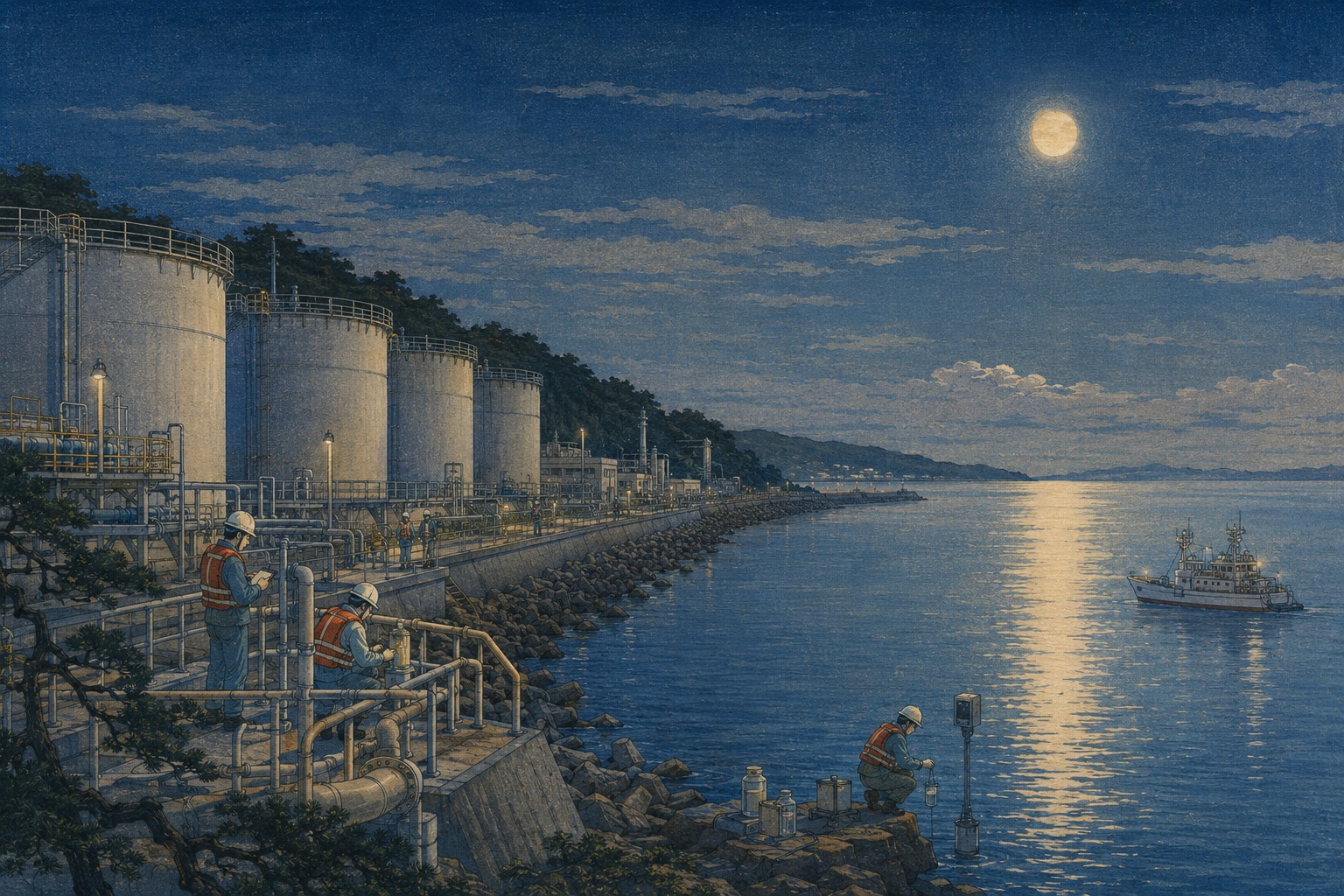
The fourth FY2026 discharge began on July 30 and is scheduled to continue through August 17. It is in progress, not complete. TEPCO plans to release approximately 7,800 m³ of treated water containing about 1.3 terabecquerels of tritium. The IAEA independently tested the latest batch before release and confirmed that the diluted tritium level was far below the 1,500 Bq/L operational limit. Environmental monitoring continues during and after the operation.
At 11:28, the ordinary machinery of an extraordinary history
Nothing about the motion of the water looks dramatic. Pumps turn. Flow meters register. A valve changes position. Treated water enters a header where it is mixed with a much larger stream of seawater, passes into a vertical shaft and moves through a tunnel beneath the Pacific seabed. About one kilometer offshore, the diluted mixture leaves the system.
Yet there is no ordinary water at Fukushima Daiichi. Every liter in this program descends from the system improvised after the March 2011 nuclear accident: cooling water passed across melted fuel, groundwater entered damaged buildings, rain found broken roofs, and an emergency became a permanent exercise in controlling liquid.
The latest operation is deliberately repetitive. TEPCO intends the fourth FY2026 batch to move at approximately 460 cubic meters of treated water per day, below the designed maximum of 500. It will be mixed with approximately 340,000 cubic meters of seawater per day. The company estimates that the 170,000 Bq/L tritium concentration measured before dilution will become about 230 Bq/L after mixing.
The transfer into measurement tanks had finished on June 4. The water was circulated and agitated beginning June 15 so that a representative sample could be taken on June 22. TEPCO, its contracted external laboratory and Japan Atomic Energy Agency checks formed layers around the source analysis. The sum of concentration-to-regulatory-limit ratios for the 29 nuclides assessed, excluding tritium, was 0.61—below the release requirement of 1. Tests of 39 additional nuclides found no significant concentrations, and 44 general water-quality criteria were met.
Those checks explain why the correct description is neither “ordinary seawater” nor an uncontrolled “dump.” This is a planned release of water that originated in a nuclear accident, has been treated and qualified batch by batch, still contains tritium and trace radionuclides, and is being diluted and discharged under a regulatory and international monitoring system.
Four kinds of water—and why the names matter
The argument around Fukushima has often become an argument over vocabulary. TEPCO insists that “contaminated water” and “ALPS-treated water” are different. Critics sometimes call all of it radioactive wastewater. The most useful approach is to describe the stages precisely.
| Term | What it means | Can it be discharged? |
|---|---|---|
| Contaminated water | Cooling water that has contacted fuel debris, together with groundwater and rainwater that mixes with it inside damaged buildings. It can contain high concentrations of radionuclides. | No. It must first pass through multiple treatment systems. |
| ALPS-treated water, etc. | The broad tank inventory after ALPS processing. It includes water already below release standards for nuclides other than tritium and water that still needs secondary treatment. | Not automatically. Every batch must qualify. |
| Water to be re-purified | Previously processed water in which the combined regulatory-concentration ratio for nuclides other than tritium remains at or above 1. | No. It must be treated again until the ratio is below 1. |
| ALPS-treated water for discharge | Water confirmed before dilution to satisfy regulatory limits for assessed radionuclides other than tritium. | Only after tritium is diluted below the operational limit and all discharge conditions are met. |
The distinction is scientific and regulatory, but it also has a history. Early public descriptions sometimes created the impression that everything emerging from ALPS was already below release standards except for tritium. That was not true of the entire stored inventory.
TEPCO’s current breakdown, dated March 31, 2026, says only 32% of the fully filled tank volume in the estimate—398,500 cubic meters—had a combined ratio at or below one. Another 42% was between one and five times the combined limit, 10% between five and ten, 8% between ten and one hundred, and 7% above one hundred. The company attributes the higher concentrations to early equipment problems and periods when the urgent objective was reducing the radiation risk at the site boundary by processing large quantities quickly.
That does not mean the higher-category water is being discharged. It means a large part of the remaining inventory must be treated again. The July 30 batch required no secondary treatment and passed its pre-release analysis. Precision demands keeping both facts in view.
How a cooling failure became a water crisis
On March 11, 2011, the Great East Japan Earthquake severed off-site electricity to Fukushima Daiichi. The reactors operating at the time shut down automatically, but shutdown did not end their need for cooling. The tsunami flooded emergency power equipment, cutting through multiple safety layers. Units 1, 2 and 3 suffered core melts; hydrogen explosions tore apart reactor buildings; radionuclides entered the air and sea; communities were evacuated.
Water helped prevent a worse catastrophe. It also became one of the accident’s longest consequences. Operators had to keep injecting water to cool the fuel debris—the mixture of melted nuclear fuel and structural material left inside the reactors. Water contacting that debris became highly contaminated and accumulated in basements and connected structures.
The plant sits in a landscape where groundwater naturally moves from higher ground toward the sea. Damaged buildings were no longer watertight. Groundwater and rain entered, mixed with contaminated water and increased the volume that had to be pumped, treated and stored. At the problem’s height, tank construction seemed to chase a moving target.
TEPCO responded with a chain of measures: pumping groundwater before it reached buildings, operating subdrains near the structures, paving ground to reduce rain infiltration, repairing roofs, building an ocean-side impermeable wall and freezing soil around the reactor buildings to form a land-side barrier. The company says new contaminated-water generation fell from about 540 m³ per day in May 2014 to about 140 m³ per day in 2020, with a target below 100 m³ per day during 2025.
The engineering problem was therefore never “one tank of waste water.” It was a dynamic water balance: liquid injected for cooling, natural water entering the site, contaminated water removed from buildings, treatment throughput, tank capacity, radioactive decay and eventual disposal.
The tank forest and the second emergency
Immediately after the accident, speed mattered more than elegance. Crews assembled bolted, flanged tanks across the site. In August 2013, one of those tanks leaked roughly 300 cubic meters of highly contaminated water, hardening public awareness that storage itself carried risk. TEPCO later moved water into welded tanks, added double dikes, covered containment areas and strengthened leak monitoring.
By the eve of the discharge program in August 2023, about 1.34 million cubic meters of ALPS-treated water and water awaiting further treatment occupied the site. More than a thousand tanks filled land also needed for waste handling, fuel-debris retrieval and other decommissioning facilities. Tanks age, pipes connect them, earthquakes and typhoons continue, and even a well-managed storage field creates an inventory that must be protected indefinitely.
That was the strongest engineering argument for disposal: controlled, gradual discharge could reduce the long-term risk and free operational space. But the tank arithmetic contains a warning against easy narratives. Although approximately 163,800 cubic meters had been discharged through the first 21 batches, TEPCO’s online inventory recently showed about 1.30 million cubic meters still stored, only modestly below the starting level. New contaminated water continues to be generated, treated and added to the system.
Discharge is therefore not an eraser. It is one outlet in an operating balance, running alongside the much harder work of stopping inflow, cooling and eventually retrieving fuel debris. If upstream water generation does not keep falling, empty tank space can be refilled.
What ALPS removes—and the hydrogen it cannot separate
ALPS stands for Advanced Liquid Processing System. It is not a single filter but a sequence of chemical precipitation and adsorption processes designed to remove radionuclides according to their chemical properties. Cesium and strontium are reduced in earlier stages; ALPS targets dozens of additional radionuclides. Under the discharge system, 29 nuclides are measured and assessed against regulatory limits, tritium is measured separately, and 39 more are checked to confirm that none is significantly present.
Tritium is the stubborn exception because it is hydrogen. An ordinary hydrogen nucleus contains one proton. Tritium contains one proton and two neutrons. When it bonds with oxygen, it becomes part of a water molecule. A treatment system that separates chemical species cannot efficiently pull out water molecules that behave almost like the water surrounding them at the enormous volumes involved.
Tritium is radioactive, with a physical half-life of about 12.3 years. It emits low-energy beta radiation that travels only a very short distance and does not penetrate skin from outside the body. Exposure can occur if tritiated water is inhaled or ingested; its biological behavior and dose therefore matter. The scientific conclusion that the planned release has negligible radiological impact does not come from saying tritium is nonradioactive. It comes from its radiation characteristics, the quantities released, dilution and dispersion, exposure pathways, food-chain modeling and conservative dose calculations.
Dilution needs especially careful language. Mixing does not destroy tritium or reduce the total becquerels in a batch. It lowers the number of decays per second in each liter, reducing exposure at any given point and enabling dispersion. The total planned tritium activity in this batch remains approximately 1.3 trillion becquerels.
- 170,000 Bq/L: measured tritium concentration in the treated water before seawater dilution.
- ≈230 Bq/L: calculated concentration after the approximately 740-fold design dilution for this batch.
- 1,500 Bq/L: Japan’s operational ceiling for the discharge program, one-fortieth of the national regulatory concentration limit.
- 60,000 Bq/L: Japan’s regulatory concentration limit for tritium in liquid discharge from a nuclear facility.
TEPCO also compares the 230 Bq/L figure with the World Health Organization’s 10,000 Bq/L guidance level for tritium in drinking water. The comparison provides scale, but it is not the governing test: the discharge is not a drinking-water supply, and the WHO value is designed for a different exposure scenario. The relevant safety case combines source limits, annual activity, modeled doses and environmental monitoring.
Five options, one decision, decades of consequences
Japan did not decide on ocean discharge immediately after the accident. Government panels examined five broad disposal pathways: release into the geosphere, underground burial after solidification, release as hydrogen, atmospheric vapor release and controlled discharge to the sea. Practicality, precedent, worker exposure, time, monitoring and cost narrowed the official discussion.
In February 2020, a government subcommittee concluded that vapor release and ocean discharge were the technically feasible options, with the sea route easier to control and monitor. On April 13, 2021, the government adopted its Basic Policy selecting controlled ocean release after treatment and dilution. The Nuclear Regulation Authority approved TEPCO’s amended implementation plan in July 2022. Construction included a mixing system, emergency isolation valves and an approximately one-kilometer discharge tunnel designed to carry diluted water beyond the harbor and reduce recirculation into the dilution intake.
The IAEA began a multiyear review in 2021 at Japan’s request. Its July 2023 Comprehensive Report concluded that the approach and activities were consistent with relevant international safety standards and that the planned, controlled releases would have a negligible radiological impact on people and the environment.
One sentence in that report remains essential: the choice to discharge was a national decision by Japan, and the IAEA review was neither a recommendation nor an endorsement of the policy. The agency assessed whether the chosen plan met safety standards; it did not decide whether Japan should have chosen a different socially acceptable option.
On August 24, 2023, the first batch entered the Pacific. By July 2026, the program had moved from global breaking news to an operational sequence. The fourth FY2026 batch is number 22 overall. Routine is an achievement—but it cannot be a substitute for scrutiny.
| Date | Turning point | Meaning |
|---|---|---|
| March 11, 2011 | Earthquake, tsunami and station blackout lead to core damage in Units 1–3. | The emergency cooling and groundwater problem begins. |
| 2013 | ALPS enters service; a major leak from a bolted storage tank exposes storage risk. | Treatment capacity expands as confidence in temporary tanks falls. |
| 2015 | Government and TEPCO tell fisheries groups that no disposal will occur without stakeholders’ understanding. | “Understanding” becomes the unresolved social standard beside legal safety. |
| 2018 | TEPCO acknowledges that much stored processed water still exceeds discharge standards for some nuclides. | Secondary treatment becomes central to the credibility of the plan. |
| April 2021 | Japan selects treated, diluted ocean discharge as national policy. | The engineering plan becomes a political commitment. |
| July 2023 | IAEA issues its Comprehensive Report. | The plan is judged consistent with international safety standards. |
| August 24, 2023 | First discharge begins. | Pre-release assessment becomes decades of operational verification. |
| July 30, 2026 | Fourth FY2026 discharge—22nd overall—begins. | The program is routine enough to count by batches, but monitoring remains active. |
A safety case built in layers
No single measurement can establish safety for a decades-long discharge. The control system is built from overlapping layers intended to catch different failures.
First comes source control. Water is circulated in a measurement tank to make the sample representative. TEPCO and outside laboratories measure the radionuclide inventory. The sum of ratios for regulated nuclides other than tritium must be below one. Water that fails must return to ALPS for secondary treatment.
Second comes dilution control. Flow meters track treated water and seawater. For this batch, the design calls for about 740 parts of dilution. If seawater pumps stop or ratios become abnormal, redundant emergency isolation valves are designed to close; one sits inside the seawall for tsunami protection.
Third comes discharge-water sampling. TEPCO samples the mixed water during release to confirm tritium is being diluted as calculated. Its published plan states that samples are taken daily.
Fourth comes marine monitoring. TEPCO obtains rapid tritium results at ten locations within three kilometers and four locations in a ten-kilometer-square area offshore. Near-site suspension levels are 700 Bq/L for the ten close points and 30 Bq/L for the four broader points, with lower investigation thresholds. Longer, more sensitive measurements cover seawater, fish and seaweed over a wider area.
Fifth comes institutional overlap. The Nuclear Regulation Authority, Environment Ministry, Fisheries Agency, Fukushima Prefecture and other bodies operate or coordinate monitoring. The IAEA maintains an on-site presence, observes operations and performs independent sampling and interlaboratory comparisons. Its live data page receives operational information during discharges.
In July 2026, experts from laboratories in China, South Korea, Russia and Switzerland joined the IAEA in sampling the 21st batch after seawater dilution and before discharge. This was the tenth mission under additional transparency measures established in 2024. Countries that had questioned Japan’s assurances were no longer limited to receiving Japanese data; their laboratories could handle samples inside an IAEA framework.
What the record shows so far
The IAEA said on July 30 that it independently tested the 22nd batch before release and confirmed tritium far below Japan’s operational limit. It also reported that the first 21 batches had remained far below that limit. Approximately 163,800 cubic meters had been discharged since August 2023 before the new batch began.
TEPCO’s fiscal 2026 record through July 24 shows that the first three batches met discharge criteria. Quick seawater monitoring within three kilometers recorded maximum tritium concentrations of 27 Bq/L after the first batch, 13 Bq/L after the second and 14 Bq/L after the third; the figures were well below the 700 Bq/L near-site suspension threshold. Results within the broader ten-kilometer-square area were below the quick-test detection limit.
| FY2026 batch | Period | Volume | Tritium activity | After-dilution concentration |
|---|---|---|---|---|
| 1st / 19th overall | April 2–20 | 7,865 m³ | ≈1.9 TBq | Maximum 353 Bq/L |
| 2nd / 20th overall | June 1–20 | 7,927 m³ | ≈1.3 TBq | Maximum 243 Bq/L |
| 3rd / 21st overall | July 6–24 | 7,894 m³ | ≈1.3 TBq | Maximum 243 Bq/L |
| 4th / 22nd overall | July 30–August 17 planned | ≈7,800 m³ planned | ≈1.3 TBq planned | ≈230 Bq/L calculated |
TEPCO plans eight releases in FY2026 totaling approximately 62,400 cubic meters and 11 TBq of tritium. The annual operational cap remains 22 TBq. A full equipment inspection is planned between the seventh and eighth batches, creating a longer winter pause before the final fiscal-year operation.
These figures support the conclusion that the system has so far operated within its designed radiological boundaries. They do not eliminate the need for future measurements. The IAEA’s own 2023 report said technical topics would need to be revisited during operation; its conclusion was conditional on the plan being executed as assessed.
Negligible dose is not the same as negligible consequence
TEPCO’s radiological impact assessment projected a public dose from the planned discharges of roughly 0.000002 to 0.00003 millisieverts per year, far below Japan’s one-millisievert annual limit for the public and the 0.05-millisievert dose constraint used for this discharge. The IAEA reviewed the method and reached the broader judgment of negligible radiological impact.
Those are very small modeled doses. Yet fisheries leaders repeatedly argued that biological safety and economic security are different questions. A fish does not need to contain unsafe radioactivity for a buyer to reject it. A rumor, a trade restriction or a supermarket’s fear of consumer reaction can change a price before a laboratory report arrives.
That distinction is rooted in the recovery after 2011. Fukushima fishers endured lost grounds, testing regimes, trial operations and years of rebuilding markets. In 2015, when groundwater management required discharges of treated subdrain water, the government and TEPCO gave fisheries representatives written assurances that they would not dispose of ALPS-treated water without the understanding of relevant parties. National and Fukushima fisheries organizations later maintained their opposition to ocean release even as some leaders acknowledged greater confidence in the technical safety case.
The start of discharge in 2023 triggered a comprehensive Chinese ban on Japanese aquatic products. Japan’s Fisheries White Paper says China accounted for 22% of Japanese fishery-export value in 2022 but only 2% in 2024. Import rules later evolved after Chinese laboratories joined independent monitoring, but the economic shock demonstrated a central point: radiation risk and market risk move on different mechanisms.
Calling every concern “misinformation” would be as unhelpful as ignoring the measurements. Some claims about the discharge are demonstrably false; some scientific questions can be tested; some objections are ethical preferences about deliberate release; and some are judgments about whether institutions that failed in the past have earned authority in the present. A credible account must separate them.
The 2018 trust fracture
Public skepticism did not arise only from the trauma of the accident. It was reinforced by communication failures. By 2018, reporting made clear that a large share of water already processed through ALPS still contained non-tritium radionuclides above release standards. TEPCO explained that early equipment problems and the urgent priority of reducing site-boundary dose had produced water requiring further purification.
The technical remedy is straightforward: treat it again. The trust remedy is harder. “Treated” had sounded final to many people. Once a category contains both releasable water and water that must be processed again, language can feel like a sales instrument rather than a description.
The present system is more explicit. Each discharge has a management number, source tanks, measurement tanks, agitation period, sample date, nuclide table, combined regulatory ratio, tritium measurement, planned dilution and third-party checks. The batch now flowing had a ratio of 0.61 before dilution and needed no secondary treatment.
The lesson is not that measurements are untrustworthy. It is that measurement without candid category definitions is insufficient. Transparency begins before the table of numbers—with a clear statement of what water is being measured and what happened to any water that failed.
The limits of monitoring
Monitoring can answer important questions. Did this batch meet source criteria? Did the dilution system perform as designed? Did tritium rise at nearshore sampling points? Are radionuclides accumulating unexpectedly in seawater, sediment or organisms? Do independent laboratories reproduce Japan’s results?
It cannot prove an unlimited negative. Detection limits matter. Sampling points are discrete in a moving ocean. Food webs change by species and season. A thirty-year operation will outlast equipment, political administrations and some institutions now responsible for oversight. The appropriate scientific posture is not “the matter is settled forever,” but “the predicted risk is extremely low, the observations so far are consistent with that prediction, and surveillance must continue.”
Monitoring also cannot decide questions of consent. A radiation detector cannot measure whether a fishing community believes the national government honored a promise, whether the benefits and burdens are distributed fairly, or whether an alternative would have been worth a higher financial cost. Those are political and ethical judgments informed by science, not replaced by it.
This is why the IAEA’s distinction matters. Its review is an assessment against safety standards, not an endorsement of Japan’s choice. Independent verification can establish whether the operation matches its authorized design. Social legitimacy requires dialogue, compensation, market access and accountability over the same decades.
What to watch during this release
- Daily diluted-water results: the calculated 230 Bq/L must be confirmed by samples from the discharge system.
- Seawater quick tests: nearshore values should remain far below the 700 Bq/L and 30 Bq/L suspension levels that apply to different monitoring zones.
- Longer precision analyses: lower-detection-limit measurements can reveal changes that one-day rapid tests cannot.
- Operational continuity: seawater pumps, flow ratios and isolation valves must remain within expected parameters through the planned August 17 completion.
- Independent corroboration: IAEA and third-country laboratory results should continue to agree within analytical uncertainty.
- Tank inventory: the important decommissioning measure is not only cubic meters released, but the net decline after newly generated water is added.
- Fisheries indicators: price, export access and consumer behavior are separate evidence streams from radiological measurements.
A temporary suspension would not automatically mean a radiological emergency. The system has been paused for weather warnings, earthquakes and equipment checks as a precaution. The meaningful questions are what triggered a stop, whether isolation worked, what inspections found and whether the reasons and restart criteria were disclosed.
A release measured in days, a responsibility measured in decades
For this batch, the planned calendar is eighteen days. For the discharge program, the horizon is decades. For Fukushima’s decommissioning, Japan still speaks in a thirty-to-forty-year frame that began in 2011, while the technical uncertainty around fuel-debris retrieval makes every schedule provisional.
The fourth FY2026 release is evidence of competence in one narrow but necessary system. Source water was characterized. The regulatory ratio for non-tritium nuclides was below one. Tritium was measured and heavily diluted. Multiple organizations checked the work. The first 21 batches remained below operational limits, and marine data have not shown a significant radiological change attributable to the program.
It is also evidence of the disaster’s persistence. The water exists because fuel melted. The tank fields exist because the site could not stop groundwater and rain from entering quickly enough. The elaborate monitoring architecture exists because TEPCO and the state do not possess the luxury of unexamined trust. Fisheries support exists because an exposure calculation cannot protect a market by itself.
At the end of the undersea tunnel, the diluted flow enters an ocean too large to mark the moment. The significance remains on land—in the instruments, the fishing ports, the laboratories, the government files and the memories of communities that had to evacuate.
The test of Fukushima’s water policy is not whether one batch can pass. The 22nd has entered the system with numbers that satisfy the designed limits. The test is whether Japan can make the same disciplined case for the 23rd, the 30th and the final batch; whether independent monitors remain independent; whether inconvenient results are disclosed as quickly as reassuring ones; and whether the people who live from the sea are treated as more than a communications problem. Safety is a calculation. Trust is a record built one release at a time.
Sources and methodology
Japan.co.jp treats TEPCO’s July 30 commencement report and July 28 pre-discharge analysis as the controlling sources for this batch’s timing, volume, source-tank measurements, dilution design and planned tritium activity. The IAEA’s July 30 independent confirmation is the controlling source for its assessment of the 22nd batch and the cumulative volume through the first 21. The article distinguishes measured pre-dilution concentration, calculated post-dilution concentration, legal concentration limits, annual activity and modeled dose; these quantities are not interchangeable. “Negligible radiological impact” is the IAEA’s safety conclusion under the plan as assessed, not a claim that the water contains no radionuclides or that economic and social effects are negligible. The displayed exchange rate—1 U.S. dollar to 160.57 Japanese yen—was supplied with a timestamp of July 31 at 12:54 a.m. UTC, equivalent to 9:54 a.m. JST.
- TEPCO: Commencement of the fourth FY2026 discharge
- TEPCO: Pre-discharge analysis and schedule for the fourth FY2026 batch
- TEPCO: Discharge history and fiscal 2026 monitoring results
- TEPCO: Tank inventory and ALPS-treated-water reduction status
- TEPCO: Treatment, qualification, dilution and safety facilities
- IAEA: Independent confirmation for the 22nd batch
- IAEA: 2023 Comprehensive Report on ALPS-treated water
- IAEA: April 2026 reports on operations, regulation and laboratory comparison
- IAEA: July 2026 international sampling mission
- Foreign Ministry: Results of the tenth Additional Measures mission
- Economy Ministry: Basic Policy and ALPS-treated-water documents
- IAEA: Fukushima Daiichi accident background
- Fisheries Agency: FY2024 Fisheries White Paper summary
- Associated Press: Fisheries opposition, support policy and the distinction between scientific and market confidence
