- A final weekend for the hand behind the frame
- What the exhibition actually displays
- A career formed before today’s international anime boom
- How I.G got its name: a founder’s recollection
- From Zillion to Please Save My Earth
- Ghost in the Shell, and the importance of exact credits
- The less visible authority of a corrected drawing
- Forty-five years of practice—and doubts
- Why preserving animation drawings matters
- How to see the exhibition—and what it leaves us with
A final weekend for the hand behind the frame
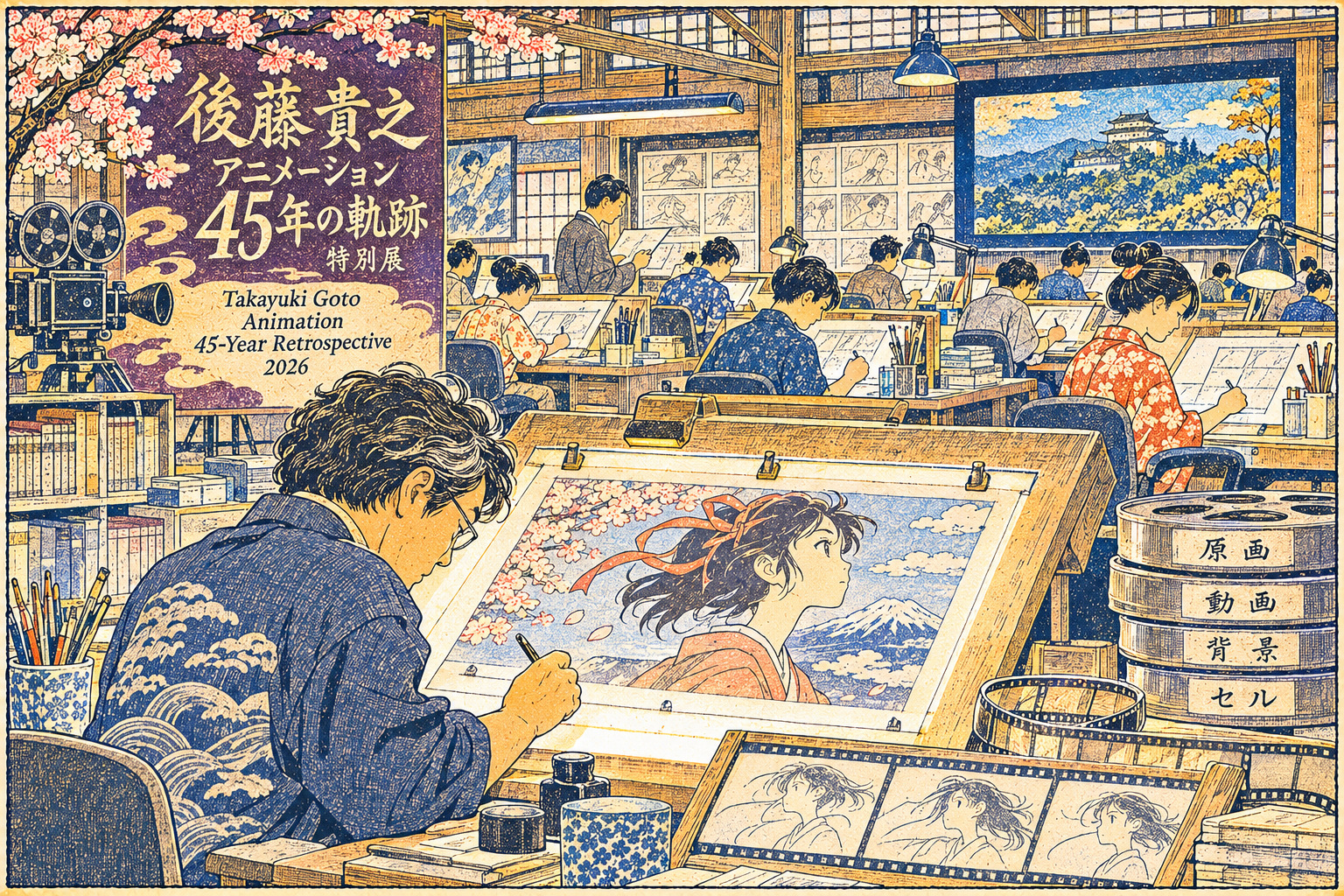
The face on the screen is usually remembered; the animator who gave it an expression can remain invisible. In Tokyo’s Ikebukuro district, a free exhibition closing on Sunday, November 8 asks visitors to reverse that habit. “Takayuki Goto Exhibition—Celebrating 45 Years as an Animator” brings together original animation drawings, illustrations made for licensed productions, animation-director corrections and explanatory panels. An exhibition originally due to finish October 12 has been extended, turning November 7 into its penultimate day.
Goto has contributed to works ranging from the action-oriented Red Photon Zillion to Please Save My Earth and Ghost in the Shell: Stand Alone Complex. He is also a founding figure of Production I.G, a studio whose history reflects the changing international position of Japanese animation. His career offers an unusually concrete route into the question of authorship: how does a collaborative medium preserve the individual decisions made by the people who draw it?
The objects in the show, rather than a nostalgic list of successful titles, make the strongest case. A sheet bearing a corrected expression is evidence of judgment and craft: someone has decided what the character should communicate, while keeping the image consistent with a much larger production.
What the exhibition actually displays
The organizer, the Association of Japanese Animations, describes a presentation of Goto’s original licensed illustrations, key drawings, corrections made as animation director or chief animation director, and chronological panels. Production I.G assisted with the project. The museum does not publish a complete object-by-object inventory, so individual drawings should not be described as displayed without a specific catalogue reference.
“Key animation” is not a decorative category. In a traditionally drawn production, key animators establish consequential poses and movement decisions; in-between artists and other departments help realize the sequence. Animation directors review and correct drawings to maintain a coherent character and visual standard across different artists’ scenes. Chief animation directors can provide a broader level of coordination. Actual responsibilities vary by production and should not be flattened into one universal job description.
For audiences accustomed to finished streaming episodes, seeing an unpolished work sheet can be revelatory. Traces of the production process—changes of line, proportion, weight or expression—show how the apparently spontaneous movement of a character is negotiated and revised.
A career formed before today’s international anime boom
The exhibition marks approximately forty-five years of activity; it does not independently establish a precise first employment date or a complete chronology of every assignment. Goto’s career reaches back to the analog era, when Japanese studios relied on layers of hand-drawn material, photographed cels and intensive coordination among specialized craftspeople. Digital tools later changed parts of this workflow, but did not eliminate the need for skilled drawing and visual decisions.
In the 1980s, action-heavy television productions pushed animators to reconcile speed, expressive character acting and tightly managed schedules. Red Photon Zillion, produced in 1987, occupies a special place in this history: it was bound up with the production group from which I.G emerged. The studio’s official chronology records Zillion work in 1987 and the establishment of IG Tatsunoko in December of that year.
Goto’s story therefore belongs to more than individual career advancement. It is a history of people building organizational structures around the work they could do together, while the medium moved from Japan’s domestic broadcasting schedules toward international film, television and digital distribution.
How I.G got its name: a founder’s recollection
At an exhibition-linked talk on September 5, Goto described the circumstances that led him to help establish the studio. According to Anime Tokyo Station’s published report, the idea followed work on a Zillion original-video-animation production; Hideaki Hatta of Kyoto Animation advised him that the team might establish a company. Goto then joined forces with producer Mitsuhisa Ishikawa. The name I.G, he recalled, came from the initials of Ishikawa and Goto.
It is a memorable anecdote, but the dates still matter. The corporate record lists IG Tatsunoko’s formation in December 1987 and its renaming as Production I.G in September 1993. The talk explains a human origin story, while the company chronology gives the institutional milestones. Neither alone should be treated as the full business history.
Goto also explained that, after working independently, he trusted Ishikawa to help select productions suited to his strengths. The relationship underscores the importance of producers in a medium commonly discussed through the names of directors and artists alone.
From Zillion to Please Save My Earth
Goto’s credits encompass distinct genres, not one fixed look. Red Photon Zillion belongs to an era of kinetic science-fiction adventure. Please Save My Earth, adapted from Saki Hiwatari’s manga, depends upon emotional nuance and the sometimes difficult task of converting a literary-graphic character into a moving performance.
During the September discussion, Goto recalled the pressure of working with a beloved source text. The museum report describes his concern that an adaptation had to respect what readers loved while still carrying an animator’s interpretation. That is a creative boundary: a face must remain recognizable and feel alive, rather than merely replicate a printed panel.
The same event account notes Goto’s pleasure that a live-action drama adaptation had been announced, potentially renewing attention to the earlier animation. The report documents his reaction; it is not evidence that he was involved in the drama or that it had already premiered.
Ghost in the Shell, and the importance of exact credits
For many international viewers, the most recognizable reference is Ghost in the Shell: Stand Alone Complex. Production I.G’s own staff page identifies Goto among the animation directors on the original television series. It separately credits Hajime Shimomura for character design. Those distinctions matter because animation direction and character design are related but different responsibilities.
On the later Stand Alone Complex: Solid State Society, the studio credits Goto and Tetsuya Nishio together for character design. This is a particularly useful comparison: across works in a franchise, the same artist can assume different formal roles. Reporting should avoid awarding a single person sole authorship of visuals created by large teams.
Goto described the Stand Alone Complex period as especially demanding during his forties, according to the September 5 event report. The finished work’s precision conceals a human problem: keeping complex drawing and production quality consistent while schedules continue to move.
The less visible authority of a corrected drawing
Anime’s international reputation often rests on recognizable characters and directors. Yet the corrected key frame reveals a different kind of expertise. The animator’s first sketch identifies a pose; the supervising artist may alter the line of a jaw, the angle of the eyes or the rhythm of an action, helping the image sit within a shared visual vocabulary.
These interventions can be highly individual, but they are not exercises in unlimited personal style. They support the project’s larger direction. In the museum’s account of his talk, Goto described trying not to overwhelm an adaptation with his own signature; instead, he looked for a restrained way to introduce interpretation while preserving the original spirit.
The exhibition thus invites a critical distinction between authorship and celebrity. A name may appear in credits without viewers knowing what that work entails. Drawing materials make some of those decisions visible, though they do not capture the full contribution of every colleague.
Forty-five years of practice—and doubts
Anniversary exhibitions can imply a smooth upward journey. Goto’s own reminiscences tell a less polished story. He recalled struggling with drawing when he began and later questioning his place among colleagues whose technical ability he admired. The museum report presents the remarks as reflections from the September event, not as a new interview conducted by this publication.
He also described how an artist’s style changes with successive productions and influences. That perspective complicates the notion of a single instantly recognizable “Goto style.” His professional identity lies partly in adaptability: learning different visual languages, genres and expectations without surrendering the discipline of drawing.
It would be easy to reduce a forty-five-year career to perseverance alone. Yet the underlying story also includes working conditions, deadlines and the institutional trust needed to sustain a specialist practice. A retrospective can celebrate achievement without denying the difficulty of making a livelihood in a labor-intensive industry.
Why preserving animation drawings matters
Anime Tokyo Station opened on October 31, 2023. Established by the Tokyo Metropolitan Government and operated by the Association of Japanese Animations, it is tasked with helping preserve production materials, including cels, while making anime culture accessible to residents and international visitors. This exhibition is part of that larger mission.
The analog production object can be vulnerable: paper ages, inks fade, cels deteriorate, and a drawing divorced from its sequence or production notes can lose context. Preserving such material is not simply about nostalgia. It allows historians and practitioners to examine how creative work was distributed, organized and revised.
Goto had a separate solo show in Nishi-Ogikubo in 2017, according to Production I.G’s archive. The 2026 exhibition extends that recognition into a public venue dedicated to the history and processes of anime, reaching audiences who may have known the shows but not the craft behind them.
How to see the exhibition—and what it leaves us with
The Takayuki Goto exhibition runs on the basement level of Anime Tokyo Station, Fujihisa Building East No. 5, 2-25-5 Minami-Ikebukuro, Toshima Ward, Tokyo, through Sunday, November 8, 2026. Entry is free. The venue is a short walk from Ikebukuro Station’s east exit. The building’s general hours are 11 a.m.–7 p.m., but special exhibition access ends at 6:30 p.m.; general final entry is 6:45 p.m. Hours and availability should be checked directly before visiting.
The venue also reports that a commemorative leaflet is offered while supplies last. Goto attended a September 5 talk and signing event, but there is no verified announcement of his attendance on November 7 or 8. This is a historical exhibition and a final-weekend visitor opportunity, not a claim of an artist appearance this weekend.
When visitors leave, they may remember an instantly recognizable character. The more significant discovery is an ordinary-looking sheet of paper bearing the marks of a decision. Animation is a mass cultural industry built one considered drawing at a time; remembering that labor is part of remembering the art.
Sources and reporting method
Official museum, organizer and studio records. Goto’s September remarks are attributed to the event organizer’s published account, not to a newsroom interview.
- Anime Tokyo Station — exhibition notice and extension
- Anime Tokyo Station — September 5 talk and signing report (Japanese)
- Anime Tokyo Station — English event report
- Production I.G — July 27 exhibition announcement
- Production I.G — official company chronology
- Production I.G — Ghost in the Shell: Stand Alone Complex staff credits
- Production I.G — Solid State Society staff and design credits
- Production I.G — 2017 solo exhibition archive
- Anime Tokyo Station — opening hours and access
- Anime Tokyo Station — frequently asked questions and preservation mission