- A city street becomes baseball’s grandstand
- The achievement behind the cheering
- A lineup built to win—and keep winning
- From the Nankai Hawks to a Fukuoka institution
- Who organizes a celebration for hundreds of thousands?
- What ¥49.8 billion actually means
- What it means for a city to claim a team
- The next season begins after the cheering stops
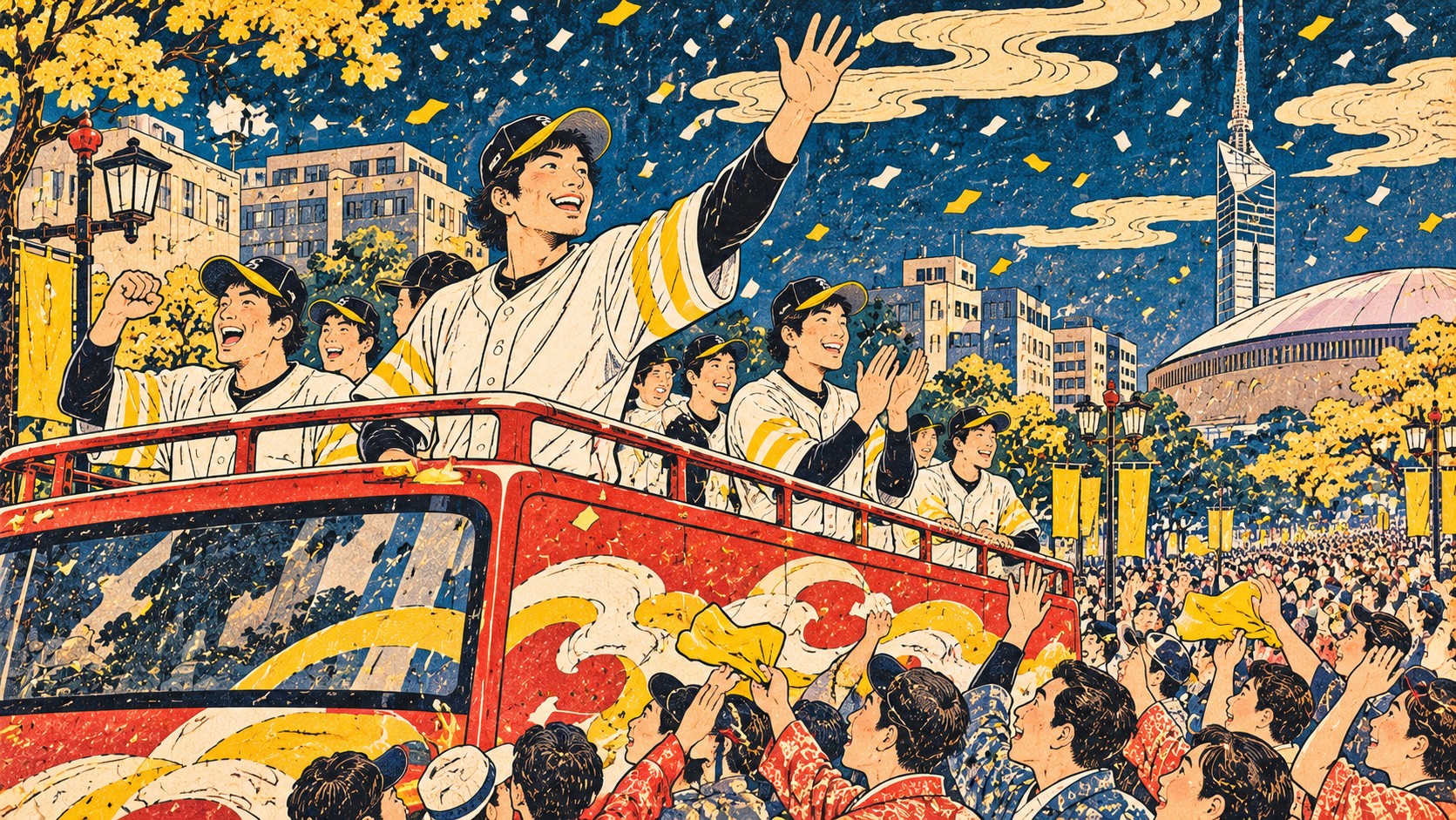
A city street becomes baseball’s grandstand
On Sunday morning, November 22, the broad Meiji-dori thoroughfare through central Fukuoka became a stage for the city’s most recognizable sporting institution. Open cars and open-top buses carried SoftBank Hawks players and officials west from near the Doi-dori intersection in Hakata Ward toward Heiwadai in Chuo Ward, a route of approximately 2.3 kilometers. Local television reported that the procession moved at a celebratory pace over roughly 40 minutes.
The club estimated that 300,000 spectators lined the route, about 10,000 more than the previous year. That number is an announced crowd estimate, not a count established by ticket scans or an independent audit. But its scale conveys how far the event extended beyond the stadium. Instead of spectators watching a game, players watched the people who sustain the team through a season.
Club chairman Sadaharu Oh, manager Hiroki Kokubo and player representative Ryoya Kurihara were among the figures at the front of the procession, according to Japanese reporting. Local broadcaster TV Nishinippon interviewed spectators who expressed gratitude and deep emotion. This report is based on those accounts and official records, not firsthand reporting from the parade route.
The achievement behind the cheering
Fukuoka was celebrating more than a single trophy. The Hawks won a third successive Pacific League championship and secured their second straight Japan Series title. The three-peat was the franchise’s first since its 1989 move to Fukuoka, although its predecessor Nankai team achieved the feat in the mid-1960s.
The October championship series against the Yokohama DeNA BayStars ended in four games. Official Nippon Professional Baseball records show that SoftBank won the first two games in Yokohama, 3–1 in 11 innings and 4–3 in 10 innings, then won 2–1 in 10 innings and 4–2 back at Fukuoka’s Mizuho PayPay Dome. A 4–0 series result sounds straightforward; three games that remained close deep into or beyond regulation were anything but routine.
The league title had its own reversal of fortune. An NPB retrospective published November 20 says SoftBank went just 10–12 in April and briefly slipped to fourth place. A dramatic May win helped reset the campaign. The team took sole possession of first place on July 1 and never relinquished it. The parade celebrated that recovery as much as the final results.
A lineup built to win—and keep winning
Kurihara supplied the season’s most conspicuous power figures: 40 home runs and 118 runs batted in, both league-leading totals, according to NPB. Kensuke Kondo contributed a .309 batting average, 32 home runs, 108 RBIs and a .431 on-base percentage, while leadoff hitter Tomoya Masaki delivered 28 homers, seven to open games. It was an unusually deep offense rather than a season resting on one exceptional player.
The pitching staff had its own four-man milestone. Ryosuke Otsu, Haru Matsumoto and Yugo Maeda each won 12 games; Naoyuki Uwasawa won 10. Injuries tested the roster, but the team continued winning. Masaki, whose contributions included decisive postseason home runs, was named the Japan Series’ Most Valuable Player.
A procession naturally favors visible stars. Yet a modern Japanese baseball dynasty also rests on coaching, player development, medical support, scouting, data analysis, facilities and thousands of operational decisions. The most interesting question is not simply how an expensive roster wins, but how a club creates enough depth to withstand a six-month schedule and then win a short series.
From the Nankai Hawks to a Fukuoka institution
The franchise began in 1938 under the Nankai railway organization. After wartime and postwar name changes it became the Nankai Hawks in 1947, representing an earlier era of Japanese professional baseball centered in Kansai. It won Japan Series titles in 1959 and 1964 and had a long tradition before its modern Fukuoka identity existed.
The pivotal civic event came in 1989, when the Daiei-backed franchise moved to Fukuoka and became the Fukuoka Daiei Hawks. The relocation gave the city a permanent major-league baseball focal point and, over time, helped form new rituals around its games. Championships in 1999 and 2003 became milestones in that relationship. The SoftBank acquisition produced the current name in 2005.
NPB records credit the franchise with 13 Japan Series championships through 2026, counting its earlier history. That long arc matters: the 2026 parade was not a celebration created from nothing by one wealthy ownership group. It was the culmination of different eras, names and generations of supporters, joined to a city that has now hosted the club for 37 seasons.
Who organizes a celebration for hundreds of thousands?
A major sports parade is not simply a team marketing exercise. A committee involving the Fukuoka Chamber of Commerce and Industry and other local organizations organized the 2026 event and invited support from companies and individual donors. The official committee website lists participating local businesses, reflecting the involvement of Fukuoka’s commercial community.
Public celebration also occupies public infrastructure. The organizers published plans to restrict Meiji-dori and connecting roads from around 10:30 a.m. until noon, asked people to use public transportation and prohibited drones. Such notices document what was planned, not a comprehensive, independently verified log of every action taken on the day.
The work behind the scenes—route security, stewarding, cleanup, transport coordination and relations with nearby businesses—reveals why these events can become citywide projects. The spectators are only one part of the story. The people who allow a dense crowd to gather safely are another.
What ¥49.8 billion actually means
In September, Fukuoka Prefecture projected that a Hawks Japan Series championship could generate ¥49.8 billion in economic ripple effects within the prefecture, covering activity from the Climax Series onward. The estimate included about ¥32.57 billion related to victory sales and similar spending, ¥12.68 billion associated with spectators at Mizuho PayPay Dome and ¥4.57 billion associated with parade-goer consumption. These were forecast impacts under an assumed victory scenario, not audited totals after November 22.
An economic ripple effect is also not identical to register sales. The prefecture’s approach considers how initial demand stimulates other production through supply chains and subsequent spending. Calling ¥49.8 billion “the parade’s revenue” would misstate both the time frame and the method. Even the ¥4.57 billion parade component is a modeled economic impact, not money collected by the parade committee.
The projection offers a plausible picture of the ways a successful team can affect shopping, transit, hotels, restaurants and media. But a careful assessment would ask how much spending was genuinely additional, where it occurred, how costs were borne and which businesses benefited. A celebratory headline should not turn a conditional model into an observed economic fact.
What it means for a city to claim a team
The relationship between Fukuoka and the Hawks was built across ordinary seasons as well as championship runs. Games provide stories that people share with family, colleagues and neighbors. The team’s colors appear in retail spaces, its stars become familiar names, and the city’s identity is expressed through something more informal than an official slogan.
That does not mean every resident is a fan or that the costs and disruptions of large events are universally welcomed. Plenty of people stayed away from the route, worked through the festivities or simply preferred a quieter Sunday. The civic test of a celebration is that it can reward participation without assuming that the entire city experiences it in the same way.
Nor is a dynasty permanent. Aging rosters, competitive rivals and unpredictable injuries eventually change every team. What may endure longer is the network of relationships built by a club that has remained in the same community for decades. In that sense, the fans rather than the trophy are the parade’s lasting subject.
The next season begins after the cheering stops
Kokubo and Oh both spoke to Japanese media about the desire to keep winning. A fourth consecutive Pacific League title in 2027 would be a first for the franchise across its Nankai, Daiei and SoftBank eras. That remains an aspiration, not a result. Even the most successful team starts the new season without a guaranteed outcome.
For older fans, the Hawks may still connect to the old Nankai or early Daiei names. For younger supporters, postseason baseball and civic celebrations may seem like annual traditions. The November 22 parade gave those very different experiences a common setting in downtown Fukuoka.
The vehicles passed in less than an hour. The connection they represented has been built since the team arrived in 1989, season by season. If the Hawks want to turn success into a durable civic institution, the next challenge is not merely to win one more championship. It is to keep earning the sense of belonging that made 300,000 people come out to celebrate.
Sources and reporting notes
This report draws on the parade organizing committee, the club, Nippon Professional Baseball, Fukuoka Prefecture and Japanese on-the-day reporting. JAPAN.co.jp did not conduct on-site reporting or original interviews. Attendance is a club estimate; economic-impact figures are pre-event forecasts.