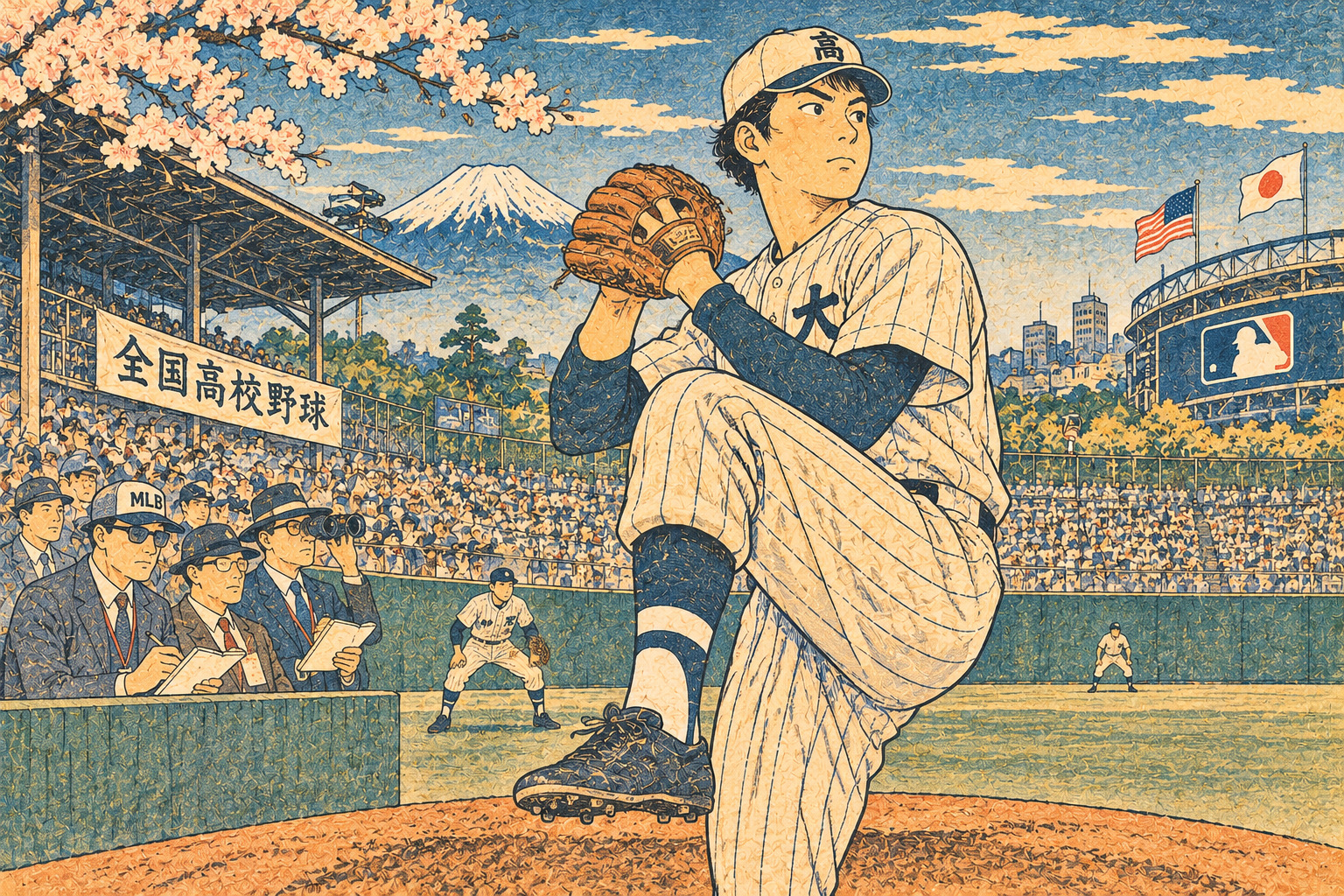
The Giants drafted him. His ambition still points across the Pacific.
The Yomiuri Giants have made Shoki Oda their first-round selection in Japan’s 2026 professional baseball draft. On November 4, the 18-year-old Yokohama High School pitcher is expected to start conversations with representatives of approximately 11 or 12 Major League Baseball organizations. School manager Hiroaki Murata disclosed the schedule on November 2; Oda’s interest in pursuing a baseball career in the United States has remained unchanged, according to the manager and contemporary Japanese reporting. The apparent contradiction is the story: Japan’s most recognizable franchise has the right to negotiate following its draft selection, but that selection does not make Oda a signed Giant. His future remains undecided.
What is scheduled to happen on November 4
The meetings are scheduled to begin November 4 and continue through mid-November, according to Japanese sports reporting. The Dodgers and Yankees have been mentioned among interested organizations, but a reported expression of interest is not a confirmed offer, much less a completed signing. At the start of the November 4 edition, the defensible headline is that meetings are expected to begin—not that Oda has accepted terms or attended every session. No verified financial offer or agreement has been made public. The distinction may sound technical; for an 18-year-old preparing to choose a country, employer and development environment, it is fundamental.
Why major clubs are listening
Oda is a right-handed high-school pitcher from Yokohama High in Kanagawa Prefecture, a school closely associated with the history of Japan’s national high-school baseball championship. His fastball registered 156 kilometers per hour on Koshien Stadium’s scoreboard during the summer tournament; some reports describe a peak of 157 kilometers per hour from other measurements. Those are not identical readings, and pitch speed is only one indicator of future professional success. The Giants nevertheless regarded Oda highly enough to use the first pick of their 2026 draft on him, as the official Nippon Professional Baseball record confirms.
A draft choice is not an employment contract
The Japanese draft grants an NPB organization exclusive negotiating rights under the domestic selection system; it does not compel the player to join. That is why Murata can express gratitude for the Giants’ interest while respecting his student’s stated preference to pursue opportunities in America. The school’s account has the Giants’ discussions with Oda still unscheduled, according to reporting as of November 3. This is not a transfer between two professional employers: Oda has not been reported as having signed with Yomiuri. Journalistic precision on this point matters because treating a draft pick as a completed acquisition distorts both the club’s position and the player’s agency.
What the American route actually offers
An MLB club can offer a path through its minor-league development system, but a direct overseas move does not mean an immediate major-league roster spot. International amateur signings operate under MLB eligibility and registration rules and organization-specific bonus pools. MLB’s published framework generally describes a January 15 to December 15 international signing period, with applicable age and registration requirements; the timing and eligibility relevant to Oda’s specific situation should be independently reconfirmed before any agreement is described. The questions Oda should hear answered are practical: Where will he train? Which coaches will work with him? How will innings, health, rehabilitation, language and education be handled?
College baseball is a separate decision, not just a backup plan
Reporting also identifies American college baseball as a possibility. That would entail a different process involving academic admission, athletic eligibility, potential scholarship terms and the American baseball calendar. It is tempting to imagine a single road labeled “United States,” but the professional minor leagues and a university campus offer distinctly different experiences, protections and demands. There is a contemporary example of this less conventional route: Japanese slugger Rintaro Sasaki went to Stanford and was selected by the Miami Marlins in the 2026 MLB draft. His path does not determine Oda’s, especially because their positions and development needs differ. It illustrates how many paths now connect Japanese school baseball with America.
The promise and unfinished work of a power pitcher
Oda’s high fastball velocity attracted attention in Japan’s summer championship. Yet a national-team exhibition against Japanese university players in August also exposed how challenging higher-level hitting can be: contemporary reporting said he conceded six runs in two innings while reaching 156 km/h. That snapshot should neither define his ceiling nor be omitted from a serious account. High-school pitchers are evaluated not merely for how hard they can throw but for delivery, command, recovery, pitch development and long-term health. A player who is impressive at 18 still needs a plan for becoming a professional at 20, 22 and beyond.
Yusei Kikuchi’s 2009 choice is a useful comparison
In 2009, Yusei Kikuchi, another coveted high-school pitcher, met with representatives from all 12 Japanese professional clubs and eight American organizations. He ultimately chose to enter Japanese professional baseball. His decision showed that interviewing American clubs did not commit a prospect to going abroad, and listening to Japanese teams did not erase international ambitions. Circumstances, regulations and individual priorities have changed since then. The historical lesson is not that Oda will follow Kikuchi, but that the number of teams in the room does not settle the most important questions.
The Shohei Ohtani parallel—and its limits
The stronger parallel is 2012. Shohei Ohtani declared an intention to begin his professional career in the United States. The Hokkaido Nippon-Ham Fighters nonetheless chose him in the first round of Japan’s draft and presented a distinctive development proposal that included a two-way role. Ohtani ultimately signed in Japan before later reaching MLB. It was an extraordinary individual story, not a universal career formula. The Giants could explain the benefits of an NPB apprenticeship; American teams could argue for earlier exposure to their organizations. Neither side can invoke Ohtani’s eventual achievements as proof that one route will be right for Oda.
The calendar has a complication beyond baseball
Negotiations also take place amid uncertainty over the next Major League labor agreement. Japanese reports have raised the possibility of a lockout if a new deal is not reached ahead of the current agreement’s December 2026 expiration. A lockout is not a confirmed event, and its implications for an international amateur signing cannot responsibly be stated as known in advance. Meanwhile, the timing of entry into an American university could create a gap between high school and the next competitive season. For Oda, this is more than a financial choice; it is a question of continuity in training and education amid events he cannot control.
The development proposal should matter more than the logo
The easiest version of this story is a list of famous clubs. A better one asks what each club is prepared to do for a pitcher at the beginning of his career. Clubs can differ in coaching philosophies, injury management, minor-league assignments, language support and willingness to accommodate education. Those details are not verified in Oda’s case yet; they should be subjects of reporting rather than assumptions about particular organizations. Japanese baseball has its own powerful case for training at home, including a familiar competitive culture and access to established professional instruction. The serious comparison is about developmental fit, not national pride.
A moment of possibility, not a final score
As of the available November 3 reporting, the confirmed facts are the Giants’ first-round draft selection, Oda’s declared preference for an American opportunity and the high school manager’s announcement of meetings beginning November 4. There is no publicly verified final contract, no established signing bonus and no definitive decision between Japanese professional baseball, a US organization and a possible college path. When the conversations begin, the real story will be what Oda learns—and which path gives him the strongest chance to develop. The story belongs to the young pitcher before it belongs to any franchise.
Sources and reporting method
Based on official NPB draft records, MLB rules, Japanese reporting of the school manager’s remarks and historical coverage. There were no direct interviews or independent observation of any November 4 meeting; future negotiations are not represented as completed.
- NPB: official Yomiuri Giants 2026 draft selections
- Kyodo: US club meetings announced, Nov. 2
- Nikkan Sports: manager Murata on Oda and meetings
- Sports Hochi: scouting trip and education options
- Daily Sports: Nov. 3 report on scheduled meetings
- Nikkan Sports: Koshien radar gun and 156 km/h
- MLB: international amateur signing rules and bonus pools
- Nikkan Sports: Yusei Kikuchi’s 2009 Japan/US decision
- Nikkan Sports: Shohei Ohtani’s 2012 draft choice
- MLB Japanese: Rintaro Sasaki and the American college path
- Chunichi Sports: Oda’s August national-team exhibition