When a mountain village made its own rain
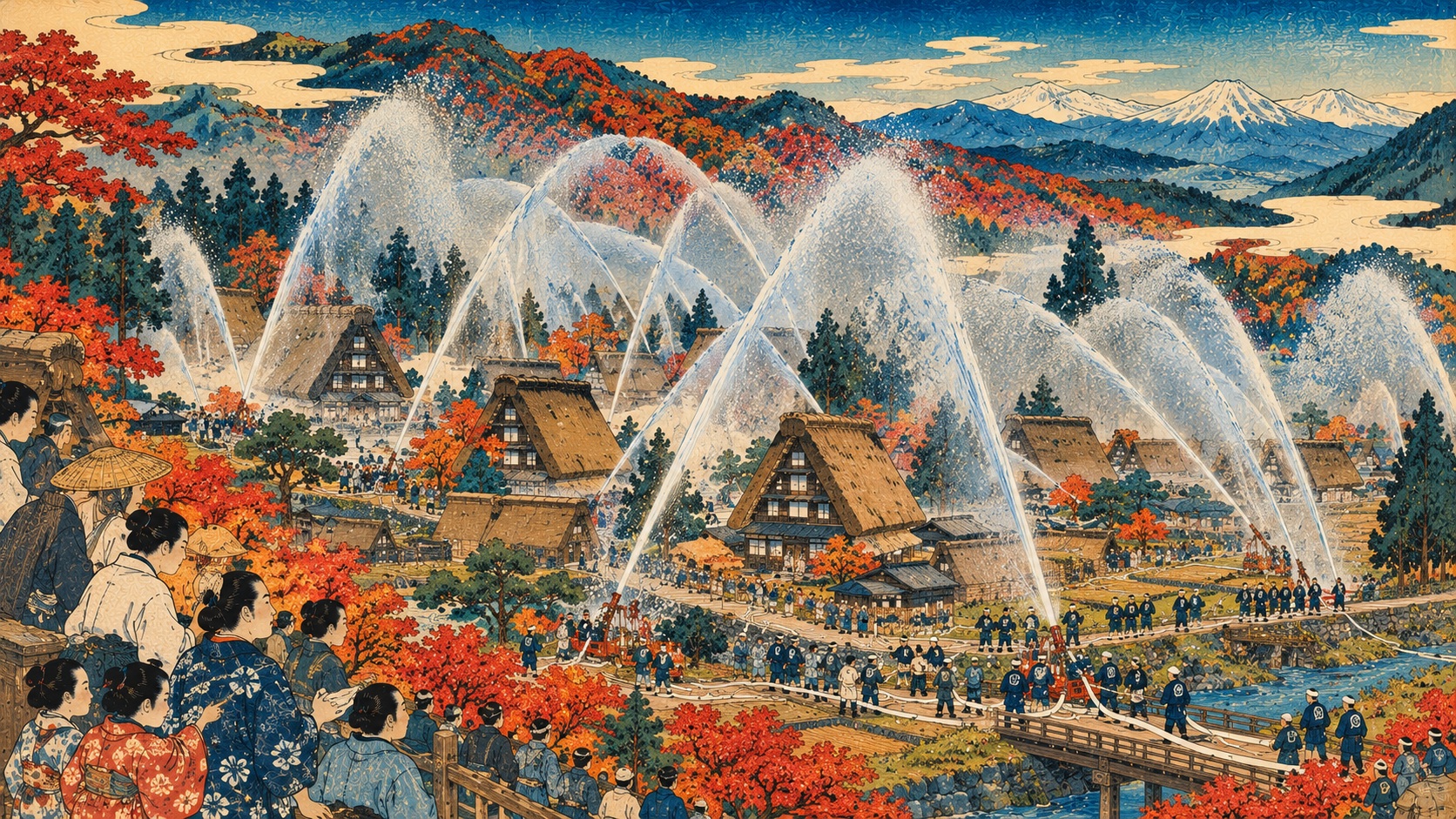
At about 8 a.m. on October 25, 2026, sirens sounded over Ogimachi, the celebrated thatched-roof village in Shirakawa, Gifu Prefecture. Around 60 mounted water cannons sent jets arching above the steep roofs. Autumn rain was already falling, but the village created a second, man-made curtain of water. Visitors photographed a seemingly magical spectacle. For the people who live there, however, this was an annual rehearsal for a threat capable of erasing an entire historic streetscape: fire.
What reporters actually observed on October 25
Contemporaneous coverage by Tokai Television, CBC and Nagoya Television places the drill at approximately 8 a.m., with residents and operators checking the water-delivery equipment. Nagoya Television reported a 15-minute discharge, five minutes longer than usual. News outlets gave differing estimates of the water arcs—about 20 meters in one report and about 30 in another. These should not be treated as a single independently measured height. The defensible facts are the date, location, approximate number of cannons, and purpose of the operation.
Why a thatched roof changes the meaning of fire
Gassho-zukuri houses are remarkable timber structures with steeply pitched thatched roofs. Their dramatic silhouettes grew from the environmental and working conditions of Japan’s snowy central mountains. Yet thatch creates formidable fire exposure: embers can be carried from a burning structure onto adjacent roofs. The cannons create a protective curtain, wetting nearby buildings and reducing the risk of fire spreading. The tactic is not simply to spray the first house ablaze. It is to prevent one ignition from becoming a village-wide catastrophe.
A remarkable machine powered by the mountain
According to the Shirakawa-go and Gokayama World Heritage Center, Ogimachi has 60 combined hydrant-and-water-cannon installations, alongside 62 hydrants and a 600-ton reservoir on higher ground to the north. Elevation supplies gravity-driven pressure. The landscape that made the settlement difficult to reach also helps supply its firefighting infrastructure. A separate Shirakawa Village information page contains an older count of 59 cannons for Ogimachi. The sources do not establish when or why this difference arose; contemporary reporting appropriately says approximately 60.
The work nobody photographs
The spectacle lasts minutes, but the system needs year-round maintenance. The World Heritage Center says residents take daily turns checking mountain-water intake points and storage facilities. Village documents also describe traditional neighborhood fire patrols, including rounds announced with calls and wooden clappers. In that light, an annual water-cannon display is only the visible end of a much longer chain of responsibilities: keeping water moving, maintaining equipment, spotting hazards early and ensuring neighbors know how to respond.
A preservation movement before UNESCO
Ogimachi gained national protection as an Important Preservation District for Groups of Traditional Buildings in 1976. The World Heritage Center documents a first water discharge following completion of local water-spray infrastructure in 1981. International recognition came in 1995, when UNESCO inscribed the Historic Villages of Shirakawa-go and Gokayama. The designation includes Ogimachi in Gifu and Ainokura and Suganuma in Toyama. Preservation, in other words, did not begin with the tourists or the World Heritage badge; local and national work preceded international attention.
The architecture is a history of labor
The steep roofs are not merely picturesque. UNESCO describes how the settlements’ relative isolation, heavy-snow environment and long history of silkworm rearing shaped a distinctive form of farmhouse, including large spaces under the roof. The cultural value lies partly in a relationship among buildings, geography, farming, social organization and practical craftsmanship. Losing an original structure can mean losing evidence of how a community solved the problems of living and working in this valley.
Three villages, different defensive systems
The World Heritage site is geographically distributed, not one single open-air museum. The World Heritage Center reports 37 water cannons at Ainokura and 24 at Suganuma, with separate reservoirs and hydrants. Each community must preserve traditional buildings while operating modern protection systems. This is a useful correction to the notion that heritage conservation means freezing a place in time. It can demand new infrastructure, careful restoration and sometimes complex compromises.
A visitor attraction that is not a performance
The October exercise attracts photographers, and the arcs of water make an unusually powerful image. But they are not an ornamental fountain installed for visitors. Ogimachi remains a lived-in settlement. An audience interested in preservation should also be interested in the residents’ privacy, safe access for emergency workers and the daily burden of maintaining traditional buildings. The public spectacle is valuable precisely because it opens a window onto responsibilities visitors might otherwise overlook.
What the annual drill can—and cannot—prove
There was no reported major fire extinguished in the October 25 drill; it was a readiness exercise and equipment check. A successful demonstration does not establish the system’s performance in every wind, fire or water-supply scenario. No new assessment of total risk reduction was presented with the news reports. What the event does show, vividly, is how heritage protection depends on engineering and community organization together. In Shirakawa-go, an extraordinary arc of water is a reminder that a historic village survives because people continue to maintain it.
Sources and verification
Based on contemporaneous Japanese broadcast reporting and official village, World Heritage Center and UNESCO documentation. No independent on-site interview; reports differ on water-arc height.