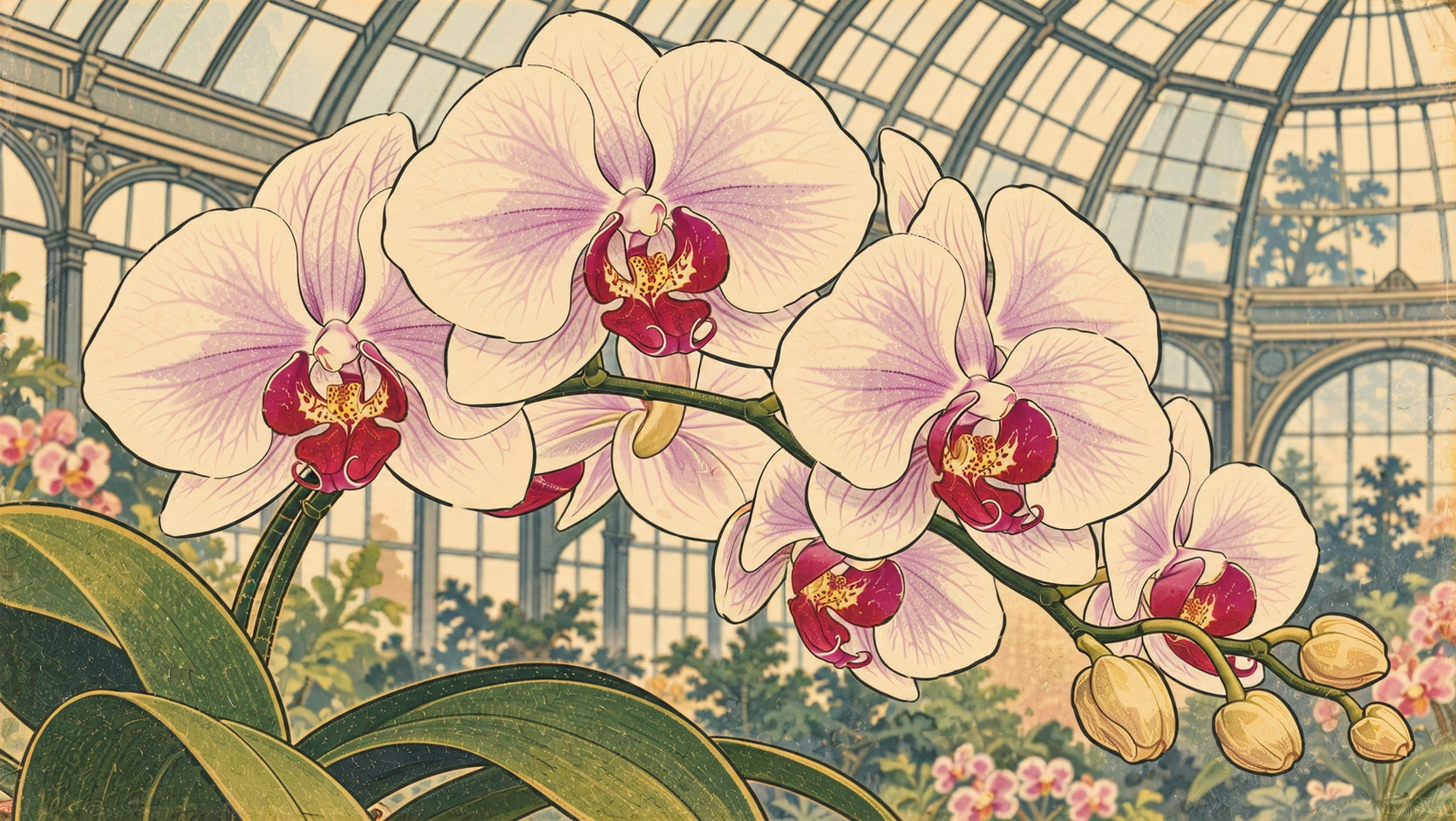
- A greenhouse inside a city of glass
- What the organizers actually promise
- Before Shinjuku: a domain estate and a botanical experiment
- A glasshouse built for new climates
- From imperial horticulture to public education
- The labor hidden inside a flower
- A conservatory with a conservation mission
- The social infrastructure of a flower show
- How to visit, and what remains unknown
A greenhouse inside a city of glass
A visitor leaving the traffic and towers of central Tokyo can enter another world at Shinjuku Gyoen: a public garden whose tropical greenhouse inherits a century and a half of experiments in growing unfamiliar plants. From November 17 to 23, 2026, its annual orchid exhibition is scheduled to place about 200 amateur-grown potted entries alongside orchids raised by the garden itself. The Ministry of the Environment calls it the 38th Shinjuku Gyoen Orchid Exhibition.
Its appeal is easy to picture—flowers of striking symmetry and color inside a luminous conservatory—but this is more than a display of horticultural virtuosity. The exhibition opens a window on a remarkable Japanese institution that evolved from a feudal estate to a government experimental station, an imperial garden, a democratic public park and a center for preserving rare plants. This advance report draws on published official records, not an eyewitness account of opening day.
What the organizers actually promise
The ministry’s October 6 announcement specifies approximately 200 submitted pots from amateur orchid enthusiasts. It also says orchids cultivated by Shinjuku Gyoen will be shown. That distinction matters: 200 is the projected number of submitted pots, not a verified total of everything a visitor will see. The application deadline was November 3 and the call limited entries to amateurs, with a maximum of 200 on a first-come basis.
The event has announced awards including recognition from the environment minister, the ministry’s Nature Conservation Bureau, the garden management office and the National Gardens Association, as well as special and encouragement awards. Winners and exact installed counts have not yet been established in the materials reviewed. The exhibition offers a chance to understand an almost invisible achievement: coaxing a healthy plant to bloom at exactly the moment a public show begins.
Before Shinjuku: a domain estate and a botanical experiment
The garden’s official history begins in 1590, when Tokugawa Ieyasu granted land in this part of Edo to his retainer Naito Kiyonari. Centuries later, the Meiji state sought to test crops and agricultural techniques. In 1872, it established the Naito-Shinjuku experimental station on the former estate. Greenhouses were part of this modernizing project: plants were resources to study and adapt, not merely objects to decorate a drawing room.
The site passed to the Imperial Household Ministry in 1879, when it became a botanical imperial garden. A major landscape redesign culminated in 1906, producing the outlines of Shinjuku Gyoen as visitors now recognize it. That progression shows why an exhibition of ornamentals belongs in a national-history story. Japan’s modern botanical knowledge was built partly in places where agriculture, prestige, experimental science and international exchange intersected.
A glasshouse built for new climates
The first greenhouse was built in 1875, according to the official garden history, and occupied roughly 100 square meters. A heated European-style greenhouse followed in the early 1890s, creating conditions for orchids whose native climates could not simply be replicated outdoors in Tokyo. Official ministry pages disagree about whether this second installation dates to 1892 or 1893, so a precise year is not asserted here.
A later Ministry of the Environment account states that by 1914 the garden cultivated more than 800 orchid varieties, including Cattleya Shinjuku and Laelia Shinjuku. Names bearing “Shinjuku” testify to the greenhouse’s role in raising and crossing ornamental flowers. Orchid growing was never just a matter of placing a beautiful specimen behind glass. It required managing temperature, water, air movement and light, season after season.
From imperial horticulture to public education
The prewar garden cultivated flowers for imperial occasions. That purpose changed dramatically across the upheavals of the twentieth century. Air raids devastated much of the grounds in 1945. In 1949 Shinjuku Gyoen opened to the public as a national garden, while its greenhouse eventually became part of a broader public educational mission.
A large display greenhouse followed in 1958; the present environmentally designed glasshouse opened in 2012. The buildings have changed, and so has the audience. What had once been associated with experimentation and elite display now helps residents and travelers encounter living collections from tropical and subtropical regions. The orchids are a particularly visible link between those identities.
The labor hidden inside a flower
Orchids are often described through the unusual architecture of their blossoms. But to grow them is to work with rhythms that rarely accommodate an exhibition calendar. Watering, humidity, light, air circulation and seasonal temperatures all matter, while different plants respond differently. An elegant flower on a display bench may represent years of patient cultivation and difficult decisions about its care.
The show brings together amateur growers rather than only professional nursery operators. That matters for the culture surrounding the plant: skills are shared by clubs, acquired through experience and measured not only in commercial success but in the health and maturity of a specimen. The official program does not establish which particular cultivars will appear, however, so we have avoided inventing a list of featured blooms.
A conservatory with a conservation mission
The modern greenhouse covers approximately 2,750 square meters. The Environment Ministry says more than 1,000 plant species are cultivated in display spaces, with roughly 2,700 species across the collection when growing areas behind the scenes are included. Those figures describe the wider greenhouse collection, not the orchid show alone.
Alongside ornamentals, Shinjuku Gyoen works with endangered Japanese plants and orchids whose international trade is controlled under CITES, the Convention on International Trade in Endangered Species of Wild Fauna and Flora. Conservation, display and commerce are related but distinct activities. A CITES-listed orchid is not automatically a specimen of illegal origin. One of a public greenhouse’s most valuable functions is explaining why such distinctions matter.
The social infrastructure of a flower show
The 2026 exhibition is co-organized by the Shinjuku Gyoen Management Office of the Ministry of the Environment and the National Gardens Association. Supporting organizations include the Japan Orchid Growers Association and several orchid clubs and societies. They represent a network of public administration, specialist knowledge and amateur enthusiasm that cannot be captured by a photograph of the finished display.
The garden traces the orchid exhibition series to 1983. Its current designation as the 38th edition reflects the organizer’s official announcement rather than an assumption that a show occurred every year without interruption. Beyond the contest awards, the lasting achievement may be this transmission of skills: people whose names visitors never learn helping plants survive long enough to be admired.
How to visit, and what remains unknown
The exhibition is scheduled for November 17–23 in the Shinjuku Gyoen greenhouse, in Naito-machi, Shinjuku, Tokyo. It runs from 9:30 a.m. to 4 p.m., with final greenhouse admission at 3:30 p.m. On November 23 the display ends at 3:30 p.m. and entry closes at 3 p.m. The organizers list no separate orchid-show admission fee; the garden entrance charge applies.
The published garden admission fees are ¥500 for adults, ¥250 for visitors aged 65 and over and eligible students of high-school age or older, and free admission for children through junior high school. Disability-certificate holders and one accompanying assistant qualify for free admission under the stated policy. The garden calendar lists November 16 and 24 as closed days. As with any living exhibition, exact flower conditions, installed entries, visitor numbers and opening-day operations require confirmation after the event begins.
Primary sources and documentation
Sources prioritize Japanese government records and the garden’s official announcements. Event logistics may change.
- Ministry of the Environment: 38th Orchid Exhibition, October 6, 2026
- Environment Ministry: Shinjuku Gyoen Greenhouse
- Environment Ministry: Shinjuku Gyoen History
- Environment Ministry: November 2026 Event Calendar
- Environment Ministry: Endangered-plant conservation
- Environment Ministry: Visitor Information
- Ministry of the Environment: official English exhibition release
- National Gardens Association: Exhibition and entry details
- Ministry of the Environment: November 2026 public schedule