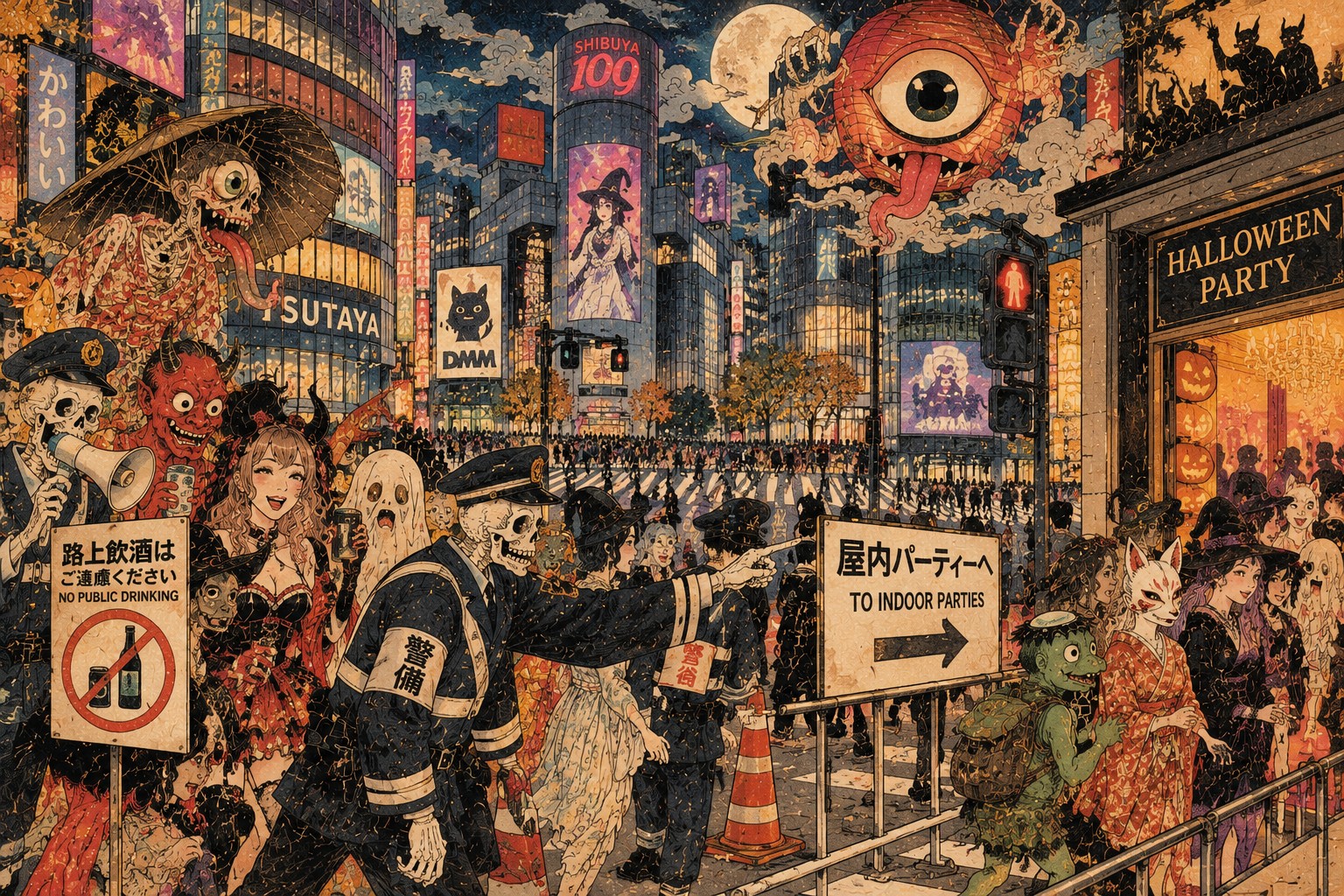
Shibuya has not banned Halloween. It is renegotiating who gets to use its streets, and how.
A Halloween city that does not want a street party
Shibuya arrives at Halloween 2026 with a reputation that has become difficult to manage. Its crossing and surrounding entertainment streets are famous around the world as a place for costumes, spectacle and spontaneous encounters. Yet the ward government is sending an unmistakable message against disruptive street gatherings. That is not the same as outlawing Halloween or costumes. The consequential story is the contest over how shared public space should work when a neighborhood becomes an international attraction.
What changes on October 30 and 31
The Shibuya Police Station, part of the Tokyo Metropolitan Police Department, announced traffic measures for the evening of Friday, October 30 through the early hours of Sunday, November 1. Vehicle closures are planned in designated areas near the station, with possible additional checks around Dogenzaka and Inokashira-dori as conditions require. Parking meters in the station area will be suspended. A road closure should not be mistaken for a blanket pedestrian exclusion zone: the actual restrictions depend on the official maps and instructions issued on site.
Why Hachiko will disappear from view
One of Tokyo’s best-known photo opportunities is being temporarily concealed. The Shibuya Tourism Association says protective fencing around the Hachiko statue is planned from around 6 a.m. on October 30 until around 5 p.m. on November 1. The statue’s plaza is a natural stopping point in front of a busy transport hub. Keeping visitors from clustering there illustrates the difficulty of managing people who want to pause, photograph and meet while commuters need to move through. Times may change and readers should use official updates.
Understand the alcohol rule precisely
The ordinance’s formal Japanese title is 渋谷駅周辺地域の安全で安心な環境の確保に関する条例, regulating the safe environment around Shibuya Station. First enacted in June 2019, it was amended so that, from October 1, 2024, consuming alcohol in roads, parks, squares and other public places within a specified zone is prohibited every day from 6 p.m. until 5 a.m. The area encompasses parts of Dogenzaka, Udagawacho, Jinnan and other neighborhoods. This is a defined public-space restriction, not a general prohibition on responsibly drinking inside licensed bars and restaurants.
The fine everyone should not confuse
A different Shibuya ordinance now carries a monetary consequence for littering. Since June 1, 2026, the ward has applied a ¥2,000 administrative penalty for improperly discarding litter across the ward. Its published tally reaches 1,547 actions through September, but that figure covers the whole period and cannot be labeled Halloween enforcement. The street-drinking rule and littering penalty are distinct legal instruments; stories that blur them misinform both residents and travelers.
The public cost of an extraordinary weekend
According to Mainichi Shimbun’s account of the ward’s September 30 announcement, Shibuya plans to spend about ¥74 million on its Halloween response over the two nights. Roughly 60 security personnel are expected Friday night and 125 Saturday night, with approximately 70 ward staff assigned across the operation. This is a meaningful public expenditure, but it cannot by itself establish whether Halloween helps or harms the local economy. A credible calculation would also need ordinary baseline policing costs, lost and added business revenue, and the social cost of congestion.
How an unofficial celebration became a world-famous spectacle
Shibuya Halloween was not originally a centralized municipal festival with an organizer, a parade permit and a ticketing operation. Costumed gatherings accelerated around the early 2010s, and by the middle of that decade the crossing and Center-gai had become recurring international images. Research from the Japan Travel Bureau Foundation traces the expansion and its governance challenges. The lack of a single event organizer is fundamental: there was no one producer able to set crowd limits, clean the streets, sell tickets or take responsibility for the neighborhood.
The turning point of 2018
During the 2018 festivities, a small truck was overturned by members of a crowd, becoming a national symbol of the disorder. Businesses also complained about litter, disruption and access. Shibuya enacted its safety ordinance in June 2019, and officials escalated their public appeals in subsequent years, including a strong request in 2023 that people avoid coming simply to gather for Halloween. The permanent evening drinking rule followed in 2024. Shibuya’s current policy is a staged response to years of tensions, not a sudden ban invented in 2026.
The party has moved behind a door
A compelling counterpoint stands within walking distance of the crossing. Shibuya Stream Hotel is advertising NEO SHIBUYA HALLOWEEN 2026 for October 31, 6–10 p.m. The organizer says the event is expanding across three floors, featuring DJs, live art, samba dancing, magic and other activities. Advance admission is ¥3,000, day-of admission ¥3,500, and a four-person VIP booth is listed at ¥50,000. These figures document a commercial offer, not an independently verified surge in Halloween spending. The hotel event is not described by authorities as the sole or official successor to street gatherings.
Not every Halloween belongs to the nightclub
The Shibuya Station East Exit shopping association scheduled a family-oriented costume competition in Inari-bashi Square on October 17. That is a different date and constituency from the Saturday-night congestion around the crossing, but the contrast is revealing. Under the single label Halloween sit children’s activities, neighborhood marketing, cosplay creativity, international tourism and late-night partying. Treating every participant as the same public-safety problem would miss the event’s social diversity.
Who gets to celebrate when the party costs money?
Moving more activity into managed hotels, clubs and ticketed venues makes it easier to control capacity, sanitation and security. It can also change the character of participation. A spontaneous public spectacle is broadly accessible in a way that a ¥3,500 door ticket is not. That does not establish that Shibuya’s government is pursuing privatization; rather, it raises a civic question about who should bear the cost of gatherings and who can afford the alternatives. Local residents and workers, meanwhile, have an equally real interest in a usable, safe neighborhood.
What an overseas visitor actually needs to know
Japan does not have a nationwide prohibition on drinking alcohol outdoors in every public space, making the local rule essential to explain clearly. On Halloween weekend, visitors should confirm whether they are within Shibuya’s designated drinking-control zone, anticipate detours around the station, and avoid obstructing pedestrian flows for photographs. The tourism association also warns about electric-scooter sharing restrictions, temporarily closed smoking sites, and proper trash disposal. Venue-specific dress codes, reservations and age rules must be checked separately.
Crowd estimates are not outcomes
The ward told reporters that the peak number of people lingering in the Center-gai area on Halloween was roughly 20,000 in 2024 but about 4,500 in rainy 2025. Officials were planning for a return toward 2024-like volumes this year. These are reported historical or planning numbers; actual attendance on October 31, 2026 has not yet been measured at this article’s research cutoff. Weather, counting methods and the definition of a crowd peak matter greatly when comparisons are made.
A global city negotiating its own popularity
Shibuya’s challenge is not to decide whether fantasy costumes are good or bad. It is to allow a neighborhood that people love to remain a neighborhood: a place where residents can sleep, businesses can trade, workers can commute, and visitors can celebrate without creating serious risks. The resulting settlement may be less spontaneous than the great street gatherings of the 2010s. Whether it produces a better Halloween will depend not on declarations but on safety, participation, access and evidence collected after the crowds go home.
Sources and verification
Based on primary ward, police, tourism and venue information, alongside attributed reporting. October 31 attendance and commercial results were not yet observed.
- 渋谷区・路上飲酒禁止条例/Shibuya Ward alcohol ordinance
- 警視庁・2026年ハロウィーン交通対策/Metropolitan Police traffic plan
- 渋谷区観光協会・2026年ハロウィーン案内/Tourism Association guide
- 渋谷区・2026年ポイ捨て対策/Litter rules
- SHIBUYA STREAM HOTEL・公式催事案内/Official event
- 渋谷駅東口商店会ハロウィン/East Exit shopping association
- 日本交通公社・渋谷ハロウィーン研究/Japan Travel Bureau Foundation research
- シブヤ経済新聞・2026年警備体制/Local reporting
- 毎日新聞・2026年対策費と人流/2026 costs and crowd reporting
- 渋谷区・2026年ごみ対策改正/May 2026 city bulletin