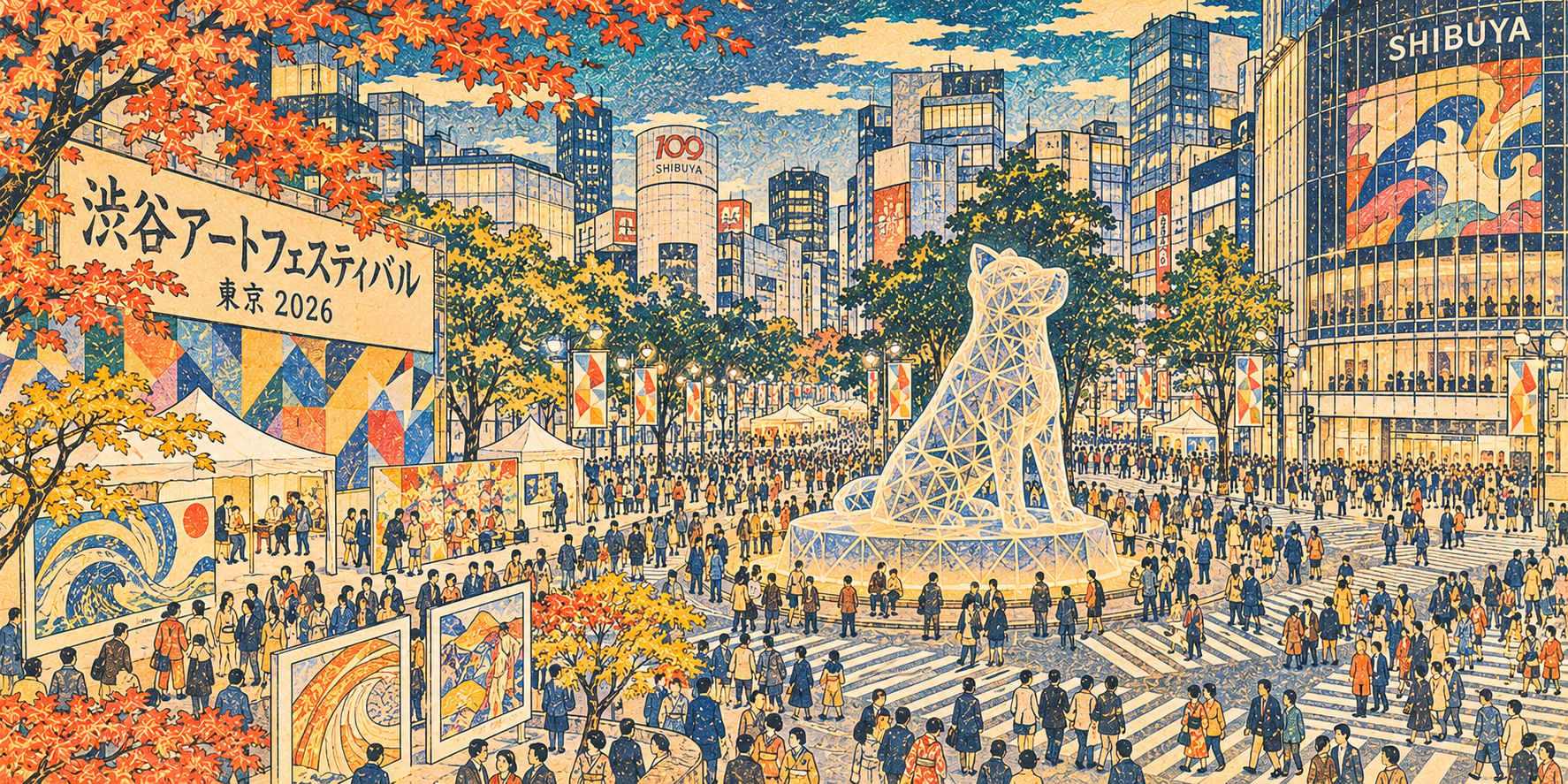
A gallery without a front door
The most interesting museum in Tokyo this week may be one you can walk into by accident. At Shibuya Station, an exhibition occupies a plaza used by commuters; by a riverside, cleaning equipment becomes a drawing tool; after dark, movement in a park becomes projected light. The 18th Shibuya Art Festival, running November 2–8, calls itself SHIBUYA ART SCRAMBLE. Its organizers have announced 13 programs, not one centralized exhibition. For an international visitor, that distinction is essential: the art is dispersed through places where Tokyo normally conducts its business. The central question is whether a city associated with consumption and spectacle can also give people genuine encounters with contemporary expression.
A festival born of a mural
The festival traces its roots to a singular piece of public art: Tarō Okamoto’s colossal mural Myth of Tomorrow, permanently installed at Shibuya Station in 2008. The prospect of the installation helped inspire the first Shibuya Art Festival in 2009. Its early program brought artists and students into commercial spaces and public gathering areas. This year marks the 18th edition. The history matters because it gives the festival a clearer purpose than decorating a shopping district. It asks who gets to encounter art and who gets to use the city as a canvas. Shibuya’s value lies partly in its tension: a dense commercial hub can also be an accessible space for unexpected culture.
What visitors can actually see on November 4
The dates are not interchangeable. The overall festival continues through Sunday, November 8, but several installations run on different schedules. The AMANATION project has a one-day exhibition in Hikarie Hall A on Wednesday, November 4, from 11 a.m. to 9 p.m.; its Shibuya Sakura Stage segment is scheduled only from November 5. Other works started as early as October 31. A sensible November 4 itinerary should therefore start with programs that have published schedules rather than assume that every venue on the festival poster is open on the same day.
A public exhibition in a station passage
Perhaps the clearest expression of the festival’s philosophy is SAPP 2026 PUBLIC EXHIBITION near Exit B7 of Shibuya Station’s east-side underground plaza, by UPLIGHT COFFEE. The operator, SHIBUYA AWARDS, describes a free show running November 2–8, from 10 a.m. to 8 p.m., connecting art to people going about ordinary journeys. It draws from SHIBUYA AWARDS 2026–27, whose selection theme is “CROSSING,” and whose organizers have announced 23 nominated works. That nomination count is not verified as the exact number of works installed in the plaza. The operator’s own visitor instructions are the best guide to the site and its hours.
Drawing by removing dirt
One of the stranger propositions is that a clean wall can itself become a work of art. The Kärcher-backed Senden Project proposes “reverse graffiti,” using a high-pressure cleaner to remove dirt selectively and leave patterns on urban surfaces. Its announced sites include the Shibuya River, Hachikō Square and portions of MIYASHITA PARK. Artist BAKIBAKI is associated with a riverfront work, while another motif invokes Hachikō’s pawprints. The project is neither conventional painting nor evidence that every cleaned wall is a permanent commissioned artwork. It invites viewers to consider the relationship between public maintenance, temporary expression and the marks a city allows people to make.
A digital playground after sunset
At Yoyogi Park BE STAGE, SHIBUYA LIGHT PLAY proposes a changing installation built from sensors and projection mapping. According to the program, it operates November 1–8 from 5 to 9 p.m. and aims to turn participants’ movement into visual output. Its setting evokes the area’s skateboarding culture without restricting participation to skateboarders. This is an important difference between art as an object to be admired and art as an event that depends on a visitor’s body. Yet it also poses a practical question: when the artwork changes continually, what exactly is being preserved when the installation ends?
A festival you can play
Miyashita Park’s lawn hosts KAWAII Ennichi, a participatory fair with art, games and projected imagery after dark. Weekday hours are listed as 4–9 p.m.; weekend and holiday hours are generally 11 a.m.–9 p.m., with an earlier 8 p.m. close on the last day. The variety may particularly suit families and travelers who do not speak Japanese, but accessibility does not make the practical details universal. Individual activities may have their own conditions or capacity restrictions. This is an opportunity to participate in an artwork, not a promise that every experience is free or available without registration.
The overlooked animals of a megacity
On the fourth-floor Hikarie Deck, Shibuya to Mori (“Shibuya to Forest”) takes a different approach to spectacle. Artist Jin Hasegawa, named in the organizer’s Japanese materials as 長谷川仁, has made a small imagined forest in an existing planted area, with tiny trains carrying representations of Mandarin ducks, beetles, Japanese house bats, lizards, raccoon dogs and humans. A related workshop involves drawing and exchanging creatures. Scheduled October 31–November 8, the work uses a playful miniature to ask a serious urban question: in a city repeatedly described through new buildings and higher towers, what living things share the space with us?
Research questions enter the gallery
A separate program at VEIL SHIBUYA blurs another conventional boundary. The Academic Culture exhibition, organized by the International Institute for Advanced Studies and STEAM Association, presents material from a project that turns researchers’ questions into visual prompts. Its announced hours are 11 a.m.–6 p.m. from November 2–8, with last entry at 5:30 p.m. This is not a scientific conference dressed up as an art fair: it is an experiment in translating curiosity into a public encounter. If art can make a question visible, it may reach audiences who would not open an academic journal.
Eight missions, one changing city
For visitors who prefer walking to gallery-going, a digital mission rally made with baton, the company associated with QuizKnock, uses a web app to send participants to eight locations. Challenges are intended to make familiar urban places newly noticeable, and completing them may qualify participants for an organizer-provided reward. The eight checkpoints should not be confused with the festival’s total program or venue count. Nor should a visitor assume that the app replaces the practical need to check a particular site’s opening hours. Its more interesting purpose is to turn looking carefully into a public game.
Art in a privately managed public city
Shibuya is an ideal location for this experiment precisely because public space is complicated. Parks, station concourses, private commercial buildings, redeveloped complexes and civic plazas have different owners and rules. To mount art across them requires permissions, staffing, safety provisions, funding and clear installation and removal plans. Corporate sponsors and property developers help make the festival possible; their involvement also raises legitimate questions about artistic independence. Public accessibility is not simply a matter of removing admission fees. An exhibition must also be understandable, navigable and welcoming to people who never intended to attend it.
A practical walk through the week
For a November 4 visit, start at the station-area SAPP display, continue toward Hikarie’s nature-themed installation and Hall A, and consider the Miyashita Park programs. After sunset, Yoyogi Park BE STAGE offers a different kind of encounter. That is a thematic suggestion, not a verified shortest walking route or guarantee of admission. AMANATION’s Sakura Stage component and the pop-art show at ShinQs Gallery 5 are listed from November 5. Organizer pages disagree on whether the Good Manner Creative Award display begins on November 4 or 5; the committee’s October 21 detailed announcement gives November 5, and visitors should confirm before making a special trip. The official SAPP operator gives a later closing time than a festival-summary listing; use the operator’s 8 p.m. guidance unless subsequently revised.
What Shibuya gains when people stop
Tokyo visitors often experience Shibuya as a sequence of urgent images: billboards, crossing signals, train signs and storefronts. The festival asks for a different kind of attention. It invites commuters to pause over unfamiliar work, families to make something together and artists to test the boundary between private creativity and shared urban life. Whether these experiences endure beyond the closing date is not established by the organizers’ enthusiasm. But the experiment is valuable precisely because it makes a difficult proposition concrete: a city need not be a museum to create room for art, and people need not plan an art outing to become its audience.
Sources and reporting method
Desk research based on Japanese primary announcements by the committee, Shibuya City and individual program operators, with historical accounts. No onsite visit or original artist interviews; program details may change.
- Shibuya Art Festival: official 2026 program
- Future Design Shibuya: October 21 program announcement
- Shibuya City: municipal festival listing
- SHIBUYA AWARDS: SAPP public exhibition and visitor guide
- SHIBUYA AWARDS: October 28 official announcement
- Festival committee: September 30 announcement
- Shibuya Cultural Project: first festival in 2009
- Festival committee: detailed 2026 program
- Festival mission rally: official web app
- Shibuya Hikarie: Shibuya to Mori installation