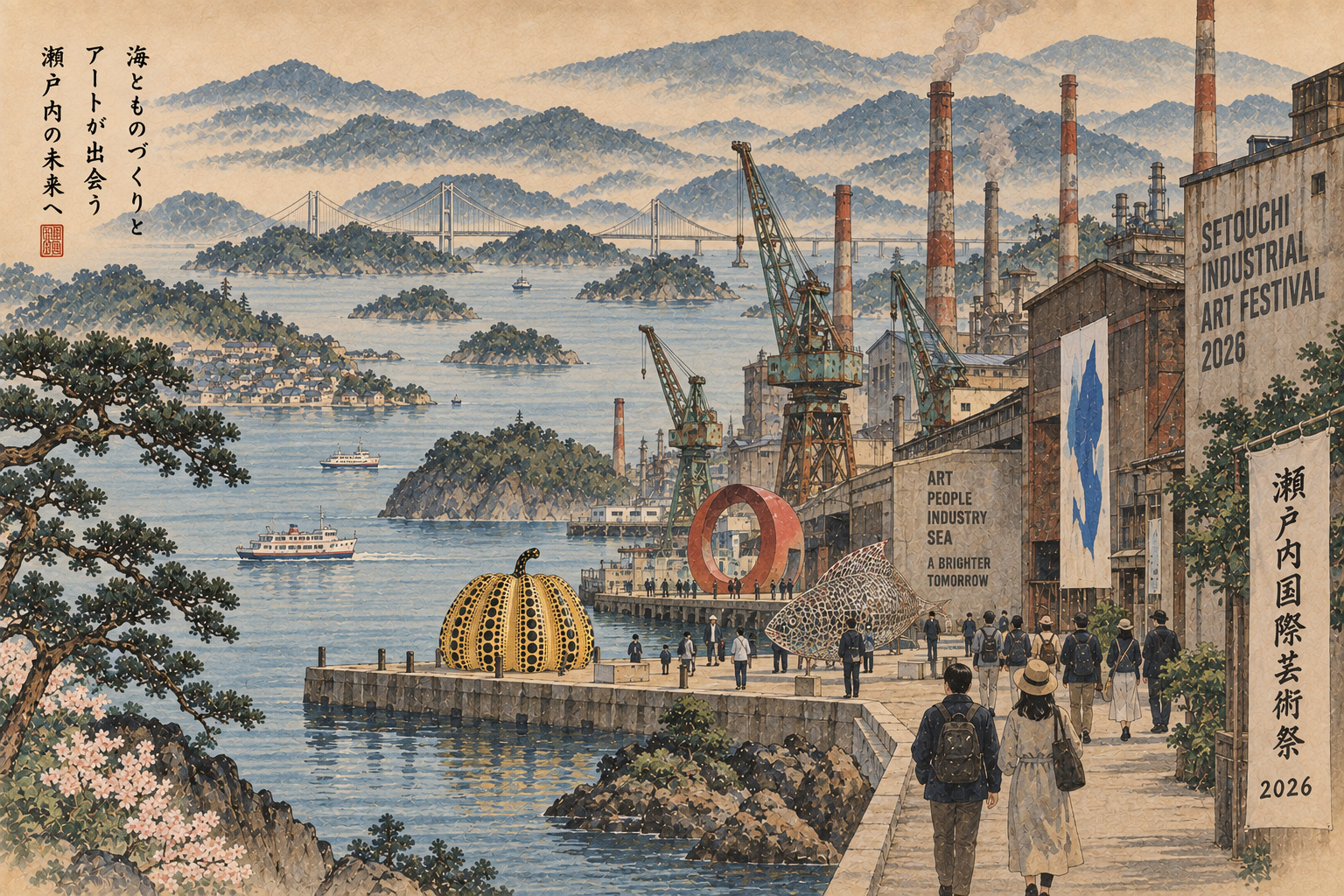
A factory is ordinarily designed to disappear behind its product. Pipes, warehouse doors, inspection stations, work clothes, machine noise and safety markings exist so something else can be made efficiently. They are not arranged for contemplation.
Beginning October 3, a new festival asks visitors to look directly at that hidden infrastructure. Setouchi Art and Industry 2026, organized by the Japan Industrial Art Foundation, runs through October 31 at seven industrial venues in Okayama City, Kurashiki, Tamano and Toon in Ehime Prefecture. Participating organizations include Fuji Clean, Kojima Jeans Street, Naikai Salt Industries, Tombow, PowerX, Mikuni Kogyo and Ohno Development.[1]
This is not the Setouchi Triennale
The similar name requires a distinction. Setouchi Art and Industry is a separate event from the Setouchi Triennale, the contemporary-art festival that began in 2010 across islands including Naoshima, Teshima and Inujima.
The Triennale became internationally associated with island communities, depopulation, abandoned buildings, landscape and contemporary art. The new industrial festival turns instead toward workplaces. Its official site names salt fields, shipbuilding and steel among the industries that supported Setouchi’s development and says visitors should encounter their history, present condition and future through a different perspective.[2]
The two projects share the idea that art can change the way a region is perceived. But one of the new festival’s defining questions is much more specific: what if the industrial infrastructure usually omitted from tourism imagery becomes the destination?
This is not a walk-in open-factory month
Access reflects the fact that these are active industrial sites. Organizers require advance reservations for all works, and public dates vary by venue. Visits are sold through official bus tours, individual-entry tickets and small-group programs. Okayama’s official tourism site labels the festival reservation-required.[1][3]
That restriction is operationally significant. Art visitors must be separated from production flows; safety gear, confidential areas, moving equipment and working schedules all matter.
Artist Motoi Yamamoto, whose salt installation is at Naikai Salt Industries, listed only October 10 and 24 for individual visits to his work and later noted that relevant tickets had sold out. The festival period therefore should not be read as permission to arrive at every factory on any day.[4]
A two-century industrial timeline compressed into one route
The festival becomes most interesting when “industry” is treated not as a single historical period but as a sequence of reinventions.
Naikai traces its salt business to 1829, when Buzaemon Nozaki began building salt fields in Kojima. Salt works expanded into what is now Tamano in 1841. By the early twentieth century, government restructuring had concentrated most Japanese salt-field production around the Seto Inland Sea. The company later moved from tidal salt fields to more industrial methods and, by the early 1970s, into ion-exchange membrane production as Japan abolished its remaining salt fields.[5]
Tombow began in 1876 making tabi socks in Hachihama, now part of Tamano. As Japanese clothing westernized, the company shifted toward school uniforms in 1930; in 2026 it marks 150 years in business.[6]
Tamano’s municipal industrial plan describes a local sequence beginning with nineteenth-century salt making, followed by copper smelting and, in the early twentieth century, shipbuilding. The shipyard that evolved into today’s Mitsui E&S helped define Tamano as a “shipbuilding city” and fostered a network of local manufacturers.[7]
Now PowerX manufactures battery systems in the same city. Its Power Base plant, completed in 2023, produces energy-storage and charging equipment and is being expanded for larger stationary battery systems.[8]
Salt fields, ships, uniforms and batteries belong to different eras, but the festival places them inside one industrial geography.
Motoi Yamamoto turns salt from commodity back into memory
At Naikai Salt Industries, Motoi Yamamoto is showing an installation made from salt, the material that has shaped this coastline for generations. Yamamoto is known for creating intricate floor installations with salt and later returning the material to the sea.
He describes the venue as an old warehouse beside the water dating from the era of Japan’s salt monopoly. The renovated interior is white, with a low entrance leading into darkness where the salt work appears.[4]
The contrast is almost too precise. In a working salt company, salt is measured by purity, consistency, volume and reliable supply. In Yamamoto’s art, it carries associations of purification, mourning, memory and time.
The festival’s 2025 monitor tour already tested this relationship at Naikai through Yamamoto’s work Outline of Time, built around the idea of experiencing the purity of salt.[9]
At a uniform factory, the product becomes a story about growing up
Tombow’s Tamano headquarters factory hosts TOMBOW Voice Theater — Three Stories About Uniforms, an audio-drama project written by Yuki Takeda, Miki Tanaka and Naoyuki Miura and performed inside a factory that makes school uniforms.[10]
A uniform is an industrial product: fabric specifications, sizing, sewing, inspection and deadlines. For the person wearing one, it carries other meanings—entrance ceremonies, graduation, clubs, rules, embarrassment, belonging and physical growth.
Putting those stories into a company that moved from tabi manufacturing in 1876 to school uniforms in 1930 turns the factory into a bridge between industrial history and private memory.
Kojima already turned manufacturing into a destination
Kojima Jeans Street provides a useful precedent. The district had long textile expertise, particularly in school uniforms and sewing. Local history sources date Japan’s first domestically produced jeans to Kojima in 1965, initially using imported denim because Japanese mills and sewing machinery were not yet equipped for the material.[11]
The present Jeans Street grew from efforts beginning around 2009 to attract local manufacturers into empty storefronts in the declining Ajino shopping district. The approximately 400-meter route around the former Nozaki residence became both a retail cluster and a form of industrial tourism.[12]
In Kojima, manufacturing has already become something people travel to see and buy. The industrial-art festival asks whether production knowledge itself can become something to contemplate.
Power Base presents a factory landscape that is still being invented
PowerX differs from salt or uniform manufacturing because its Tamano plant is not industrial heritage. It is new.
The company has installed robotics, automated guided vehicles and local 5G in battery-module manufacturing. In March 2026 it announced an additional production line for the large stationary Mega Power 2500 system, scheduled to begin operation in January 2027.[8]
Visiting Power Base therefore reverses the usual industrial-heritage gaze. The question is not what old manufacturing looked like before it disappeared. It is what the industrial landscape of Japan’s energy transition may look like while it is being built.
Can a waste-disposal landscape be beautiful?
At Ohno Development’s Fureppu Toon site in Ehime, the venue is a controlled landfill and resource-recycling complex. Visitors wear site clothing and travel by bus into a large engineered valley where waste is isolated from surrounding ground and gradually covered over years. Architects Ryue Nishizawa, Shingo Masuda + Katsuhisa Otsubo and Sako Yamada participate, with Kazuyo Sejima supervising.[13]
Seeing an artwork about environment in a white gallery is different from standing inside the infrastructure that receives society’s discarded materials.
The stronger question may not be whether such a landscape is aesthetically beautiful. It is whether citizens have an obligation to look at systems they normally pay to make invisible.
When does industrial art become corporate advertising?
An art festival staged by participating companies contains an obvious critical tension.
The organizers and companies say the project aims to rediscover regional industrial value, communicate technology and work to wider audiences and contribute to local vitality and the transfer of manufacturing culture to the next generation. The 2025 trial materials even cite possible recruiting and local-development benefits.[9]
Those are legitimate institutional goals, but they are not the same thing as artistic value. If art simply makes participating companies look innovative or attractive, the factory risks becoming a brand set.
Industrial sites also contain environmental burden, workplace risk, waste, dependence on global markets and difficult histories of restructuring. The strongest works will be those capable of holding admiration for technique together with questions about what production consumes, leaves behind and asks of workers and communities.
The project began as a 2025 monitor tour
The 2026 festival grew from a trial held in January 2025 around Tamano. Visitors toured Naikai Salt Industries, Miyahara Seisakusho and PowerX under themes of sea, shipbuilding and energy. Motoi Yamamoto, SAI and SYMBOL+ produced work around salt, marine engines and electricity storage.[9]
Miyahara Seisakusho, founded in 1924, developed as a Mitsui E&S partner manufacturing and assembling marine diesel-engine components—one example of the supplier ecosystem created around Tamano’s shipbuilding economy.[14]
The official 2026 edition expands the experiment to seven venues and extends the route from Okayama to Ehime.
Tamano itself reads like an industrial exhibition
Tamano is especially suited to the concept because its industrial history is layered in place. The city’s own policy history begins with salt production in 1841, followed by copper refining, shipbuilding, uniforms and other factories. Shipbuilding became a defining industry and supported surrounding manufacturers.[7]
The same city also experienced the vulnerability of industrial specialization. Shipbuilding downturns in the 1970s and 1980s hit the regional economy hard and pushed local institutions to search for industrial revitalization.
Now battery manufacturing occupies part of that geography. The festival therefore presents industry not as a preserved past but as continuing replacement: one technology, labor system and supply chain layering itself over another.
Can “industrial culture” be more than a slogan?
Japan frequently celebrates monozukuri: precision, craftsmanship, quality control, incremental improvement and knowledge embedded in workplaces. If manufacturing is genuinely treated as culture, however, more has to be preserved than finished products.
When a factory closes, it can take with it the operator who hears a machine fault by sound, the worker who judges material by touch, local terminology, maintenance habits and relationships among specialist suppliers.
An art festival cannot archive all of that. What it can do is introduce outsiders whose first response to ordinary factory routines may be to ask why they work that way at all. That question can make invisible knowledge visible.
How this differs from an ordinary factory tour
A standard factory tour explains process: raw material enters, equipment transforms it, quality is checked and a product ships.
Art introduces another layer of questions. Why does salt look white? What does a school uniform remember? How can stored electricity—something invisible—be represented? At what point does a landfill become landscape again?
The official festival language says explicitly that it wants something different from conventional factory visits.[2]
Attendance alone will not tell whether the experiment worked
Because this is the first edition, claims about economic impact, recruiting success or regional revitalization would be premature. Those are goals stated by organizers and companies, not yet measured outcomes.
More meaningful long-term questions may be whether visitors leave understanding what each company actually makes and what problems its technology solves; whether employees gain new language for describing their own work; whether local students see manufacturing as contemporary rather than obsolete; and whether new industrial archives or public-access programs remain after the artworks leave.
If factory visits, documentation and collaboration survive the one-month event, the festival may become more than cultural programming wrapped around industrial promotion.
Putting cranes and pipes back into the Setouchi landscape
Setouchi is frequently pictured through islands, calm water, sunset, white museums and tourism. Yet the same inland sea also held salt fields, ports, shipyards, steel, chemicals, textiles and freight.
The islands and the cranes are not two different Setouchis. Both shaped the region.
The new festival’s most valuable contribution may therefore be visual rather than economic: returning factories, pipes, work clothes, storage yards and recycling facilities to the picture of what Setouchi actually is.
It does not ask visitors to go to a factory instead of a museum. It asks them to borrow a museum’s habit of attention and take it somewhere that normally produces rather than displays.
Sources
- Japan Industrial Art Foundation, Setouchi Art and Industry 2026 launch announcement
- Setouchi Art and Industry official site
- Official Okayama Tourism Web, Setouchi Art and Industry 2026
- Motoi Yamamoto, Naikai Salt Industries exhibition notice
- Naikai Salt Industries, company history
- Tombow, corporate history
- Tamano City, basic industrial-promotion policy
- PowerX, Power Base large battery-system line expansion
- PowerX, 2025 Setouchi industrial-art monitor tour
- Japan Industrial Art Foundation, TOMBOW Voice Theater
- Kojima tourism information, history of domestic jeans production
- Kojima Chamber of Commerce, Kojima Jeans Street
- Nippon Travel Agency, Ohno Development festival tour
- Tamano City, Miyahara Seisakusho interview