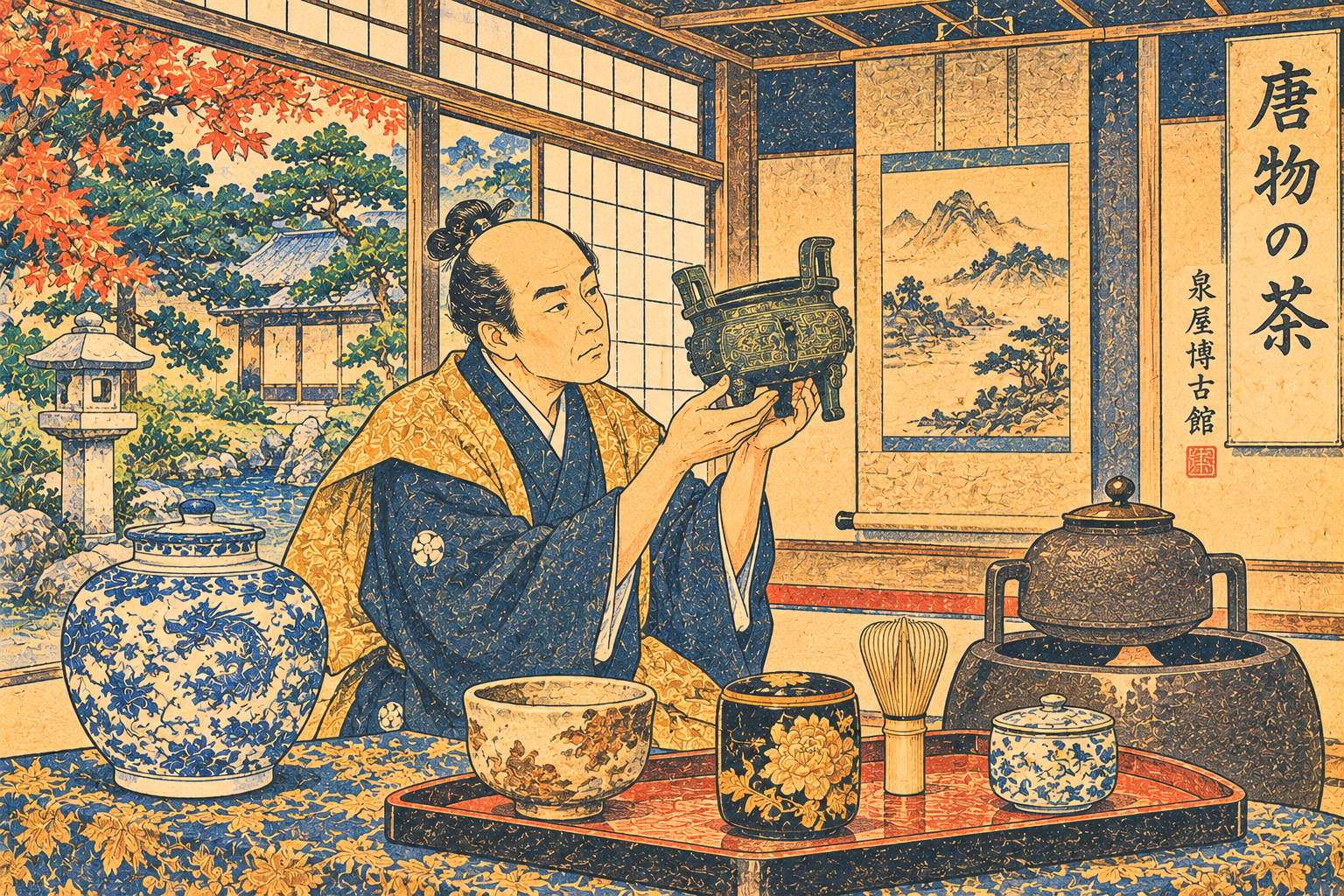
A bronze flower vase opens a three-millennium story
What does a Japanese tea ceremony have to do with bronze vessels cast for ceremonies in ancient China? At a new exhibition in Tokyo, the answer starts with a flower vase. The Birth of Karamono: Exploring the Origins of Chanoyu Designs, opening November 3 at the Sen-oku Hakukokan Museum Tokyo in Roppongi, follows the forms and values associated with imported objects across East Asia. The story stretches from the Bronze Age through Chinese scholarly culture, medieval Japanese collecting, and the aesthetics later associated with Sen no Rikyū. The exhibition is not claiming that a modern tea ceremony existed 3,000 years ago. It asks how designs that began in very different settings acquired new lives.
Why this exhibition is different
Three institutions collaborated for the first time: Sen-oku Hakukokan, the Tea Ceremony Museum associated with Urasenke and Konnichian, and Ashiya Kama no Sato, a center devoted to the heritage of iron kettles and casting. The museum says the undertaking draws on several years of joint research. About 80 works are scheduled across two rotations, including six designated National Treasures and nine Important Cultural Properties. These are totals for the complete exhibition, not a promise that every work can be seen on a single visit. A special display goes beyond connoisseurship to investigate the experimental reconstruction of a historic bronze flower vase.
“Karamono” was never simply a country-of-origin label
Literally associated with things from the continent, karamono is often introduced in English as Chinese imports. But the museum’s Japanese press material makes an essential distinction. The term historically described goods valued as coming from abroad, and objects assigned that status could originate on the Korean Peninsula or in Southeast Asia, or even be made within Japan. The category reflected taste, authority, inherited reputations, and how objects were presented. A teabowl could acquire an individual name and become a celebrated meibutsu, an object whose biography was inseparable from its material form. To understand karamono, then, is to understand how Japan made meaning out of exchange.
Long before tea: Chinese ritual bronzes
Among the museum’s examples is the late Shang-period Ding Fu Ji Zun, dated to roughly the eleventh century BCE. It originated in a world of ritual bronze making, not Japanese tea gatherings. Such vessels came to embody the prestige of antiquity for later Chinese collectors and scholars. During the Song dynasty, renewed interest in ancient bronzes fed imitation and reinterpretation across metalwork and ceramics. The design vocabulary could persist even as an object’s material, function, or intended audience changed. That distinction matters: visual continuity is not proof that an original ancient ritual practice persisted unbroken.
The Song dynasty and the art of looking
Song-period literati helped turn the study of objects into a sophisticated cultural pursuit. Paintings, ceramics, calligraphy, and historical bronzes could speak to a person’s learning and judgment. Powdered tea was whisked in bowls in Song-period China; tea utensils and the arrangements around drinking became objects of aesthetic attention. Japan later received both physical goods and the practices of evaluating them. The 13th- to 14th-century Wenlin tea container called Wakakusa, held by the Tokyo museum, offers a way of seeing how an imported vessel could acquire a distinctly Japanese name and standing.
Sea lanes, temples, and medieval Japan
Kamakura- and Muromachi-period trade helped bring tea-related objects and Chinese art into Japan. Buddhist institutions and political elites provided influential settings for collecting and display, but there was never a single uniform pattern of reception. Japanese users selected and recombined objects for rooms, gatherings, and ceremonies of their own. This is how an apparently borrowed design language became a domestic cultural vocabulary. The exhibit’s historical argument is less about an exotic object arriving on a ship than about successive generations learning to recognize some objects as exemplary and others as ordinary.
A shogun’s collection helped define taste
The display examines the so-called Higashiyama treasures associated with Ashikaga Yoshimasa, the eighth Muromachi shogun. Its discussion of the Kundaikan Sōchōki, a historical guide to evaluation and display, shows how collectors established ideas of authenticity, ranking, and presentation. The curatorial question is revealing: if the Japanese tea world prized foreign objects, who decided which ones mattered? Standards were produced locally, among people with political influence and cultural training. Imported origin and Japanese interpretation worked together.
A flower vase with an unresolved origin
The Ming-period bronze flower vase known as Kodō Momojiri Hanaire is a focus of the exhibition. Such kodō (also written with characters meaning old bronze) flower containers were traditionally assigned high standing in the tea world. Yet the origins and casting techniques of related surviving pieces can be unclear. Working with the Tea Ceremony Museum and Ashiya Kama no Sato, Sen-oku Hakukokan undertook experiments in casting. The reconstruction cannot establish the provenance of every historic object. Its value lies in testing plausible processes—how a vessel might have been formed, what techniques it required, and which clues careful examination can reveal.
The road to Rikyū was not a rejection of China
Sen no Rikyū, a central figure in the development of wabi tea in the sixteenth century, is frequently invoked as the embodiment of a pared-back Japanese aesthetic. Yet that narrative becomes misleading if it assumes that Japanese simplicity required discarding continental influence. Locally made wares gained prestige, and choices of texture, asymmetry, and everyday materials became important; still, inherited forms, imported containers, and standards of connoisseurship remained influential. The museum’s perspective places Rikyū within a continuing history of adaptation rather than at a clean cultural break.
Why the Sumitomo collection matters
The museum’s ability to trace these long histories owes much to the collecting interests of Sumitomo Tomoito, known as Shunsui, a prominent member of the industrial family in the late nineteenth and early twentieth centuries. The Sumitomo family’s association with copper and Shunsui’s interest in sencha tea culture helped shape his acquisition of ancient Chinese bronzes. The museum foundation was established in 1960 after the family donated more than 500 bronzes and mirrors. Collections were made publicly accessible from 1961. The Kyoto museum’s first purpose-built building opened in 1970, while a Tokyo branch opened in 2002 and adopted its current name in 2021. The modern museum is itself evidence of the long afterlife of objects collected across borders.
What visitors can actually see on November 4
The first rotation runs November 3–23. Among the objects identified for this period are the National Treasure Autumn Landscape, attributed to Emperor Huizong, the National Treasure tenmoku tea bowl with scattered-flower decoration, and calligraphy by the Southern Song monk Wuer Kexuan, designated an Important Cultural Property. A different National Treasure, Winter Landscape, and the celebrated celadon bowl known as Bakōhan are listed for the second rotation beginning November 25. Other announced highlights include the National Treasure Autumn Fields and Grazing Cattle, a Japanese Muromachi-period Ashiya iron kettle, and a Korean tea bowl. Visitors seeking a particular object should check the museum’s official work list; rotation and conservation conditions matter.
Planning a visit—and leaving with a different question
The exhibition runs November 3–December 13 at 1-5-1 Roppongi, Minato-ku, Tokyo. Hours are 11 a.m.–6 p.m., until 7 p.m. Fridays, with last entry 30 minutes before closing. The museum is generally closed Mondays, except November 23, and closes November 24 instead. Admission is ¥1,500 for adults, ¥800 for students, and free for visitors under 19 with appropriate ID. No timed-entry reservation is required for ordinary admission. The practical reward is a room full of beautifully made objects; the deeper reward is a more complicated view of cultural originality. Rather than treating the tea ceremony as a sealed expression of Japanese identity, the exhibition shows how identity was formed by selecting, transforming, and caring for things from far beyond Japan.
Sources and reporting method
Document-based reporting using the museum’s Japanese primary announcements, exhibition listings, collection history and contemporary coverage. No onsite visit or original curator interview was conducted. Display schedules and admission arrangements may change.
- Sen-oku Hakukokan Museum Tokyo: Official exhibition
- Museum press release, updated October 28
- Museum institutional history
- History of the Sumitomo collection
- Sumitomo Group: Museum and collection history
- Museum English exhibition information
- Official exhibition tickets and admission
- Internet Museum: November 2 exhibition preview