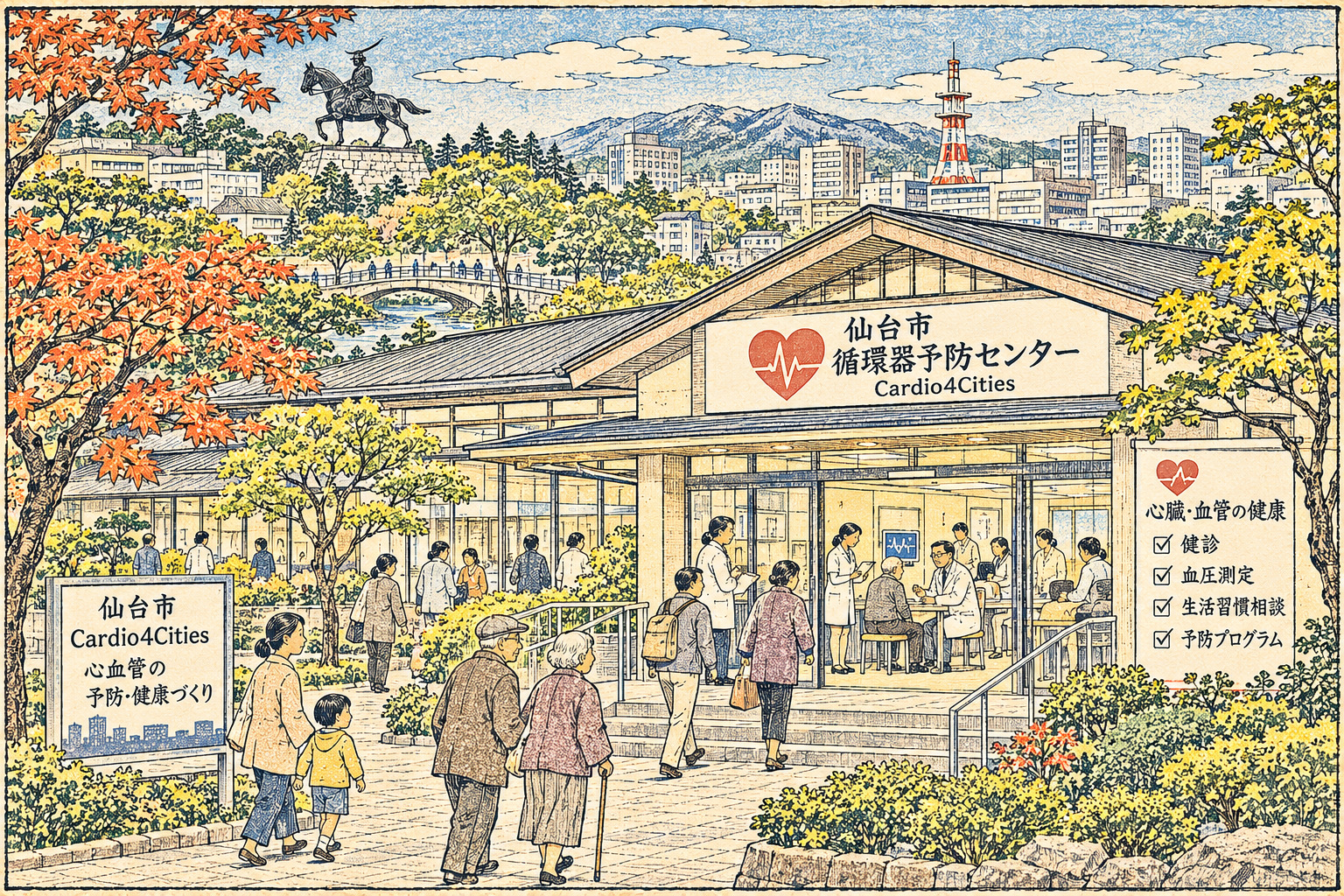
- A public-health project that begins far beyond the clinic
- What Sendai has actually announced
- The CARDIO4Cities model—and why the acronym matters
- From São Paulo and Dakar to northeastern Japan
- Why cardiovascular prevention matters in Japan
- The hidden geography of access
- Three partners, three different responsibilities
- A brief history of the approach: change the system, not the patient alone
- What would count as success after three years?
- The question other Japanese cities will ask
- The city as a place where prevention either works—or breaks
A public-health project that begins far beyond the clinic
A person with high blood pressure may feel entirely healthy. That is part of the problem. There may be no urgent reason to take time off work, find a physician, make another appointment or continue taking medication. Yet cardiovascular risk accumulates quietly, long before the emergency that sends someone to hospital. A city that wants fewer heart attacks and strokes must therefore confront an uncomfortable fact: many of the decisions that shape cardiovascular health happen outside healthcare facilities.
Sendai, the major city of northeastern Japan, is about to test a citywide answer. On November 2, 2026, its municipal government, Tohoku University and the Switzerland-based Novartis Foundation agreed to work together under CARDIO4Cities, an international approach to preventing cardiovascular disease. Sendai is the first Japanese city to participate. The partnership envisages roughly three years to develop and put a program into practice.
The immediate news is an agreement, not proof of success. The larger question is whether the city can use existing employers, neighborhoods, clinics and public agencies to make risk detection, treatment and long-term management easier for more residents.
What Sendai has actually announced
The municipality describes four main areas of work: using data to identify and visualize local health challenges; improving cardiovascular prevention in workplaces; supporting health promotion in communities; and strengthening coordination among healthcare providers. Tohoku University identifies high blood pressure, diabetes, abnormal blood lipids and obesity as principal cardiometabolic risk factors for the initiative.
The November 2 signing involved city officials and university representatives including Tohoku University executive Hideo Harigae and Sendai Mayor Kazuko Kori. The university release names the municipality, the university and the Novartis Foundation as the collaborators. It identifies a three-year horizon for establishing and implementing the program.
What is not yet public in the materials reviewed is equally important. No complete list of participating clinics, finalized neighborhood boundaries, participant targets, detailed spending plan, data architecture or independently audited outcome target is provided. Those details will determine whether the announcement becomes a measurable intervention.
The CARDIO4Cities model—and why the acronym matters
The Novartis Foundation describes CARDIO4Cities as a whole-of-city approach to cardiometabolic health. Its six CARDIO pillars combine quality of Care, better Access to diagnosis and management, policy Reform, Data and digital technology, Intersectoral collaboration and local Ownership. Each pillar addresses a different barrier. An excellent clinical guideline is of limited use to a resident who never reaches a clinic; a screening event accomplishes little if the person identified cannot continue care.
The program therefore aims to redesign the pathway, not merely add health campaigns. Municipal government can convene partners and understand local disparities. Clinicians can assess risk and guide treatment. Employers and community organizations can reach people who rarely encounter preventive services. Data may reveal where the pathway breaks down.
None of that establishes that Sendai has already selected any particular workplace intervention or digital tool. Those are potential applications of the model, not confirmed procurement or deployment decisions.
From São Paulo and Dakar to northeastern Japan
CARDIO4Cities began in 2018 in São Paulo, Brazil; Dakar, Senegal; and Ulaanbaatar, Mongolia, according to Tohoku University. The foundation says the approach has since expanded to more than 40 cities. Those early participants matter because they show what the model can look like under very different healthcare systems and urban conditions.
A peer-reviewed 2025 observational analysis of experience in Brazil and Senegal reported favorable trends in stroke outcomes. In São Paulo, the risk of hospitalization for stroke during follow-up was 24.5 percent lower in districts with the initiative than in other districts. Research on the wider model also reports improved hypertension control in participating settings.
But a lower observed risk in an intervention area does not establish that the program alone caused the difference. The study was observational, with potential confounding from district characteristics and other influences. The research disclosed Novartis Foundation funding. These findings are evidence worth examining—not a percentage improvement that can be promised to Sendai residents.
Why cardiovascular prevention matters in Japan
Japan already has advanced clinical services, routine health examinations and a long history of public-health policy. Yet cardiovascular disease remains a major cause of death. In the Ministry of Health, Labour and Welfare’s finalized 2024 vital-statistics summary, heart disease excluding hypertensive heart disease accounted for 226,277 deaths, while cerebrovascular disease accounted for 102,808.
These categories are reported separately and should not be turned into a claim about the number of preventable deaths under this project. They nevertheless help explain why the city is turning attention to earlier detection and better management. Elevated blood pressure, diabetes, lipid disorders, smoking and other risk factors can work together over years before a serious event occurs.
Sendai is not starting from a blank slate. Japan’s existing screening and health-guidance systems can provide a platform. The practical challenge is reaching residents who do not attend, ensuring follow-up after an abnormal result and sustaining effective management rather than assuming that detection automatically produces better health.
The hidden geography of access
A citywide average can hide people whom the system does not reach. Workers with unpredictable hours, older people with mobility barriers, residents who rarely visit a primary-care provider and individuals who cannot easily understand the services available to them may face very different obstacles. Averages improve most readily when services reach people who are already relatively engaged.
That is why local data can matter more than a large headline number. Disaggregating information by relevant geography and population characteristics could reveal where screening, referral or continuing care is weakest. A workplace program might reach employees who cannot attend daytime clinics; community networks might lower the barriers for other groups.
These examples describe the logic of a citywide approach. They are not a statement that Sendai has approved specific programs for every neighborhood or demographic group. A credible evaluation will ask not only how many people participated, but also who remained outside the program.
Three partners, three different responsibilities
Sendai can set public priorities and bring local agencies together. Tohoku University contributes academic expertise across medicine, population health and analysis. The Novartis Foundation supplies an implementation approach developed in other cities. Their different roles could be complementary, but clarity about accountability will be essential.
The municipal announcement is unusually explicit about organizational identity. The Novartis Foundation is a nonprofit organization based in Basel, Switzerland. It receives funding from Novartis but says it operates independently of the company’s business activities. Sendai also specifies that Novartis Pharma K.K. and the Novartis Foundation for the Promotion of Science in Japan are separate organizations and are not designing or executing the city’s CARDIO4Cities project.
Those distinctions matter where philanthropy, public health and the pharmaceutical industry meet. The future evaluation should document decision-making responsibility, funding, access to residents’ health data, consent, privacy and the possibility of conflicts of interest without presuming misconduct.
A brief history of the approach: change the system, not the patient alone
Public-health efforts against hypertension have traditionally included patient education, physician treatment and screening. More recently, health systems have emphasized continuity: a high blood-pressure measurement must lead to appropriate confirmation, clinical evaluation, treatment where indicated and follow-up over time.
The CARDIO4Cities experience adds an urban-management layer. In some international settings, program partners brought services into workplaces and community locations, developed decision support for healthcare personnel and used routinely collected data to find gaps in care. A 2026 roadmap article by Ann Aerts and Jagat Narula frames the model as an approach that can be embedded in existing services rather than requiring a new parallel healthcare system.
Japan’s needs will differ from those of the original participant cities. Insurance coverage, routine examinations, population aging, local government capabilities and patterns of care are different. Importing a logo or an international benchmark is easy; integrating a model into everyday local health services is harder.
What would count as success after three years?
Counting pamphlets, workshops and free screenings will show whether activities occurred. It will not establish that fewer residents suffered cardiovascular events. A useful evaluation should follow the stages of prevention: who was reached; who was found to have elevated risk; who entered appropriate clinical care; who continued treatment; and whether control of risk factors improved.
Longer-term outcomes, including hospitalization for stroke or heart attack, would be valuable but require careful interpretation. Changes in age structure, healthcare utilization, other interventions and external events can alter those figures. A before-and-after headline without a plausible comparison can be misleading.
The projected three-year period may allow the partners to establish a functioning program and report intermediate outcomes. It may not be sufficient to demonstrate all long-term clinical effects. That distinction should influence how Sendai announces targets and how the public evaluates progress.
The question other Japanese cities will ask
Tohoku University says the partners hope to develop a model useful to other Japanese cities. That ambition creates a second test beyond Sendai’s own residents. Can the work be documented in a form that another municipality with different clinics, employers, transport routes and budgets could actually adopt?
Transferable knowledge would include not just improved screening rates but the cost of running the effort, staff workload, methods of protecting personal data and the causes of unsuccessful interventions. A failed initiative can be informative if the implementation and evaluation are transparent. A publicity campaign with no reproducible measures is much less useful.
By entering CARDIO4Cities, Sendai is not demonstrating that it has already solved cardiovascular disease. It is committing to investigate whether municipal systems can make everyday prevention more reliable. That is a meaningful, but still unproven, possibility.
The city as a place where prevention either works—or breaks
For a resident, prevention is rarely a dramatic event. It is the blood-pressure reading noticed at the right time, the appointment that can actually be kept, the doctor who follows up and the everyday circumstances that make continuing care possible. When those links fail, even a sophisticated health system can miss people who need it.
The November 2 agreement invites a new kind of question about urban health: not simply whether Sendai has excellent hospitals, but whether its workplaces, neighborhoods, medical practices and public agencies can operate as a more connected system. The research from overseas makes the possibility credible; it cannot establish Sendai’s outcome in advance.
The next chapter will be written in the details—what the partners choose to do, how many residents they truly reach and whether they publish results that withstand scrutiny. The promise is a city that helps people avoid becoming patients in the first place. The test is whether that promise becomes measurable reality.
Sources and reporting method
Document-based reporting from Sendai City, Tohoku University and the Novartis Foundation, Japanese vital statistics and published research. No independent interviews were conducted.
- 仙台市:2026年10月公表、11月2日調印式・事業連携
- 東北大学:2026年11月2日共同発表
- Novartis Foundation: CARDIO4Cities official program
- Aerts and Narula, CARDIO4Cities roadmap, American Journal of Preventive Cardiology (2026)
- Peer-reviewed observational study, Stroke outcomes in Brazil and Senegal (2025)
- 厚生労働省:2024年人口動態統計・死因順位(概況)
- Swiss Re Foundation: CARDIO4Cities implementation in Brazilian municipalities