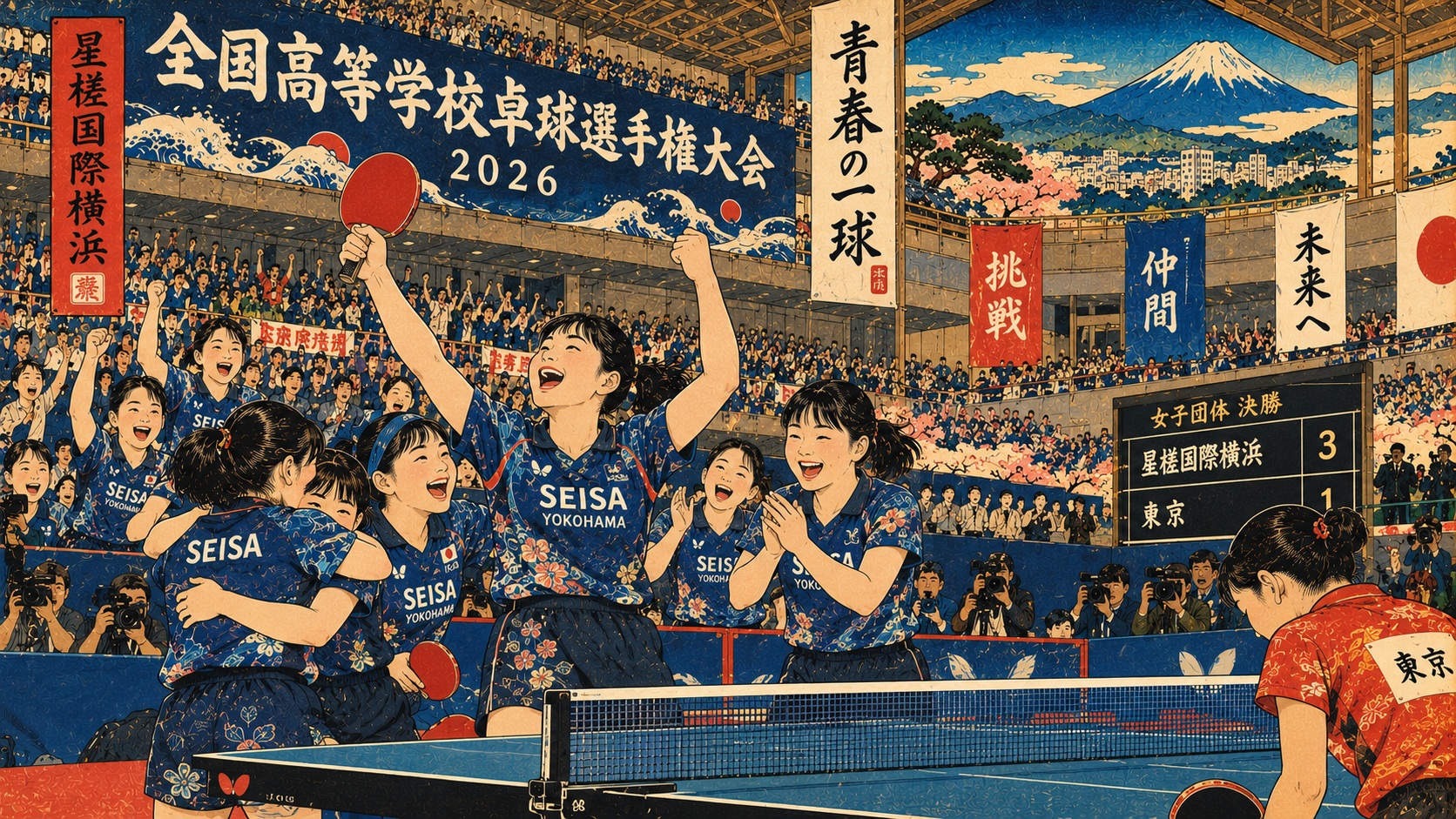
They did not merely win against other schools. They beat the corporate teams that normally define the national title.
The result no high-school team had managed before
At the 2026 All-Japan Table Tennis Championships team competition in Miyazaki, the women’s final ended with a score that carried significance well beyond the school calendar: Seisa International High School Yokohama 3, Sanritsu 1. The Japan Table Tennis Association confirmed that this was the first title by a single high-school team in the competition’s history, across either the men’s or women’s divisions. This was not a championship reserved for teenagers. Seisa had beaten experienced company-sponsored teams to become Japan’s national team champion.
Makino lost first—and then won the title
The final opened badly for Seisa. Mirei Makino lost in five games to Sanritsu’s Yuka Mimura. Then Aoba Takahashi beat Seira Ushijima in four games, and Waka Fujimoto defeated Yua Yamazaki in four. With Seisa ahead 2–1 in the team tie, Makino returned for the fourth match against Ushijima. It stretched to five games, and the deciding game reached a tense finish. Makino prevailed 14–12, securing the team’s third point. An athlete who had lost the opening encounter delivered the clincher.
Why a team score can hide the drama
In this format, teams arrange up to five individual singles matches; the first side to win three takes the tie. Match order is strategic because different styles of play and possible repeat appearances matter. Japanese specialist publication Table Tennis Report describes the fourth and fifth matches progressing concurrently late in the final. Takahashi lost the fifth against Mimura, but Makino’s fourth-match victory settled the team contest. The official score was therefore 3–1, not 3–2. Understanding the competition format is essential before reconstructing its final minutes.
The first-year player who kept saving Seisa
Takahashi, a first-year high-school student, was among the stars of Seisa’s campaign. Table Tennis Kingdom reported that she won all eight matches she played. Against Juroku Financial Group in the quarterfinals she delivered the fifth-match victory in a 3–2 tie. Against Chugoku Electric Power Lycis in the semifinals, she again won the decisive match in another 3–2 contest. Then she leveled the final at 1–1. The same player repeatedly met difficult opponents at the points when her team could least afford a mistake.
The contribution of Waka Fujimoto
Fujimoto, also reported by Table Tennis Kingdom to have won five of five matches, took the third point in the semifinal tie and, in the final, beat Yamazaki to turn a 1–1 contest into a 2–1 lead. A team championship can be framed around one winning star, but Seisa’s title required different athletes to contribute at different stages. Fujimoto’s win did not merely add to a statistic; it changed the pressure on the next player to appear.
Five company teams could not stop them
Seisa’s run began in a group that included Denso, the defending champion, and Resonac. Seisa beat Denso 3–1 and Resonac 3–0. In the knockout phase it edged Juroku Financial Group 3–2, beat Chugoku Electric Power Lycis 3–2 and overcame Sanritsu in the final. These opponents represented an established world of Japanese corporate table tennis. It was a succession of difficult victories, not one isolated upset; and the final opponent had already defeated Denso in the semifinals.
The near-misses earlier in 2026
The school entered October with notable disappointments. In March, its girls’ team finished runner-up to Shitennoji High School at the national high-school selection tournament, losing the final 2–3. In August, it was also runner-up in the girls’ school team event at the Inter-High School Championships. Those earlier results establish a chronology of rising competitiveness, but they do not by themselves prove what motivated the players or which training changes produced the October championship.
A hybrid pathway from classroom to professional competition
Seisa’s own school site identifies Makino as a student and an athlete affiliated with Kinoshita Table Tennis Academy. Equipment maker Nittaku lists Takahashi with both Seisa and Kinoshita Academy. That overlapping identity helps explain the structure of elite youth development in Japan: serious teenagers may be school students, club athletes and participants in higher-level leagues at once. It would be inaccurate to assume every member of the title-winning team has identical training, affiliations or opportunities.
The coach spoke of growing belief
Coach Takashi Watanabe told specialist publication Table Tennis Report that appearances and victories for his players in Japan’s T.League had strengthened confidence within the wider team. He described rapid progress over the preceding month and credited the squad with handling pressure despite difficulties caused by humidity at the venue. These comments were gathered by that publication, not through an interview conducted by Japan.co.jp. Reporting their provenance matters as much as recording the optimism.
The opponents deserve their place in the story
Sanritsu reached the final after beating Denso 3–0 and almost forced a different outcome. Mimura won the opening match, while Ushijima took Makino to the final game in the championship decider. Denso and Chugoku Electric Power Lycis finished joint third. On the men’s side, Kyowa Kirin defeated First 3–2 for its fifth championship, the first in nine years. This broader picture underscores the depth and diversity of the tournament that Seisa won.
What the first title actually proves
A high-school team winning an open national team event upends an easy hierarchy between student and professional-level squads. It is evidence of Seisa’s exceptional October performance, not proof that all Japanese student programs enjoy equal facilities or that success at this tournament guarantees international dominance. Sustained development depends on schooling, coaching, club support, athlete welfare and continued competition. Those questions extend beyond any single trophy.
An ending that points forward
The record will show Seisa International High School Yokohama defeating Sanritsu 3–1 on October 25, 2026. Inside that result lie a first-year player who repeatedly held the line, a reliable teammate who built the lead, and an ace who recovered from an early defeat to win the last decisive point. It is a sporting result important enough without invented dialogue or premature predictions. For one weekend in Miyazaki, a group of high-school players became the best women’s team in Japan.
Sources and verification
Verified against official association results, specialist Japanese match reporting, historical school tournament results and school/athlete profiles. No first-hand interviews were conducted.
- Japan Table Tennis Association: final results
- Japan Table Tennis Association: tournament information
- Table Tennis Report: final, results and coach interview
- Table Tennis Report: quarterfinals
- Table Tennis Kingdom: October 26 championship recap
- Kanagawa Table Tennis Association: national school selection event
- Kanagawa Table Tennis Association: August Inter-High results
- Seisa International High School: student profiles
- Nittaku: Aoba Takahashi profile