No life was detected. The paper analyzes archived spacecraft spectra and laboratory freezing experiments, not a new spacecraft encounter.
An ocean that sends its samples into space
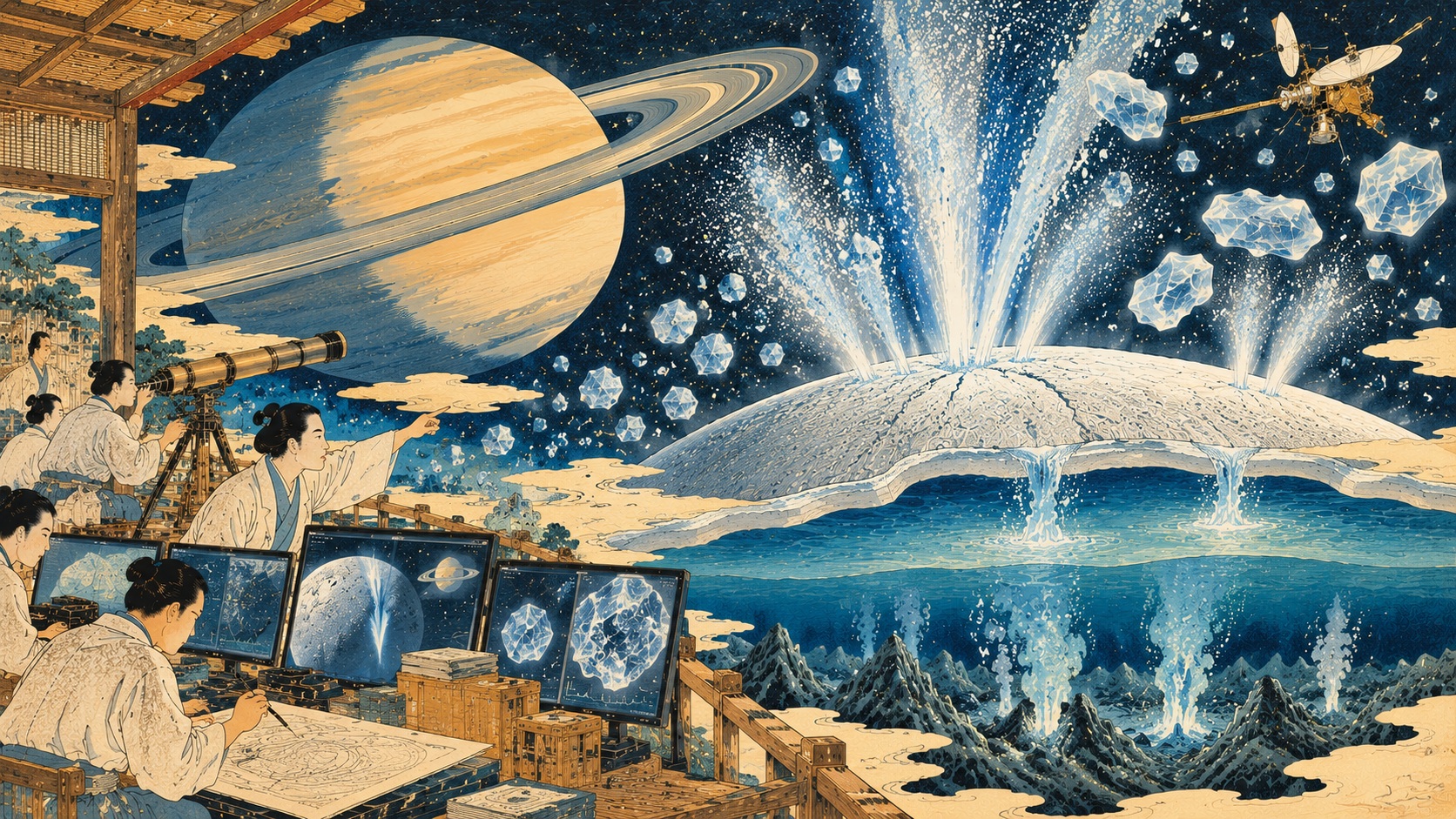
Enceladus offers planetary scientists an extraordinary shortcut. Beneath a shell of ice, Saturn’s small moon harbors a global ocean; near its south pole, plumes of vapor and grains escape through fractures into space. Some particles populate Saturn’s diffuse E ring. A spacecraft can sample that material without drilling through the crust. But what if the grains have changed chemically during their escape? A newly analyzed set of Cassini observations makes that question essential rather than incidental.
The discovery is older than the latest university posting
The research appeared September 25, 2026, in Science Advances under the title “Cassini CDA observes compositional segregation of Enceladus’ ice grains from slow freezing and fragmentation of oceanic spray.” Science Tokyo’s Earth-Life Science Institute highlighted it September 28, while a university English-language news page is dated October 22. The later post is not a new spacecraft observation. Cassini’s Saturn mission ended in 2017; this paper extracts fresh understanding from archived data and laboratory work.
A thousand clues, none quite alike
Frank Postberg and an international team studied 961 mass spectra of salt-rich Type 3 ice grains gathered by Cassini’s Cosmic Dust Analyzer in Saturn’s E ring. Many were dominated by very different compounds: sodium chloride, sodium carbonates or bicarbonates, sodium phosphates, sodium hydroxide, and potassium-bearing salts. Some combinations—notably sodium-rich chloride and carbonate—rarely appeared together within the same grain. If all particles arose from ocean spray, why did their chemistry look so uneven?
Japanese laboratory experiments find a way to sort the salts
Researchers including Yasuhito Sekine and Minori Koga at Science Tokyo’s Earth-Life Science Institute recreated droplets containing salts expected in Enceladus-like ocean water. Slowly frozen droplets about 200 micrometers across developed distinct salt-rich zones, particularly when cooling occurred at around 10 kelvins per minute or less. Fast freezing left ingredients comparatively mixed. Thermodynamic calculations and the broader experiments supported segregation under sufficiently large droplet sizes and rates below roughly 20 K per minute. The comparison makes a physical case for chemical sorting during freezing.
A violent finish to a slow beginning
The proposed sequence begins with relatively large droplets moving slowly through deeper icy fissures. Different salts precipitate as freezing advances, leaving chemically distinct portions within each icy pellet. Closer to the surface, accelerating gas rushes through narrow vents. Collisions with the walls shatter the frozen drops into tiny fragments, often enriched in just one component. The researchers model speeds exceeding 100 meters per second in the later flow. Nobody has filmed those channels from inside Enceladus; this is an interpretation linking measurements, experiments and calculations.
The danger of treating a grain as a miniature ocean
A phosphate-rich grain can be an excellent clue to ocean chemistry without being a representative spoonful of ocean water. The ice grain may be enriched because freezing sorted one dissolved salt into that region before the larger drop broke apart. The same process also presents an advantage: concentrated constituents can be easier for instruments to detect than those diluted across the original mixture. Enceladus could be doing part of a laboratory’s sample-preparation work naturally. Future missions need both insights: some ingredients are amplified, and single-grain concentrations may mislead.
From an overlooked moon to a prime astrobiology target
Cassini launched in 1997 and entered orbit around Saturn in 2004. Its 2005 Enceladus encounters transformed ideas about the moon when instruments and images revealed unusual south-polar activity and plumes. Scientists later found evidence for a global subsurface ocean. In 2017, molecular hydrogen in the plume supported the existence of ongoing water-rock reactions and possible chemical energy sources. A 2023 study identified phosphates in expelled grains. In 2025, a separate analysis examined organic molecules in freshly ejected particles. These steps established chemical interest—not organisms.
Habitability is not habitation
Liquid water, potentially usable chemical energy, and biological building blocks are the reasons Enceladus commands attention. They are not proof that life arose there. The 2026 paper focuses on an intermediate physical process: how spray freezes, separates and breaks apart. It does not detect microbial cells, biomarkers confirmed as biological, or a living ecosystem. A mission designed to search for life would still need rigorous contamination control, multiple independent chemical measurements and careful interpretation of ambiguous compounds.
What the study cannot yet establish
The laboratory droplets are analogues, not direct samples from beneath Enceladus’s crust. The sizes and velocities of subsurface ocean droplets, the geometry of individual vents and local freezing conditions remain inferred. Likewise, while sorting could affect organic compounds, the paper’s direct, carefully described compositional evidence is strongest for salts. Questions remain about how frequently this mechanism operates, whether other processes create similar particle signatures, and how to recover the ocean’s bulk chemistry from a biased collection of grains.
The hidden journey is part of the science
Enceladus appears to deliver ocean material to investigators for free. But the delivery system is not neutral: it may transform the message before the spacecraft reads it. The international collaboration’s achievement is to turn an awkward inconsistency in Cassini’s archive into a testable model of the moon’s icy interior. If future explorers can separate the ocean’s original chemistry from the alterations along the way, they will be better prepared to ask the grander question of whether this remote sea could sustain life.
Sources and verification
Based on the peer-reviewed study, Science Tokyo/ELSI disclosures and NASA mission documentation; researchers were not independently interviewed.
- Science Tokyo ELSI original research highlight (Sep. 28)
- Science Tokyo news posting (Oct. 22)
- Science Advances paper DOI
- PubMed bibliographic record
- NASA Cassini mission chronology
- NASA phosphorus research background (2023)
- NASA on fresh plume organics (2025)
- Japanese Planetary Science Society 2023 abstract (Koga and Sekine)