- A century-old Hiroshima company enters the AI sorting race
- What an optical sorter sees
- The role of 3D-CloudFit—and what remains human
- The economics of a false rejection
- A separate machine capable of more than 30 tons an hour
- The less glamorous step after milling
- From a motorized rice mill in 1896
- Why sake belongs in a story about algorithms
- A market that stretches far beyond Japan
- The final test is on the factory floor
A century-old Hiroshima company enters the AI sorting race
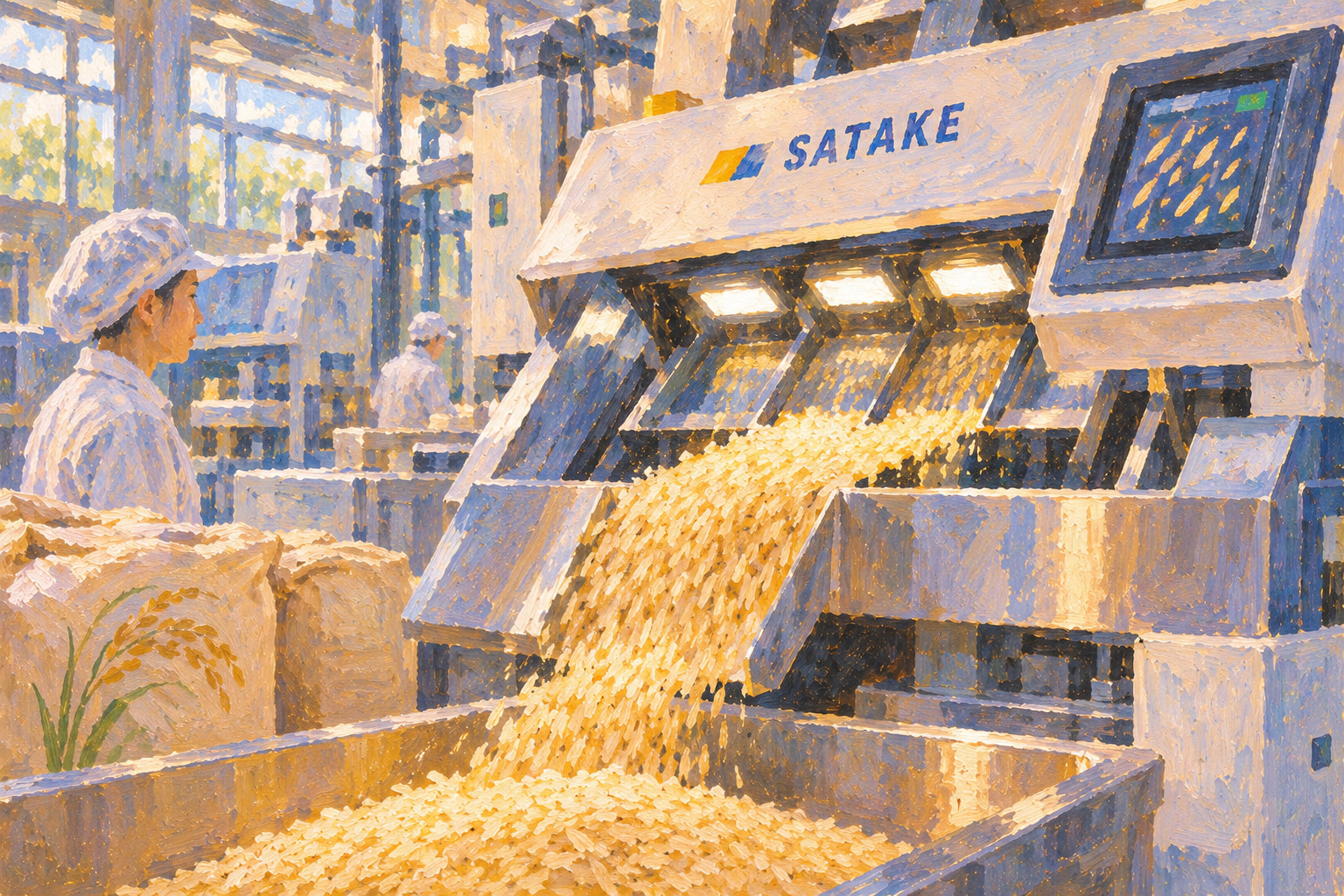
On November 18, Satake USA unveiled an expansion of its ENPRESOR optical-sorter family, adding an RGB-plus-infrared model called ENPRESOR LUX. The machines inspect flowing agricultural products and reject items that fail configured quality criteria. For a company founded in Hiroshima’s rice country in 1896, the announcement is the latest expression of a very old ambition: make more usable food with less exhausting and inconsistent manual processing.
The announcement is narrower than the phrase “AI-powered rice revolution” might suggest. It comes from Satake’s Houston-based U.S. subsidiary, applies to tree nuts, beans, seeds and grains as well as rice, and describes a lineup whose sales and shipments began in 2026. Separately, on November 17, the group announced updated KB rice polishers. Both developments matter, but they perform different jobs.
What an optical sorter sees
An optical sorter handles moving material at speed. Controlled feeding presents grains or other food items to illumination and cameras; image-processing systems classify individual objects; a timed rejection mechanism, commonly compressed air, separates selected defects or foreign material from the usable stream. Unlike simple mechanical sizing, this approach can respond to the appearance of each item.
Visible RGB imaging can distinguish color patterns; infrared sensing can add information that is not evident to a human eye. But “infrared-equipped” is not a universal guarantee against contaminants. Detection depends on the material, its properties, the camera configuration and the conditions of the production line.
The role of 3D-CloudFit—and what remains human
ENPRESOR incorporates Satake’s AI-based 3D Auto-Fit Pattern Sorting System, branded 3D-CloudFit. Its purpose, the company says, is to make pattern and sensitivity setup more automatic, reducing the number of adjustments operators must perform when products and defect profiles change. High-intensity LED lighting and image processing support the inspection process.
The lineup also includes two 19-inch touchscreens, diagnostics and a real-time analysis tool called VISION BOARD. These features may help a manager identify unstable conditions sooner. They do not eliminate the need to validate rejection thresholds, clean equipment, maintain sensors or comply with food-safety processes. Automation is an aid to operational discipline, not a substitute for it.
The economics of a false rejection
For a food processor, removing the wrong grain can be costly. A system that rejects every ambiguous item might produce cleaner output but waste an unacceptable portion of a harvest. A system that is too permissive may fail customer specifications or allow unwanted material to remain. Operators need to balance purity and recovery, especially when the incoming product varies by region and season.
This is where better image analysis and more repeatable settings might create commercial value. Yet Satake’s release does not supply independent side-by-side defect-detection rates, false-rejection rates, energy consumption or waste-reduction measurements. The strongest evidence would come from controlled trials under comparable conditions, not the presence of the AI label.
A separate machine capable of more than 30 tons an hour
Satake’s October 5 announcement of the CHT16A illustrates a different engineering priority: capacity. Developed primarily for overseas grain and seed processors, including in India, the optical sorter is rated at more than 30 metric tons per hour for long-grain rice under specified conditions. Its Smart Sensitivity feature creates settings from defect color characteristics, while its shape analysis addresses broken, adhered or malformed grains.
That capacity must not be transferred to ENPRESOR. They are distinct product lines. The CHT16A’s five-stage sorting configuration was also described as a late-2026 option rather than a universally installed capability at launch. Precisely distinguishing the product families is vital when assessing what a new announcement proves.
The less glamorous step after milling
On November 17, Satake introduced redesigned KB Series rice polishers. Dating to 1977, the KB family removes residual bran from the surface of milled rice. The new models—KB40HS-T, KB60HS(2)-T and KB80HS(2)-T—combine polishing with clearer controls and an automatic mode that targets preset operating values.
They can display motor current, water consumption and product flow, with optional SCADA connectivity and remote monitoring. The highest stated throughput is eight metric tons per hour, dependent on rice and processing conditions. A polisher is not a sorter; its role is surface finishing. Together the announcements show the group pushing instrumentation into multiple stages of grain processing.
From a motorized rice mill in 1896
Satake’s story began when founder Riichi Satake developed a powered rice-milling machine in 1896 in what is now Higashihiroshima. The shift away from painstaking manual pounding was part of an agricultural transformation whose importance is easy to overlook when modern factories are defined by software and sensors.
In 1908, improved abrasive milling equipment helped make more precise rice preparation possible for the sake industry. The company was incorporated in 1939 and established Satake USA in 1980. It dates its first color sorter to 1979 and a taste-measurement system to 1986. March 2026 marked the 130th anniversary of the company, now headed by president Kazuhisa Matsumoto. Its long development arc links mechanical power, optics, sensing and digital controls.
Why sake belongs in a story about algorithms
In Hiroshima’s Saijō district, sophisticated milling has particular cultural significance: the rice destined for sake has different processing requirements from ordinary table rice. Satake’s proprietary Shingin approach involves removing outer layers along the natural flatter shape of a grain rather than producing a uniformly rounded form. The goal is to remove certain undesirable constituents efficiently while giving brewers another way to shape flavor.
In November 2026, Satake announced awards recognizing the technical achievement of its Shingin milling equipment. These honors do not validate the performance of ENPRESOR, but they illuminate the common engineering logic: study the properties of a grain and remove only what the process needs removed.
A market that stretches far beyond Japan
The company says its technologies and equipment serve roughly 150 countries. Overseas rice processors, seed businesses and food manufacturers need different optical settings, service arrangements and quality thresholds. A processor of lentils faces different defects from a processor of rice, and a nut packer may demand a different sensor mix.
Global reach is not proof of market uptake for a newly expanded product range. The November ENPRESOR announcement gives no disclosed unit sales, selling prices or independently verified productivity gains for this particular series. Those would be important indicators of whether its combination of imaging and AI changes customer economics.
The final test is on the factory floor
Satake’s Japanese-language announcement on November 18 also discussed the use of KOMECT, its production-support system, at a rice-growing enterprise in Akita. That domestic announcement is distinct from the U.S. optical-sorter news. Viewed together, however, they point to the broader direction of agriculture: more data from growing through processing.
If optical AI can make machinery easier to configure, fewer skilled hours may be spent on trial-and-error adjustments. But deployment still depends on capital cost, electricity, spare parts, training and reliable verification of end-product quality. After 130 years of mechanization, the central question remains familiar: does a new machine actually make the work better for the people using it—and the food better for those who eat it?
Primary sources and reporting limits
This independently written report compares company disclosures available through November 19, 2026. It does not include a direct interview, machine testing or access to customer production data. Performance claims remain attributed to Satake.
- Satake USA ENPRESOR announcement / ENPRESOR米国発表 (November 18, 2026)
- Satake new KB polishing series / KBシリーズ海外発表 (November 17, 2026)
- Satake CHT16A optical sorter / CHT16A発表 (October 5, 2026)
- 株式会社サタケ:会社概要
- 株式会社サタケ:沿革
- 株式会社サタケ:創業130周年 (March 2, 2026)
- 株式会社サタケ:「真吟」技術表彰 (November 17, 2026)
- 株式会社サタケ:「真吟」食品産業技術功労賞 (November 12, 2026)
- 株式会社サタケ:「KOMECT」活用事例 (November 18, 2026)
- 株式会社サタケ:光選別機技術史
- 株式会社サタケ:トップメッセージ