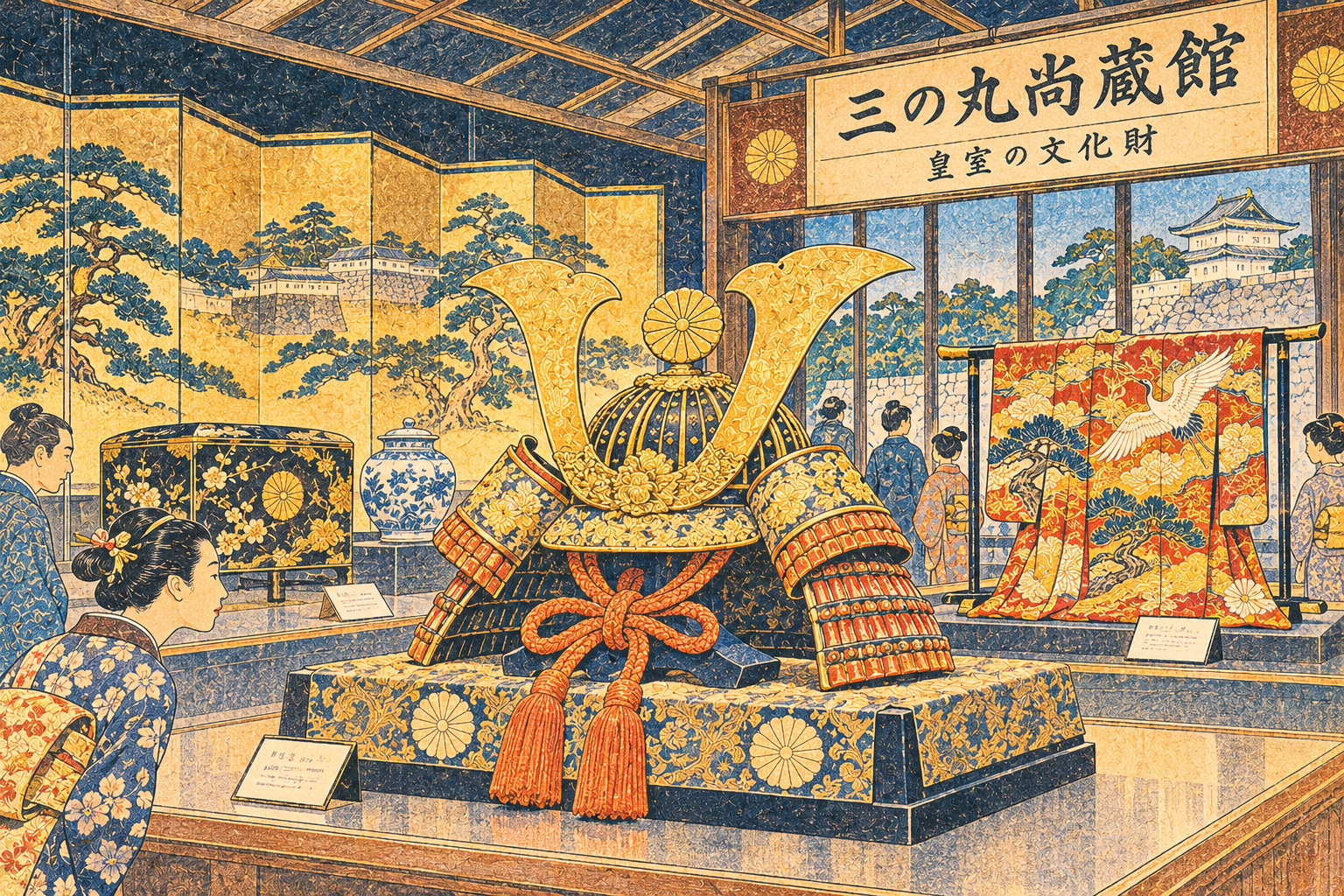
A royal collection becomes a public encounter
An eighth-century lute, an ornate mirror and a 1903 lacquer bookshelf might appear to belong to entirely different worlds. In Tokyo this week, they provide three entry points into the same question: how did works once associated with the Japanese imperial household survive, and what happens when they become part of a public museum? The Museum of the Imperial Collections, Sannomaru Shozokan, fully reopened on November 3 in the East Gardens of the Imperial Palace. Its first major exhibition, “Beauty Through the Ages: Treasures of the Imperial Collections,” begins with a compelling premise: objects are witnesses to the movement of people, technology, belief and political authority across centuries.
An eighth-century instrument with a global story
The opening rotation includes the Raden Shitan no Biwa (North Repository No. 27), a Shosoin lute made with red sandalwood and mother-of-pearl inlay, identified by the museum as eighth century, from China's Tang period or Japan's Nara period. Rather than declaring a single unproven birthplace, the attribution captures the international environment in which elite Japanese culture developed. Its materials and construction belong to a world of long-distance transmission. A musical instrument can be read as evidence of tastes, skilled hands, routes and relationships—not merely as a beautiful thing to admire through glass.
A mirror whose survival was not inevitable
Another early attraction is an octagonal mirror with a mother-of-pearl back, North Repository No. 42-7, attributed to eighth-century Tang China. Its decoration incorporates shell, amber and turquoise. In a curatorial explanation published by Japan's Agency for Cultural Affairs, museum senior curator Junichiro Tanaka links the object to the inventory of treasures associated with Emperor Shomu. He notes that it was badly damaged during a theft in the Kamakura period and repaired in the Meiji era. Its survival is therefore also a history of loss, repair and decisions about what should be kept.
Why 756 matters
According to the Imperial Household Agency's chronology, Empress Komyo offered objects cherished by the late Emperor Shomu to Todaiji temple in 756. The Shosoin repository in Nara subsequently preserved an extraordinary body of materials linked to court culture and Buddhist institutions. Their preservation connects religion, patronage, commerce and the development of administrative records. The claim made for this week's exhibition is specific: Shosoin treasures are being shown inside the Imperial Palace grounds for the first time. It does not mean that the treasures have never before been exhibited to the public.
The shogun's painter and a Meiji cabinet of marvels
The opening presentation is not limited to the ancient world. Kano Tanyu's 1642 Tale of Genji screens place courtly literature inside Edo-period painting, while Ito Jakuchu's 1755 Rising Sun and Phoenix explores a very different pictorial imagination. A more recent highlight, the 1903 chrysanthemum lacquer-and-mother-of-pearl bookshelf, is a collaboration involving designer Rokkaku Shisui, lacquer artist Kawanobe Itcho and metalwork specialist Unno Shomin. The object's elaborate construction makes sense within the Meiji world of specialist crafts, imperial commissions and international exposition culture. It resists the easy story that traditional Japanese craftsmanship simply remained unchanged.
The institution was born from a gift in 1989
The collection's public institutional history began in 1989, when Emperor Akihito—now Emperor Emeritus—and Empress Kojun, the mother of Akihito and consort of Emperor Showa, donated art long held by the imperial family to the nation. The museum opened in November 1993 on the site of Edo Castle's third bailey. “Sannomaru” refers to that historical precinct; “Shozokan” evokes the management of imperial storehouses. Subsequent donations enlarged the collection. From the beginning, the mission involved scholarship and preservation as much as display, giving objects that had once been largely inaccessible a new public role.
What changed in the museum itself
The rebuilding program began in 2019. Management moved from the Imperial Household Agency to the National Institutes for Cultural Heritage in 2023, when the museum partly reopened under its present name. It closed again in May 2025 for completion of construction. The expanded site now has three exhibition rooms, alongside a lecture hall and museum shop. The administrative shift matters: the collection is increasingly interpreted through the work of professional public museum institutions, with conservation, cataloguing and education central to its long-term mission.
The 190-object exhibition comes in three separate chapters
A practical distinction will save visitors disappointment. Approximately 190 works are included across the exhibition's three rotations, not all at once. The first runs November 3–23 and contains the Shosoin lute and mirror, Tanyu's screen and the Meiji bookshelf. The second runs November 26–December 20, with objects including the seventh-century Dragon-Headed Ewer from the Horyuji treasures held by Tokyo National Museum. The final rotation, December 23–January 24, is scheduled to include the Mongol Invasion Scrolls and Kano Eitoku's Lions screen. Every rotation replaces the preceding selection.
The imperial collection is not a single uniform collection
The exhibition brings together museum holdings, Shosoin treasures, and the Horyuji donated treasures held by Tokyo National Museum. That distinction in custody matters to anyone interested in provenance. The Japanese imperial household historically collected, received, commissioned or safeguarded objects through very different routes. Some entered public ownership through modern gifts, while others remain associated with separate institutions. To call them all “imperial treasures” captures a cultural relationship but obscures the varied legal and material histories that museum labels should help visitors understand.
A century after the beginning of Showa
The organizers also mark 100 years since the change of imperial era to Showa in 1926. Sections of the exhibition address Meiji craftsmen, Taisho modernity and the cultural world of Showa, alongside early Japanese painting, the Shosoin and Horyuji. These eras tell different stories about court sponsorship, modernization, exhibition culture and objects made for imperial celebrations. The result is not a seamless march of national style. It is a chance to understand how changing political institutions shaped the conditions under which art was made, acquired and preserved.
The other great Jakuchu show is next year
Visitors drawn by the prospect of all 30 scrolls of Ito Jakuchu's celebrated Doshoku Sai-e should note the calendar carefully. That presentation is a separate exhibition scheduled for February 4–March 14, 2027, not part of the museum's opening rotation this November. A subsequent exhibition, running March 25–May 16, is devoted to 1,300 years of Japanese calligraphy. The program makes the reopening a sequence of opportunities for returning visitors rather than a single display.
Planning a visit—and what to take away
The museum is at 1-8 Chiyoda, Chiyoda-ku, within the East Gardens of the Imperial Palace. General admission to the opening exhibition is ¥2,500, with timed advance reservations required; tickets are not sold at the venue on the day. Regular opening hours are 9:30 a.m. to 5 p.m., extended to 8 p.m. on Fridays and Saturdays, with last entry 30 minutes before closing. Many students and people under 23 qualify for free admission, subject to identification and, in most cases, reservation requirements. Always check the official schedule for rotation gaps and closures. More important than the number of treasures is the question they leave behind: what does it take, institutionally and humanly, to carry a fragile object across centuries and make it meaningful to someone seeing it for the first time?
Sources and reporting method
Based on museum and government primary documents, checked against contemporaneous independent reporting. No onsite attendance or interviews are claimed. Exhibited works and rotations follow the museum’s official listings.
- Museum exhibition, featured works and rotations
- Museum opening announcement
- Museum institutional history
- Agency for Cultural Affairs: curatorial guide
- Imperial Household Agency: Shosoin history
- Museum: upcoming 2027 exhibitions
- Museum: reservation and visitor information
- NICH: museum and public stewardship
- Museum: collection-image permissions
- Museum: official English exhibition and object titles