- A Championship Built in Three Swings—and Seven Innings
- The Game, Inning by Inning: Where Five Runs Came From
- Hiroto Takahashi Set the Terms on the Mound
- Rui Muneyama’s MVP Was Part of a Deeper Lineup
- Why “Three-Peat” Does Not Mean Three Straight Years
- A Manager’s Task: Assemble a Team Across Club Lines
- Four Wins, Four Different Challenges
- The Route Toward Los Angeles Is Not an Automatic Qualification
- What Tokyo Dome’s Final Means After the Celebration
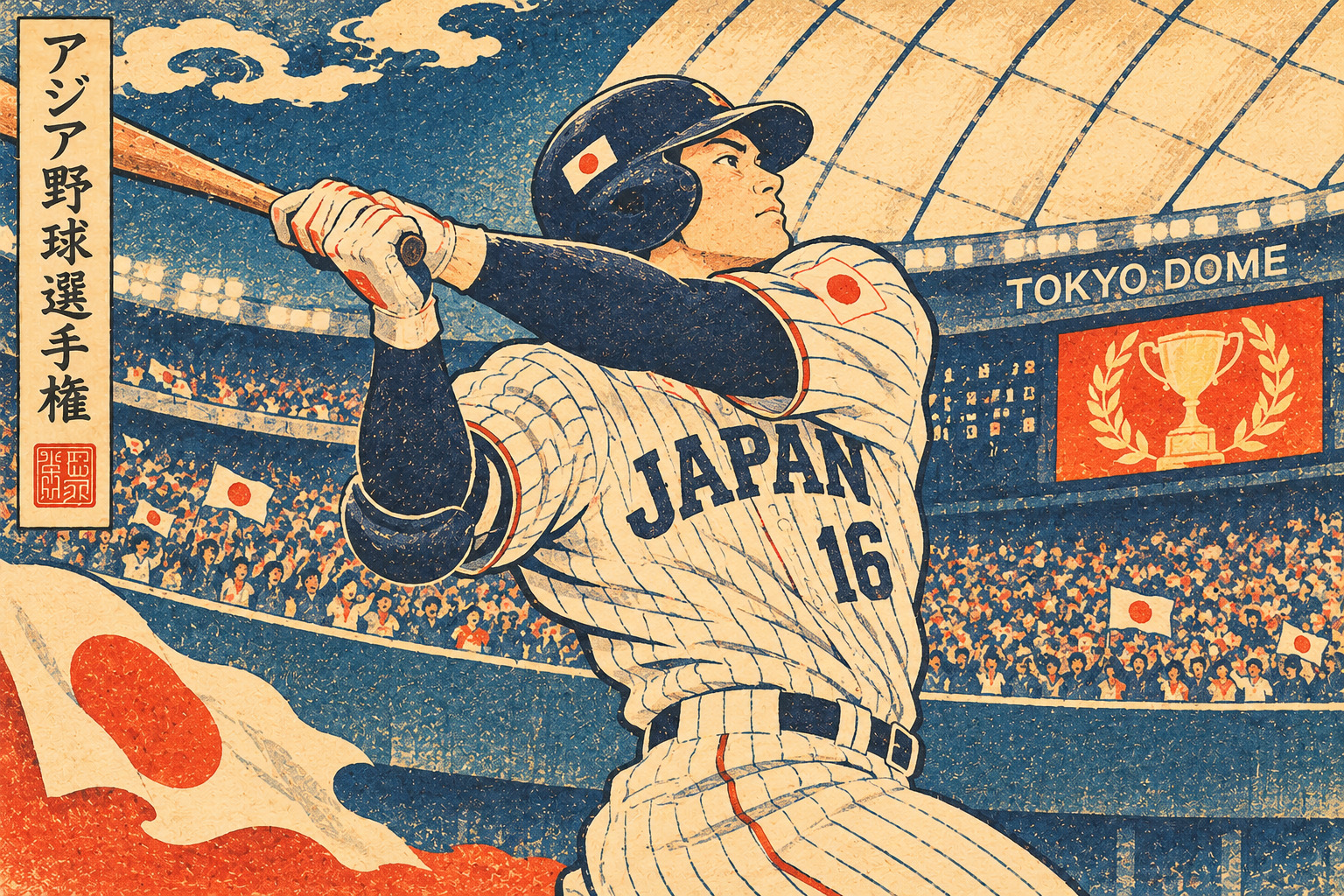
A Championship Built in Three Swings—and Seven Innings
The final did not turn on one spectacular moment. Japan struck first when Misho Nishikawa drove a changeup into the left-field seats in the opening inning. Rui Muneyama supplied a run-scoring double in the third. In the fifth, Tomoya Masaki launched a three-run homer that opened an insurmountable gap. By the time the Tokyo Dome crowd celebrated on November 15, Japan had defeated South Korea 5–1 and won a third consecutive Asia Professional Baseball Championship.
The home runs would dominate a highlight reel, but the game was equally a story of the paths between them: a stolen base, an opposition throwing error, a well-timed hit, and Hiroto Takahashi keeping South Korea away from second base for six innings. Japan finished the night with ten hits and no errors; South Korea had five hits and two errors. It was a coherent performance across hitting, pitching and defense.
This was not the World Baseball Classic and it did not confer a world championship for every generation of players. The competition was designed around emerging professional talent. Precisely for that reason, the result opens a more interesting question: how does Japan keep producing players capable of functioning together in international baseball after only a brief preparation period?
The Game, Inning by Inning: Where Five Runs Came From
South Korea started Kim Geon-woo. Nishikawa, batting third for Japan, worked a full count before driving a changeup for a solo homer to left in the first inning. The third began with Yudai Shoji singling to right, stealing second and advancing on an errant throw. Muneyama followed with a double into left-center. A sequence of small advances had created the conditions for an extra-base hit to matter.
The fifth inning showed a different kind of pressure. Taiga Kojima singled, and a Korean throwing error on Shoji’s sacrifice bunt widened the opening. Masaki then punished a fastball for a three-run blast to the upper deck in left, his fifth home run of the tournament. Japan now led 5–0. The inning combined good execution, an opponent’s mistake and a decisive swing; none of the three elements should be edited out of the account.
South Korea scored once in the seventh, but Japan did not lose control. It is tempting to call any four-run victory comprehensive. The better account is more exact: Japan created scoring opportunities early, converted them efficiently, and prevented the visitors from making their late response a sustained rally.
Hiroto Takahashi Set the Terms on the Mound
Hiroto Takahashi of the Chunichi Dragons pitched seven innings, allowed four hits and one run, struck out seven and walked one. For the first six innings, South Korea did not advance a runner to second base. His outing made every Japanese run feel more consequential, because Korea was being forced to fight through a narrowing window for a comeback.
In the seventh, a double by Ahn Hyun-min gave the visitors their first genuine opening. Pinch-hitter Ahn Jae-seok later delivered a run-scoring single, but Takahashi retired the next hitter to end the threat. Yutaro Ishida of the DeNA BayStars followed with a clean eighth. Hibiki Shinohara of the Seibu Lions surrendered a leadoff double in the ninth before closing the game without further damage.
A seven-inning performance in one international final is evidence of effectiveness under those conditions, not a guarantee of future dominance against different teams. The opponent, available rest, roster rules and tactical context will change. The credible achievement here is the one measured on November 15, not a prediction of inevitable success at the next event.
Rui Muneyama’s MVP Was Part of a Deeper Lineup
Muneyama, an infielder with the Rakuten Eagles, was named tournament MVP after collecting ten hits in 19 at-bats, batting .526 and driving in 11 runs across four games. He hit four homers over three successive games and added a key double in the final. The most revealing part of those numbers may be the combination of power and contact against pitchers unfamiliar from his domestic league schedule.
Masaki produced five homers and 11 RBIs during the event; the official post-tournament assessment credited him with a .462 average. Nishikawa hit .533 over the tournament and recorded three hits in four at-bats in the final. The numbers make the point that this was not a single-star team, even with one player deservedly receiving the trophy.
Such a concentrated hot streak must be interpreted carefully. Four games cannot establish the future ceiling of a professional career. Yet the performances give Japan’s coaching staff tangible evidence about who can adjust to new opponents, exploit mistakes and contribute under short-series pressure.
Why “Three-Peat” Does Not Mean Three Straight Years
The Asia Professional Baseball Championship began in 2017, with Japan winning the inaugural edition. It returned in 2023, when Japan completed another undefeated run, and was staged again in 2026. Japan has won all three editions. Its third consecutive championship is therefore a three-peat across tournaments, not three annual titles.
Japan, South Korea, Chinese Taipei and Australia are the participating national or regional teams. For younger professionals, the format provides exposure to different pitching profiles and strategic habits without the long acclimatization available over a domestic season. It also gives teams an opportunity to assess players under a form of pressure that everyday club games cannot exactly reproduce.
Japan and South Korea bring decades of baseball rivalry and exchange to these encounters. That history helps explain the emotional charge of another final between them. Still, the 2026 championship is best understood within its own competitive format rather than automatically equated with a World Baseball Classic final or Olympic gold-medal contest.
A Manager’s Task: Assemble a Team Across Club Lines
Manager Tadahito Iguchi had to turn players from rival organizations into a functioning lineup and pitching staff in a matter of days. His postgame comments, published by Samurai Japan, emphasized both attacking baseball and defending leads, alongside the need to create a core around which the next generation of the national team could form.
Masaki and Muneyama supplied headline power, but speed from Shoji, relief work from Ishida, and Ryuki Watarai’s contribution to team cohesion also drew notice in the official review. International rosters demand different contributions from their regular starters and bench players. Team success is often built as much on readiness for unfamiliar roles as on obvious individual brilliance.
The tournament should therefore be seen as an evaluation opportunity. Club competition will resume, injuries and form will change, and new candidates will emerge. A short international title offers a useful benchmark but does not lock a player into a future roster.
Four Wins, Four Different Challenges
Japan opened by shutting out Chinese Taipei 5–0 on November 12, beat South Korea 9–5 on November 13, overwhelmed Australia 16–1 on November 14 and defeated Korea 5–1 in the championship game the next day. Those four wins amounted to 35 runs scored and seven conceded. The totals demonstrate success, but the individual games tell more about how the team responded to different situations.
The first meeting with South Korea required Japan to win a higher-scoring contest. In the final, the pitching staff limited the same opponent to one run. Australia’s one-sided loss should not be used as a proxy for the entire region’s competitive standard. Tournament margins are shaped by who pitches, who is available, how teams rotate players and what a particular day demands.
Australia defeated Chinese Taipei 6–4 in the third-place playoff. The official final standings were Japan, Korea, Australia and Chinese Taipei. All four teams left the competition with evidence for their next stage of player development, even if only one raised the trophy.
The Route Toward Los Angeles Is Not an Automatic Qualification
After the final, Iguchi spoke of seeking an Olympic berth through the 2027 Premier12 tournament, with the 2028 Los Angeles Games as a broader ambition. That is a declared objective, not a consequence of the November 15 result. Winning this championship did not itself qualify Japan for the Olympics; qualification procedures and subsequent international results remain separate hurdles.
For a national coach, the value of the games lies partly in what can be learned about combinations: which players handle pressure at the top of the order, which pitchers can protect a lead, and which defenders communicate well despite coming from different clubs. Such observations cannot be fully replicated in a training camp.
The next steps belong to both the national-team program and domestic organizations. Players must carry their international experience back to club baseball and continue earning their place. The Tokyo championship is a beginning of that process, not its final verdict.
What Tokyo Dome’s Final Means After the Celebration
Japan’s title defense was made tangible by Nishikawa’s opening homer, Muneyama’s double, Masaki’s three-run shot and Takahashi’s seven innings. It was also made possible by unglamorous moments: reaching base, advancing a runner, fielding cleanly and getting through the final outs after Korea put men on base.
The deeper significance is institutional. Players from several professional organizations performed together in a short window, reflecting both the training within Japanese clubs and the ability of a national program to assemble talent at the right time. No single statistic can capture that system, and a championship alone cannot prove its superiority under every format.
The third consecutive championship is a documented achievement. Its lasting value will depend on whether these players, and the coaches who have learned from them, translate four November games into stronger international baseball in the years ahead. That is the question that survives the final score.
Official Records and Reporting Limitations
This analysis uses the official November 15 match report and November 16 tournament review. It does not claim on-site reporting or original player interviews. The 2026 championship does not independently determine eligibility or selection for Premier12 in 2027 or the 2028 Olympics.
- Samurai Japan: Official November 15 championship game report
- Samurai Japan: Tournament overview, results, MVP
- Nippon Professional Baseball: 2026 championship results
- Samurai Japan: November 16 tournament assessment
- Samurai Japan: 2023 tournament retrospective and 2017 origins
- Samurai Japan: Official English-language 2026 tournament overview
- Samurai Japan: Official starting pitchers announcement
- Samurai Japan: Final inning-by-inning box score