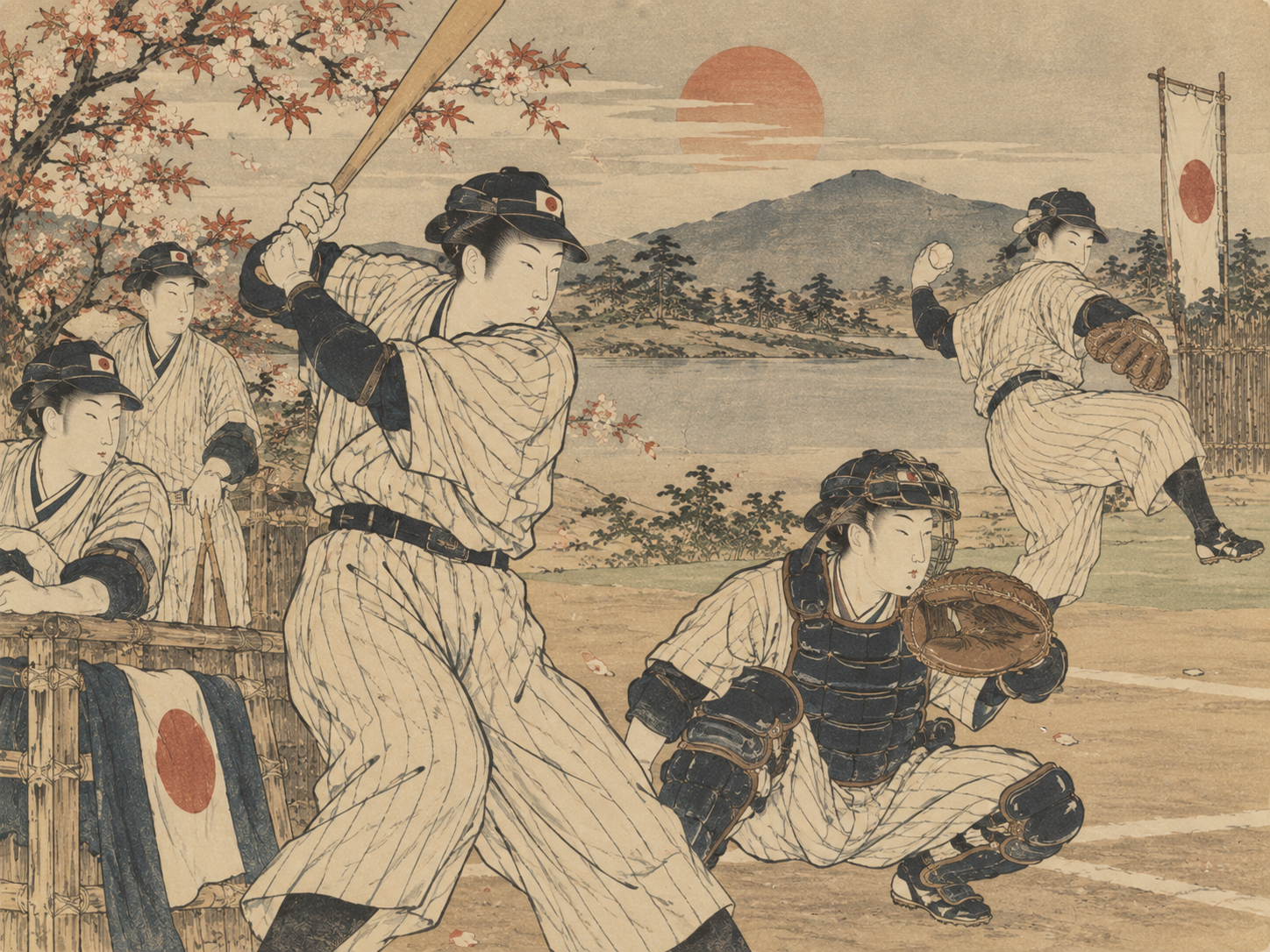
Japan has won the World Baseball Classic, the Premier12 and Olympic gold. Yet the Asian Games contain a strange blank in the country’s modern baseball record. Japan has won the Asian Games baseball title only once—at Hiroshima in 1994, when it beat Korea 6-5 in the final. Thirty-two years later, the gold has never returned. [10]
The team trying to end that drought is not Japan’s WBC superteam. It is Samurai Japan’s corporate-league national side: 24 players drawn from company teams such as Toyota, ENEOS, NTT, Nippon Life, JR clubs and others that make up Japan’s distinctive industrial baseball system. They will play the 20th Asian Games from September 21 to 27 in Okazaki and Toyohashi, Aichi Prefecture. [2][3]
Final camp began September 15 at ENEOS’s Todoroki ground in Kawasaki. The hitters spent part of the opening session training their eyes on pitches thrown by a machine at more than 160 kilometers per hour. That detail captures the campaign better than the anniversary number. Japan does not need to solve 32 years in one gesture. It needs to see elite velocity early, make decisions quickly, convert a handful of scoring chances and recover from mistakes before a short tournament moves on. [1]
The Japanese Olympic Committee records baseball as becoming an official Asian Games medal sport at Hiroshima 1994. Japan, fielding a team built from corporate-league and university players, defeated Korea 6-5 in the final. Samurai Japan describes the 2026 attempt as a bid for a second gold, 32 years and eight editions later. [5][10]
“Samurai Japan” does not mean the WBC roster
Japan uses the Samurai Japan identity across several national-team categories. The Asian Games entry belongs to the amateur/corporate-league program, not the top team that plays the World Baseball Classic. The final roster includes players from JR Shikoku, Oji, Toyota, ENEOS, Nippon Life, JFE West Japan, NTT East and West, Tokyo Gas, JR Central and other company teams. [2]
This matters because the Asian Games entered a professional era long ago. The JOC’s historical account says international baseball opened to professional participation around the 1998 Bangkok Games, when Korea and Chinese Taipei began sending professional-heavy teams. Japan continued to rely primarily on corporate-league and university players. In Bangkok, Japan reached the final but lost 13-1 in seven innings to a Korean team that included major-league pitcher Chan Ho Park. [10]
The same structural issue was still visible in 2014, when the JOC described Korea and Chinese Taipei as opponents with professional players while Japan again fielded a corporate-league side. [14] The exact 2026 opponent rosters must be judged from their own final registrations, but the Asian Games themselves do not impose a simple amateur-only environment.
That gives Japan’s team a particular identity. These players compete at a high level while belonging to corporate clubs that are also workplaces, institutions and pipelines into professional baseball. The challenge is not to imitate the WBC team; it is to prove that Japan’s industrial-league system can win this specific tournament.
Why the 1994 gold never became a habit
Hiroshima 1994 was the first Asian Games in which baseball was an official medal sport. Japan was host, and the roster included players who later became major NPB figures, including Nobuhiko Matsunaka and Toshihisa Nishi. The final against Korea ended 6-5. [10]
The competition changed sharply four years later. Professional participation raised the ceiling of rival rosters. Japan still reached the Bangkok final in 1998 but was overwhelmed by Korea. [10]
More recent editions show the problem in different forms. In 2018, Japan reached the Jakarta final but lost 3-0 to Korea and took silver. [9] At Hangzhou in 2023, Japan suffered an opening-stage 1-0 loss to China, struggled to score in the super round against Korea and Chinese Taipei, and finished with bronze after rallying to beat China 4-3 in the third-place game. [8]
Samurai Japan’s own review after Hangzhou concluded with a clear target: use the 2026 home Games to take the first Asian Games gold since Hiroshima. [11] The lesson across three decades is not one simple deficiency. Roster rules, professional opposition, elite velocity, tournament structure and tiny offensive margins have all mattered. But one theme repeats: in short international tournaments, Japan has often had too few opportunities to waste any of them.
Hangzhou changed the offensive question
The 2023 bronze mattered because it exposed the gap without euphemism. Samurai Japan’s post-tournament analysis described the difficulty of balancing its preferred team concepts with the need to win immediately. Then-captain Shoji Kitamura said Japan had failed to hit when it needed to against Korea and acknowledged a clear difference. [11]
The corporate national team has since leaned harder into offensive quality: bat speed, hard contact and the ability to handle high-end fastballs rather than relying only on defense and situational execution.
The 160-km/h work in the 2026 camps is the clearest visual symbol of that adjustment. In July, manager Tomoyasu Kawaguchi specifically identified pitches above 150 km/h as a Hangzhou problem and said the team was using machines near 160 to train visual tracking. [5] On September 15, the same work continued above 160. Ryosuke Fujisawa of Tokyo Gas said his perception of that speed had changed after continuing velocity work following the Intercity Baseball Tournament. [1]
The goal is not to produce a lineup that can simply “hit 160.” International at-bats include spin, count leverage, changing eye levels and runners on base. The training is about buying fractions of a second for decision-making.
Back-to-back Asian Championship titles are real evidence—but not a forecast
Japan enters with recent proof that this corporate-league program can beat strong Asian opposition. At the 2023 BFA Asian Championship in Taiwan, Kawaguchi’s team went unbeaten. It beat Chinese Taipei twice, defeated Korea 5-2 and won the final 1-0 over Chinese Taipei. Motoki Mukoyama was tournament MVP. [7][13]
In 2025, Japan repeated. It won its second consecutive BFA Asian Championship and 21st title overall, routing Chinese Taipei 11-0 in the final. Pitcher Kazuki Kondo, now on the Asian Games roster, threw 12 scoreless innings in the tournament and was named MVP. Captain Ryosuke Aizawa also captained that championship team. [6][12][17]
Those results matter because many members of the 2026 roster have already lived through international games against Chinese Taipei, Korea and China. Kawaguchi said in July that players with experience in the national-team program and winter leagues understand the special difficulty of international competition, and that experience informed selection. [5]
But a BFA title should not be turned into an Asian Games prediction. Eligibility and roster construction differ from event to event. The useful conclusion is narrower: Japan has recently demonstrated that its corporate-league model can beat teams containing high-level professional talent in Asian competition. [16]
Kawaguchi treats communication as a competitive tool
Kawaguchi has built the program around something harder to quantify than velocity: fast trust. Corporate-league players are rivals most of the year. National-team camps are short. The staff therefore emphasizes communication among players and between players and specialists so that information can move quickly.
That approach helped the 2025 Asian Championship team, which had 17 first-time national selections among 24 players. After the title, Aizawa said group-work sessions helped players learn one another’s personalities before competition began. [17]
The captain brought the same idea into the September 15 camp. Aizawa wanted energy immediately rather than a polite reunion after two months apart, and he said a short tournament requires a group capable of moving on quickly after mistakes. [1]
This is not merely morale language. The opening round lasts three straight days. The super round follows after one day off. Medal games come the next day. There is very little calendar space for emotional recovery, mechanical rebuilding or a clubhouse problem to solve itself.
Aizawa has already captained an Asian champion
Aizawa, an outfielder for Toyota, gives Japan continuity in the middle of the field and the middle of the team. He played in the 2023 Asian Championship and captained the 2025 championship side. [13][17]
Kawaguchi selected him again as captain for the Asian Games, praising his ability to see the whole group and translate staff intentions to players. [5]
That role is unusually important in a national team assembled from many employers. A captain has days, not months, to connect a pitcher from JR Shikoku with a catcher from NTT West, a Toyota infielder with an ENEOS teammate, and a staff using data specialists alongside traditional coaching.
Aizawa also has to produce. In a tournament decided by small sample sizes, leadership that does not reach the scoreboard has limited value.
Kondo arrives as the reigning BFA MVP
Among the pitchers, Kondo has the clearest recent international résumé. The JR Shikoku right-hander was MVP of the 2025 BFA Asian Championship after 12 scoreless tournament innings, including six shutout innings in the final. [6][17]
On the first day of final camp, Kondo was one of the pitchers who entered the bullpen immediately, working with catcher Yuki Tsujimoto to align their feel. He framed his Asian Games goal in team terms: he wants Kawaguchi to finish as a champion. [1]
That does not make Kondo the confirmed starter for China, the super round or a possible final. Samurai Japan has not published a rotation. Shuichiro Kayo, Mizuki Kato, Yoshiki Fuchigami, Kento Nagano, Sho Akiyama, Shin Higuchi, Koki Taniwaki and Wataru Matsuda give the staff multiple options across a seven-day event.
A late pitching change
The final roster changed on September 11. Left-hander Kento Matsuda of Vital-Net withdrew because of a conditioning issue; Nippon Life right-hander Koki Taniwaki was added. [2]
The move keeps the pitching staff at nine. The official notice does not provide enough medical detail to judge the severity of Matsuda’s condition, nor does it describe Taniwaki’s intended role. It should therefore be treated as a roster change, not automatically as a downgrade or upgrade.
The final 24
| Position | Player | Club |
|---|---|---|
| Pitcher | KONDO Kazuki | JR四国 |
| Pitcher | HIGUCHI Shin | 王子 |
| Pitcher | TANIWAKI Koki | 日本生命 |
| Pitcher | KAYO Shuichiro | トヨタ自動車 |
| Pitcher | KATO Mizuki | ENEOS |
| Pitcher | FUCHIGAMI Yoshiki | トヨタ自動車 |
| Pitcher | NAGANO Kento | JFE西日本 |
| Pitcher | AKIYAMA Sho | 三菱自動車岡崎 |
| Pitcher | MATSUDA Wataru | 日本製鉄室蘭シャークス |
| Catcher | ARIMA Ryo | ENEOS |
| Catcher | TSUJIMOTO Yuki | NTT西日本 |
| Catcher | FUKUI Shogo | トヨタ自動車 |
| Infielder | YANO Yukiya | 三菱重工East |
| Infielder | WADA Keita | トヨタ自動車 |
| Infielder | SOEDA Manami | 日本通運 |
| Infielder | KUMADA Toyo | トヨタ自動車 |
| Infielder | YAMADA Kenta | 日本生命 |
| Infielder | SATOH Yuki | トヨタ自動車 |
| Infielder | MARUYAMA Masashi | ENEOS |
| Outfielder | SHIBASAKI Masato | 王子 |
| Outfielder | MUKOYAMA Motoki | NTT東日本 |
| Outfielder | AIZAWA Ryosuke | トヨタ自動車 |
| Outfielder | FUJISAWA Ryosuke | 東京ガス |
| Outfielder | MIZUTANI Shohei | JR東海 |
Manager: Tomoyasu Kawaguchi (Mitsubishi Motors). Coaches: Taketomo Tamano (TDK), Kojiro Yamada (Osaka Gas Network) and Toru Kato (Nippon Steel Technology). Romanized names follow Samurai Japan’s official English roster. [2][4]
China first; then Palestine and the Philippines
Japan is in Group A. It opens against China at 6:30 p.m. on September 21 in Toyohashi, faces Palestine at 6:30 p.m. September 22 in Okazaki, then the Philippines at noon September 23 in Toyohashi. Group B contains Chinese Taipei, Korea, Hong Kong and Thailand. The top two teams from each group advance to the September 25-26 super round; the top two in the super round meet in the final at 6:30 p.m. September 27 in Toyohashi. [3]
The opener deserves special attention. China beat Japan 1-0 at Hangzhou in 2023. Japan later beat China 4-3 for bronze. [8] At the 2025 BFA Asian Championship Japan beat China 13-0, but different competitions and rosters make that result a poor shortcut for the Asian Games. [12]
If Japan reaches the super round, it will meet the top two teams from the group containing Korea and Chinese Taipei. Which teams advance cannot be assumed in advance. What can be said is that Japan’s road to gold is structurally designed to bring the strongest surviving teams together before the final.
1994 Hiroshima — Japan beats Korea 6-5 for its only Asian Games baseball gold.
1998 Bangkok — The professional era changes the competition; Korea beats Japan 13-1 in the final.
2018 Jakarta — Japan takes silver after a 3-0 final loss to Korea.
2023 Hangzhou — Japan rallies past China 4-3 for bronze.
2023 BFA — Kawaguchi’s corporate side wins the Asian Championship unbeaten.
2025 BFA — Japan repeats, beating Chinese Taipei 11-0 in the final.
2026 Aichi — Home again, chasing a second gold after 32 years.
Home advantage also creates home pressure
The 2026 Asian Games return to Japan 32 years after Hiroshima. Baseball is staged in Okazaki and Toyohashi. The coincidence is irresistible: Japan’s only gold came the last time the country hosted this event, and the next opportunity is again at home. [15]
There is no evidence that hosting guarantees a better baseball result. Home conditions remove some travel friction and add familiar support, but they also concentrate expectation. Corporate teammates, employers, families and domestic media are closer. A tournament that has lived as history becomes a demand.
Kawaguchi’s program does have a strong recent record. It won the 2023 and 2025 BFA Asian Championships. After the 2025 title, the manager said Japan should not surrender the top of Asia as the program turned toward the home Asian Games. [15]
But confidence is not the same as prediction. Seven days of baseball separate a strong preparation story from a medal.
The medal also carries the reputation of corporate baseball
This national side represents more than Japan. It represents a Japanese sports institution: shakaijin baseball, the corporate game. Players belong to company teams, compete in the Intercity Baseball Tournament and Japan Championship, and often balance employee status with elite competition. Some will enter NPB; others will build long careers within the corporate system.
There is room to debate whether Japan should field professionals at an event that allows professional participation. But the corporate program’s recent Asian titles show that it is not merely symbolic. It is a high-level development system capable of beating strong opposition. [6][7]
Kawaguchi has said he wants spectators to leave the Asian Games thinking, in effect, “corporate baseball is good.” [1] At a home event, a medal can send viewers back toward Toyota, ENEOS, NTT, JR and the broader company-game ecosystem in a way an overseas tournament cannot.
What it takes to end 32 years
The Hiroshima champions cannot help this team beyond history. The modern roster brings a different kind of evidence: wins over Chinese Taipei and Korea at the 2023 BFA championship, another Asian title in 2025, a captain who has already led a champion, an MVP pitcher, hitters trained for extreme velocity and staff experienced in assembling a team quickly. [6][7][16]
Once China throws the first pitch on September 21, however, “32 years” becomes background. The baseball becomes immediate: execute the bunt or swing decision; command the strike zone; turn hard contact into outs; prevent one error from becoming three runs; arrive on elite velocity; use the bullpen before a close game escapes.
Aizawa’s emphasis on moving forward after mistakes is well suited to this format. [1] There is almost no time for regret in a tournament where one opening-round slip can shape a super-round route and one super-round loss can change the medal game.
No one can responsibly say today whether Japan will be holding gold in Toyohashi on the night of September 27. What is certain is that this 24-player corporate side has a home opportunity to close one of Japanese baseball’s most persistent historical gaps. Thirty-two years is a long time. Baseball still reduces it to the next pitch.
Sources and references
- Samurai Japan: Final camp begins in pursuit of first Asian Games gold in 32 years (Sept. 15, 2026)
- Samurai Japan: Roster change, final 24-player team and pre-tournament camp schedule (Sept. 11, 2026)
- Samurai Japan: 20th Asian Games tournament overview and schedule
- Samurai Japan English: 2026 Asian Games player list and official romanization
- Samurai Japan: Corporate-league national team begins build toward 32-year Asian Games gold drought (July 20, 2026)
- Samurai Japan: Back-to-back BFA Asian Championship title, 21st championship (Sept. 28, 2025)
- Samurai Japan: 2023 BFA Asian Championship title, 1-0 over Chinese Taipei (Dec. 10, 2023)
- Samurai Japan: Bronze medal at Hangzhou after 4-3 comeback over China (Oct. 7, 2023)
- Samurai Japan: 2018 Jakarta Asian Games final, 0-3 loss to Korea and silver medal
- Japanese Olympic Committee: Asian Games baseball history — Japan’s lone 1994 gold and the professional era from 1998
- Samurai Japan: Hangzhou review — target a first gold since 1994 at Aichi-Nagoya
- Samurai Japan: 2025 BFA Asian Championship full results and final standings
- Samurai Japan: 2023 BFA Asian Championship full results and final standings
- JOC: 2014 Asian Games baseball team faces pro-player opposition with a corporate-league selection
- Samurai Japan: From consecutive BFA titles toward a first Asian Games gold in 32 years
- Samurai Japan: 2023 BFA review — winning against professional-player opposition
- Samurai Japan: Corporate-league side returns after consecutive Asian Championship titles (Sept. 30, 2025)
- Samurai Japan: 2023 Hangzhou Asian Games corporate-league roster
Evidence reviewed in the early hours of September 16, 2026, Japan time. The September 11 Samurai Japan roster notice and official tournament page control the final player list and schedule. The September 15 team report supports the 160-plus-km/h visual training and player comments. The JOC history supports the 6-5 Hiroshima final and the shift to professional participation from the late 1990s. Japan.co.jp did not verify the final 2026 rosters of Korea, Chinese Taipei or other opponents and therefore does not describe those teams as professional-heavy as a current fact. The article reports past results and present structure without predicting the medal outcome.