The most beautiful race is not a race for speed
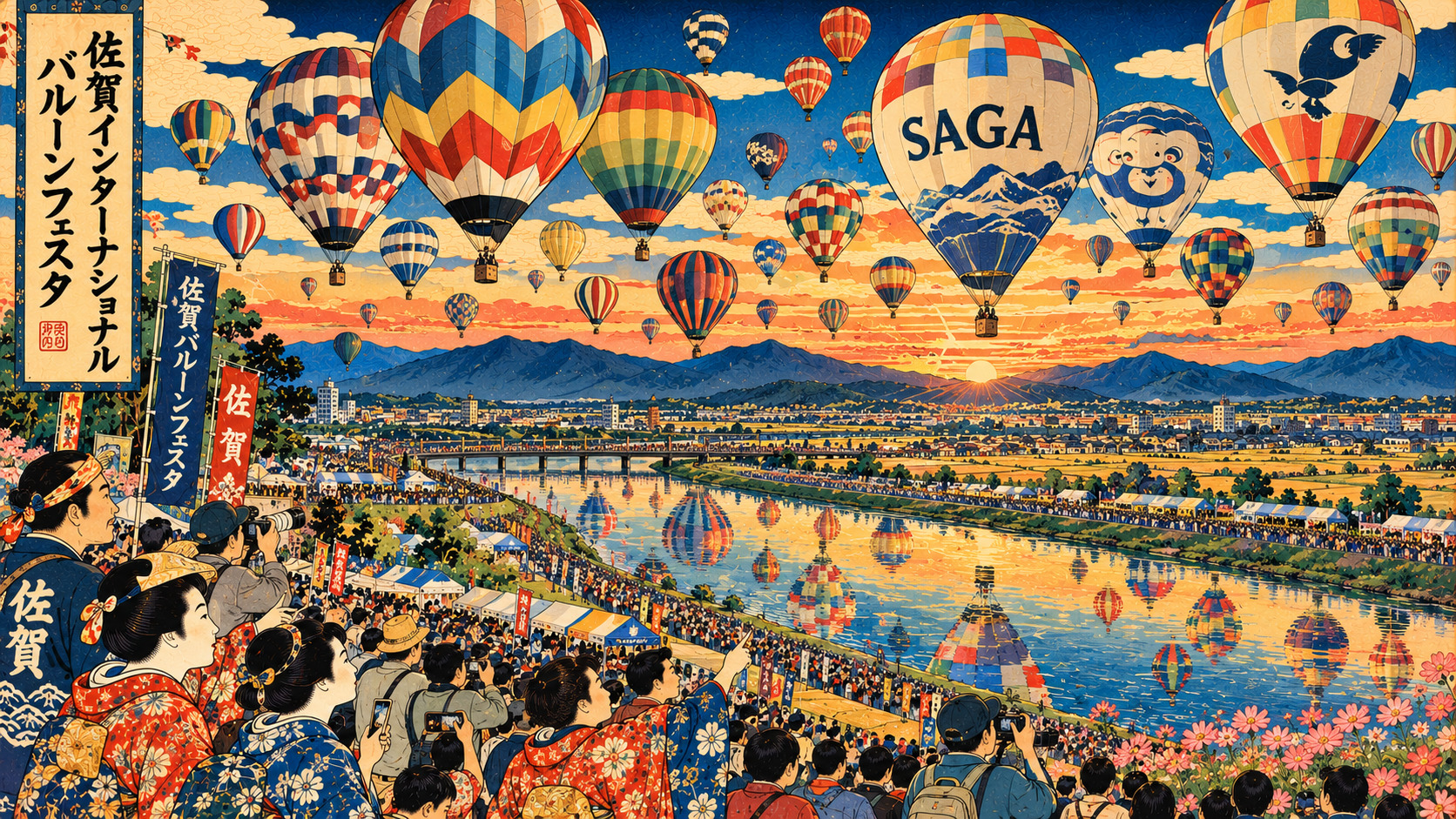
At sunrise above Saga’s Kase River, hot-air balloons look like enormous floating lanterns. Their competition, however, is a precise test of judgment. Pilots have no steering wheel. They heat air to rise and let it cool to descend, seeking different wind directions at different altitudes and measuring how accurately they can approach a target. The 2026 Saga International Balloon Fiesta runs from October 30 through November 3, with the 39th Pacific Cup and the third round of the Honda Grand Prix among its listed competitions. The result depends on more than spectacle: it depends on weather, skill and organizers’ safety decisions.
What has actually flown so far
The first day, October 30, was disrupted by rain and wind, and flights were cancelled. Better weather returned October 31, though afternoon competition was cancelled in strong winds. On November 1, calm morning conditions allowed balloons to fly and official competition to proceed, according to contemporaneous local weather reporting. These are documented developments available as of November 1. Results for November 2 and November 3, including final standings, are not known at this reporting cutoff. It would be misleading to describe an anticipated finale as an event already completed.
How to navigate without steering
Hot air changes the density of the air inside a balloon envelope. That controls ascent and descent, not direct horizontal propulsion. Near the surface, a balloon may drift one way; at another altitude, the wind may carry it in a different direction. Experienced crews use observations, forecasts, launch timing and small altitude changes to build a route. Competition tasks typically reward proximity to targets rather than fastest travel. Which tasks are flown can vary, and competitors must adjust their tactics to the weather and the restrictions imposed for safety.
The Pacific Cup and the art of accuracy
The 2026 program identifies the 39th Pacific Cup, the Honda Grand Prix round and Balloon Fantasia. These are related but not interchangeable attractions: scored competition differs from display balloons that are designed principally to entertain visitors. The Pacific Cup rewards accumulated performance under specified tasks. A cancellation reduces the number of scoring opportunities and can reshape a competition. The only defensible way to name the eventual winner is to consult the organizer’s final results rather than extrapolate from a beautiful flight or an early leaderboard.
From five balloons in Fukuoka to world championships in Saga
The event’s story began in 1978 with a small balloon gathering in Amagi, Fukuoka Prefecture. Organizers moved the competition to the Saga Plain in 1980, when 14 balloons took part. A decisive milestone came in 1989, when Saga hosted the ninth World Hot Air Balloon Championship: the official historical table reports 132 balloons and 1.17 million spectators that year. Saga hosted a world championship again in 2016. Its international stature reflects decades of local organizing, pilot experience and coordination, not an overnight marketing achievement.
Why a rice-growing plain matters
The Saga Plain offers broad fields and relatively open approaches, particularly after the autumn rice harvest. Ballooning needs safe launch and landing locations, and a competition cannot operate in isolation from the landowners who make those locations possible. A Japanese government feature on the festival highlighted the cooperation of local farmers. That detail changes the way to see a panorama of colorful envelopes: beneath them is a working agricultural landscape, with livelihoods, seasonal schedules and responsibilities that matter just as much as the visiting audience.
A sporting event with a regional economic footprint
Saga City describes an international gathering of more than 100 balloons, while local coverage of opening day reported around 120 expected entries from 15 countries and regions. Those are prospective participation figures, not proof that every balloon flew. Visitors may spend money on rail and bus travel, accommodation, food and the on-site Umakamon Market. Such activity can support regional businesses, but claims of total economic benefit require reliable attendance counts, spending surveys and attention to displaced spending and public costs. An official final assessment was not available at this reporting cutoff.
Night mooring turns flame into theatre
La Montgolfier Nocturne, scheduled for November 2 and 3 from 6:30 p.m., presents tethered balloons illuminated by their burners against the night sky, with music and a planned fireworks finale. The organizer explicitly warns that high wind or rain may force cancellation or a burner-only version without inflated envelopes. Spectacular promotional images should not erase this uncertainty. Evening conditions are decisive, and a visitor should distinguish what is advertised from what the crew can safely deliver on the day.
Planning a November 3 visit
The published timetable lists morning competition beginning around 7 a.m., Balloon Fantasia from around 9 a.m., and the evening night-mooring program. None is guaranteed in adverse weather. Saga’s municipal bus operator has announced holiday parking-lot shuttle service from 5:45 a.m. until 8 p.m. on November 3, priced at ¥250 one-way for adults and ¥130 for children. Travelers should check live organizer and transport notices before leaving; a cancellation may be communicated close to launch time.
The value of knowing when not to fly
For a spectator, a cancelled balloon flight can be disappointing. For a pilot, crew or official, recognizing the moment when conditions have become unsafe is fundamental professionalism. That tension gives Saga’s event its real drama: every launch is a decision made in imperfect information, against the clock and under public scrutiny. The fiesta has become one of Japan’s most memorable annual sporting landscapes because it combines international competition with farmers, volunteers and local businesses. Its next chapter should be measured in safe flights and sustainable regional relationships, not simply crowd estimates or a collection of photographs.
Sources and reporting method
Based on primary organizer, city and transit information, with contemporary reporting through November 1. No original pilot or vendor interviews. Final rankings and November 2–3 outcomes were not yet available.
- Official 2026 schedule
- 2026 competition outline
- How balloon competition works
- Official fiesta history
- Official night-mooring schedule and weather policy
- Saga City 2026 festival information
- Saga City Bus special shuttle details
- Weathernews November 1 report
- Kyodo opening-day report
- Cabinet Office on ballooning and farmers