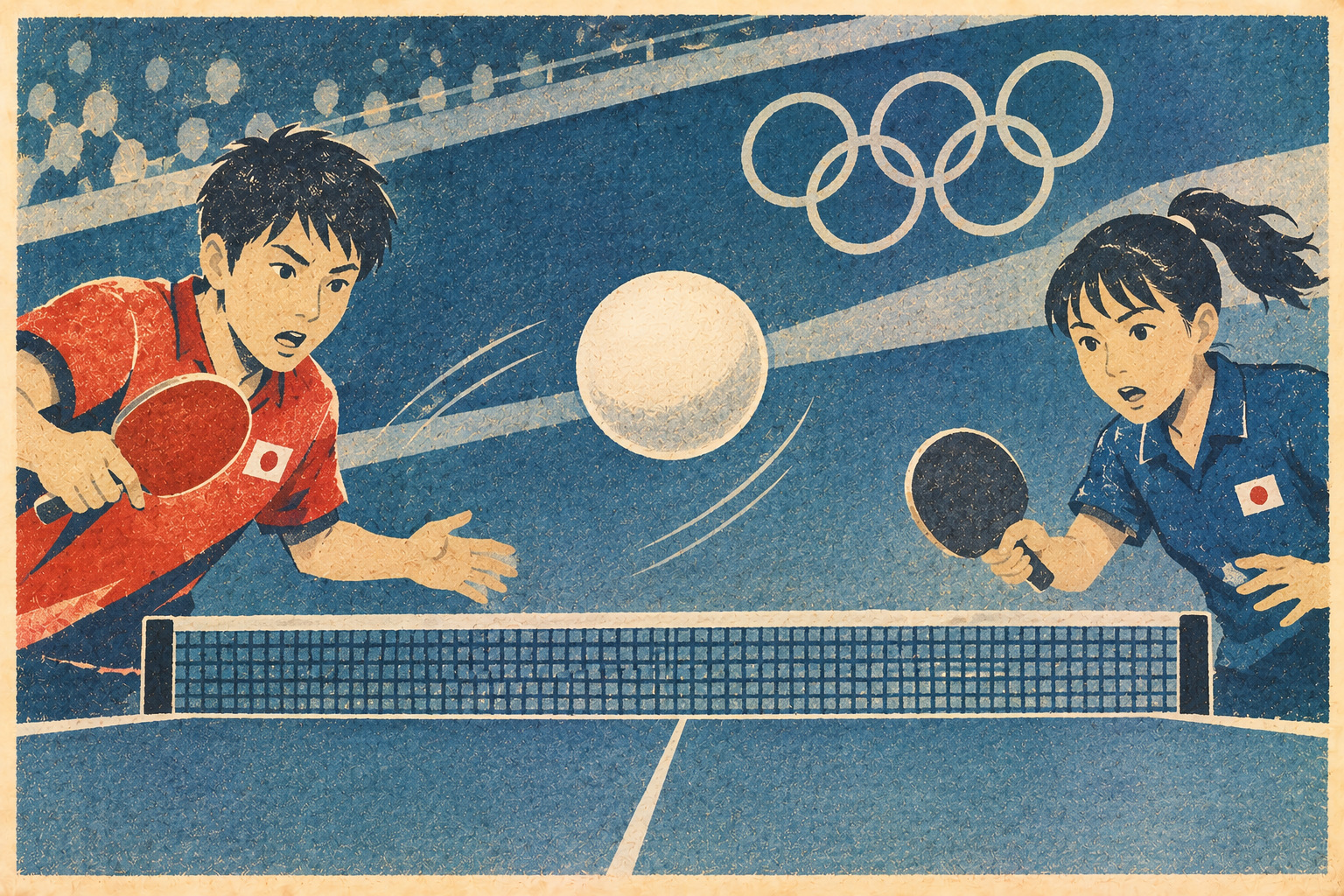
- Two gold medals, earned in two different ways
- The mixed doubles final was decided by narrow margins
- Kawakami’s singles final: a lead nearly lost
- Matsushima won gold—and learned from a fourth place
- From Niigata clubs to the international circuit
- A 13-year-old from Kyoto in a national training system
- What really happened sixteen years earlier
- Why Dakar matters beyond Japanese medals
- Two training pathways, one pair at the table
- The achievement is certain; the future remains open
Two gold medals, earned in two different ways
The scoreline tells the drama in miniature. In the men’s singles final at the Dakar 2026 Youth Olympic Games on November 5, Japan’s 17-year-old Ryuusei Kawakami raced into a three-game lead against Colombia’s Emanuel Otalvaro. He then lost two games in succession. The match was no procession: Kawakami needed a sixth game, won 11–6, to finish a 4–2 victory.
Two days earlier, he had already climbed the podium with a teammate four years his junior. Kawakami and 13-year-old Miku Matsushima won mixed doubles gold on November 3, beating a Hong Kong, China pair in four games. Together those results gave Kawakami two titles and Matsushima one. Matsushima also made the women’s singles semifinals, eventually finishing fourth.
It is tempting to package these results as a simple story about Japan’s next Olympic superstars. They tell something more substantial: how different athlete-development systems can converge in one partnership, how youth table tennis is spreading beyond its traditional powerhouses, and what a medal can—and cannot—tell us about a teenager’s future.
The mixed doubles final was decided by narrow margins
Japan’s pair faced Li Ki Ho and Su Tsz Tung of Hong Kong, China in the mixed doubles gold-medal match. The opening game went 11–9 to Japan; the second slipped away 10–12. Kawakami and Matsushima then took the third 11–6 before surviving a deuce in the fourth, 13–11. The final result was 3–1.
Their path was arguably harder than those four numbers suggest. In the quarterfinals they eliminated China’s Li Hechen and Yao Ruixuan 3–1, winning a pivotal third game 15–13. They then beat Chinese Taipei’s Lin Chin-Ting and Chen Min-Hsin 3–1 in the semifinal.
The Japan Olympic Committee described Kawakami’s two-wing attacking play and Matsushima’s blocks and deft exchanges close to the table as a complementary combination. That is the JOC’s observation, not an independent technical assessment by this publication. The measurable facts are the game scores, the opponents and the progression through the draw.
Kawakami’s singles final: a lead nearly lost
On November 5, Kawakami faced Colombia’s Emanuel Otalvaro for individual gold. The International Table Tennis Federation and Japan Table Tennis Association agree on the sequence: Kawakami took the opening three games 15–13, 11–7, 13–11; Otalvaro replied 11–6, 11–2; Kawakami captured the sixth 11–6. It was a four-games-to-two triumph with a dangerous reversal of momentum in the middle.
To reach that final, Kawakami defeated Puerto Rico’s Steven Moreno 4–0 in the quarterfinals and Korea Republic’s Lee Seungsoo 4–2 in the semifinals. Otalvaro’s silver was itself a landmark for Colombian table tennis, according to the ITTF. The final was thus not merely another chapter in a Japan-versus-China rivalry: it was evidence of a wider range of challengers.
Kawakami is reported in the ITTF’s official post-final interview as thanking his family and coach. Rather than inventing personal reflections, this report relies on the recorded match results and published interviews.
Matsushima won gold—and learned from a fourth place
Matsushima’s tournament deserves its own account. In women’s singles she won all three group matches, progressed past an opponent from Thailand and defeated Poland’s Katarzyna Rajkowska 4–0 in the quarterfinals. She then lost the semifinal 0–4 to Chen Min-Hsin of Chinese Taipei.
The bronze-medal match was especially close. Against Hong Kong, China’s Su Tsz Tung, Matsushima lost 3–4, with the final game decided 11–8 to Su. The full sequence was 11–9, 7–11, 11–5, 9–11, 11–8, 7–11, 8–11, from Matsushima’s perspective. Fourth place was a defeat, not another medal; it was also a considerable individual performance by a 13-year-old.
Her age is central to the public interest but no excuse to speculate about her emotions, private life or future. She has already won an Olympic youth gold in a team event. In singles, the top four at Dakar showed the margins separating promising players of the same generation.
From Niigata clubs to the international circuit
Kawakami was born on October 5, 2009. His current club, Kinoshita Table Tennis Academy, traces his development through junior competition in Niigata and a period at the JOC Elite Academy before his move to Kinoshita. His record includes the 2024 national junior-high singles title, the 2025 inter-high boys’ singles crown and the 2025 World Youth Championships under-19 men’s singles championship.
In 2026 he also won Japan’s national junior boys’ title and finished runner-up in a WTT Feeder event in Berlin, according to his academy and equipment sponsor. Those outcomes help explain why he entered Dakar as a leading contender rather than a surprise discovery.
Yet young athletes do not progress on an automatic conveyor belt. Success at under-19 level is an accomplishment on its own; it is not a reliable promise of senior world titles. The step from youth competition into the full professional circuit changes the range of opponents and demands.
A 13-year-old from Kyoto in a national training system
Miku Matsushima was born in Kyoto on June 24, 2013. She studies at Seiritsu Gakuen Junior High School and is listed by the Japan Olympic Committee as a member of its Elite Academy program. She was also one of Japan’s two flag bearers at the opening ceremony in Senegal.
Her equipment sponsor describes her as a left-handed attacking player and records a series of junior international results in 2026, including under-17 and under-19 singles titles at a WTT Youth Contender event in Vientiane. She entered Dakar with significant experience against players older than herself.
Her route differs from Kawakami’s current private-academy affiliation. The distinction matters: Japanese table tennis does not rely on one training institution or one uniform model. The partnership in Dakar brought together athletes nurtured through related but different parts of that ecosystem.
What really happened sixteen years earlier
Japan’s Olympic committee has drawn a historical line to Singapore 2010, the inaugural Youth Olympic Games. At that edition, Koki Niwa and Ayuka Tanioka took gold in a mixed continental-team competition. Niwa also won men’s singles gold.
The comparison needs a footnote. The 2010 mixed-team format and the 2026 mixed doubles event are not identical. Calling the 2026 title Japan’s first mixed-gender youth Olympic table tennis gold in sixteen years conveys the broad continuity; calling it the same discipline contested under the same rules would blur an important distinction.
Youth Olympic medals can start compelling careers, as Niwa’s subsequent senior international record illustrates. But each generation faces a different field and structure. The historical parallel should illuminate, not predetermine, Kawakami and Matsushima’s next decade.
Why Dakar matters beyond Japanese medals
Dakar 2026 is the first Olympic sporting event held on African soil. The Games run from October 31 through November 13, with competition in Dakar, Diamniadio and Saly. Table tennis was staged at the Dakar Expo Centre in Diamniadio, near the Senegalese capital.
The tournament also offered a reminder of table tennis’s expanding geography. A Colombian reached the men’s final. Chinese Taipei took women’s singles gold, Singapore women’s singles silver, and medals were distributed across multiple national Olympic committees. The ITTF noted that China did not appear on the podium at this edition.
None of these results implies China has ceased to be a dominant force in senior table tennis. The meaningful claim is narrower: in this particular youth tournament, the medal table was diverse, and competitors from several regions forced the favorites into difficult matches.
Two training pathways, one pair at the table
Kinoshita Table Tennis Academy is a private athlete-development organization. The JOC Elite Academy is a distinct Olympic development program. Kawakami competes for Kinoshita; Matsushima is part of the JOC academy and attends junior high school. Their mixed doubles gold shows what happens when athletes from separate training environments coordinate under the same national team.
Their semifinal and final were won not by serving statistics alone but by repeatedly managing decisions in rapid exchanges, as tournament reports describe. Mixed doubles has its own timing, changing hitting order and shared responsibilities. Two individually accomplished singles players still have to function as a unit.
There is a responsibility in covering athletes of 13 and 17: performances deserve scrutiny, but school-life details, personal pressure and prospective professional decisions require direct evidence. The available public record supports the competition analysis; it does not authorize guesses about private sacrifices.
The achievement is certain; the future remains open
As of the conclusion of table tennis competition on November 5, the outcomes are clear. Kawakami won the men’s singles and mixed doubles titles. Matsushima took mixed doubles gold and finished fourth in women’s singles. Those accomplishments will remain part of Japan’s Youth Olympic record whatever either athlete does next.
How they arrived matters nearly as much as the medals: national junior competition, international youth events, the academy systems, and close contests with Chinese, Hong Kong, Korean, Taiwanese and Colombian opponents. They reached the top of one tournament in an expanding global sport.
For readers encountering their names for the first time, Dakar is a starting point, not a concluding chapter. The gold medal is already theirs. Their senior careers have yet to be written.
Sources and reporting method
Official match results, athlete records and institutional histories were cross-checked. The 2010 mixed-team format is distinguished from the 2026 mixed doubles event.
- 日本卓球協会/Japan Table Tennis Association — ダカール大会の全試合結果
- 日本オリンピック委員会 — 川上流星・松島美空ペアの金メダル報告(11月6日)
- 日本オリンピック委員会 — 川上の男子シングルス優勝、松島の4位(11月6日)
- JOC — ダカール2026代表選手名簿(氏名読み・年齢・所属)
- 国際卓球連盟 ITTF — Golden Double for Ryuusei Kawakami (Nov. 5)
- ITTF — Japan Strikes Gold in Mixed Doubles (Nov. 4)
- 木下卓球アカデミー — 川上流星プロフィール
- 日本卓球協会 — JOCエリートアカデミー登録選手
- JOC — 2010年シンガポール大会の混合チーム金メダル
- IOC — Dakar 2026, the first Olympic sporting event in Africa