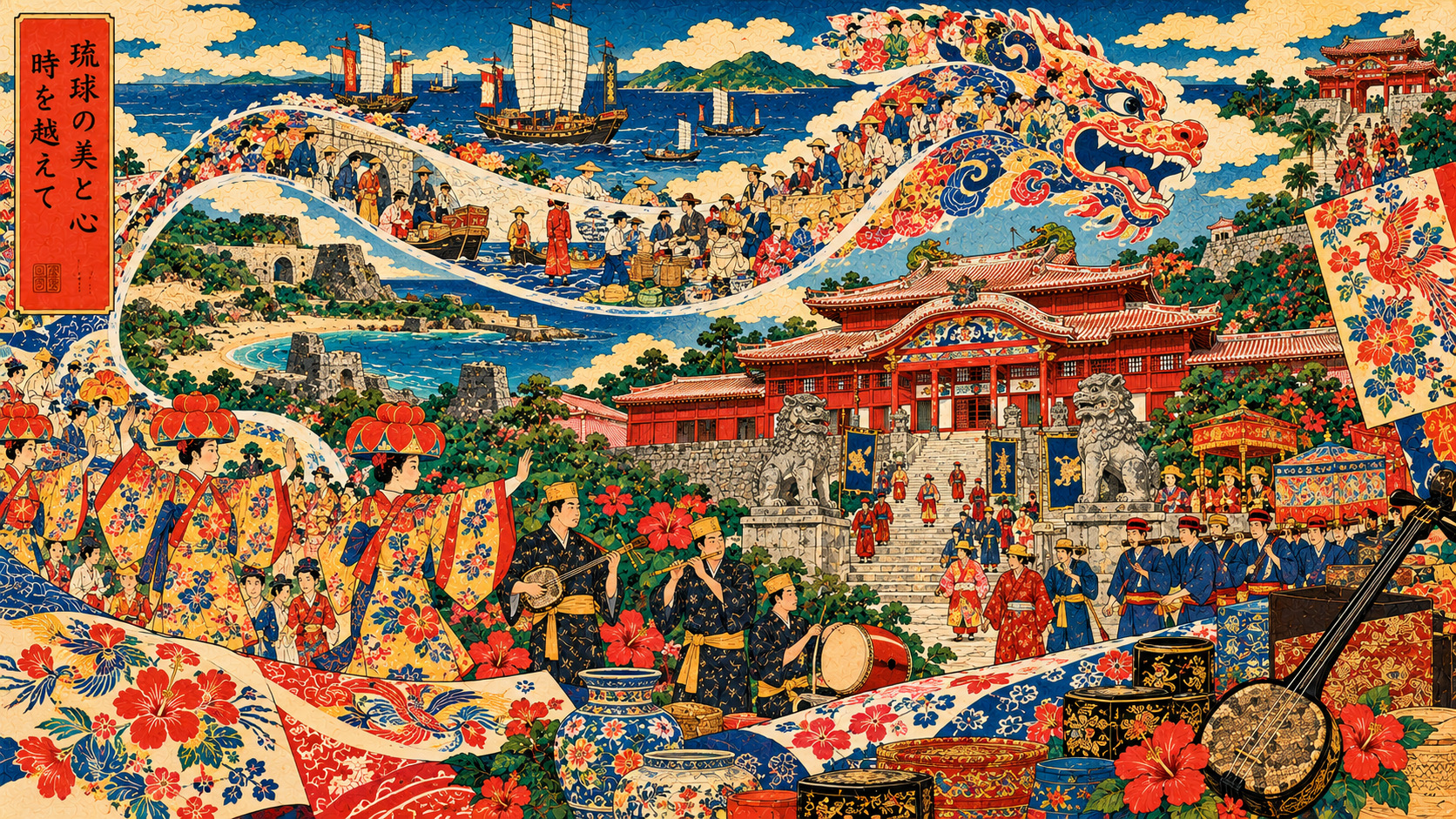
The story of Ryukyu is not confined to a castle: it is written in the art, work and exchange of a maritime society.
A kingdom’s memory, beyond a rebuilt palace
When fire devastated Shuri Castle in October 2019, the loss resonated well beyond Okinawa. Now, with the reconstructed main hall scheduled to reopen on November 23, 2026, the Kyushu National Museum in Dazaifu has opened an exhibition with a broader proposition: the Ryukyu Kingdom can be understood not only through its palace but through the things its people wore, painted, traded, wrote and preserved. Kyuhaku’s Ryukyu Collection runs from October 27 to December 6, and it draws on the museum’s own holdings rather than promising newly unearthed treasures. Its significance lies in the relationships between those objects.
A bird’s-eye view of a maritime capital
The nineteenth-century Bird’s-Eye View of Shuri and Naha, painted by Aka Sōkyō with an inscription by Ogata Dōhei, connects two essential places in the kingdom’s story: Shuri, the seat of royal authority, and Naha, a commercial harbor. Roads and settled landscapes spread between them. The museum plans to print a reduced version on the back of its exhibition catalogue for visitors, subject to supplies. The view is an artistic depiction, not a precise modern survey, but it prompts an important question: what did it take for political power, merchants, materials and news to move between court and coast?
Eight meters of everyday life
An unusually expansive display of the nineteenth-century Ryukyu Customs Scroll is another highlight. The museum says roughly eight meters of this approximately thirteen-meter work will be presented. Scenes of dress, hairstyles, work, weddings and funerals offer entry points into social history that diplomatic chronologies rarely capture. Such images need critical reading: any scroll has a creator and a viewpoint, and its figures should not be treated as a statistically representative account of every Ryukyuan community. Yet its scale makes the texture of daily life difficult to ignore.
The language of cloth and lacquer
Some of the exhibition’s most accessible objects are also among its most technically revealing. Bingata, Okinawa’s vividly patterned resist-dyed textiles, is represented by a nineteenth-century garment. A striped red garment and a tray embellished with mother-of-pearl further illuminate textile and lacquer craftsmanship. The dragon on the lacquer tray is an overtly Chinese-derived motif, but that should not make the object merely a copy of Chinese art. Craftspeople adapted designs, materials and techniques to a particular courtly culture. The museum notes the historical restrictions on who could wear certain bingata garments, reminding visitors that beauty was also structured by status and privilege.
An artistic dialogue across the sea
The museum brings together the work of a Chinese teacher and a Ryukyuan pupil: Sun Yi’s Four Seasons, Birds and Flowers scroll, dated 1712, and a 1706 flower-and-bird painting by Wu Shiqian, also known as Yamaguchi Sōki, who studied painting in China. The dates, makers and titles come from the museum’s Japanese exhibition list. The relationship turns transnational exchange from an abstraction into a human activity—one artist learns from another, adapts a method and contributes to a visual culture that cannot be assigned exclusively to a modern national border. Calligraphy by Qing envoy Zhou Huang and writing associated with Ryukyuan scholar Zheng Jiaxun broaden the picture to diplomacy and literature.
History refuses a single national frame
The Ryukyu Kingdom emerged as a maritime polity in the fifteenth century, building relationships across East and Southeast Asia. Its political position changed sharply after Satsuma’s 1609 invasion, while relations with the Chinese imperial court continued. The National Museum of Japanese History has emphasized that narratives centered on the royal capital can obscure the experiences of Amami, Miyako and Yaeyama, where trading systems and political demands were not experienced equally. That complexity matters: depicting Ryukyu solely as an exotic island culture or solely as an extension of the Japanese mainland erases the choices and constraints of the people who lived there.
The difference between a castle and its memory
UNESCO inscribed the Gusuku Sites and Related Properties of the Kingdom of Ryukyu in 2000. The designation encompasses archaeological and historic sites, not simply the modern reconstructed wooden palace building lost in 2019. According to Shuri Castle Park, the reconstructed main hall is scheduled to open to the public at noon on November 23, with timed advance booking required for visits inside. Preserving an architectural site and preserving textiles or scrolls call for different methods and institutions. The museum’s collection provides material testimony beyond the rebuilt landmark.
Why this exhibition is in Fukuoka
Kyushu National Museum opened in Dazaifu on October 16, 2005, with a mission to understand the making of Japanese culture within Asian history. That outlook makes it a useful place to encounter Ryukyuan objects. Dazaifu has its own long history as a site of exchange with the continent. Seen from this vantage point, Okinawan paintings, textiles and documents are not peripheral curiosities but evidence that historical identities in the region developed through travel, negotiation, learning and sometimes conquest. The collection also raises questions museums should keep asking about provenance, restoration and the interpretation of material heritage.
Planning a visit—and what remains uncertain
The exhibition occupies Room L of the fourth-floor Cultural Exchange Exhibition Hall. Admission is ¥700 for adults and ¥350 for university students; high-school students, visitors under 18 and those 70 and older enter free. Check the museum before visiting for possible changes to the display. While the museum identifies major works and their broad histories, this article does not independently audit the provenance of every item or claim to have inspected the objects in person. Visitor numbers, post-opening reactions and conservation details have not been independently established.
An archive of connections
The bird’s-eye map opens onto a harbor. Dyed garments open onto hierarchies of status and taste. A Chinese painter and his Ryukyuan student show how instruction and aesthetic choices crossed water. Together they resist the comforting idea of a culture sealed within one island or one era. As Shuri’s rebuilt hall approaches its public reopening, the exhibition in Dazaifu offers a companion lesson: architectural restoration matters, but an understanding of a kingdom also depends on the fragile, movable evidence of human lives.
Sources and verification
Based on the museum’s original Japanese checklist and English exhibition materials, Shuri Castle Park announcements and institutional history sources. No onsite visit, curator interview or complete provenance audit was undertaken.
- Kyushu National Museum: Exhibition and objects
- Kyushu National Museum: English listing
- Museum: Current displays and checklist
- Shuri Castle: Public access and bookings
- Shuri Castle: Reopening announcement
- National Museum of Japanese History: Maritime Ryukyu
- UNESCO: Gusuku World Heritage listing
- Kyushu National Museum: Museum history