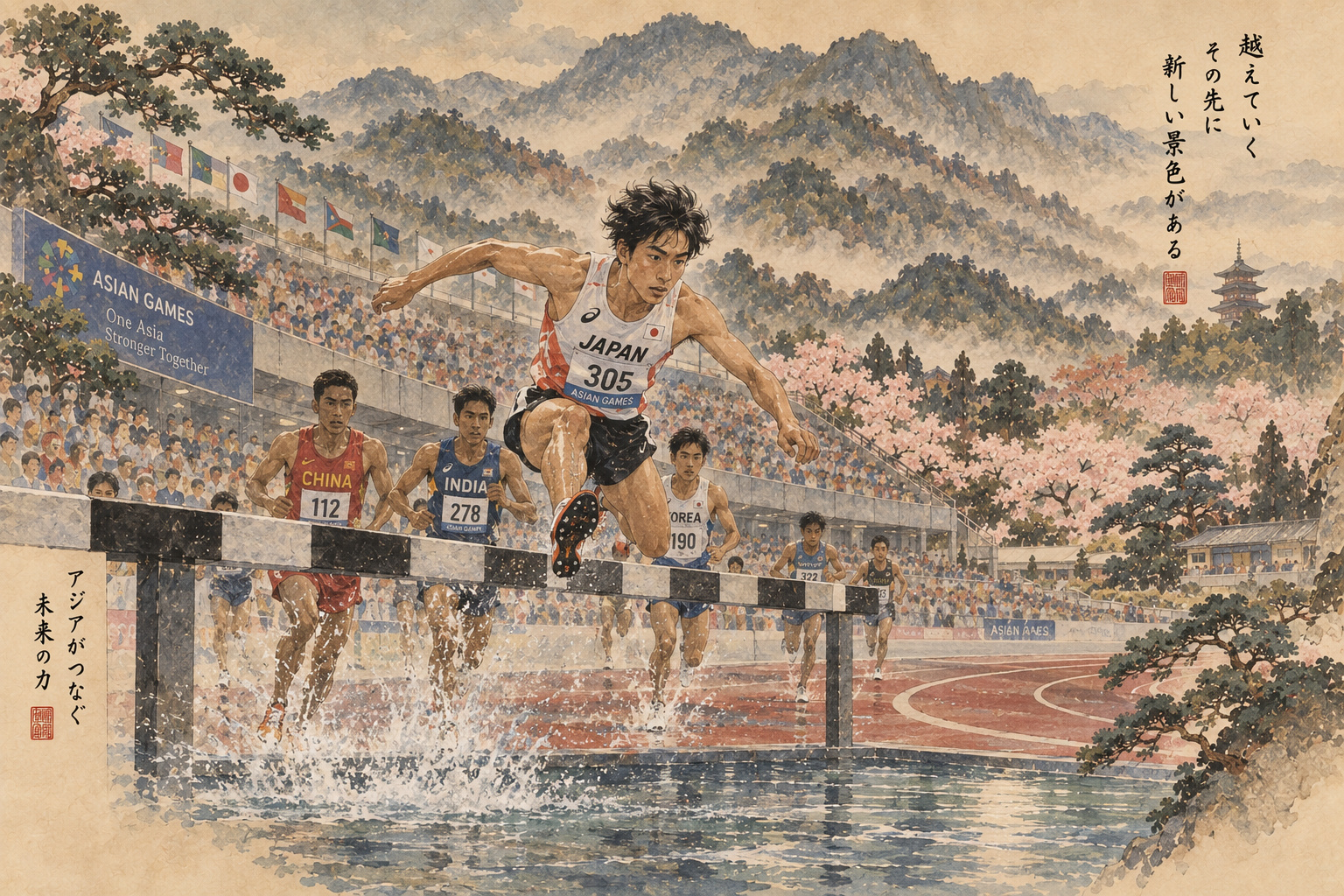
One barrier, one water jump and one final straight separated Ryuji Miura from a piece of Japanese athletics history. On September 28 at Mizuho Park Stadium in Nagoya, the SUBARU runner won the Asian Games men’s 3,000-meter steeplechase in 8:17.36, breaking the Games record. Ryoma Aoki of Honda followed in 8:17.60, only 0.24 seconds behind. Qatar’s Zakaria El Ahlaami took bronze in 8:18.13, while defending champion Avinash Mukund Sable of India was fourth in 8:21.67.[1]
For Japan, the victory ended a 28-year wait in an event it once ruled. The previous Japanese men’s champion was Yasunori Uchitomi at the 1998 Bangkok Games. JAAF’s historical record shows that Japan won seven consecutive Asian Games steeplechase titles from 1966 through 1990 before the balance of power shifted elsewhere in Asia.[2]
This was not a race Japan was entitled to win
Miura entered as the Japanese record-holder with a personal best of 8:03.43, making him the obvious favorite on paper. But Asian men’s steeplechase has risen sharply in quality.
At the 2023 Hangzhou Games, Sable won in 8:19.50, then a Games record, while Aoki took silver and Seiya Sunada bronze. Miura was not in that Japanese team. Going into Nagoya, the recent Asian performance list also included El Ahlaami at 8:15.41 and Aoki at 8:18.63.[2][3]
Miura’s winning 8:17.36 was nearly 14 seconds slower than his personal best. That is not a sign of weakness. Championship racing is different from a paced Diamond League. Positioning, water-jump efficiency, surges and the timing of the final move matter as much as raw clock speed.
The steeplechase is not simply distance running with barriers
The 3,000-meter steeplechase includes 28 fixed barriers and seven water jumps. Unlike sprint hurdles, the barriers do not fall. Athletes can clear them, step on them or use them to launch forward. Every choice affects momentum and balance.
The water jump adds another layer. The pit is deepest immediately after the barrier and becomes shallower farther away, so elite athletes try to project themselves forward and minimize time in deep water. Late in a race, one poor clearance can cost more than a small pacing error.
Miura has described meeting the steeplechase as life-changing. Born in Shimane in 2002, he attended Hamada Higashi Junior High, Rakunan High School and Juntendo University before joining SUBARU in 2024. His unusual combination of flat speed and barrier rhythm took him from a strong Japanese junior to a consistent global finalist.[4]
At 19, he broke an 18-year-old Japanese record
The turning point came on May 9, 2021 at the READY STEADY TOKYO Olympic test event. Miura, then 19 and a second-year Juntendo student, ran 8:17.46. That broke Yoshitaka Iwamizu’s 8:18.93 national record from the 2003 World Championships, a mark that had stood for 18 years, and comfortably beat the Tokyo Olympic qualifying standard of 8:22.00.[5]
That summer, Miura finished seventh at the Tokyo Olympics, becoming the first Japanese man to place in the Olympic steeplechase. He went on to finish sixth at the 2023 World Championships in Budapest, eighth at the 2024 Paris Olympics and eighth again at the 2025 World Championships in Tokyo. JAAF described him before these Games as having four global championship top-eight finishes since Tokyo 2021.[2]
His national record kept falling: 8:09.91 in 2023, then 8:03.43 in Monaco on July 11, 2025. That remains the Japanese record.[6]
What 8:03.43 changed
Before Miura, the Japanese record had spent nearly two decades in the 8:18 range. Running close to eight minutes looked like another competitive world. Miura broke that scale of expectation first as a teenager and then pushed it to 8:03.43.
The world record, Lamecha Girma’s 7:52.11, is still about 11 seconds faster. Morocco’s Soufiane El Bakkali and generations of Kenyan and Ethiopian runners have defined the global medal standard around eight minutes. Yet 8:03.43 puts a Japanese athlete in a performance range where merely reaching a global final is no longer the only goal.
World Athletics lists Miura as a two-time Olympic top-eight finisher and two-time World Championships top-eight finisher. No previous Japanese steeplechaser built that record of repeated global relevance.[7]
Tokyo 2025 and the frustration of being consistently excellent
Miura finished eighth at the 2025 World Championships in Tokyo. He returned to a Japanese global championship as the national-record holder and one of the stronger performers in the field, but again finished outside the medals.[8]
Seventh in Tokyo 2021, sixth in Budapest 2023, eighth in Paris 2024, eighth in Tokyo 2025: it is an extraordinary level of consistency. It can also create a peculiar frustration. A runner good enough to be in every major final can spend years close enough to medals to know exactly how far away they remain.
The Asian Games therefore presented a different challenge. Miura was no longer simply trying to survive against the world’s best. He was expected to win.
Ryoma Aoki made the gold harder—and the result bigger
Aoki’s 8:17.60 silver medal matters almost as much to the story as Miura’s gold. He was only 0.24 seconds behind.
Aoki had already won Asian Games silver in 2023 and represented Japan at four consecutive global championships from 2021 through 2024. JAAF lists his 8:18.63 in 2026 as the second-fastest Japanese performance on the pre-Games form chart.[2]
Japan had previously gone one-two in the men’s Asian Games steeplechase in 1954 and 1970. Miura and Aoki recreated that result more than half a century later.[2]
Both Japanese runners broke the old Games record
Sable’s 8:19.50 from Hangzhou had stood as the Asian Games record. Miura cut it to 8:17.36. Aoki’s 8:17.60 also beat the old mark.[1][3]
So this was not a soft championship won because the pace stayed slow. Japan produced the two fastest steeplechase performances in Asian Games history to that point.
Japan once owned this event
The 28-year gap is more striking when viewed against the event’s early history. According to JAAF, Japanese men had collected 10 steeplechase gold medals before Nagoya.
Susumu Takahashi won in 1951 and 1954. Takeshi Saruwatari, Nobuyoshi Miura, Takaharu Koyama, Masaya Shintaku, Tadashi Kono, Shigeyuki Aikyo and Kazuto Yamada followed. From 1966 through 1990 Japan won seven consecutive editions. Uchitomi’s 1998 title was the last before the long gap.[2]
Then Bahrain, Qatar and more recently India became major forces. Japan remained competitive enough to win medals—Aoki and Sunada went silver-bronze in 2023—but no Japanese runner returned to the top step until Miura.
Miura’s weapon is not only barrier technique
Elite steeplechasers need genuine flat speed. Miura’s personal bests include 3:36.59 for 1500 meters and 7:47.98 for 3000 meters. Those numbers help explain why a tactical race can suit him: if the pack remains together, he has enough speed to race aggressively after the final water jump.[7]
The 0.24-second margin over Aoki shows that Nagoya demanded precisely that kind of finish. Miura did not have the luxury of turning the race into a solo time trial.
Asian gold is not the same wall as a world medal
Winning the Asian Games does not mean the world-championship medal problem has been solved. Men’s steeplechase remains one of the strongest events in global distance running. El Bakkali won the 2024 Olympic title in 8:06.05, and global finals regularly include multiple athletes with personal bests close to or below 8:05.[8]
Miura’s 8:03.43 gives him the speed to inhabit that world. The difficulty is reproducing the right positioning, efficiency and finishing power in a final containing the best Kenyan, Ethiopian, Moroccan and emerging European or North American runners at the same time.
That is why Nagoya should not be described as proof that a world medal must come next. Its significance is different: a runner who has spent years proving that he belongs in global finals also proved that he can carry favorite status and close a championship race.
Miura also raised the domestic standard around him
Miura’s breakthrough coincided with a broader rise in Japanese steeplechase. At the 2021 national championships, Miura, Hiromu Yamaguchi and Aoki all ran under the Tokyo Olympic qualifying standard, giving Japan three Olympic qualifiers in one race.[9]
A generation that once chased 8:20 as an elite national benchmark began treating it as a standard multiple athletes could reach. Aoki’s Asian Games silver is evidence that Miura is not lifting the event alone.
Why winning at home still matters
The athletics program at Aichi-Nagoya 2026 marked the first Asian Games held in Japan since Hiroshima in 1994. JAAF selected 85 athletes—45 men and 40 women—for one of its largest recent Asian Games teams.[10]
Miura has already competed under heavier global scrutiny in Tokyo, Paris, Budapest and Monaco. Yet a home Asian Games title belongs to a different category of achievement. It goes into the medal history of the national team, not merely a ranking list.
For a runner from Shimane who had already become Japan’s fastest ever over the barriers, Nagoya supplied something the stopwatch could not: the first Asian Games gold of his career and Japan’s first in the event since the last century.
The 28-year wait ended with a race slower than his best—and more important than the clock
Miura’s career can be read as a sequence of numbers: 8:17.46 at 19, Olympic seventh, World Championships sixth, Olympic eighth, 8:03.43 national record, another world eighth.
Nagoya added 8:17.36. On a personal-best list it is unremarkable. In Japanese athletics history, it is the number that ended a 28-year gap.
Yasunori Uchitomi won in 1998. For the next seven Asian Games, Japan did not. On September 28, 2026, Miura cleared the last barriers, held off Aoki by 0.24 seconds and put Japan back on top of an event it once considered its own.
Sources
- World Athletics, 20th Asian Games – Men's 3000m Steeplechase
- Japan Association of Athletics Federations, Asian Games history and men’s middle/long-distance preview
- World Athletics, 2023 Asian Games men’s steeplechase
- World Athletics, Ryuji Miura feature
- JAAF, 2021 Japanese Championships steeplechase preview
- JAAF, Japanese records
- World Athletics, Ryuji Miura profile
- World Athletics, Tokyo 2025 men’s steeplechase final
- JAAF Virtual Museum, 2021 Japanese Championships
- JAAF, Aichi-Nagoya 2026 athletics program preview