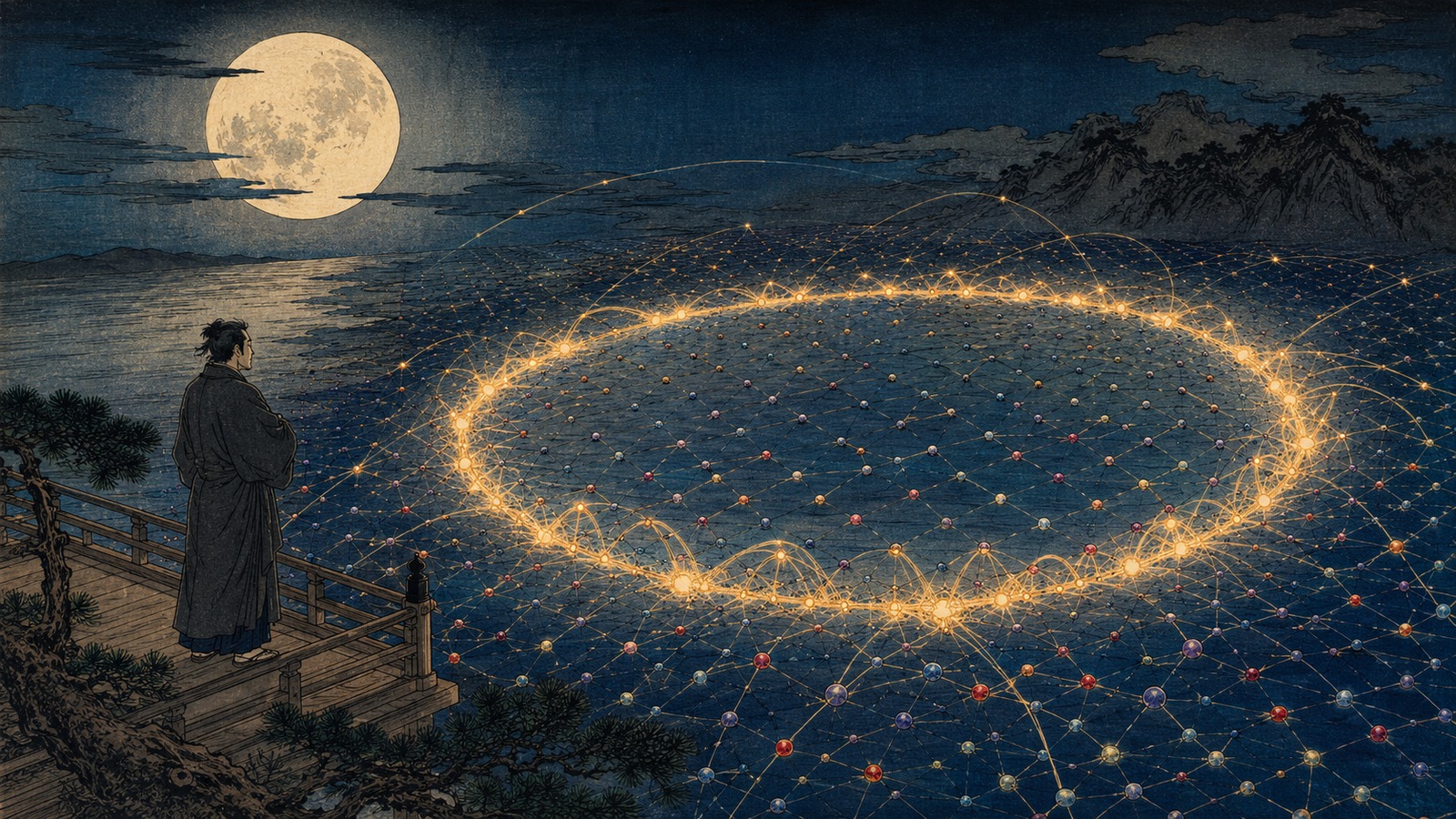
Cut an ordinary loaf and the information lost at the cut is mostly on the cut: crust, crumb, seeds, air pockets.
Cut a quantum many-body state and, in principle, the loss can be terrifyingly larger. The state of the left half may be inseparable from the state of the right half through an astronomical web of entanglement. If every degree of freedom on one side shares independent quantum information with every degree of freedom on the other, the amount crossing the division grows with the volume. A faithful classical description then becomes impossible with any reasonable memory.
Yet the low-energy states of much of nature are kinder. Their entanglement tends to scale not with everything inside a region but with the size of its boundary. This “area law” is one of the deepest reasons a classical computer can simulate many one-dimensional quantum materials at all.
RIKEN theorists Donghoon Kim and Tomotaka Kuwahara have now proved that the kindness survives in a much less domesticated world. Their theorem covers broad one-dimensional interacting boson systems—including Bose–Hubbard and φ⁴ classes—even when interactions extend over distance and the energy or particle number available at a single site has no fixed ceiling. The paper appeared in Nature Communications; its version of record was dated July 27 and RIKEN announced the result on August 3.
What “area” means on a line
Imagine a chain of quantum sites. Divide it between two neighbors. In one dimension, the boundary is not a wall with growing area; it is one cut point, or two if a finite interval is surrounded on both sides. An area law therefore says that the entanglement entropy across the cut remains bounded as the chain grows. A volume law would make it rise with the length of the chosen region.
Entanglement entropy is calculated by ignoring, or tracing out, one side and measuring how mixed the remaining side appears. For a pure, unentangled product state it is zero. For an entangled state, neither half possesses a complete state of its own; the entropy records how much quantum information is shared across the division.
The word “spreads” can mislead. Kim and Kuwahara did not calculate a movie of entanglement moving after a quench. They characterized where entanglement resides in a lowest-energy state. Long-range forces matter because they connect distant sites across the cut, but the conclusion is spatial scaling, not temporal propagation.
| Scaling | In a region of length L | Computational meaning |
|---|---|---|
| Area law | Entropy stays bounded by the cut boundary in 1D | Ground state may admit a compact tensor-network description |
| Logarithmic correction | Entropy grows like log L | Still structured, but not a strict constant bound |
| Volume law | Entropy grows in proportion to L | Classical representation generally becomes exponentially demanding |
The two assumptions that bosons break
The cleanest earlier theorems were built for spin chains. A spin site has a finite menu of local states—up and down in the simplest case—and interactions usually couple nearby neighbors. Mathematically, that means a finite local Hilbert space and bounded local operators. Locality also permits an approximate “light cone”: influence outside it is strongly suppressed.
Bosons resist both conveniences. Identical bosons are permitted to occupy the same state. A lattice site can hold zero particles, one, two, three and onward without a built-in maximum. Its local Hilbert space is infinite-dimensional. Numerics routinely impose a cutoff—perhaps no more than N bosons per site—but a proof must show that the discarded tail cannot alter the ground state or its entanglement.
Interactions can also be long ranged. Instead of stopping after a nearest neighbor, their strength may fall as a power of distance. A site on the left then couples to many sites on the right. The number of bonds crossing a cut grows, and familiar short-range proof machinery no longer transfers automatically.
Doing both at once is the hard case. A naïve boson-number cutoff large enough to preserve a long-range ground state can itself grow with system size. The entropy bound then inherits a logarithm of that cutoff, precisely spoiling the constant area law one intended to prove.
Two model families under one roof
The Bose–Hubbard model describes bosons hopping between lattice sites while interacting when they meet. It is central to optical-lattice experiments with ultracold atoms and captures phases such as a Mott insulator, where repulsion pins an integer number of particles to each site, and a superfluid, where particles delocalize coherently.
The φ⁴ theory begins from a field rather than particles on named sites. Its energy includes a term proportional to the fourth power of a scalar field. Variants appear across statistical mechanics, condensed matter and lattice quantum field theory. Mathematically it resembles a chain of anharmonic oscillators, each with an unbounded position and energy scale.
Kim and Kuwahara did not prove merely two textbook examples. Their framework allows wider polynomial interactions, including multi-body terms and some processes that do not conserve particle number. But breadth comes with conditions.
| Included | Required | Still outside or unresolved |
|---|---|---|
| Broad Bose–Hubbard and φ⁴ classes | One-dimensional lattice | General 2D and 3D area laws |
| Power-law long-range interactions | Decay faster than 1/r² | Slower-decaying arbitrary long range |
| Unbounded local occupation or energy | Stable, nondegenerate gapped ground state | Gapless and degenerate cases in full generality |
| Repulsive bosonic regimes and controlled fluctuations | Concentrated particle-number or field tails | Attractive collapse/clustering counterexamples |
| φ⁴ field class | Technical symmetry and boundedness assumptions | Removing the parity assumption |
The gap is crucial. A spectral gap separates the ground state from the first excitation by a nonzero energy. It makes the ground state stable against small perturbations and is a central hypothesis in rigorous one-dimensional area laws. The paper also assumes a nondegenerate ground-state energy.
Repulsion is equally important in the Bose–Hubbard class. If attraction encourages many bosons to collapse onto one or two sites, local occupation can scale with the whole system and create an area-law violation. The authors explicitly construct or discuss such counterexamples. “Unbounded local energy” does not mean every runaway Hamiltonian is tamed; it means no artificial finite ceiling is imposed, while physical stability controls the probability of extreme occupation.
The proof’s central move: cut the infinity carefully
The first task was to prove concentration. In the repulsive Bose–Hubbard class, large occupation costs increasing energy. The researchers converted that energetic penalty into an exponentially decaying tail: in the ground state, the probability of finding very many bosons at a site becomes rapidly small. For φ⁴ fields, they developed a corresponding bound on large field fluctuations.
That result allows an infinite local space to be truncated with a quantified error. But a uniform cutoff at every site is too expensive when interactions are long ranged. The team instead used a site-dependent reduction: retain more local states where they matter for the boundary problem, and control the approximation differently with distance. The infinity is not denied; its improbable sectors are fenced off with an error budget.
Once the effective local dimension is finite under control, the authors rebuild machinery related to approximate ground-state projection. Such a projector suppresses excited-state components while retaining the ground state, and it can be factorized across a cut. The balance is delicate: the operation must improve the ground-state approximation faster than it creates entanglement. Iterated successfully, that balance produces an upper bound independent of chain length.
- Show that extreme boson numbers or field amplitudes are exponentially unlikely in the stable ground state.
- Truncate each infinite local state space with an explicit, spatially tailored error bound.
- Construct an effective finite-dimensional Hamiltonian that retains the relevant ground-state structure.
- Apply a generalized approximate ground-state projector across the cut.
- Bound the Schmidt rank and therefore the entanglement entropy.
- Translate that bound into a matrix-product-state approximation guarantee.
From black-hole horizons to chains of atoms
The phrase “area law” entered quantum-information science through an unexpected door. In 1973 Jacob Bekenstein argued that a black hole should possess entropy proportional to the area of its event horizon, not the volume hidden behind it. Stephen Hawking’s radiation calculation fixed the famous coefficient. The boundary appeared to count inaccessible information.
In 1993 Mark Srednicki divided the ground state of a free quantum field by an imaginary sphere, traced out the inside and found that the resulting entanglement entropy scaled with the sphere’s area. The calculation suggested that boundary scaling was not only a black-hole peculiarity; it emerged from ordinary quantum fields when information on one side of a cut was ignored.
Condensed-matter physicists found the same structure from the computational direction. Steven White introduced the density-matrix renormalization group in 1992. DMRG was astonishingly accurate for one-dimensional systems because it retained the states that mattered most to entanglement across a cut. Matrix product states later supplied its natural language: a chain of small tensors joined by virtual bonds whose dimension measures how much entanglement the representation can carry.
1935: Einstein, Podolsky and Rosen frame the puzzle later named entanglement; Schrödinger names and analyzes it.
1964: Bell turns the philosophical dispute into experimentally testable inequalities.
1973–75: Bekenstein and Hawking connect black-hole entropy to horizon area.
1992: White introduces DMRG, transforming one-dimensional many-body computation.
1993: Srednicki derives area scaling for entanglement entropy of a free field.
2007: Hastings proves an area law for gapped one-dimensional short-range quantum systems.
2020: Kuwahara and Keiji Saito extend rigorous 1D results to long-range interacting spin systems.
2026: Kim and Kuwahara remove both short-range and bounded-local-energy restrictions for broad interacting bosonic classes.
For years the algorithm seemed to know a truth before mathematicians could fully certify it. Then, in 2007, Matthew Hastings proved an area law for gapped one-dimensional quantum systems with short-range interactions and finite local dimensions. That theorem placed the empirical success of tensor-network methods on firmer ground. Later results sharpened the bounds and broadened the interactions.
Kuwahara and Keiji Saito’s 2020 result showed that a one-dimensional gapped spin system could retain an area law even with sufficiently decaying long-range interactions. The 2026 theorem closes a different gap: it admits genuinely interacting bosonic fields whose local state spaces are infinite. The advance is not that the area law was newly invented, but that two major escape routes from earlier proofs can now be blocked together.
Why a bound on entanglement becomes a computing result
A generic quantum state of n sites requires exponentially many amplitudes. A matrix product state compresses it into a sequence of tensors. The bond dimension D controls the size of the virtual connection between neighboring tensors. Low D is compact but cannot carry much entanglement; high D is expressive but expensive.
An area law says that a cut does not need a bond dimension exponential in the length of the region merely to reproduce ground-state entanglement. Kim and Kuwahara go further by giving an explicit approximation guarantee. For inverse-polynomial local error and a constant spectral gap, the required bond dimension grows quasi-polynomially with system size. Local observables can then be evaluated with a cost proportional to roughly nD³—close to polynomial rather than fully exponential.
“Close” matters. The paper does not present a new turnkey simulation package or prove a polynomial-time algorithm for every covered Hamiltonian. The authors list development of a quasi-polynomial-time ground-state algorithm as a future goal. Existence of a compact approximation is a foundation for an algorithm, not automatically the algorithm itself.
The practical importance is nonetheless real. Researchers already use DMRG and matrix-product methods on Bose–Hubbard and lattice-field problems, often truncating boson occupation because the calculation demands it. The theorem explains when such compression has a principled basis and supplies a route toward certified error bounds.
The limits define the next map
First, the area-law theorem itself is one-dimensional. In two dimensions the boundary grows with linear size, and loops and topology complicate tensor networks. The authors’ boson-number concentration tools apply in arbitrary dimensions, but the full higher-dimensional entanglement proof remains open.
Second, interactions must decay faster than 1/r² in the one-dimensional result. “Long range” therefore does not mean equally strong coupling between every pair. Near or below the threshold, accumulated distant influence may change the structure fundamentally.
Third, attractive models can concentrate bosons and violate the law. The φ⁴ treatment retains a parity-related assumption that the authors want to remove. Systems with conserved total boson number also bring a subtle, sometimes unavoidable logarithmic contribution; the paper carefully distinguishes these cases from a strict constant law.
Finally, ground-state structure is not finite-temperature behavior or real-time dynamics. Heating a system, driving it far from equilibrium or waiting after a quench can create volume-law entanglement even when its ground state obeys an area law. The theorem is powerful because its domain is precise.
A boundary that saves the bulk
The state space of an interacting boson chain is infinite at every site and exponential across the chain. Long-range coupling appears to stitch every part to every other. On paper, it looks like the sort of object a classical computer should never compress.
Kim and Kuwahara’s proof shows why that first impression can be wrong. Repulsion and stability suppress the extreme local sectors. A gap protects the ground state. Sufficiently decaying interactions limit the cumulative damage of distance. Entanglement remains rich, but it is arranged in a way that a boundary can account for.
This is not a claim that nature is simple. It is a theorem about how nature hides complexity. A many-body ground state may contain correlations no classical picture can reproduce, yet the information needed to join its two halves need not grow with everything inside them.
From the surface of a black hole to a chain of ultracold atoms, the recurring lesson is that a boundary can know far more than its size suggests. RIKEN’s new result makes that lesson valid in a larger mathematical world—one where particles can pile without a formal ceiling and reach beyond their nearest neighbors, but still leave a compressed signature at the cut.
Reporting notes and principal sources
This article distinguishes a rigorous theorem from experimental verification and spatial entanglement scaling from real-time propagation. “Area law” is used under the paper’s stated assumptions; known exceptions and open cases are included.
- RIKEN: “A new unified theory for the spread of quantum entanglement at ultralow temperatures,” August 3, 2026
- Kim and Kuwahara, Nature Communications 17, 7294 (2026)
- Kuwahara and Saito: 1D long-range interacting area law, 2020
- Hastings: “An Area Law for One Dimensional Quantum Systems,” 2007
- Srednicki: “Entropy and Area,” 1993
- White: density-matrix formulation for quantum renormalization groups, 1992
- Eisert, Cramer and Plenio: review of entanglement area laws, 2010
- Bekenstein: “Black Holes and Entropy,” 1973