- A financing facility, not a completed investment
- What the three megabanks actually do
- Why drawdown flexibility can matter more than the headline amount
- Green finance is a restriction on use, not a promise of profit
- The covenant hidden behind the celebratory announcement
- From a recycling consultancy to an independent power developer
- Battery storage has several business models
- The 775 MW pipeline requires careful reading
- Five gigawatts by 2030, but which five gigawatts?
- An energy transition that needs capital as much as technology
- What will demonstrate success
A financing facility, not a completed investment
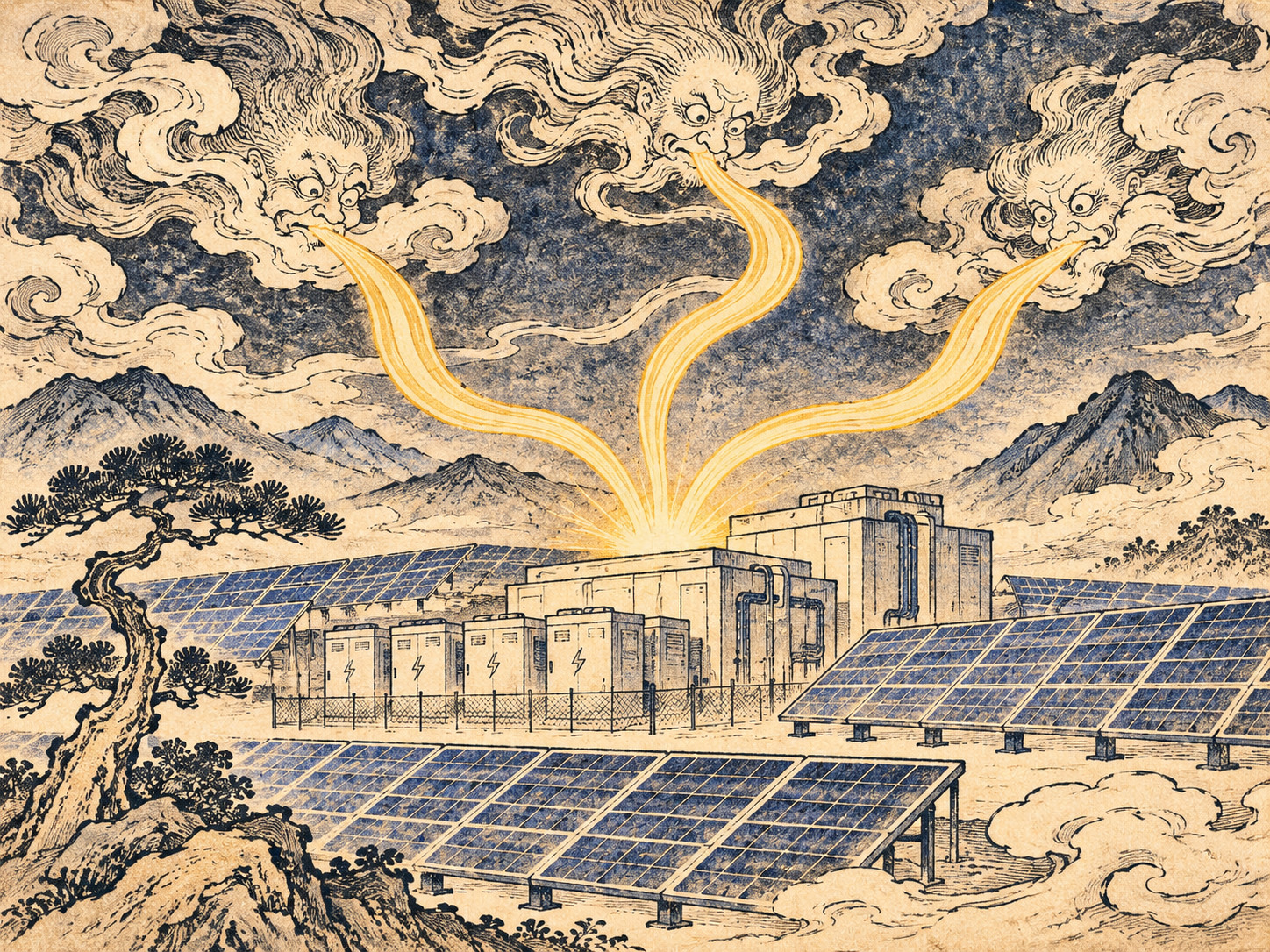
The challenge in renewable power begins long before electricity reaches the grid. Developers must pay to secure land, negotiate connections, obtain permissions and procure equipment—often while the eventual start date remains uncertain. On November 16, 2026, Tokyo-listed RENOVA announced a ¥10.34 billion green syndicated loan arranged by Mizuho Bank, Sumitomo Mitsui Banking Corporation and MUFG Bank. The essential detail is not simply that three huge banks are involved. The agreement is a seven-year committed term loan with a three-year window in which money can be drawn as needed. It should not be described as ¥10.34 billion already disbursed or spent on completed projects. The difference between a financing commitment and operating infrastructure is central to understanding Japan’s energy transition.
What the three megabanks actually do
The three banks are identified as arrangers: institutions responsible for organizing the syndicated facility. Syndication enables several lenders to provide financing under a coordinated structure and can reduce the concentration of exposure on a single balance sheet. The available disclosure does not specify each arranger’s ultimate lending share, the complete lender roster, interest margins or fees. It would therefore be misleading to divide the headline amount into three equal pieces or assume that the arrangers alone supply all the money. Japan’s megabanks lend across many energy technologies; participating in this facility is a financing decision, not a general guarantee of the performance of RENOVA’s future investments.
Why drawdown flexibility can matter more than the headline amount
Energy projects rarely follow a perfectly predictable cash-flow schedule. A grid connection can be delayed, a civil-works milestone can bring forward expenditure, or procurement costs can shift. With a committed term facility, a developer can match eligible borrowing to qualifying funding needs during the availability period. RENOVA says this is intended to limit unnecessary interest expense while supporting timely investment. That claim is plausible in principle, but it cannot be quantified from the published terms because the margin, commitment fees, utilization schedule and repayment profile are not disclosed. A seven-year financing period also does not imply the same seven-year revenue contract for every power or storage project.
Green finance is a restriction on use, not a promise of profit
The facility is designated a green loan. In practice, such financing directs proceeds toward specified environmental categories, supported by project-selection procedures, management of proceeds and reporting on allocation and claimed environmental outcomes. RENOVA says the funding will support solar power, onshore wind and battery storage in Japan and overseas. Japan Credit Rating Agency evaluated the company’s green-finance framework as Green 1(F) on September 24, 2026. That external assessment concerns the environmental financing framework. It is not insurance against credit losses, a prediction of future generation, or independent verification that every financed project has delivered its promised climate benefit.
The covenant hidden behind the celebratory announcement
The securities disclosure contains a condition missing from many simplified descriptions of the deal: a financial covenant requiring avoidance of consolidated operating losses for two consecutive fiscal years. Such covenants are part of the relationship between borrower and lender, especially in industries where construction schedules, power prices, financing costs and operating availability can move earnings. The filing does not fully disclose the remedies, negotiation procedures or cure periods that would apply if the covenant were breached. Readers should not assume either that the provision is insignificant or that one adverse result automatically triggers immediate repayment. It is a real financing condition whose relevance will depend on RENOVA’s future earnings and the contract’s fuller terms.
From a recycling consultancy to an independent power developer
RENOVA’s history illustrates how Japan’s renewable industry has changed. The company was founded in May 2000 as Recycle One, conducting environmental and energy research and consulting. It entered renewable-power development in 2012 and adopted the RENOVA name in December 2013. After divesting its plastics-recycling interests in 2016, it concentrated on renewable energy, listed on the Tokyo Stock Exchange Mothers market in February 2017 and moved to the First Section in 2018. Its development model expanded from the solar-power opportunities of the feed-in-tariff era toward a portfolio of generation, storage and more demanding long-term finance arrangements. This new loan is part of that evolution rather than a sudden beginning.
Battery storage has several business models
A battery is not merely a container for surplus solar power. It can help balance supply and demand across hours, provide dispatchable capacity and participate in services designed to maintain power-system stability. RENOVA’s November 12 investor presentation identifies several economic models, including support through Japan’s long-term decarbonization power-source auction, long-term storage-use agreements and market-based capacity or balancing services. Each has different sources of income and exposure to market rules. A megawatt of rated output does not tell an investor how much revenue the installation will earn; duration, dispatch strategy, availability, degradation, market access and contracted payment terms matter as well.
The 775 MW pipeline requires careful reading
RENOVA reported a total battery-storage portfolio of 775 MW, approximately 2.3 GWh, in its November 2026 investor materials. That figure combines projects that are operating, construction-stage and still in development. It separately identified 452 MW as operating or construction-started—a category that is emphatically not the same as 452 MW generating revenue today. Several facilities are planned to start in future fiscal years, with dates subject to revision. The company projects storage EBITDA of ¥13.5 billion to ¥14.5 billion in fiscal 2030 under its current assumptions. That is a forecast, not earned income. Nor should the ¥10.34 billion corporate facility be portrayed as fully funding the entire 775 MW project portfolio.
Five gigawatts by 2030, but which five gigawatts?
Under its 2030 management plan, RENOVA targets 5.0 GW of gross project capacity in operation or under construction by fiscal 2030. Gross capacity represents projects as a whole rather than the capacity attributable to RENOVA’s economic ownership share. A merely prospective development project is not necessarily part of the eventual operational or construction total. The company also describes planned additional investment of ¥340 billion, focused on Japan, including more than ¥150 billion for battery storage. Those are management intentions over several years; the newly announced loan covers only a fraction of this ambition. Execution requires separate project finance, equity, commercial agreements and successful permitting.
An energy transition that needs capital as much as technology
Japan’s feed-in-tariff system, introduced in 2012, helped drive the rapid expansion of solar generation. A feed-in premium regime began in 2022 as developers increasingly encountered market-price exposure and the need to integrate variable renewable output. The seventh Strategic Energy Plan, adopted in February 2025, envisages renewable generation supplying roughly 40%–50% of electricity in fiscal 2040. Reaching a national planning projection is not the same as announcing new panels. Interconnection, community consent, supply-chain capacity, flexible demand, storage and financing have to advance together. It would be equally wrong to treat the government outlook as assurance of the cash flows of any one company or power station.
What will demonstrate success
JCR upgraded RENOVA’s long-term issuer rating to BBB+ with a stable outlook in August 2026 and separately assessed its green-finance framework in September. These external judgments, and the November financing agreement, say something about the company’s access to capital. They do not substitute for operating evidence. The next meaningful questions concern how much of the loan is actually drawn, which projects receive funds, when those projects begin operation, how the company reports allocation and environmental results, and whether it continues to satisfy the financing covenant. The real test of green lending will arrive over years, in functioning infrastructure, measurable energy services and the communities that live alongside these investments.
Primary sources and reporting limitations
Independent reporting and analysis based on securities disclosures, company filings, JCR reports and official policy documents available through November 16, 2026. The interest rate, fees, lender shares, actual drawdowns, project allocation and detailed remedies for any covenant breach were not established. No direct interviews were undertaken.