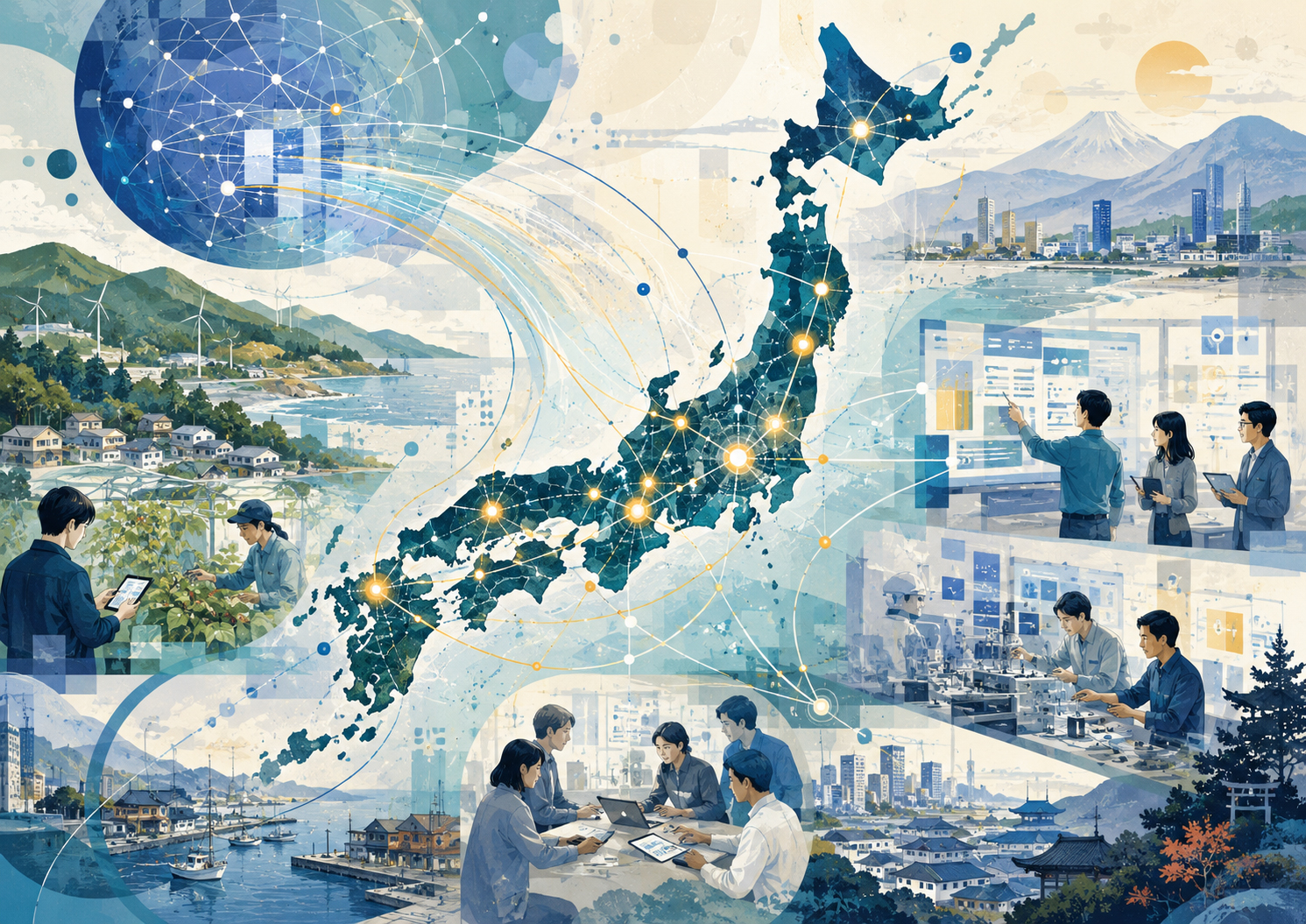
Translating world technology into regional language
Generative AI, space, robotics, semiconductors, quantum computing, energy and finance generate daily headlines. For a regional Japanese company, however, the real question is not what happened. It is how the development affects staffing, equipment, sales, tourism, logistics, care or agriculture.
The web program Mirai Kaigi launched on July 3, 2026 with a stated mission to interpret advanced technology through the perspective of regional revitalization. Rather than explain technology in isolation, it asks how work and daily life may change and what SMEs and communities can actually do.
The idea is more important than it looks. Regional firms do not primarily lack information. They lack an editorial layer that converts global technology into local budgets, people, customers, regulations and equipment decisions.
Why global news fails to reach local decisions
Technology coverage is built around major corporations, funding rounds, product launches and national policy. Readers learn about Nvidia, OpenAI, SpaceX and TSMC.
A local hotel, food processor, construction company or hospital still needs to know which workflow changes, how much implementation costs, how data will be protected and who will operate the system.
Without that layer, news remains knowledge rather than action. Large urban companies can access consultants, IT departments, venture networks and universities. In a regional SME, one owner may handle sales, hiring, financing and digitalization at once.
Regional Japan has always translated imported technology
Japan’s regions have never been passive recipients. Suwa connected silk and precision machinery; Hamamatsu moved from looms into musical instruments and motorcycles; Toyota moved from looms to automobiles; Kitakyushu grew around steel.
After the war, local factories, technical colleges, banks, trading companies and governments adapted foreign technologies into Japanese production and quality systems.
The challenge today is that technology has shifted from visible machinery to cloud services, models, data and APIs. Adoption now requires workflow design, contracts, cybersecurity and data preparation.
The One Village One Product lesson
Oita Prefecture’s One Village One Product movement, launched in 1979, did not simply import outside trends. It refined local resources and connected them to national and global markets.
The model improved quality, branding, processing and distribution. It translated regional products into market value.
Modern technology policy should follow the same logic. Attracting an AI company is not the objective. The objective is embedding technology into local agriculture, tourism, manufacturing and care.
The promise and limits of technopolis policy
Japan’s 1980s technopolis policy attempted to attract advanced factories, research institutions and talent outside major cities.
It created clusters and employment, but decision making and R&D often remained in Tokyo or overseas headquarters. Factory location alone did not guarantee local knowledge or entrepreneurship.
AI-era policy must build the ability of local firms to use and create technology, not only host facilities.
Regional revitalization has had many names
Japan has pursued depopulation policy, regional core cities, technopolises, revitalization programs and the Digital Garden City vision.
Yet young workers, headquarters and investment capital continued to concentrate in major cities. Infrastructure alone does not retain population without durable jobs and income.
Translating technology news into daily business action is smaller than a major infrastructure program, but potentially more persistent.
What Mirai Kaigi is trying to do
Mirai Kaigi says it will cover AI, space, energy, finance, communications and robotics through the question: how can regional Japan use this?
To create value, it must go beyond summaries. A report on a new AI model should include cost, data protection, implementation steps, failure cases and places to seek help.
Making technology accessible is not only simplifying vocabulary. It is connecting technology to profit, hiring, customer experience and equipment renewal.
Five questions regional firms need answered
- What problem does it solve? Labor, quality, sales, inventory, mobility, health or disaster response.
- What does it cost? Setup, subscription, training, maintenance and data work.
- Who operates it? Owner, staff, outside vendor, municipality or university.
- What will be measured? Time, sales, accidents, waste, turnover or satisfaction.
- Can the company exit? Contract termination, data migration, fallback process and security response.
When technology news answers those questions, it becomes an investment decision.
AI connects directly to regional labor shortages
Many regional firms do not lack demand; they lack workers. Hotels, care providers, builders, logistics companies, food processors, farms and retailers struggle to recruit.
Generative AI can support reservations, translation, estimates, job advertisements, manuals and customer service. Robotics may support transport, cleaning, farming and monitoring.
But tools do not eliminate shortages automatically. Companies must standardize work, prepare data and train people to verify output.
Japan’s 2026 digital and AI subsidy
Japan’s SME Agency is operating a 2026 Digitalization and AI Introduction Subsidy to support IT and AI investment.
Subsidies reduce cost but do not guarantee sound technology selection. Firms can end up buying an eligible tool without a clear operating improvement.
Regional media and support organizations should ask whether a tool remains worth using after the subsidy ends.
What the 2026 SME White Paper suggests
The 2026 SME White Paper summary says AI adoption has advanced to some degree and that internal training and cross-department cooperation improve digitalization outcomes.
Buying software is not enough. Employees need to understand it, and departments need shared data and goals.
The missing resource is often a person who can connect management, operations, vendors, banks and local government.
Can regional banks become technology translators?
Regional banks and credit unions know local firms, finances and owners. Many are expanding from lending into DX support, recruitment, succession and startup matching.
Events such as FFG Mirai no Kaigi in Fukuoka connect companies, startups, municipalities, financial institutions, universities and investors.
But banks must avoid turning technology advice into commission-driven product sales. Independent evaluation and post-adoption measurement matter.
Technical colleges and regional universities
Japan’s technical colleges have long supplied practical engineers to regional industries across mechanical, electrical, chemical and information fields.
In the AI era, students can work on real problems such as inventory prediction, visual inspection, tourism translation, farm sensors and robot control.
Universities and colleges can help with pilot projects, employee training and data preparation—not only academic papers.
The traditional role of local media
Regional broadcasters and newspapers have long translated national events into local consequences through coverage of government, disasters, agriculture and business.
Technology reporting is harder because specialist staff and budgets are limited, leading to repetition of Tokyo announcements without local application.
A web program can connect experts, owners and municipalities without the scale of a major broadcaster.
YouTube as regional media
YouTube gives regional media national reach and searchable archives. Short clips and long conversations can share one channel.
But algorithms reward spectacle and viewing time, not necessarily useful regional management information. Distribution needs newsletters, local organizations and practical titles.
Success should be measured by consultations and projects, not only views.
The danger of copying global success stories
Regional firms cannot copy overseas examples directly. U.S. AI companies assume English-language data, venture capital and large markets. Chinese robotics firms benefit from manufacturing scale and procurement.
Regional Japan has different customer volumes, wages, regulations, seasonal demand and succession problems.
Translation includes explaining what will not work locally, not only celebrating success abroad.
Moving from pilot to production
Regional DX has suffered from proof-of-concept fatigue: many pilots, few durable deployments.
Before testing begins, participants should decide who pays, who operates and how long the system will be used. Evaluation should measure sales, time, accidents or customers—not merely whether the technology functioned.
Media coverage should include cost, failure, employee training and whether the project still operates two years later.
Technological capability and regional growth
A 2026 study analyzed about 3.9 million corporate patent records from 1981 to 2015 and found that prefectural technological sophistication was positively associated with later real gross regional product per capita growth.
The effect appeared stronger in lower-income prefectures. The important factor was not simply patent volume, but the ability to combine more complex technologies.
The finding suggests regions should build networks across firms, universities, banks and governments rather than bet everything on one fashionable technology.
From news to regional projects
Useful technology media offers a next step: advisers, subsidies, pilot sites, laboratories, banks and startups.
A logistics-AI story might connect a local carrier and technical college for a three-month dispatch pilot. A robotics story could lead to measurement of one food-factory process. Satellite news could become an agricultural or disaster map.
Media does not have to operate the project, but it can build the bridge.
How to measure impact
- Reach: Not only views, but region and industry reached.
- Understanding: Whether audiences can explain uses and risks.
- Consultation: Inquiries to banks, universities and municipalities.
- Pilots: Projects started because of the coverage.
- Continuation: Technology still in use after one year.
- Income: Effects on sales, wages, productivity and local transactions.
Regional technology by the numbers
Japan.co.jp view: regions need future editing, not future news
Global technology news reaches regional firms at the same speed as it reaches Tokyo. The next divide is not internet access. It is the ability to convert information into action.
Mirai Kaigi’s value lies not only in explaining AI and space. It lies in connecting global news to local labor, customers, budgets, equipment, universities and finance.
Regional revitalization is not a smaller copy of Tokyo’s success. It is the integration of global technology with local industry, nature, culture and skills.
One program will not transform a regional economy. But changing a headline from “not relevant to us” into “something we can test next month” can change business decisions.
Regional Japan is not searching for the next giant technology. It is searching for ways to use giant technologies in small, affordable, safe and practical forms.
Sources and further reading
- Mirai Kaigi, July 3, 2026: Launch of the web program linking regional revitalization and advanced technology.
- Japan SME Agency: Digitalization and AI Introduction Subsidy 2026.
- 2026 SME White Paper summary: AI adoption, internal training and cross-department cooperation.
- METI: Regional revitalization and the use of AI, autonomous mobility and drones.
- FFG Mirai no Kaigi: Connecting companies, startups, finance, municipalities and universities in Fukuoka.
- Karashima and Inoue, 2026: Technological fitness and regional growth in Japan.
- Japan SME Agency digital support: Information, subsidies and accredited support organizations.