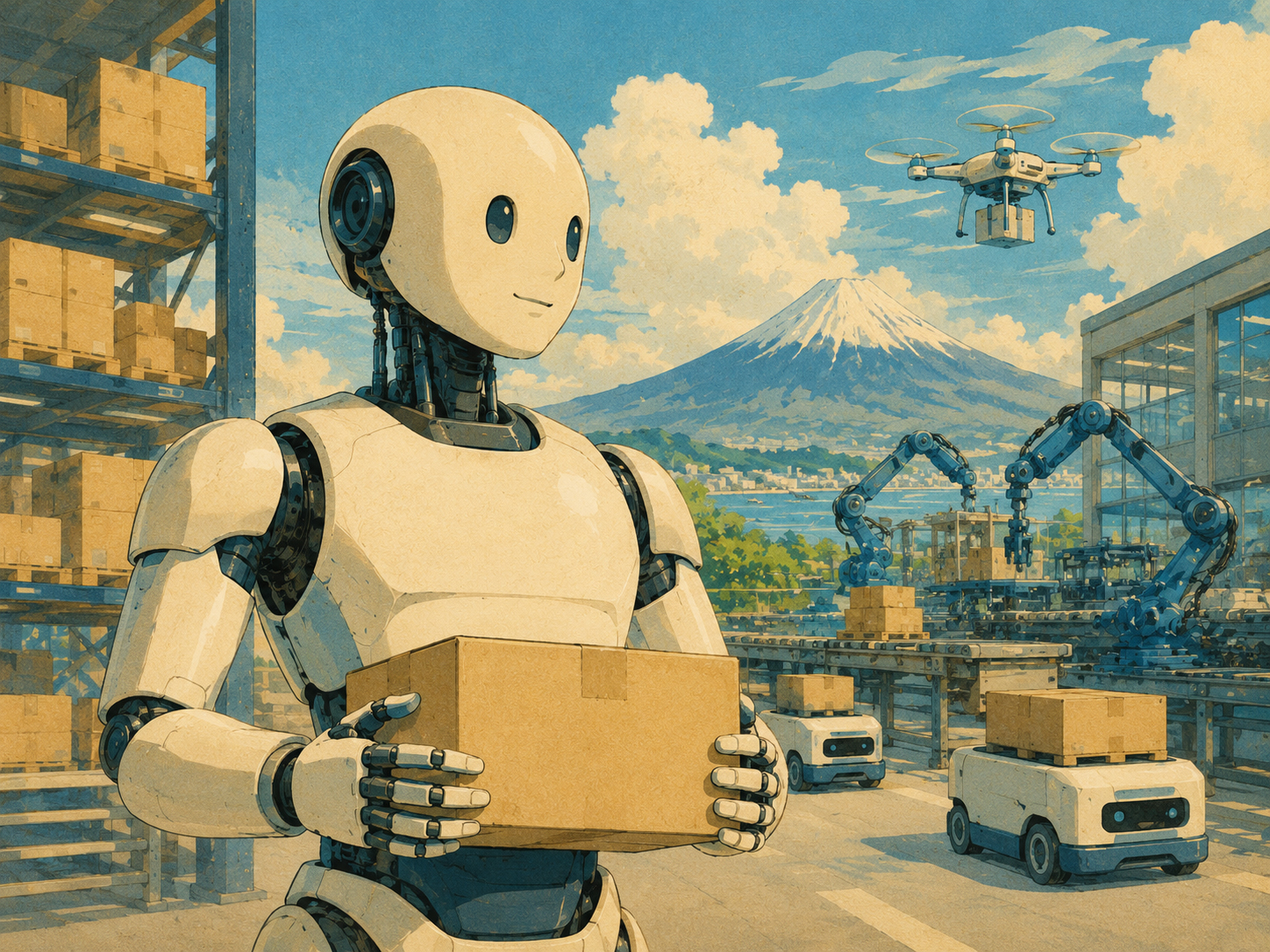
In 2026, a new phrase began to attach itself to Japan’s robot industry: “physical AI.” Until recently, most people experienced artificial intelligence as something inside a screen — a system that writes, translates, searches, summarizes, draws, predicts, or speaks. Physical AI moves the question outside the screen. Can AI pick up parts in a factory? Move boxes through a warehouse? Help at an airport? Cut weeds around infrastructure? Inspect pipes, bridges and solar sites? Support a nurse turning an elderly patient? The next frontier is not just intelligence that answers. It is intelligence that acts.
A 2026 robotics exhibition announcement circulated on PR TIMES called the year a turning point — even “the first year of physical AI.” It described physical AI as technology that sees the real-world environment, understands the situation and executes the most appropriate action. A later release framed the field broadly, covering humanoids, robot arms, drones and autonomous machines, and cited expectations that the AI robotics market, including humanoids, could reach roughly ¥60 trillion globally by 2040, with Japan aiming for a major share.
There is, of course, marketing in that phrase. Trade shows, investment decks and startups need labels. But this one should not be dismissed too quickly. Japan has more than half a century of industrial robotics experience, a severe demographic constraint, real demand in factories, logistics, care, construction, agriculture and infrastructure maintenance, and a policy push to connect foundation models with machines that operate in the physical world. That combination makes “physical AI” more than a slogan. It is a test of whether Japan’s old robot strength can become a new AI advantage.
What physical AI means
Physical AI is the reunion of robotics and artificial intelligence. Traditional industrial robots excel at repeating a defined motion with speed and precision: welding, painting, carrying, assembling, inspecting. Japan became one of the world’s great powers in that domain. But once a robot leaves a highly controlled cell — or begins to share space with people — everything becomes harder. Objects are not in the same place every time. Floors may be wet. Humans approach unexpectedly. Boxes vary in weight. The workday produces situations that were never in the manual.
Physical AI is the effort to handle that messy reality. It combines cameras, LiDAR, tactile sensors, sound, force sensing and location data with language, images, 3D geometry, simulation, digital twins, reinforcement learning, teleoperation logs and robot foundation models. The ambition is to move robots from machines that repeat instructions to machines that perceive, reason, adapt and learn from the field.
But language AI and physical AI are not the same. A chatbot error may produce a bad paragraph. A physical AI error may drop a box, damage equipment or hurt a person. That makes safety, verification, emergency stops, liability, insurance, labor rules and operator training central. Physical AI is a story about impressive robot videos, but it is also a story about slow, serious safety engineering.
Japan’s robot story began in the factory
To understand Japan’s position, start with the factory. Kawasaki Heavy Industries signed a license agreement with Unimation in 1968 and began production of Japan’s first industrial robot, the Kawasaki-Unimate, in 1969. Through automobiles, electronics, semiconductors and machine tools, Japan’s postwar manufacturing system paired human craftsmanship with precise automation.
Companies such as FANUC, Yaskawa Electric, Kawasaki Heavy Industries, Daifuku and SMC came to symbolize Japan’s robotics and automation base. According to the International Federation of Robotics’ World Robotics 2025 report, Japan remained the world’s second-largest market for industrial robots in 2024, with 44,500 units installed and an operational stock of 450,500 units. In Japan’s automotive sector, roughly 13,000 industrial robots were installed in 2024, the highest level since 2020.
Japan is therefore not a country merely dreaming about robots. It is a country whose robots already weld, carry, inspect and support production. The importance of physical AI is that it sits on top of this base. Can Japan extend its accumulated strengths in motors, controls, sensors, quality systems, factory discipline and kaizen into robots that perform more flexible tasks? That is the strategic question.
From the 2015 robot strategy to foundation models
Japan’s government launched the New Robot Strategy in 2015. It sought to move robots beyond manufacturing into services, nursing and medical care, infrastructure and disaster response, agriculture, forestry, fisheries and food production. The phrase “social implementation” was already central: robots were not to remain laboratory curiosities or factory-only machines.
Japan’s policy vocabulary then broadened through Society 5.0. The Cabinet Office describes Society 5.0 as a human-centered society that balances economic development with solutions to social problems. UNESCO has framed it as an approach to chronic challenges such as aging, depopulation, social polarization, and energy and environmental constraints.
The 2026 shift is that robotics policy is now being tied more directly to foundation models. In May 2026, METI and NEDO selected projects under GENIAC to make manufacturing and other data “AI-ready” and to support R&D on robotics foundation models. AIRoA, the AI Robot Association, says it aims to bridge the AI and robotics communities and create open platforms and datasets for robotics foundation models.
That matters because Japan’s robotics advantage has historically been strongest in hardware, control, process knowledge and customer-specific engineering. In the AI robot era, data, software talent, foundation models and open ecosystems become just as important. A future robot will need more than a good arm. It will need eyes that understand the world, ears that understand instruction, and memory that learns from failure.
Why Japan needs this now
Physical AI is urgent in Japan because the demographic problem is urgent. Labor shortages are spreading through manufacturing, logistics, construction, care, agriculture, food service, security, airports and hotels. A Reuters corporate survey in 2026 found that about one-third of Japanese companies were already using or considering AI-powered robots. Manufacturing was the leading intended use, followed by dangerous tasks and customer-facing roles.
In care, the stakes are even higher. Reuters reported in 2025 on AIREC, a Waseda University humanoid research project exploring AI-driven robots for future elder care. The tasks — repositioning patients, assisting with daily chores, helping in physically intimate care — are not simple automation. They involve safety, dignity and trust.
Stanford research on robots in Japanese nursing homes notes that rapid aging and caregiver shortages have pushed the government to promote robot use in care facilities. But care robots are difficult. Residents differ physically and cognitively. Staff must decide whether the robot actually reduces work or adds new work. Acceptance matters. This is where the promise and limits of physical AI become clearest.
It is not only about humanoids
The phrase physical AI often makes people imagine humanoid robots. Humanoids are powerful symbols because they might use stairs, doors, shelves and tools designed for humans. But the real deployment field is wider: robot arms, autonomous mobile robots, collaborative robots, cleaning robots, mowing robots, inspection drones, construction machines, agricultural machines, delivery systems, airport baggage support and more.
In Japan, early economic value may come less from full humanoids and more from task-specific systems. A robot that moves safely through a warehouse aisle, identifies defects on a line, cuts grass at a solar plant, inspects a tunnel, carries hotel linens or sorts produce may create value sooner than a general-purpose humanoid. The winning product may not be the most spectacular demo. It may be the robot that works every day, can be serviced, fits the workflow, reduces injury risk and pays back its cost.
Global competition: American AI, Chinese scale, Japanese field discipline
The physical AI race combines three kinds of power. The United States is strong in foundation models, chips, simulation, cloud infrastructure and startup capital. China is strong in mass production, supply chains, price and deployment speed. Japan is strong in industrial robots, precision components, quality management, field improvement and long relationships with demanding customers.
The risk is that Japan’s old strengths do not automatically become new strengths. The era of general robot foundation models rewards data volume, software speed, international talent and open development. Reuters’ 2026 survey noted that Japan remains a powerhouse in conventional industrial robotics, with companies such as FANUC, Yaskawa and Kawasaki, but faces tougher competition from the United States and China in AI-enabled robots.
That is why AIRoA’s data-platform work and METI/NEDO support for robotics foundation models matter. They are not just research programs. They are tests of whether Japan’s robot industry can compete in an era where the machine, the model and the dataset are inseparable.
Safety and trust may become Japan’s export
The hardest problem in physical AI is safety. A foundation-model-enabled robot may be more flexible than a traditional programmed robot, but also harder to predict. Why did it choose that action? How does it stop near a person? How does it handle children, elderly people, disabled people, foreign tourists or exhausted workers? How is responsibility assigned after an accident?
Recent research on foundation-model-enabled robotics emphasizes physical risk control across the robot lifecycle: before deployment, before incidents and after accidents. That focus may actually favor Japan. Japanese manufacturing culture is strong in safety, quality, maintenance and incremental improvement. As robots leave laboratories and enter hospitals, airports, factories, stations and homes, “safe, reliable and maintainable” may be as important as “intelligent.”
Japan.co.jp’s view
Calling 2026 the “first year of physical AI” is a little grand. But it is a useful rallying phrase. Japan may not win by simply chasing American language-model giants. It may still have a chance where AI meets physical work.
Japan has factories, aging communities, infrastructure to maintain, farms, airports, hotels, hospitals, small manufacturers and disaster-response needs. It has robotics companies, component suppliers, universities and a culture of field improvement. The question is whether these assets can be connected through data, AI, standards, capital and talent rather than left in separate verticals.
Physical AI is not only a story about robots replacing people. For Japan, it is more realistically a story about supplementing missing labor, reducing dangerous work, preserving skills, supporting care and keeping local economies functioning. The next chapter of robot-nation Japan may not be a stronger arm. It may be an arm that learns.
Reader’s guide
| Question | How to read it |
|---|---|
| What is new? | AI is moving from text and images into machines that perceive and act in the physical world. |
| Japan’s strength | Industrial robotics, manufacturing sites, precision parts, quality control and kaizen. |
| Japan’s challenge | Foundation models, data sharing, software talent, global speed and safety standards. |
| Key fields | Manufacturing, logistics, care, construction, infrastructure inspection, agriculture, security, airports and tourism. |
| Japan.co.jp’s view | “Physical AI year” is marketing language, but it points to a real strategic transition for Japan’s robotics industry. |
Sources and references
This article drew on PR TIMES, METI, NEDO/AIRoA, the Cabinet Office, the International Federation of Robotics, Reuters, Stanford, Kawasaki Robotics and recent robotics research literature.
- PR TIMES: 2026 as “physical AI year,” market framing and industrial applications.
- METI: GENIAC project selections including robotics foundation models.
- AIRoA: AI Robot Association mission and open platforms.
- Cabinet Office: Society 5.0.
- Government of Japan: New Robot Strategy.
- International Federation of Robotics: World Robotics 2025.
- Kawasaki Robotics: History of Robot Division.
- Reuters: One in three Japan firms using or considering AI robots.
- Reuters: AI robots and Japan’s ageing population.
- Stanford APARC: Impact of robots on nursing home care in Japan.