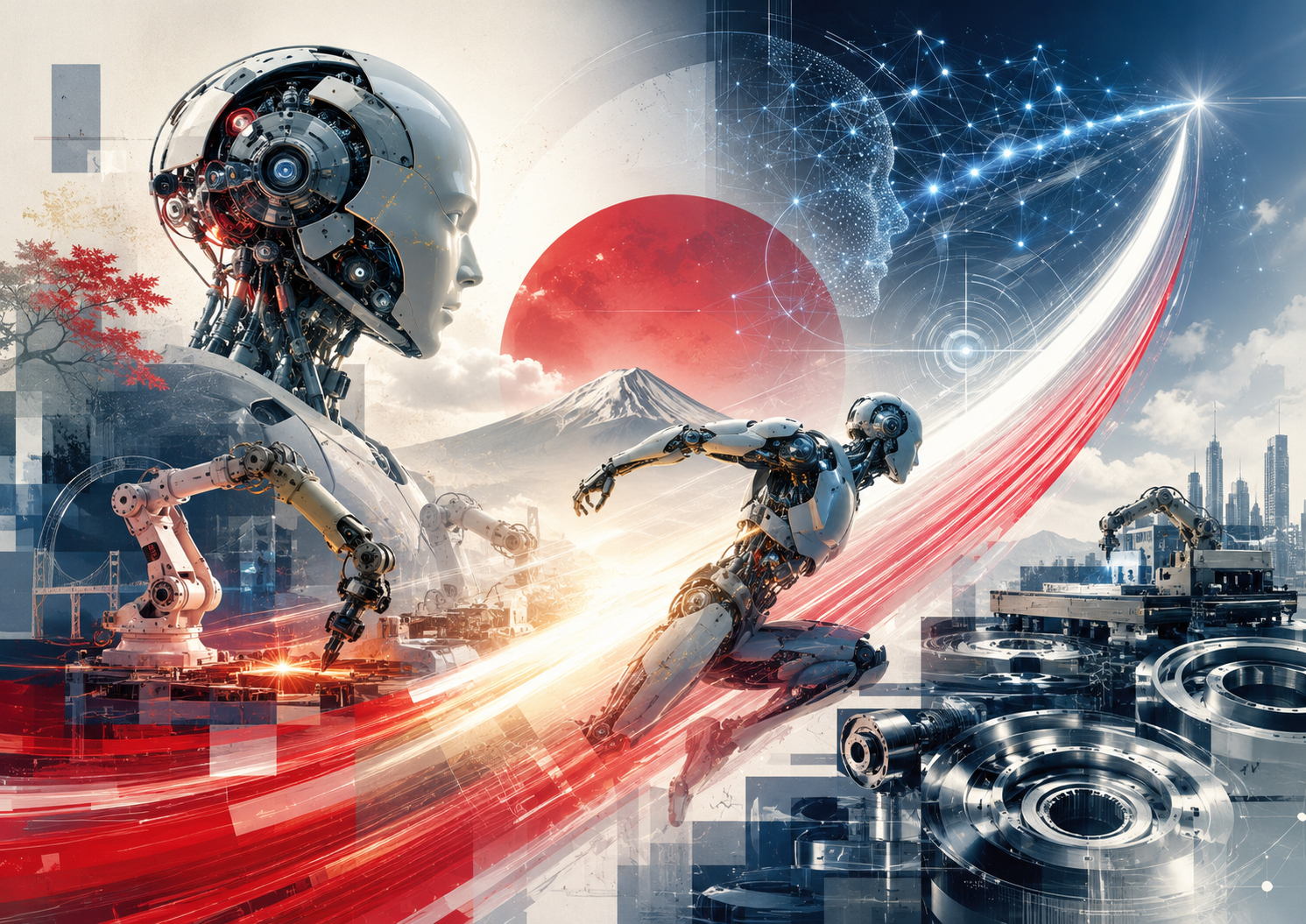
What Japan lost in the software era
Japan was one of the defining technology powers of the late twentieth century. Sony electronics, Toyota production, FANUC robots, Nintendo games, Canon optics and Japanese semiconductors represented engineering leadership.
But leadership shifted during the eras of the internet, smartphones, cloud computing, search, social media and generative AI. Japanese firms could build exceptional devices without controlling the operating systems, cloud platforms, application markets and data networks that captured the greatest value.
The failure was institutional as much as technical: slow decisions, siloed companies, domestic optimization, weak rewards for software talent, limited startup acquisition and a culture that punished failure. Products could succeed in Japan without becoming global standards—the recurring “Galápagos” problem.
Physical AI offers a route around that weakness because intelligence is moving back into machines, vehicles, factories, logistics, care and energy systems—areas where Japan still possesses deep industrial assets.
What physical AI means
Physical AI describes systems that perceive, predict and act in the real world. It combines cameras, lidar, force sensors, language models, world models, control software and simulation.
Traditional automation repeats predefined motions. Physical AI understands goals and adapts: move this box, stop when a worker approaches, or pick irregular food without damaging it.
Unlike text AI, physical AI cannot escape physics. A bad answer from a chatbot may be inconvenient. A bad action from a robot can injure someone, destroy equipment or halt a production line. Latency, stability, redundancy, emergency stopping and liability are therefore core product features.
Why Japan is suited to the field
Japan already owns much of the physical body required for AI: industrial robots, servo motors, reducers, machine tools, cameras, image sensors, automotive components, semiconductor materials, measurement systems and control equipment.
FANUC, Yaskawa, Kawasaki Heavy, Mitsubishi Electric, Omron, Keyence, THK, Nabtesco, Harmonic Drive, Sony, Toyota, Honda, Denso and Renesas occupy different markets, but collectively provide the senses, joints, nervous system and manufacturing infrastructure of physical AI.
Japanese factories also hold decades of operating records, maintenance histories, quality data and tacit worker knowledge. The Institute of Geoeconomics argues that this accumulated operational data could become a national advantage.
The problem is conversion. Data trapped in paper, individual expertise, legacy controllers and incompatible company systems is not automatically usable for machine learning.
The Toyota Production System was pre-digital intelligence
Japanese factories became intelligent before AI entered the vocabulary. Just-in-time production, jidoka, andon, kanban and kaizen created systems that detected abnormality, stopped processes, identified causes and prevented recurrence.
This resembles data-driven management, but the knowledge lived in work standards, visual inspection, meetings and experienced employees. Physical AI could move some of that tacit intelligence into sensors and models.
Yet filming a skilled worker is not enough. Models need the reason behind an action, the meaning of an abnormal signal and the safe range of force. Digitizing genba knowledge requires structure, not merely observation.
The success and limits of industrial robots
Japan remains a world leader in factory robotics. It installed about 44,500 industrial robots in 2024 and operated roughly 450,500. The automotive sector alone installed about 13,000.
Traditional robots, however, require experts to teach motions, safety fences and reprogramming after product changes. That economics works for high-volume factories but not always for small manufacturers, food plants, logistics or care.
Natural-language instruction, vision, imitation learning and simulation could cut programming time. A 2026 Reuters survey found that one third of Japanese companies were already using, planning or considering AI-powered robots, with manufacturing the dominant application.
From Society 5.0 to real-world AI
Japan introduced Society 5.0 in its 2016 science and technology plan—a human-centered super-smart society fusing cyberspace and physical space to address aging, regional decline, disasters and mobility.
The vision was advanced but often abstract. Data remained fragmented, public-sector digitalization lagged and many deployments never moved beyond demonstration projects.
Physical AI could make Society 5.0 concrete. A system that improves factory yield, drives a vehicle, transports hospital supplies or inspects infrastructure turns cyber-physical integration into economic activity.
Noetra and a domestic foundation model
In 2026, Japan moved to organize Noetra around a domestic multimodal foundation model for robot control. METI announced support reported at ¥387.3 billion for domestic physical-AI development.
Sovereign capability matters because factory, vehicle, medical and disaster data involve trade secrets and national security. Total dependence on foreign cloud platforms creates exposure to export controls, outages, pricing changes and data leakage.
But “domestic” is not itself a competitive advantage. An expensive, closed and slow-moving national model would become dependent on subsidy.
Noetra needs common APIs, evaluation systems, data contracts and simulation environments that cross corporate boundaries.
World models change robotics
World models are becoming central to physical AI. They allow a system to predict how the environment will change after an action and to reason before moving.
A warehouse robot can anticipate a blocked aisle, an unstable load and battery limits. An autonomous vehicle can estimate pedestrian movement, road conditions and the intentions of other drivers.
A 2026 research tutorial described world models as a bridge among perception, prediction, planning and action, while emphasizing unresolved challenges in long-horizon reasoning and unfamiliar environments.
The automobile is Japan’s largest test bed
Automobiles are physical AI at industrial scale. Toyota, Honda, Nissan, Denso, Aisin, Renesas and Sony Honda Mobility are investing in driver assistance, autonomy, in-car AI and automated production.
A vehicle is a robot on wheels, combining cameras, radar, control, maps, communications and edge chips. Japan leads in vehicle quality and mass production but has trailed Tesla and Chinese companies in software-defined vehicles.
Leadership requires designing cars as continuously updated software products and learning from fleet data. Closed specifications within corporate groups cannot match global software speed.
Care and medicine as early global markets
Japan’s aging society is both a weakness and an early market. Robots for lifting, walking, monitoring, transport, rehabilitation and documentation can become exports if proven in Japanese care settings.
Care is also an industry of dignity and trust. Consent, accident liability, privacy and the risk of replacing human contact must be addressed.
The winning systems will probably not eliminate caregivers. They will remove repetitive transport and physically damaging tasks so people can focus on judgment and conversation.
Disasters, construction and infrastructure
Earthquakes, typhoons, floods, aging infrastructure and Fukushima decommissioning create real demand for field robots.
Drones, quadrupeds, underwater machines and remote heavy equipment can inspect bridges, tunnels, dams, power lines and hazardous sites. Construction offers opportunities in surveying, transport, welding and excavation.
These markets may commercialize before household humanoids because they offer clear economic value through reduced risk, insurance costs, downtime and labor shortages.
The SME barrier
Japan’s manufacturing strength depends on smaller suppliers, but physical-AI adoption can easily remain concentrated in large corporations.
Many SMEs lack AI engineers, use legacy equipment and cannot predict the return on investment. In the Reuters survey, only 4% of companies were already using AI robots.
Lower-cost sensors, retrofit controls, leasing, regional integrators and usage-based pricing will be essential. Firms may need to buy inspection or transport as a service rather than purchase a robot.
Data sharing is Japan’s hardest problem
Physical AI needs data, but Japanese companies often treat operational information as proprietary advantage. Sharing equipment specifications, failure records and work video raises intellectual-property and liability concerns.
Yet no single company has enough diverse data to train a general model. The United States can collect through cloud platforms; China can collect through manufacturing scale. Japan needs anonymization, data trusts, purpose limits and revenue-sharing rules.
Failure data is especially valuable. Safe robots must learn from slips, collisions, misgrips and false detections, not only successful demonstrations.
Safety can become an export advantage
Japan’s reputation rests on quality, reliability and long-term service. Physical-AI safety could become a commercial advantage rather than a compliance burden.
Learning robots behave probabilistically, so conventional machine standards are insufficient. Force, speed, falls, communication loss, cyberattack and model updates require continuous evaluation.
If Japan leads international standards for incident reporting, audits, remote stopping and data governance, “safe for years of operation” could become a valuable national brand.
Competition with the United States, China and Europe
The United States leads in AI compute, models, simulation and cloud platforms. China combines electronics and EV supply chains with rapid production of low-cost humanoids, actuators and dexterous hands. Europe is strong in machinery, collaborative robots and safety standards.
Japan risks supplying motors, reducers and sensors while foreign operating systems and clouds capture most of the value. Component strength alone will not restore leadership.
Noetra and domestic models therefore matter, but they must remain connected to international researchers, developers and customers rather than become an isolated national stack.
How work will change
Physical AI raises fears of job loss. Japan’s first problem, however, is often a shortage of workers rather than a shortage of jobs.
The effects will still be uneven. Transport, inspection, cleaning and repetitive assembly may decline, while maintenance, integration, safety supervision and data operations grow.
Workers will not automatically move from low-skill to high-skill roles. Training is necessary, and productivity gains must reach wages and shorter hours if society is to accept the transition.
Conditions for a Japanese comeback
- Openness: Startups and SMEs need access to models and data.
- Standards: Common APIs, communications and safety evaluation must arrive early.
- Scale: Move from demonstrations to affordable, maintainable products.
- Software: Put software talent at the center of industrial management.
- Exports: Design for world markets from the beginning.
- Measurement: Report uptime, productivity, safety and wage effects—not only deployments.
Japan.co.jp view: the next Sony may be a system
Japan did not lose technology leadership because it forgot how to manufacture. It failed to convert manufacturing into global software, data and service platforms.
Physical AI reconnects old strengths with new intelligence: factories, vehicles, sensors, robots, materials and quality systems.
But supplying components is not enough. Japan must own learning platforms, operating software, data markets, safety certification and maintenance services.
The next globally important Japanese technology company may not sell one beautiful robot. It may provide the system that allows thousands of different machines to learn, update and operate safely.
Physical AI is perhaps Japan’s most natural route back to leadership—but only if it is a path forward into a software economy, not a return to the old hardware model.
Sources and further reading
- Institute of Geoeconomics, June 24, 2026: Japan’s manufacturing data and the physical-AI race.
- The Japan Times, June 30, 2026: ¥387.3 billion for a domestic physical-AI foundation model.
- Reuters, May 20, 2026: Survey of Japanese corporate AI-robot adoption.
- International Federation of Robotics: Japan’s industrial-robot installations and stock.
- International Federation of Robotics: Japanese auto-industry robot installations.
- UNESCO: Society 5.0 and Japan’s social challenges.
- Oh, 2026: Tutorial on world models and physical AI.
- Firoozi et al.: Foundation models in robotics and the challenges of data and safety.