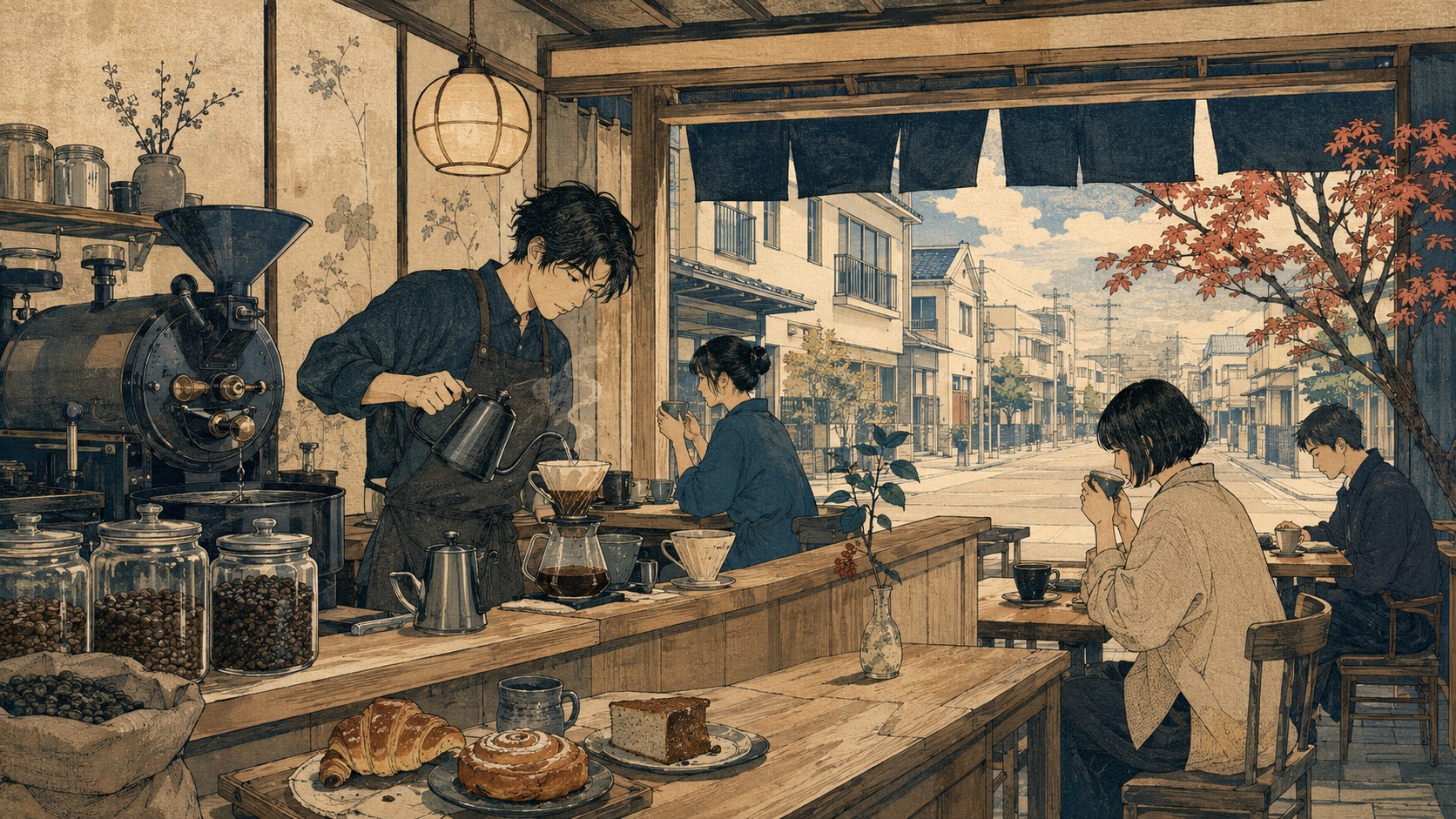
Philocoffea’s Former Roastery held a preview opening on July 28, 2026, and its grand opening on July 31. This feature was prepared for the August 3 edition from company announcements, industry records and municipal sources available by 6:00 a.m. Japan time on August 1. Hours, closing days, coffees and prices may change; visitors should confirm current information with the operator.
The roasting-room door has opened to customers
A new café usually begins with a new address. Philocoffea’s Former Roastery has done the opposite. At 2-3-29 Honcho in Funabashi, Chiba Prefecture, the company has invited customers into the room where, beginning in 2018, it roasted beans, checked quality, packed orders and imagined a future that was then much smaller.
This is not a replica of a founder’s garage created after success. The company says the space functioned as an actual roastery until 2024. Heat, exhaust, green-coffee sacks, sample roasts, cupping notes, rejected profiles and dispatch deadlines belonged to its working life. Turning that back room into a 57.27-square-meter, 16-seat shop is therefore more than a property conversion.
Production is normally hidden from consumption. A customer sees the cup, menu, package and polished final form of a brand. At the Former Roastery, the time behind the product becomes part of what is being offered. The room can show that coffee is not simply discovered as “delicious.” It is selected, roasted, measured, compared, explained and revised.
What the 16-seat shop is offering
According to Philocoffea’s opening announcement, batch brew begins at ¥600, cold brew at ¥600 and café latte at ¥700. Published hours are 10 a.m. to 6 p.m. Coffees are sourced from specialty lots around the world, roasted by the company, and served by a team that includes roasters and baristas with competition recognition.
For the opening period, espresso and latte were scheduled to use “734 Panama Don Julian Pacamara Natural.” Philocoffea described the espresso in terms of dried apple, raisin and brandy, and the milk drink through apple pie, honey and a soft sweetness resembling raw caramel. Such tasting notes are proposals rather than laboratory measurements, but they reveal a central habit of specialty coffee: a bean is read through variety, farm, process, roast and sensory character, not only as “light” or “dark.”
The company is also bringing baked goods from a central kitchen opened in June 2026, with a particular emphasis on gluten-free products. That decision prevents the shop from treating coffee as an isolated sacred object. Pairing food with coffee offers beginners an accessible route into flavor and gives regular customers a reason to make a single cup part of a longer everyday visit.
From a hospital room to Dublin in three years
Kasuya’s path is not a conventional apprenticeship legend. In the biography published by his company, he was working for an information-technology venture when he developed type 1 diabetes in 2012. He became interested in coffee during his hospitalization, entered the profession in 2013 and, only three years later, won the 2016 World Brewers Cup in Dublin.
The competition evaluates manually brewed filter coffee, including taste, technical execution, presentation and the competitor’s ability to explain the cup. Philocoffea’s official history says representatives from 36 countries took part in 2016. Kasuya became the first Japanese competitor to reach the final and the first Asian to win the championship.
“World champion” is a powerful phrase above a shop door, but a title cannot operate a company. Producing one exceptional competition service and handing a dependable cup to a first-time visitor at 10 a.m. on a rainy weekday are different disciplines. Philocoffea’s subsequent growth can be read as an attempt to close the distance between them.
The 4:6 Method was more than a recipe
Kasuya’s 4:6 Method divides the total brew water into two conceptual parts. The first 40 percent—normally separated into two pours—is used to alter the balance between acidity and sweetness. The remaining 60 percent is divided to adjust the brew’s perceived strength. The numbers are not a universal law of extraction; they are a framework for thinking and testing.
Its cultural importance lies in moving part of hand brewing away from private intuition. Japanese pour-over had often been associated with a master’s circular motion, the fineness of the stream, bloom timing and years of tacit experience. The 4:6 Method gave drinkers quantities and sequences they could change deliberately. A world-championship idea came down to the kitchen scale.
That does not make coffee automatic. Bean, roast, grind, water, temperature, brewer, humidity and technique still alter the cup. The important shift is that the brewer can explain why a variable changed. Philocoffea’s promise that both professionals and beginners can ask questions at the Former Roastery extends that philosophy. Expertise becomes language that lets a guest enter the cup, not authority that tells the guest to remain silent.
The name Philocoffea goes back to the tree
The company’s English-language site explains that “Philocoffea” combines philosophy with coffea, the botanical name associated with the coffee plant. It is not an accidental misspelling of “coffee.” Trace the cup, dripper, roaster, business and human connections far enough, the company argues, and everything returns to the tree.
The restored roastery follows the same logic. As a business grows, a brand can fragment into products, logos, store counts, collaborations and social-media metrics. Returning to the root does not require abandoning them. It means making visible again the questions beneath them: Why buy this coffee? Why roast it this way? For whom is the experience being designed?
Philocoffea was founded by Kasuya and co-founder Masami Kaji, and the company was established in November 2017. The story is therefore not only a world champion’s biography. It is also the work of turning sourcing, roasting, quality control, hiring, wholesale, education and retail into an organization. The Former Roastery can be understood as the room where individual talent began becoming a repeatable company process.
Funabashi has long turned movement into commerce
Honcho is more than a suburban address east of Tokyo. Funabashi municipal histories place the district within the Edo-period Funabashi post town. The Sakura Road—later widely called the Narita Road—connected Edo with Shimosa and the Boso Peninsula. Travelers, goods and information crossed here.
When the Sobu Railway opened in the Meiji era and Funabashi Station was established, the city shifted from post town toward commercial center. Its focus moved from the old Honcho route toward the station; later, coastal industry, wholesale functions and residential development were layered onto the city. Funabashi has repeatedly grown by receiving outside flows and converting them into local daily life.
Philocoffea’s work is a small contemporary version of that history. Coffee arrives from Panama, Ethiopia, Kenya and Colombia. Competition knowledge travels through Dublin. Equipment, books and online instruction circulate internationally. Yet the company’s headquarters and formative space remain in Funabashi. Reopening the old roastery resists the idea that a regional city is merely a waiting room before Tokyo.
From Kahiichakan to the Former Roastery
Formal coffee imports into Japan began after the treaty-port opening in 1859. In 1888, Kahiichakan opened in Tokyo’s Shitaya-Kuromoncho and helped establish the model of a public coffee room. Cafés spread through Asakusa, Osaka, Ginza and Kyobashi, becoming places where writers, artists and modern thinkers encountered Western ideas as well as a new drink.
Imports stopped in 1944 during the war and resumed in 1950. Domestic instant-coffee production and trade liberalization helped create a postwar boom. UCC’s historical summary says that in the early 1970s roughly 8,000 coffee shops were opening annually and about 65,000 opened in the nine years from 1966 through 1975. Siphons, cloth filters, dark roasts, morning sets, spaghetti Napolitan and carefully selected music turned imported coffee into a distinct Japanese kissaten culture.
Self-service chains, canned coffee, convenience-store machines, home brewing, the so-called third wave, lighter roasts, single origins and competition culture were later layered on top. Japan consumed 397,272 tonnes of coffee in 2025, and the All Japan Coffee Association identifies it as the world’s fourth-largest consuming country. The Former Roastery has only 16 seats, but it opens inside a vast and mature national culture.
Specialty coffee is not merely a high-scoring bean
Specialty coffee is often reduced to a numerical threshold. The Specialty Coffee Association’s current definition is wider: a coffee or coffee experience recognized for distinctive attributes and, because of those attributes, carrying significant additional value in the marketplace. Flavor, aroma and mouthfeel matter, but so do origin, producer, farming practice, processing and the relationships surrounding the coffee.
Under that definition, a barista is not only an extraction operator. The barista edits the distance between farm and guest into a period of time the guest can understand. But complexity can become exclusion. If explanations multiply until a newcomer is afraid to order, value has failed to travel. Because the Former Roastery says it is for professionals and beginners alike, its hardest test may not be handling expensive lots. It may be lowering the entrance to knowledge without flattening it.
The Specialty Coffee Association of Japan traces its predecessor to 1987, its name change to 1999 and its re-establishment as a more open organization in 2003. Tokyo hosted the World Barista Championship in 2007. Kasuya’s 2016 victory was not an isolated miracle appearing without context; it rested on decades of Japanese development in brewing equipment, service, competitions and disciplined sensory learning.
Sixteen thousand four hundred stores and sixteen seats
In July 2026—the same month the Former Roastery opened—Kasuya and FamilyMart released a jointly developed premium mocha through approximately 16,400 convenience stores. The companies said the product used Ethiopian Yirgacheffe G1 coffee and revised bean quantity, roast, bloom time and machine design. One experience begins with a convenience-store button. The other begins with a conversation inside a 16-seat room.
They appear to be opposites. Seen through Philocoffea’s mission of bringing exceptional coffee experiences to more people, they are two solutions to the same problem at different scales. Across 16,400 stores, the recipe and machine must reproduce quality when anyone presses the control. Across 16 seats, a human can ask what the customer likes, explain the coffee and adjust the encounter.
Mass access risks thinning quality into a marketing phrase. A specialist shop risks becoming a closed hobby. Kasuya’s business moves repeatedly between those dangers. The point of the Former Roastery is not to flee scale. It is to recover the individual drinking moment that scale makes difficult to see.
A Pacamara bean also contains agricultural instability
Pacamara, selected for the opening espresso, is known for very large beans and the capacity for exceptional cup quality. World Coffee Research records it as a cross between Pacas and Maragogipe developed through the Salvadoran coffee-research system. The same catalog also warns that it is highly susceptible to coffee leaf rust and is neither uniform nor stable from one generation to the next.
Flavor descriptions can end with elegant comparisons to fruit, wine or confectionery. The tree producing those flavors grows amid disease, heat, rainfall variability, labor shortages and volatile prices. Japan’s coffee industry listed poor harvests, historically high commodity prices and yen weakness among the major stories of 2025. A premium cup costs more for reasons that extend far beyond interior design.
If the Former Roastery is to deliver a genuinely exceptional experience, it should be able to discuss not only sweetness but variety instability, farmer choices, processing risk and the economic conditions of sourcing. This is not about burdening the customer with guilt. It is about refusing to turn agriculture into invisible magic.
Baked goods are not a distraction from coffee
Some specialist shops express purity by removing almost everything except the beverage. Everyday hospitality is broader. Morning hunger, an afternoon pause, gift buying, children, dietary restrictions and long conversations all shape why people enter a café.
Philocoffea opened a central kitchen in June 2026 and expanded baked goods centered on gluten-free options. That is partly an operating decision, but it also broadens who can share the room. A person who wants food, someone avoiding gluten and a coffee devotee can participate in the same visit.
Pairing is also one of the least intimidating ways to learn flavor. Fruit-like acidity changes beside a tart item; roasted-nut impressions connect with browned pastry; milk and caramel reinforce each other. A customer does not need to memorize sensory vocabulary before recognizing the change. Because the Former Roastery is a shop rather than an examination room, knowledge is allowed to arrive after pleasure.
The danger of turning memory into retail
“The place where it all began” is a powerful commercial story. That power carries risk. If customers visit only to confirm a founder myth, the shop becomes a corporate museum. Old photographs, roaster marks and quotations can begin to matter more than the current cup.
The task is not to preserve memory untouched, but to use it for new work. Young baristas can test ideas. Neighborhood regulars can describe what they want. Visitors from abroad can learn the 4:6 framework. Local students can help create products. Philocoffea joined a practical marketing program with Funabashi Municipal High School in 2026 and began an original coffee project connected to the school’s football community. The company’s “origin” is starting to become a shared local resource rather than an internal legend.
Sixteen seats are both constraint and advantage. Crowding may discourage visitors and revenue has a physical ceiling. Yet reactions are audible, staff knowledge can grow quickly and menus can change without the inertia of a national chain. A small room can retain an experimental speed that larger systems lose.
Philocoffea’s expansion and return
| Year | Event | Meaning for the Former Roastery |
|---|---|---|
| 2012 | Kasuya becomes interested in coffee during hospitalization. | A change of direction begins with an interruption rather than a planned career ladder. |
| 2013 | He enters professional coffee. | His rapid movement toward competition and brewing theory begins. |
| 2016 | He wins the World Brewers Cup and presents the 4:6 Method. | Personal technique becomes a framework that can travel globally. |
| 2017 | Philocoffea is established. | Competition work is converted into sourcing, roasting, retail and education. |
| 2018 | Shapo Funabashi opens; the Honcho roastery begins operating. | Retail and production grow together in the company’s home city. |
| 2021 | Philocoffea 201 and Platts Narashino open. | Different formats and customer groups broaden the company. |
| 2024 | The original roastery ends its production role. | The company must decide whether its first working room is obsolete or reusable. |
| 2025 | An Omotesando flagship becomes Philocoffea’s first Tokyo shop. | The brand gains a capital-city platform for international communication. |
| July 2026 | A new coffee reaches about 16,400 FamilyMart stores; the 16-seat Former Roastery opens in the same month. | Mass access and one-to-one hospitality are tested simultaneously. |
Opening guide
| Item | Published information |
|---|---|
| Name | PHILOCOFFEA Former Roastery / PHILOCOFFEA 旧焙煎所 |
| Opening | Preview on July 28, 2026; grand opening on July 31 |
| Address | 2-3-29 Honcho, Funabashi, Chiba 273-0005 |
| Size and seating | 57.27 square meters; 16 seats |
| Hours | 10 a.m.–6 p.m.; subject to change |
| Closing days | Announced as none; check official social channels for details |
| Indicative prices | Batch brew from ¥600, cold brew from ¥600, café latte from ¥700 |
| Features | Specialty coffees, competition-experienced staff and baked goods with a strong gluten-free selection |
Seven questions to watch
- Can it become a neighborhood shop? A destination for championship fans is not the same as a daily place for Honcho.
- How low is the knowledge threshold? Variety and processing language should invite curiosity, not test the customer.
- Can 16-seat economics work? Premium coffee, skilled labor, occupancy and food must be supported by sustainable pricing.
- Does quality travel beyond the founder? The staff must reproduce the philosophy on days when Kasuya is absent.
- Will local projects endure? School, neighborhood and business collaborations need to become more than opening publicity.
- How transparent is origin? Does the shop communicate farming, processing, price and climate risk as clearly as tasting notes?
- Can the two scales improve each other? Convenience-store reach and specialist dialogue should become a feedback loop rather than separate brands.
The cup returns to the beginning; the company does not move backward
What once happened in the old room was the transformation of green coffee into fragrant brown beans. Too much heat destroys possibility; too little leaves it closed. Time, temperature, airflow and judgment convert potential into flavor.
In 2026, the room is transforming something else. It is turning a company’s private memory into public time. It is turning a world-championship victory into a beginner’s question. It is measuring nationwide scale again through conversations across 16 seats. It is turning Funabashi from a past origin into a future departure point.
The shop’s success will not be decided by opening-week lines or photographs. It will be decided on an ordinary weekday months later: whether a neighbor orders the usual cup, whether a newcomer can sit without understanding every term, and whether a young staff member can explain a coffee in an authentic voice.
Roasting is the work of applying heat to a raw material until a different value emerges. That is also what Philocoffea is attempting with the Former Roastery. It has applied new heat to eight years of memory and is waiting to see what aroma rises next.
Sources and verification
Japan.co.jp reviewed company announcements, official sites, industry-association data, municipal histories and crop-variety records available by 6:00 a.m. Japan time on August 1, 2026. Tasting notes, prices and operating details are attributed to the operator. Historical and cultural conclusions are Japan.co.jp analysis based on the listed material and are not medical, investment or product-purchasing advice.
- Philocoffea: Former Roastery opening announcement
- Philocoffea: company story and World Brewers Cup history
- Philocoffea: name, stores and 4:6 Method
- Philocoffea: FamilyMart Premium Mocha collaboration
- Philocoffea: central kitchen and gluten-free baked goods
- Philocoffea: Omotesando flagship anniversary
- Specialty Coffee Association: definition of specialty coffee
- Specialty Coffee Association of Japan: organizational history
- All Japan Coffee Association: consumption and trade data
- UCC: Japanese coffee history, Kahiichakan and the kissaten boom
- Funabashi City: history of local commerce and industry
- Funabashi City: Funabashi post town and Honcho history
- World Coffee Research: Pacamara variety profile
- All Japan Coffee Association: major coffee developments of 2025
- Philocoffea: Funabashi Municipal High School marketing project
