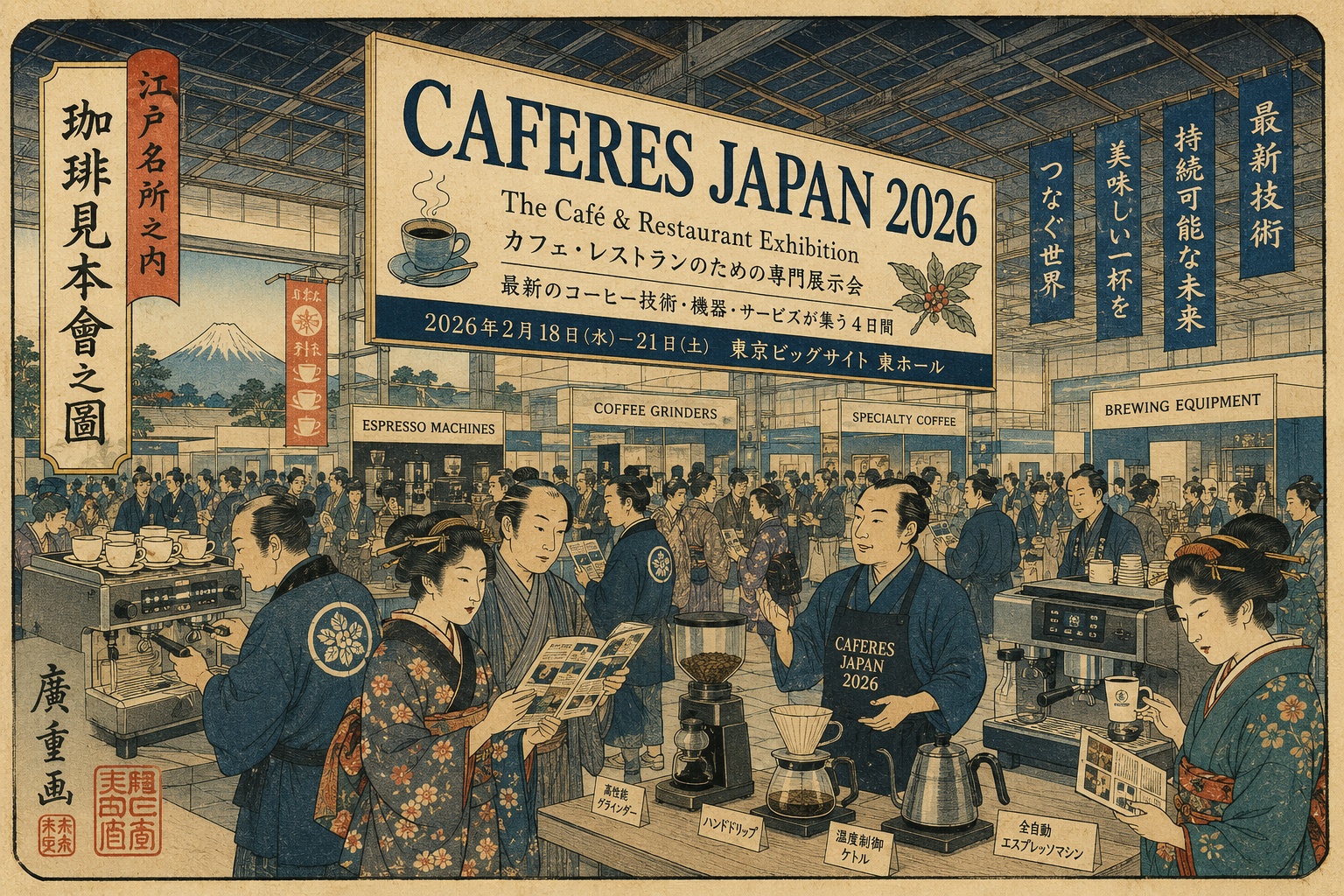
CAFERES JAPAN 2026 is scheduled for August 4–6, from 10:00 a.m. to 5:00 p.m., in Tokyo Big Sight’s South Exhibition Hall. Japan.co.jp’s reporting cutoff was 6:00 a.m. Japan time on August 1, before the doors opened. The organizer’s figures of 600 exhibitors, 45,000 visitors and more than 50 seminars are forecasts that include concurrent exhibitions, not results. The official 2025 total was 44,427. Performance, quality, waste-reduction, energy and labor-saving figures attributed to equipment companies reflect their stated tests and operating assumptions; they have not been independently verified by Japan.co.jp.
Before the doors open, the machines wake first
Before Tokyo Big Sight admits its first buyer, the exhibition floor has a morning unlike any working café. A Swiss automatic machine completes a cleaning cycle and lights its screen. Another system warms itself to pull four cups at once. A self-checkout terminal loads its payment page. Cloud-connected menus synchronize recipes and prices. Behind the polished counters sit less photogenic objects—bean containers, shelving and cleaning tools—that may decide whether the operation works at all.
CAFERES JAPAN 2026 can be described as a display of the “future café.” Yet the scarcest product changing hands is neither artificial intelligence nor a robot. It is human time. How many minutes can be removed from opening preparation? How many days before a new employee can serve a consistent drink? How many seconds disappear from taking an order at the lunch peak? How long does closing sanitation require? Who updates recipes across fifty stores, and who responds when the network or machine fails?
The show’s central question is therefore more demanding than whether a machine will replace a barista. It is which repetitions should be handed to machines, and what people should do with the time returned. After extraction, dosing, milk texturing, ordering, payment, monitoring, storage and cleaning are automated, does an employee’s minute become cheaper—or more valuable because it can be spent tasting, teaching, solving exceptions and making a guest feel known?
Six hundred exhibitors gather because a café is not one machine
According to the organizer, CAFERES JAPAN 2026 will run for three days at Tokyo Big Sight’s South Hall. Advance registration is required; a visitor without an invitation code may pay JPY 2,000 at reception. This is not principally a consumer tasting festival. It is a B2B market for café owners, chains, hotels, restaurants, roasters, manufacturers, distributors and people preparing to open a business.
The 14th Tokyo Cafe Show sits at its center, alongside specialist areas for bakery and sweets, takeout and delivery, and related food-service fields. Exhibits span coffee and tea, alcohol, ingredients, roasting and brewing equipment, ovens, refrigeration, sanitation, packaging, furniture, signs, point-of-sale systems and customer acquisition. A coffee shop does not fail only because its espresso machine is inadequate. Water, power, storage, cleaning, payment, training, staffing and menu architecture all have the power to stop a cup from reaching the customer.
The organizer expects 600 exhibitors, 45,000 visitors and more than 50 seminars, all including concurrent shows. Those are forecasts. The comparable official 2025 result was 44,359 visitors plus 68 members of the press, for 44,427 in total, with one person counted once even when attending more than one day. The 2026 forecast becomes a result only after the show closes.
Four faces of labor saving on the 2026 floor
| Exhibit example | Value claimed by the supplier | What a buyer still needs to test |
|---|---|---|
| Franke New A Line | Integrated flow, milk, temperature, recipes, cleaning and order queues, with cloud control across sites. Franke reports up to 44% lower energy losses for the new A600 NM versus its predecessor under a stated standard. | Measurements using the buyer’s beans, water, menu, volumes, idle periods and cleaning pattern; Japanese availability, price, maintenance and offline operation. |
| Eversys commercial automatics | Cameo: up to 175 drinks per hour; Enigma: up to 350 espressos per hour; Legacy: up to 175 espressos. Published Japanese list prices range from JPY 3.3 million to JPY 6.16 million, tax included. | Real throughput after milk drinks, ice, refilling, cup handling, sanitation and staff movement; total ownership cost and realistic payback. |
| POS+ | A terminal switching between self-checkout and ticketing, QR self-ordering, and a phone combining POS, cashless payment, table management and electronic receipts. | Cash, verbal and accessible alternatives; outages, fees, privacy, data portability and support for customers without suitable phones. |
| Erecta / BRUTE | Containers, shelving and cleaning systems for storing and moving beans, holding roasted coffee and improving back-of-house hygiene. | Whether the system actually reduces lifting, cross-contamination, wasted floor space, searching and first-in-first-out errors. |
Together, these products show that labor saving is not a single technology. One machine automates extraction. One software platform moves ordering to the customer. One cloud system centralizes decisions at headquarters. One durable container makes a physical workflow safer and faster. The right investment is not the newest object; it is the system that removes the operation’s largest constraint.
When a cup becomes the edge of a network
Franke plans the Japanese debut of its new A600 and A800 at CAFERES. The machines illustrate an important shift: a coffee machine is becoming a network endpoint rather than an isolated kitchen appliance. Franke says iQFlow dynamically controls flow and timing during extraction. New FoamMaster produces hot and cold milk foam and is designed to retain texture up to 72°C. PrecisionTemp sets different temperatures by beverage. FrankeOS and FrankeConnect allow remote setup, software updates, and centralized management of menus, recipes and prices.
For a chain, that means moving from a manager changing settings on each machine to headquarters changing the taste of hundreds of machines at once. A bean change, seasonal drink, price revision or recipe correction can be distributed quickly. The same power can distribute a mistake just as quickly. Standardization protects consistency, but it also scales bad decisions.
Franke’s IndividualClean is described as monitoring use and prompting sanitation when needed rather than requiring the same deep-clean routine regardless of volume. Its queue function can hold drink orders and move immediately to the next one. These are not only technologies for reducing “brewing time.” They target the small cognitive pauses in which a worker checks what comes next, re-enters an order or decides whether cleaning is due.
Environmental claims require precision. Franke says the new A600 NM, using HeatGuard, can reduce energy losses by as much as 44% versus the earlier A600 NM when measured under DIN 18873-2. That is a supplier comparison under a defined standard, not a promise that an entire café’s electricity bill will fall 44%. Real results depend on opening hours, idle time, refrigerators, ice makers, ventilation, sanitation and customer volume.
There are no customers inside “350 cups per hour”
De’Longhi Japan plans to display five commercial automatic models from Eversys and De’Longhi. The published capacities are striking. The Cameo C’2m can produce two drinks at once and is rated at up to 175 espressos or cappuccinos per hour, with a Japanese list price of JPY 4,378,000 including tax. The Enigma E’4ms/Classic is rated at up to 350 espressos per hour, with a list price of JPY 6,160,000. The Legacy L’2m is rated at up to 175 espressos or 120 cappuccinos per hour and lists at JPY 3,300,000.
Maximum extraction capacity is not maximum store capacity. Someone still receives the order, places cups, replenishes milk, handles ice, adds lids, calls names, wipes spills and answers allergen questions. A real line does not order only espresso. Iced lattes, plant-based milk, syrups, takeout and food items create a mix in which catalogue speed and counter speed separate.
Payback cannot responsibly be calculated as purchase price divided by one employee’s wage. The total includes finance or lease costs, water and electrical work, filtration, detergent, consumables, parts, service contracts, training, downtime, waste and the value of counter space. The machine may not eliminate a whole job. It may cover a missing peak position, shorten training, reduce remakes and preserve quality when the experienced person is absent. Its benefits can appear across several lines of the income statement.
If the customer enters the order, has service disappeared?
POS+ will show a terminal that can switch between post-payment self-checkout and prepaid ticketing, QR self-ordering, and a phone that combines POS and cashless payment with table management, electronic receipts and scanning. For a small counter shop or food truck, removing a fixed register can recover scarce floor space as well as labor.
QR ordering can reduce the wait to attract a server, make add-on ordering easier and present photographs, languages, sold-out status and allergen information consistently. It also transfers work to the customer’s phone, battery, data plan, eyesight and confidence. When cash users, people without smartphones or customers who cannot comfortably read a screen are treated as operational exceptions, efficiency becomes exclusion.
Good digitization leaves a human entrance open. Verbal ordering, cash, a paper menu and staff assistance can remain where needed, and an outage procedure can be rehearsed. Buyers should ask who owns the order data, whether it can be exported to another system, how fees change and what happens when a vendor or network is unavailable.
Service was never only the act of typing an order. It is explaining acidity to a first-time specialty customer, helping after a child spills a drink and remembering what a regular prefers. When software absorbs input work, management must deliberately return that time to human work—or it will simply create a café in which nobody needs to speak to anybody.
The least glamorous container in the future café
Bright screens and precision nozzles dominate exhibition photographs. Erecta’s BRUTE container reveals another reality. The company says specialty roasters in Japan use the durable commercial containers to store and move coffee, including temporary post-roast holding, alongside shelving and microfiber cleaning systems.
In a roastery, staff repeatedly lift, transfer, weigh, label, open, close and clean. A container that is durable, washable, stackable, compatible with carts and easy to identify can reduce physical strain and errors. A high-performance roaster does not create a productive room when aisles are blocked, containers are inconsistent and first-in-first-out rotation is unreliable.
“Technology” too often means AI and robots. Standard containers, cleaning heads, shelf heights, labels and floor layout are technologies too. For many small operators, the first piece of the future worth buying may not cost millions of yen. It may be the object that removes one step from a motion repeated a hundred times a day.
The Kahiichakan of 1888 was already an experiment in technology and society
Japan’s café history was never only a history of beverages. Kahiichakan, opened in Ueno’s Kuromon district in 1888, reportedly served black coffee for one sen and five rin and provided games such as cards and cricket, along with a stationery room containing brushes and inkstones. Coffee houses later opened in Asakusa, Osaka, Ginza and Kyobashi, becoming salons where people discussed literature, art and Western ideas.
Kahiichakan’s “technology” was the editing of an imported drink, urban lighting, print culture, games and writing tools into one place. Customers did not purchase black liquid alone. They purchased a new way to spend time, the right to share space with strangers and the sensation of belonging to a modern city.
Later kissaten absorbed flannel filters, siphons, records, telephones, air conditioning, magazines and toasters while developing a culture that now appears traditional. The sight of a person slowly brewing coffee is itself the product of equipment, logistics, fuel and urban life. It is a technological culture, not the absence of technology.
That history prevents a simple claim that mechanization necessarily removes a café’s soul. The question is not whether a machine exists. It is what kind of time the store is designed to give the customer. A high-throughput station shop and a slow independent roastery do not need the same answer.
Japan has automated coffee again and again
In 1969, UCC developed and began selling what it describes as the world’s first canned coffee beverage. It became widely known after Expo ’70 in Osaka. Coffee moved from an in-store cup into a sealed package and became available “anytime, anywhere.” In 1970, UCC completed Japan’s first fully automated coffee plant and began the country’s first production of vacuum-packed regular coffee.
That automation did not erase the kissaten. It expanded the number of coffee occasions—cans, vending machines, home brewing, bean counters and cafés. A different standardization began after Starbucks opened its first Japanese store in Ginza in 1996 and reached its 2,000th domestic store in 2025. Beans, training, store design, vocabulary, cup sizes and the permission to stay were reproduced as a chain experience.
In 2026, Seven-Eleven announced plans to expand its new latte machine to about 11,000 stores during the fiscal year, adding roughly 5,000 units. The company says the machine uses about 10% less electricity than its predecessor under stated conditions, improves foam and reduces cleaning time through redesigned components. The claim is a company estimate and varies with use. Even so, it proves that café automation is not a trade-show future; it is everyday infrastructure.
Across this history, Japan never chose “human hands” or “machines” once and forever. Machines multiplied access, and each multiplication forced human cafés to define a different value. Because canned coffee exists, a kissaten sells a space a can cannot provide. Because a convenience machine can produce a stable low-priced cup, a specialty shop has to make origin, roasting, conversation and individuality legible.
The world’s fourth-largest market is squeezed by bean prices and the yen
The All Japan Coffee Association reports that Japan consumed 397,272 tonnes of coffee in 2025, 99.3% of the previous year, making it the world’s fourth-largest consuming market. Green-bean imports totaled 359,382 tonnes. Brazil, Vietnam and Colombia together supplied nearly three quarters of imports.
The association’s major news for 2025 included record arabica and robusta prices amid climate-related crop problems, continued price revisions in Japan as global costs met a weak yen, and a slight decline in domestic consumption. It also noted demand for time-saving concentrates, sticks and drip bags, as well as wider efforts in logistics efficiency, renewable energy and producer support.
For a short-staffed shop handling expensive beans, dosing errors, remakes, excess milk and stale inventory hurt more than before. Automation can protect food cost through precise measurement and temperature. But a machine cannot make low-grade green coffee into premium value. Without raw-material quality, roasting, freshness, water, recipe and explanation, the only thing standardized may be mediocrity.
A 58.6% shortage turns equipment into a management issue
In Teikoku Databank’s January 2026 survey, 58.6% of restaurant companies reported a shortage of nonregular workers. That was 2.1 percentage points better than a year earlier and the third consecutive improvement, but it remained the second-highest industry reading after staffing and placement services. The report noted the combined burden of raw-material prices and labor costs needed to attract people.
In February, the Ministry of Agriculture, Forestry and Fisheries released a practical guide to automation and labor saving in restaurants. It describes food service as a characteristically labor-intensive industry, with cooking, plating and customer service contributing to productivity below many other sectors. The government has a five-year plan for concentrated productivity investment across twelve severe-shortage industries.
The ministry’s broader productivity framework is important. It identifies three directions: improve products and service; rationalize work and transfer resources; and improve employee skills and satisfaction. If automation is defined only as reducing headcount, the last two purposes disappear. Unless returned time becomes training, quality, hospitality, rest or pay, the technology may merely compress more duties into the people who remain.
What machines can standardize—and what they cannot
| Machines are strong at | People remain responsible for |
|---|---|
| Repeating water volume, flow, time, temperature, milk quantity and recipes | Tasting changes in beans, water, humidity and roast, then deciding how the recipe should change |
| Parallel extraction, drink queues and centralized price or menu distribution | Reading a guest’s urgency, uncertainty, language, allergy, health needs and mood |
| Scheduled prompts, logs, sales and inventory data | Noticing abnormal sound, smell or dirt, stopping safely and recovering from failure |
| Photographic and multilingual self-ordering, cashless payment | Protecting the dignity of people who cannot use the interface and handling exceptions gracefully |
| Reproducing the same drink across many locations | Creating a reason to drink it here: place, story, trust and relationship |
When a supplier promises “barista quality,” the barista’s job must not be reduced to pressing an extraction button. Skilled people select coffee, interpret roast, measure water, notice grinder drift, prepare for the rush and infer preference from incomplete language. The more a machine reproduces downstream motions, the more important upstream judgment and downstream relationship become.
It is telling that CAFERES also hosts barista competitions. Human beings compete over extraction, taste, explanation and movement beside machines marketed for automatic consistency. That is not a contradiction. It shows that standardized volume and a singular sensory performance occupy different roles in the same market.
How to be skeptical of a machine labeled “energy saving”
Suppliers promote insulation, standby controls, precise milk dosing, usage-based cleaning and remote diagnostics as ways to reduce energy, ingredients, detergent, downtime and service travel. Those directions are plausible. A product-level improvement is not the same thing as a lower footprint for the whole café.
Manufacturing and shipping the new machine, retiring the old one, refrigeration, ice, cups, lids, cloud computing, parts and cleaning chemistry all matter. Replacing a functioning machine early creates an embodied cost that operating savings must first recover. Remote diagnostics may reduce technician visits while adding connectivity and data infrastructure.
A serious buyer asks for the measurement standard, comparison model, idle assumption, annual volume, cleaning frequency, consumables, repairability, parts horizon, resale value and end-of-life plan—not only the maximum reduction percentage. A claim of lower milk waste is useful only after the store has measured how much milk it currently discards.
A networked coffee machine needs a plan for how it fails
Cloud connectivity allows recipe distribution, price changes, predictive alerts and remote support. It also turns kitchen equipment into a cybersecurity and vendor-dependence question. Weak account control can expose settings to unintended changes. A service outage or discontinued platform can remove functions from otherwise sound hardware.
Buyers should know what works offline, whether recipes can be backed up, whether data can be exported, whether software updates can be delayed and what the machine becomes when support ends. A POS system adds payment information, order history, loyalty records and employee logs.
Failure should be designed around the question “How many minutes until we can operate on paper?” rather than the promise that failure will never happen. Handwritten tickets, a cash box, a short menu, a manual brewer and a call tree make digitization resilient. A café that has discarded every fallback may be efficient and fragile at the same time.
Ten questions before signing an order
- Where is the largest constraint? Extraction, ordering, payment, cleaning, preparation, storage or recruitment?
- What is throughput with the real menu? Test the store’s milk, ice, modifiers and food mix—not only maximum espresso output.
- Who defines quality? Establish sensory and numerical standards for taste, temperature, foam and service time.
- How many cleaning minutes change? Include disassembly, detergent, rinsing, wastewater and closing work.
- What is total ownership cost? Hardware, work, utilities, connectivity, service, parts, finance, downtime and upgrades.
- How does the store trade during failure? Define backup hardware, manual procedure, service response, parts and refunds.
- Who owns the data? Confirm export, migration, retention, third-party use and account permissions.
- Who must not be excluded? Preserve cash, speech, languages, accessibility and staffed assistance.
- Where will the returned time go? Allocate it to training, hospitality, product work, rest, safety and pay—not only fewer shifts.
- What proves success after six months? Track remakes, waiting, turnover, complaints, waste and repeat visits as well as sales per labor hour.
A trade show is valuable because competing machines can be touched and tested. Buyers should bring the same beans, milk and order sequence, and ask for a rush, replenishment, cleaning and error recovery—not only a perfect first drink prepared by the demonstration team. The hundredth cup of a difficult morning is more revealing than the first cup under exhibition lighting.
The future store needs stronger work, not simply fewer people
Labor shortage is a sales opportunity for equipment companies. For a restaurant, it is a problem in human lives: vacancies, departures, insufficient training, missed breaks and the difficulty of raising pay when prices are hard to pass on. Machinery alone cannot solve it.
In a good implementation, the work changes. A new employee spends less time memorizing a complicated extraction sequence and more time learning beans, hygiene, allergens and guest communication. An experienced barista is released from repetition to supervise taste, develop products and teach. A manager uses remote sales and settings not as a substitute for presence, but as evidence to interpret with the people in the store.
In a bad implementation, one position is removed and cleaning, refilling, food running, complaints and fault recovery are piled onto whoever remains. Self-ordering removes conversation, automatic brewing removes the person who tastes and central cloud control removes local judgment. The operation becomes efficient and ownerless.
Who receives the last minute?
Kahiichakan sold a new kind of urban time with coffee in 1888. Canned coffee carried that time outside the shop in 1969. The automated plant of 1970 made national consistency possible. The chain era after 1996 reproduced an experience across locations. CAFERES JAPAN 2026 asks again how one minute should be used.
A machine can measure flow, texture milk, queue orders, take payment and request cleaning. It can take a minute from a person or return it. If management sees the returned minute only as an empty wage cost, the café may become fast, quiet and forgettable.
If the minute is used to ask what the customer likes, explain where a coffee came from, teach a new employee how to taste or let an exhausted worker pause, technology can make hospitality denser rather than thinner. The highest achievement of automation is not making a machine look human. It is allowing a human being to stop working like a machine.
Sources and verification
Japan.co.jp reviewed organizer materials and primary or attributable sources from Japan’s agriculture ministry, the All Japan Coffee Association, Teikoku Databank, UCC, Starbucks, Seven-Eleven and announced exhibitors available by 6:00 a.m. Japan time on August 1, 2026. CAFERES JAPAN 2026 had not opened. The 600-exhibitor, 45,000-visitor and 50-plus-seminar figures are organizer forecasts; 44,427 is the official 2025 result. Supplier throughput, quality, labor and energy claims are presented as company statements, not independently verified outcomes. The displayed exchange rate is the provided value of JPY 157.57 per U.S. dollar; July 31 at 9:00 p.m. UTC equals August 1 at 6:00 a.m. JST.
- CAFERES JAPAN 2026: dates, venue and expected exhibitor and visitor scale
- CAFERES JAPAN: registration, JPY 2,000 on-site admission and DX/labor-saving focus
- CAFERES JAPAN: official 2025 attendance and counting method
- CAFERES JAPAN: product and service categories
- Franke Japan: New A Line features and supplier performance claims
- De’Longhi Japan: announced Eversys capacities and Japanese list prices
- POS+: self-checkout, QR ordering and phone POS exhibit
- Erecta: BRUTE storage, transport, shelving and cleaning products
- Ministry of Agriculture, Forestry and Fisheries: restaurant automation guide
- MAFF: three approaches to food-service productivity
- Teikoku Databank: January 2026 restaurant labor-shortage survey
- All Japan Coffee Association: consumption, global rank and green-bean imports
- All Japan Coffee Association: 2025 prices, yen, convenience and sustainability trends
- UCC: Kahiichakan and the history of coffee in Japan
- UCC: canned coffee and Japan’s first fully automated coffee plant
- Starbucks Japan: the 1996 first store and 2,000th store in 2025
- Seven-Eleven Japan: new latte-machine rollout and company energy/cleaning claims
