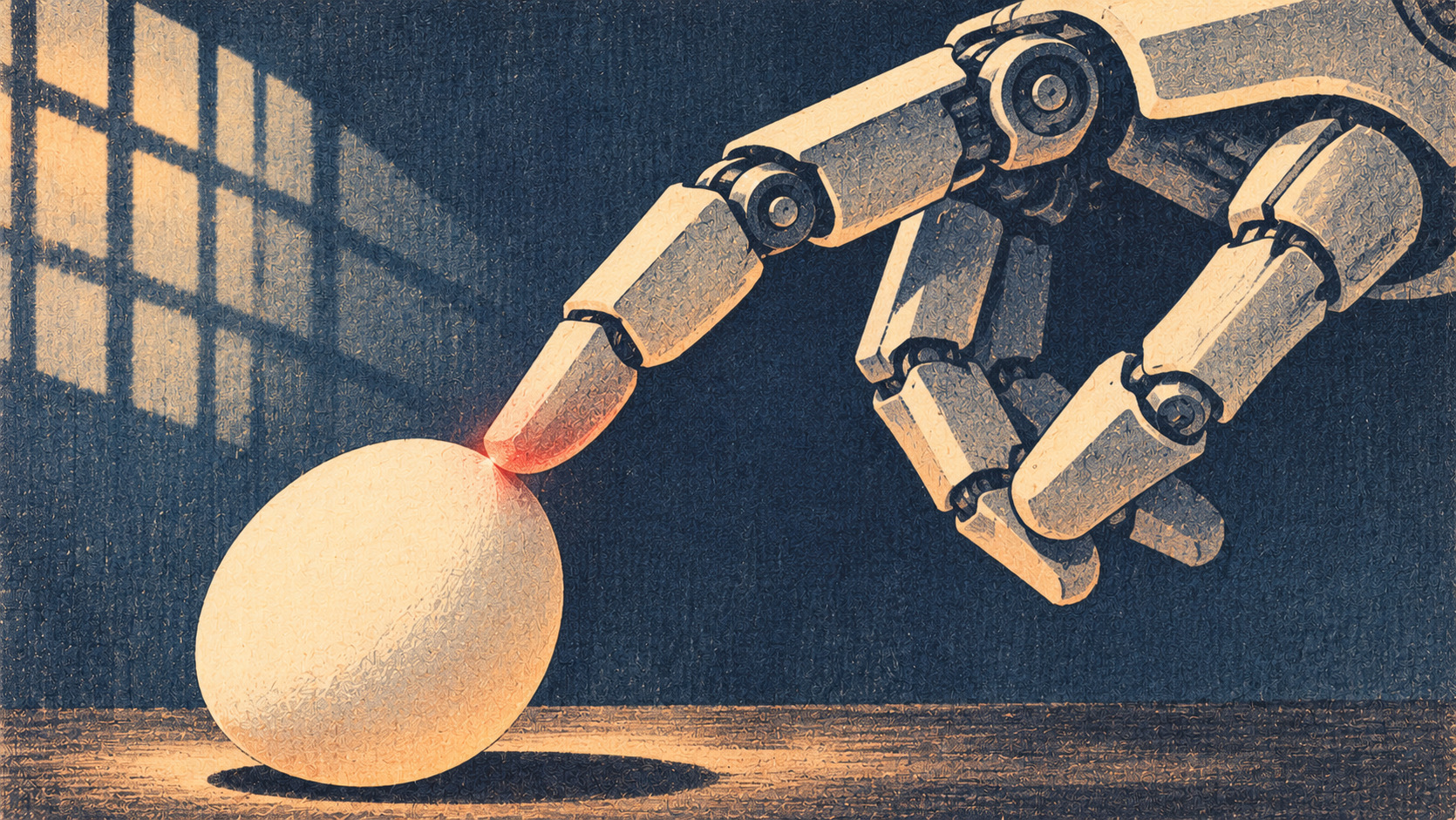
- The surprisingly hard task of touching an egg
- What is genuinely new in November
- Two clocks inside a robotic hand
- What the 65% result actually means
- Why the dataset may matter as much as the algorithm
- A long history of machine touch
- A Japanese company inside an international research network
- Why Japanese factories might care
- The distance between a demonstration and a production line
- The future may depend on a quieter kind of intelligence
The surprisingly hard task of touching an egg
A robot can follow a complicated spoken instruction and still struggle to lift a single egg. It must establish contact without squeezing too hard, detect the beginning of a slip and adjust its grip as the object moves. Most of those corrections happen at the fingertips rather than in the camera image. The problem is easy to overlook when the machine is not breaking anything; it becomes painfully obvious when the object is fragile, flexible or unexpectedly positioned.
On November 5, 2026, Panasonic Holdings and Panasonic R&D Company of America announced a jointly developed research system intended to close that gap. Called Tactile-Reactive Dexterous Manipulation, or T-Rex, it gives a vision-language-action model a faster channel for tactile feedback. The researchers tested it on difficult two-handed manipulation tasks, with results scheduled for presentation at the Conference on Robot Learning in Austin, Texas, November 9–12.
The breakthrough is not a robot that has learned to feel like a person. It is a system that can make a useful distinction between planning an action and correcting an action after contact has begun. That distinction could matter far beyond the laboratory.
What is genuinely new in November
The chronology is more nuanced than an announcement headline suggests. The underlying T-Rex paper was posted as an arXiv preprint in June 2026. Panasonic's Japanese and English press releases appeared on November 5, ahead of the system's planned presentation at CoRL 2026. This article, dated November 11 in Japan, examines the research and its industrial implications; it does not assume new conference results have already emerged.
Research groups list the work among the conference's 2026 papers. Acceptance at a scientific conference and publication of a preprint are meaningful forms of scientific disclosure, but neither constitutes an independent factory endurance trial or universal validation of a technology's commercial readiness.
Sources: Panasonic official release · Research preprint
Two clocks inside a robotic hand
Modern vision-language-action, or VLA, systems use images and language instructions to decide what a robot should do. Some impressive systems can translate broad directions into sequences of motions, but contact-rich manipulation demands much faster responses. When a card slips or a soft object bends, a new high-level prediction may arrive too late to correct the force being applied.
Panasonic reports that T-Rex generates higher-level actions at about five updates per second, while a tactile reaction module makes finer corrections at about 20 updates per second. The point is not that 20 Hz replicates human reflexes or describes every sensor's sampling frequency. It is that the architecture lets a slower planner work alongside a quicker contact-sensitive controller rather than forcing every correction through the same expensive visual processing loop.
The paper describes a variable-rate Mixture-of-Transformers architecture and a temporal tactile encoder. In practical terms, different parts of the model handle different kinds of evidence on different schedules. That is an engineering answer to an old physical truth: once a robot has touched something, the contact may change faster than the scene it sees.
What the 65% result actually means
In tests spanning 12 real-world tasks—including page turning, egg transfer, toothpaste application, unlocking a door, pulling out a thin card and installing a light bulb—T-Rex recorded an average success rate of 65%. The strongest reported baseline reached 35%, a difference of 30 percentage points, not a relative 30% improvement. Without tactile information, the researchers report, T-Rex's average fell to 42%.
The project site describes 16 randomized trials per task and comparisons with six baseline systems. Those results support the conclusion that the researchers' tactile-reactive approach outperformed the evaluated alternatives under the reported testing conditions. They do not prove that a robot will succeed on 65% of every unfamiliar action in an uncontrolled home or factory. Task selection, demonstration data, hardware and scoring rules all matter.
Panasonic calls the result state of the art. That is an attributed claim based on its reported evaluation, not an independently verified ranking of every tactile robotics system. Nor is the 23-percentage-point difference between 65% and the no-tactile 42% condition a guarantee that touch alone is responsible for all improvements across unrelated systems.
Sources: Project evaluation details
Why the dataset may matter as much as the algorithm
Tactile data are expensive to collect. Video of people moving through the world can be gathered in vast quantities; synchronized recordings of force, deformation, robot joint states and two-handed contacts require physical machines and instrumentation. The T-Rex team assembled more than 7,700 robot episodes totaling about 100 hours, using more than 200 everyday objects and 22 fundamental actions.
The recordings include head and wrist camera images, robot-state and action information, language instructions and tactile readings from sensors on ten fingertips. The training process also draws on 22,889 hours of human egocentric video, followed by tactile-rich mid-training and roughly 100 demonstrations for each final task.
Those two training sources should not be conflated. Thousands of hours of human video are not thousands of hours of a robot successfully manipulating objects with touch. The technical wager is that broad visual experience can be paired with a smaller but carefully structured collection of physical interactions to teach the system when and how to correct itself.
A long history of machine touch
Machine tactile sensing did not begin with generative AI. Researchers have explored force-feedback grippers, instrumented fingertips and tactile arrays for decades. In 2014, MIT's Computer Science and Artificial Intelligence Laboratory described a robotic fingertip sensor derived from GelSight, a technology first reported in 2009. The sensor helped a robot handle an irregularly positioned USB connector—precisely the kind of contact problem that conventional rigid automation struggled with.
The more recent development has been to connect tactile feedback to learning systems that can interpret language and visual context. VLA models broaden the range of things robots can attempt, but a robot's physical world still contains friction, compliance, slippage and mechanical uncertainty. T-Rex sits at that intersection of established touch sensing and newer foundation-model approaches.
Traditional industrial automation was built around repeatability in structured settings. A new generation of mobile and dexterous systems is being asked to handle a wider variety of objects, sometimes changing from one task to the next. Such flexibility increases the value of feedback about what actually happens at the point of contact.
Sources: MIT tactile research history
A Japanese company inside an international research network
Panasonic Holdings and its American research subsidiary identify collaborators from the University of California, Berkeley, NVIDIA, Stanford University, Sapienza University of Rome and ItalAI. The research paper lists a large international author team. This is not accurately described as a Panasonic-only invention, nor should the involvement of major research organizations be mistaken for an announcement of a consumer product.
Panasonic's corporate roots go back to March 7, 1918, when Kōnosuke Matsushita established a small electrical-equipment workshop with family members. The contrast with the modern joint research effort is instructive. A company associated with mass-produced electrical goods is helping investigate the learning and control systems that may shape future manufacturing equipment.
The practical ownership, licensing and commercialization terms of the research cannot be fully determined from the public announcement. Industrial partnerships, product pricing or purchase availability should not be invented simply because the science comes with recognizable corporate names.
Sources: Panasonic founding history
Why Japanese factories might care
Panasonic points to assembly operations such as inserting or removing parts and driving screws, as well as logistics jobs involving flexible or fragile goods. These are areas where traditional pick-and-place automation may encounter variable shapes, gripping forces and material properties. A robot that can notice a slipping part or change force during an insertion may have value even without looking or moving anything like a person.
The broader market backdrop is substantial. The International Federation of Robotics reported in September 2026 that the world's operational industrial robot fleet reached about five million in 2025. Japan installed 36,219 industrial robots that year, down 19% from 2024, making it the world's third-largest market by annual installations. These industry numbers do not measure demand for T-Rex or the size of the tactile-robotics business; they illustrate the scale of an established automation sector facing new demands.
For Japanese manufacturers, the opportunity is not merely substituting a machine for a worker. More flexible robots might relieve repetitive operations, improve handling consistency and broaden the range of economically automatable tasks. But individual plants must still evaluate throughput, integration, safety systems and operator oversight.
Sources: IFR World Robotics 2026
The distance between a demonstration and a production line
A 65% success rate across research tasks is scientifically interesting. It is not a production uptime guarantee. A factory may need extremely high repeatability over thousands of cycles, compatibility with existing machines, predictable recovery after failures and clear controls for situations in which a person approaches the work cell.
Questions for industrial buyers include how the system performs on unseen materials, whether tactile sensors require frequent recalibration, how rapidly it recovers after a dropped object, whether operation slows under changing loads and what happens if the contact controller makes the wrong correction. Those are standard technology diligence questions, not reports of flaws identified in T-Rex.
The public materials provide no commercial list price, independently audited factory deployment count, long-run safety certification or measured customer return on investment. Until such evidence appears, the technology should be described as research with promising reported results rather than a generally available industrial solution.
The future may depend on a quieter kind of intelligence
The most memorable vision of artificial intelligence is often a machine that talks. In industrial robotics, the more consequential capability may be one that is almost invisible: adjusting a grasp just enough that nothing slips, tearing one sheet from a stack without taking two, or turning a component without damaging its threads.
T-Rex offers evidence that touch can become a responsive partner to language and vision in learned manipulation systems. Whether it becomes an enduring manufacturing technology will depend on independent replication and the unforgiving economics of actual work. The robot that changes a factory may not look dramatically different. It may simply know, at last, when to loosen its grip.
Primary sources and verification limits
State-of-the-art performance is attributed to Panasonic’s evaluated baselines. The 65% figure is a research benchmark, not certified reliability in commercial deployment.