- The industrial machinery behind a familiar taste
- A production-line upgrade measured in practical details
- What does aluminum-free packaging actually change?
- The first business was not a sauce company
- A sauce born from a problem on the hotplate
- Hiroshima okonomiyaki belongs to a city, not one brand
- The container is part of the product
- From Hiroshima to factories on three continents
- Teaching the next generation what to cook
- How to judge the next phase
The industrial machinery behind a familiar taste
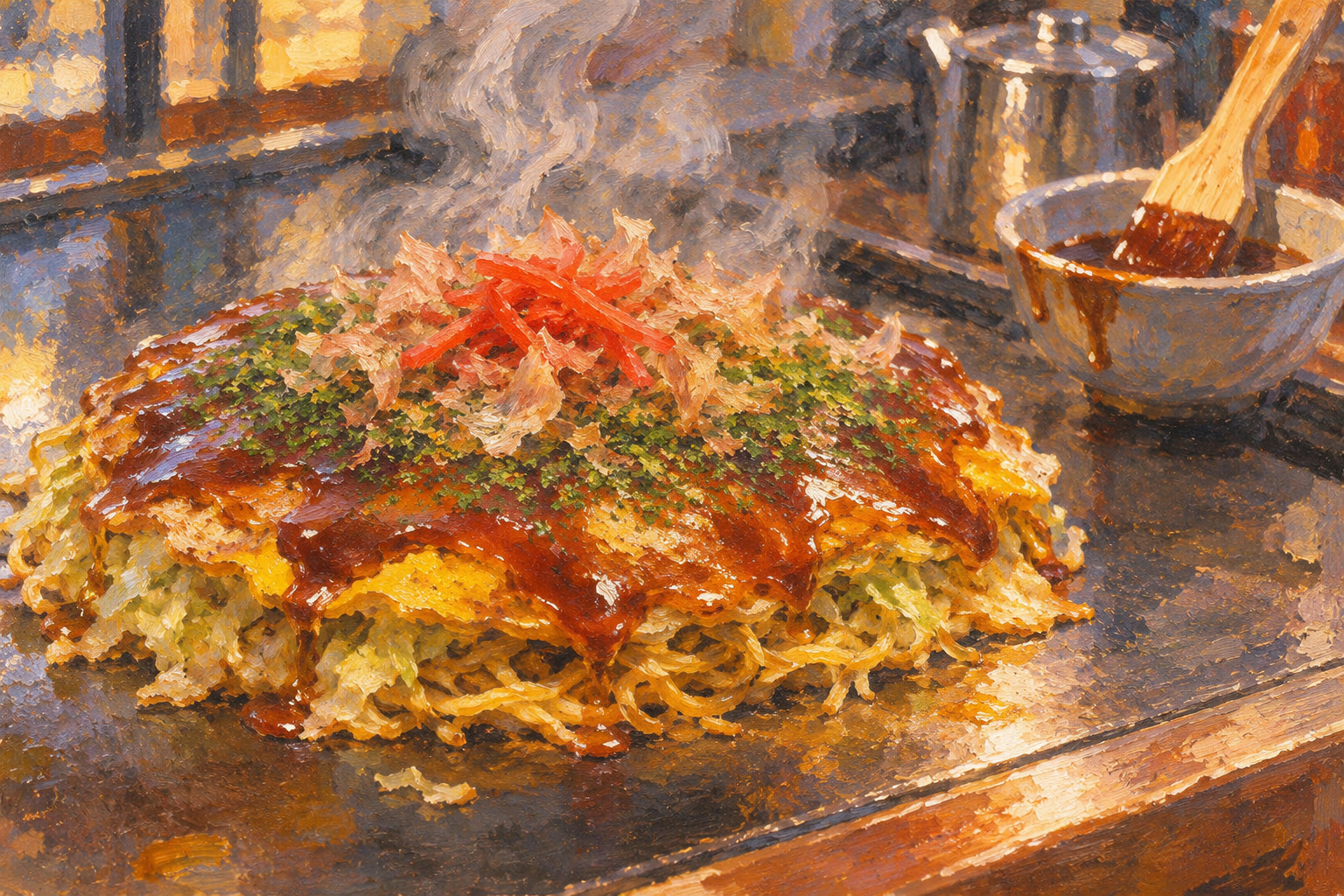
The enduring image of Hiroshima-style okonomiyaki is a cook working a hot iron griddle, stacking cabbage, noodles, eggs and thin batter before finishing the dish with a distinctive dark sauce. Yet its commercial reach depends on equipment far removed from the restaurant: machines that accurately fill, seal and dispatch thousands of cartons of food products.
On November 18, 2026, Hiroshima-based Otafuku Sauce announced that two rebuilt paper-carton filling lines at its head-office factory had begun full operation on October 27. The manufacturer says each line can now fill 2,200 cartons an hour, 10% more than its predecessor. The announcement is modest beside the factory projects associated with Japan’s biggest industries, but it captures a consequential question for regional food producers: how do you preserve a recognizable taste while changing how it is made and delivered?
The answer reaches back through postwar Hiroshima, a sauce developed in response to restaurant owners, changing packaging technology and the challenge of serving diners far beyond Japan.
A production-line upgrade measured in practical details
Otafuku says the two new lines are intended principally for larger packages, including 700-milliliter cartons of rakkyo vinegar for pickled scallions and 1,200-gram cartons of sauces used by restaurants and prepared-food counters. The company links demand growth to food-service businesses and supermarket delicatessen operations, without giving a product-by-product sales breakdown in the announcement.
A 10% increase to 2,200 units an hour is the rated capacity of each new line, not a disclosure of actual average output. A theoretical combined maximum of 4,400 cartons an hour ignores product changes, cleaning, downtime and plant-wide bottlenecks. Otafuku did not disclose the upgrade’s capital cost, utilization rate or measurable effect on earnings.
Its most revealing detail may be ergonomic. Workers previously had to climb a step to reach the carton feeder; the new machine positions the stocker at waist height and holds more cartons. The company estimates that restocking frequency has fallen to approximately one-third of its former level. It is a concrete attempt to reduce repetitive physical work, though the release does not provide independently audited injury or time-saving data.
What does aluminum-free packaging actually change?
The machinery can accommodate cartons that no longer use an aluminum-foil layer, while the manufacturer says they provide a comparable barrier against the external conditions that can degrade food. Otafuku plans to begin production using the aluminum-free material around February 2027 and gradually switch relevant products.
There is an engineering trade-off behind every package. A food carton needs protection against oxygen and light, compatibility with filling equipment, transport durability and an acceptable shelf life. Removing aluminum may alter material recovery or environmental impacts, but the net result depends on the replacement barrier, regional recycling systems, energy inputs and food waste.
No full lifecycle assessment or verified carbon-savings percentage accompanied the release. An ability to fill aluminum-free cartons is not evidence that every carton has already changed, or that the new package is automatically more sustainable in every market. Otafuku also cites overseas packaging expectations, without identifying all the jurisdictions or rules involved.
The first business was not a sauce company
Otafuku traces its origins to 1922, when Seiichi Sasaki established Sasaki Shoten in Yokogawa, Hiroshima, trading in soy sauce and alcoholic drinks. The operation later moved into vinegar fermentation; by 1938 it sold a product under the Otafuku vinegar name.
On August 6, 1945, the atomic bombing destroyed the family’s business premises. According to the company’s centenary history, Sasaki borrowed a sake brewery in the Nagatsuka district and resumed vinegar production in 1946. That detail matters because the familiar modern brand came out of the practical, precarious work of rebuilding everyday commercial life.
The firm began making sauce in 1949 and selling it in 1950. It was a late entrant into a market already accustomed to Worcestershire-style sauces. To discover what restaurants needed, it went directly to the cooks who used them.
A sauce born from a problem on the hotplate
Restaurant owners had a specific complaint: thin Worcestershire-style sauce slipped off okonomiyaki and could burn on a hot iron surface. Otafuku’s account of its own product development says that dialogue with cooks led, after extensive experimentation, to a thicker sauce marketed specifically for okonomiyaki in 1952.
One technical ingredient of the transformation was the use of the concentrated sediment from vegetables, fruit and spices that settled during conventional sauce-making. What might have been discarded became useful in creating a thicker consistency. The company introduced a household okonomiyaki sauce in 1957, helping carry an eating-out flavor into the home.
The recipe continued changing. Dates were incorporated in 1975 as the company sought a rich sweetness during an era of costly ingredients. Today, viscosity, sweetness, acidity and consistency remain industrial qualities as well as culinary ones: a sauce must taste right, behave properly on heat and meet food-safety standards at scale.
Hiroshima okonomiyaki belongs to a city, not one brand
The dish itself has a broader and more complicated history than the product line. An inexpensive prewar street snack known as issen yoshoku, built around a thin wheat-flour batter and simple toppings, is commonly cited among its antecedents. During and after the war, scarce flour and vegetables were assembled into inexpensive meals that could be prepared on iron griddles.
Over time the Hiroshima style developed its familiar layered approach, often combining batter, large amounts of cabbage, bean sprouts, pork, noodles and egg. There is variation among shops and families, and the distinction from the better-known mixed-batter Kansai style does not make either one a single immutable recipe.
Small restaurants, frequently run within residential neighborhoods, served as both food businesses and meeting places during Hiroshima’s reconstruction. The story should not be reduced to a single corporate invention: cooks, suppliers, households and the city’s economic circumstances all helped shape the cuisine. Otafuku’s contribution was to develop products and training that supported that community of practice.
The container is part of the product
The renewed cartons continue a surprisingly long tradition of packaging changes. Otafuku moved its head-office factory to Hiroshima’s Shoko Center district in 1978 and began using paper containers for sauces. In 1982 it adopted a squeezable plastic bottle, the Fuku Bottle, to make viscous sauce easier for households to dispense.
Packaging affects more than appearance. It influences cost, shelf life, pourability, shipping weight, waste and the speed at which restaurant staff can use the contents. In this context, the capacity to fill different carton sizes—including a newly supported 500-milliliter format—and add labels for custom-order products can broaden flexibility without changing the underlying food.
The company’s historical record also shows attention to teaching customers how to use what it sells. It opened a Tokyo okonomiyaki training center in 1987, the Wood Egg Okonomiyaki Museum in 2008 and the OKOSTA cooking studio at Hiroshima Station in 2018. A restaurant technique gradually became a teachable experience as well as a packaged flavor.
From Hiroshima to factories on three continents
Otafuku’s corporate profile lists manufacturing operations in the United States, China and Malaysia in addition to its domestic network. Its American business dates to 1998 and operates in the Los Angeles area; the company also lists a Qingdao plant in China and a Malaysia operation that produces certified halal seasonings.
These locations are part of the reason a packaging change in Hiroshima has international relevance. Export markets have different food regulations, consumer needs, distribution distances and expectations for packaging. A brand built on one regional Japanese dish must learn how to supply supermarkets, restaurants and households in places where the cuisine is not a daily tradition.
But an international brand is not the same thing as every bottle being exported from Hiroshima. Some products are manufactured in overseas facilities, and the company has not specified the country-by-country effect of its November equipment upgrade. Claims of worldwide sales growth or market share would require additional figures.
Teaching the next generation what to cook
Otafuku’s November news was not limited to machinery. On November 6, the company and Hiroshima broadcaster RCC announced an idea competition for prefectural high-school students to create new versions of okonomiyaki. Entries were open November 1–29, with a final event scheduled for February 21, 2027; the winning dish is intended to be commercialized with Otafuku’s assistance.
That contest embodies an interesting tension in regional food culture. If a celebrated local dish is treated as a museum piece, fewer young people may claim it as their own. If it changes without reference to its community, it can become merely a marketing label. Food companies operate between preservation and reinvention.
The competition had not selected a winner as of this article’s November 19 research cutoff. Its significance is therefore in the initiative and its stated intention, not in a product already brought to market.
How to judge the next phase
The new filling lines strengthen Otafuku’s stated ability to meet demand, offer new packaging and improve repetitive work. These are measurable operational objectives, not proof of an industry-wide transformation. The next questions are what happens in sustained production: output per shift, rejected cartons, maintenance intervals, worker feedback and whether aluminum-free packaging meets its promised performance.
Financial results and lifecycle impact could ultimately be more important than the equipment specifications alone. This report cannot establish the investment’s payback period or the environmental gains of the new material because the company has not published those data in the November release.
For Hiroshima, there is a larger continuity. The enterprise that once sold vinegar from a recovering city now operates across several countries, yet it still depends on the apparently simple act of delivering a sauce that cooks can trust. The future of this regional food industry may be decided as much by the factory worker refilling cartons at waist height as by the flavor on the griddle.
Primary sources and reporting limitations
Independently written from Otafuku’s November 18 and November 6 announcements, corporate histories and factory information. No factory visit, executive or worker interview, independent throughput test or packaging lifecycle assessment was conducted. Figures are company-reported and future changes remain contingent.