- A festival in the place where community work happens
- What visitors are scheduled to see
- A city explained in numbers
- Why this city developed differently
- A center opened in 2024, not just an event hall
- Seven food trucks—and more than a food festival
- Language is infrastructure
- A history of mobility, not a single community
- The practical guide for Sunday
- Participation is a longer test than attendance
A festival in the place where community work happens
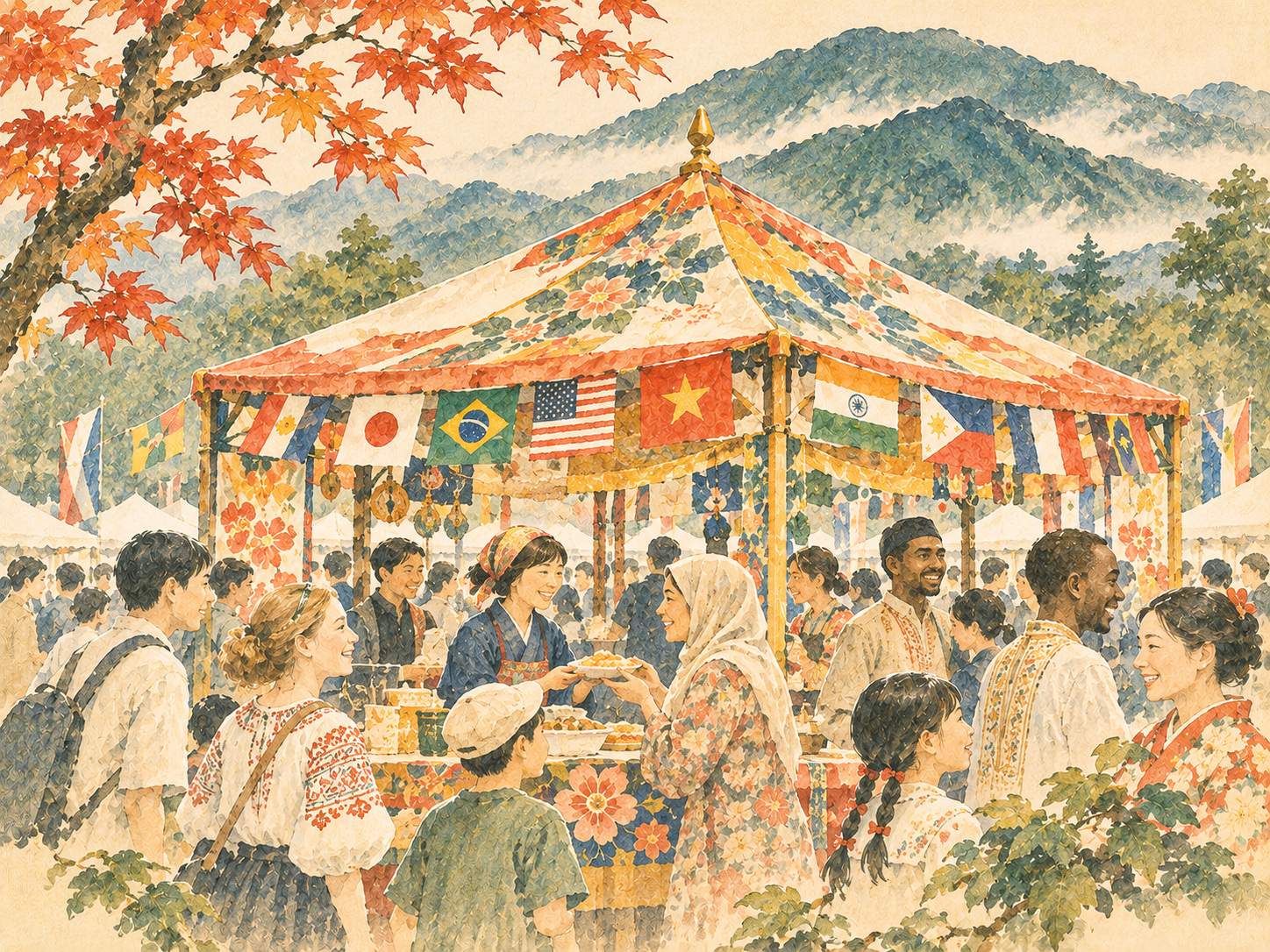
On November 15, the city of Ota in Gunma Prefecture plans to bring Brazilian, Nepalese, Peruvian and Vietnamese performances into the same public space. The Multicultural Interaction Festa Ota 2026 is free, scheduled from 10 a.m. to 2 p.m., and located at the city’s multicultural coexistence center on Iizuka-cho 69-3. A stage program, food trucks and displays by local civic groups are all planned.
What makes the occasion more interesting than a festival calendar listing is its venue. The center opened on December 2, 2024 as a place supporting Japanese-language learning, community participation and contact among residents. The entertainment occupies one day; the larger story concerns what it means to share an industrial city across languages and life histories.
What visitors are scheduled to see
The program published by Ota City includes an opening performance by the affiliated orchestra Jeunesse of Ota Art School, followed by Brazilian dance from Minna no VAMOS PAPEAR, Nepalese dance, a Peruvian performance by GRUPO KAZOKU and Vietnamese dance. The multinational band KIJOKO is listed later in the day, along with a drawing and closing ceremony. These are scheduled appearances, not performances independently observed by JAPAN.co.jp.
Inside, community organizations are due to present their activities. They include the Japanese-language group Ayumi no Kai, Friendship Force Ota Gunma, UNESCO-related volunteers and other associations. Their presence may be the festival’s most consequential feature: a visitor can encounter not just a performance but people who organize opportunities to study, volunteer and build relationships throughout the year.
A city explained in numbers
Ota’s municipal resident-register statistics, dated October 31, 2026, record 221,510 residents, including 17,326 foreign residents. That is about 7.8 percent of the population. Foreign-resident numbers rose from 16,695 at the end of December 2025, even as Ota’s total population edged down. The figures describe registered residency, not visitors, commuters or the legal status of any individual.
Gunma as a whole counted 87,544 foreign residents at the end of December 2025, according to the prefecture, or 4.6 percent of its population at that time. Isesaki had a slightly larger foreign-resident count than Ota in that prefectural snapshot. Comparisons must keep their dates straight: the Ota figures in this article are from October 2026, whereas the prefectural breakdown is from December 2025.
Why this city developed differently
Long before Ota became a manufacturing center, it served as a market and post town on the Nikko Reiheishi route. Its industrial transformation accelerated after the emergence of Nakajima Aircraft in the early twentieth century. The city’s historical accounts document the move from military aircraft production to postwar products including the Rabbit scooter, followed by expansion around Fuji Heavy Industries.
This legacy matters because manufacturing helped shape Ota’s jobs, infrastructure and outside connections. But it would be inaccurate to assume every foreign resident works in a factory, or that one employer or immigration pathway explains the population. Ota’s contemporary communities include workers, entrepreneurs, students, spouses, children and older residents with widely different experiences.
A center opened in 2024, not just an event hall
The Multicultural Coexistence Center Ota began operations on December 2, 2024, in the BUS Terminal Ota complex. The municipality identified Japanese-language and learning support and multicultural community-building as core functions. Its original operating notice specified weekday use from 9 a.m. to 9 p.m., with reception ending at 5 p.m.; special-event arrangements should be checked separately.
A permanent space can make otherwise fragmented activities easier to find. A family seeking language study, someone hoping to volunteer, or a community group needing a venue may encounter one another there. That is a potential benefit of the center’s design, not a documented measure of how much it has improved residents’ lives. Such claims would require users’ testimony and evaluation data.
Seven food trucks—and more than a food festival
Ota lists seven planned vendors serving Brazilian-style pizza and coxinha, Vietnamese banh mi, hamburgers, Japanese yakisoba, Italian gelato and Turkish kebabs. For some visitors, sharing a familiar dish may be the easiest way to open a conversation. Equally important, food should not be treated as a complete representation of anyone’s nationality or identity.
There is a broader civic question behind the stalls: can local institutions help people communicate about the less festive parts of life? A school enrollment notice, an employment contract or a storm warning demands clarity and trust. Cultural hospitality and institutional access are related but not interchangeable.
Language is infrastructure
Public services do not become accessible simply because a document is translated into another language. Residents may need accurate interpretations of technical terms, reliable points of contact, plain Japanese, literacy support and opportunities to ask questions. The stakes are especially clear in healthcare, education, housing, disaster preparedness and employment.
Japan’s national roadmap toward a society of coexistence with foreign nationals was adopted in June 2022 and reviewed again in fiscal 2025. Its priorities include language education, information and consultation, life-stage support and foundations for participation. The roadmap provides policy context for Ota’s challenge; it is not independent evidence that any particular festival has delivered those outcomes.
A history of mobility, not a single community
Gunma’s foreign-resident population spans many countries and regions. The prefecture’s December 2025 report lists Vietnam, Brazil, the Philippines, Indonesia and Nepal as its five largest nationality groups. They differ enormously in migration histories, languages, household situations and individual circumstances.
This diversity complicates easy storytelling. A Brazilian performance does not speak for every Brazilian resident. Someone taking a Japanese class should not be assumed to be newly arrived or struggling. A local organization’s work deserves description in its own terms. Because JAPAN.co.jp has not interviewed festival participants for this advance report, it does not invent personal quotations or examples of their experiences.
The practical guide for Sunday
According to the city’s November 1 update, the festival is scheduled for Sunday, November 15, from 10 a.m. to 2 p.m. at Multicultural Coexistence Center Ota, 69-3 Iizuka-cho, Ota City. Admission is free. There are planned games, a drawing and food-truck sales; tickets for the drawing are to be distributed to qualifying visitors arriving between 10 a.m. and 1 p.m.
The official page provides leaflets in Japanese, Portuguese, Spanish, Chinese, English and Vietnamese. A limited giveaway of 100 tote bags is also advertised for visitors bringing the leaflet. Scheduled performers or vendors may change. Readers should check the municipal notice for the latest arrangements, or contact the Ota International Association office at 0276-48-1001.
Participation is a longer test than attendance
A successful day might be crowded and joyful. Yet the more meaningful measures are longer-lived: whether people discover language classes, find volunteer partners, know where to ask for help, or take part in planning the civic events that represent their neighborhoods. A tally of food sales or attendees alone cannot answer those questions.
In that respect, the festival offers a useful lens on a larger Japanese challenge. Ota’s demographic mix is not a temporary spectacle but part of the city’s everyday reality. The event itself has not yet occurred at this reporting cutoff, and its eventual turnout, participant comments and longer-term effects remain unverified. The question worth returning to is what changes after the music stops.
Primary sources and reporting limitations
The November 15 program is scheduled, not reported as already completed. Actual performances, attendance and participant experience remain unverified. Municipal October 2026 and prefectural December 2025 figures have different reference dates.