- A capital that can keep working
- The port that helped form a state
- From industrial giant to international metropolis
- Why concentration persists
- The engineering of national continuity
- What the Second Capital Law actually does
- An economy already operating at scale
- Eight areas, a connected industrial system
- What comes after the Expo?
- A separate decision about Osaka City
- Counting the costs before promising the benefits
- A network of regions, not a new single center
A capital that can keep working
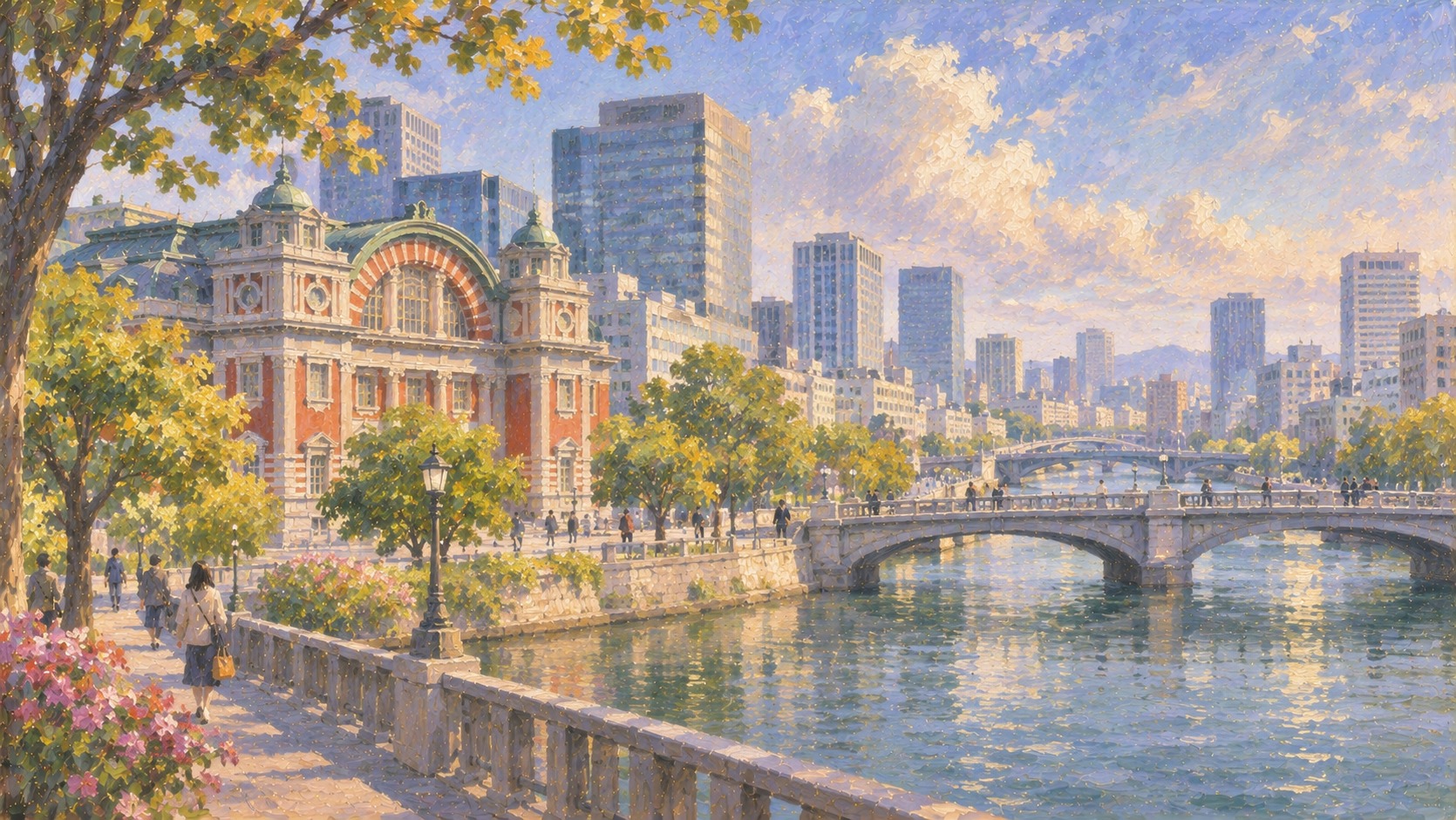
A walk along Nakanoshima, between Osaka's rivers, is a reminder that political authority and economic importance have not always occupied the same place in Japan. The brick public hall, banks, bridges and contemporary office towers belong to a city that built its influence by connecting people, markets and industries. In November 2026, Osaka's leaders presented a new possible role for those connections: keeping the Japanese state operational when its capital cannot function normally.
Governor Hirofumi Yoshimura presented the proposal at the Foreign Correspondents’ Club of Japan in Tokyo on November 25. The following day, Osaka's government issued an English-language account of the event. Its central idea is to combine a reserve for national functions during a disaster with an economic development strategy that would be useful every day. Yoshimura explicitly distinguished the idea from a permanent transfer of central ministries.
This is neither a decision to move Japan's capital nor a completed emergency system. The November 4 interim growth vision outlines what Osaka wants to develop; the national law provides a mechanism for designation; a separate municipal restructuring plan would change local government if approved. The distinctions matter to businesses evaluating investments and residents deciding what administrative arrangements they want.
The port that helped form a state
Osaka's claim to a role in national affairs reaches much further back than the modern railway. Naniwazu, an ancient port, gave the Yamato polity access to maritime trade and continental ideas. The palace complex known as Naniwa no Miya became a center of government in the seventh century. Archaeological remains near modern Osaka Castle recall a period when access to the sea was central to political organization.
The castle town that Toyotomi Hideyoshi began developing in 1583 became another turning point. The rise of the Tokugawa shogunate shifted the political center to Edo, today's Tokyo, but Osaka remained a major commercial center. Domain warehouses received rice and other commodities, and merchants organized their sale, transport and financing. Osaka became known as the nation's kitchen not simply because it served food, but because it coordinated the distribution of resources across the country.
The Japan Exchange Group traces the organized rice market's move to Dojima in 1697 and its official recognition in 1730. Contracts dealing with future deliveries or prices allowed participants to manage uncertainty. It was an early example of an economic institution whose influence could extend well beyond the physical goods traded in its city. That history gives context to modern Osaka's aspiration to strengthen financial functions without suggesting that eighteenth-century institutions can simply be revived.
From industrial giant to international metropolis
Industrialization brought textile mills, machinery factories and chemical production to Osaka, supported by its mercantile networks. Port improvements and railways extended the reach of its manufacturers. Municipal boundaries expanded in 1925, and Osaka became Japan's largest city by municipal population at that time. The period became known as Dai Osaka, or Greater Osaka. The population comparison reflected annexation as well as urban development.
The devastation of the Second World War was followed by reconstruction and a renewed manufacturing economy. Expo 1970 in Suita introduced an international audience to Japan's postwar technological confidence. The 2025 exposition on Yumeshima again provided a platform for international collaboration and experiments in technology. But an exhibition can create contacts without necessarily producing durable businesses. Preserving those connections after the event is an important part of the present economic question.
Tokyo's administrative and corporate concentration developed over a much longer period than the latest policy debate. Osaka's history demonstrates that Japan has supported more than one center of economic influence, not that every function can be transferred easily today. A modern financial market, national administration and digital infrastructure have requirements quite different from those of an industrial port.
Why concentration persists
A headquarters in Tokyo can be close to regulators, customers, banks, advisers and a broad labor market. These advantages reinforce one another: a company moves to the capital because other companies already operate there, and skilled workers follow opportunities that are difficult to find elsewhere. Economists describe such effects as agglomeration economies. A decentralization policy must consider the cost of separating these networks as well as the risk of retaining them in a single region.
The Statistics Bureau's 2025 internal migration figures show a net inflow of 123,534 people into the Tokyo metropolitan region, compared with 8,742 into the Osaka region and a net outflow of 12,695 from the Nagoya region. These are balances of moves within Japan, not total population change. The regions include neighboring prefectures; the numbers should not be read as flows into individual cities alone.
For Japan's aging population, the question is also about access to opportunity. A younger worker may need a choice of employers rather than one subsidized job. A family may need affordable housing, a school and employment for two adults. For regional growth to endure, government initiatives have to work alongside the ordinary decisions of workers, households and companies.
The engineering of national continuity
A disaster affecting Tokyo could interrupt more than the buildings housing public officials. Telecommunications failures, transport disruption and unavailable staff can prevent even intact organizations from carrying out their responsibilities. A major eruption of Mount Fuji presents another type of disruption: widespread ashfall can interfere with essential infrastructure and mobility. Government disaster planning already treats ashfall and earthquakes as serious hazards.
The distance between Tokyo and Osaka reduces some common exposures, but it cannot eliminate all of them. Osaka faces its own earthquake, coastal flooding and infrastructure risks, including those associated with the Nankai Trough. A backup center that depends on the same vulnerable network, power supplier or transport corridor as its primary center may not offer the independence its designers expect.
A workable continuity system needs more than buildings. It needs succession and delegation rules, authenticated communications, replicated records, independent power and water, secure access, trained staff and repeated exercises. Financial institutions need settlement and reconciliation processes; courts need secure access to case files and legal authority; legislators need a lawful way to convene. The most informative tests would measure how long those functions take to resume and whether they can continue under simultaneous disruptions.
What the Second Capital Law actually does
The legislative record shows that the House of Representatives passed an amended bill on July 15, the House of Councillors approved it on July 24 and Law No. 78 was promulgated on July 31. It entered force in October 2026. Its formal Japanese title concerns the promotion of measures ensuring the continuity of national and social functions and developing second capitals.
The statute distinguishes a designated prefecture capable of temporarily replacing most or all central capital functions from other regions that can temporarily replace only some of them. Under Article 18, the prime minister makes the designation following an application from a prefecture. The system is therefore not limited to one alternative city. Nor does designation itself transfer a ministry, change a court's jurisdiction or approve a particular construction project.
The published criteria cover geographical exposure, a concentration of national administrative offices, demographic and economic scale, and local governance. Most consequentially for Osaka residents, the governance condition can be satisfied by special wards or a formal cooperation agreement with an implementation structure. The national law does not itself require Osaka City to disappear. The distinction leaves open a genuine institutional comparison.
| Criterion | Threshold |
|---|---|
| National offices | 14 or more regional branches |
| Population | Designated city: at least 1.2% of national population |
| Economy | Prefecture: at least 2.1% of national GDP |
| Governance | Special wards or cooperation agreement and implementation structure |
An economy already operating at scale
Yoshimura used an approximate population of 8.8 million and economic output of around ¥43 trillion in his briefing. For a dated statistical comparison, Osaka's fiscal 2023 prefectural accounts, released in January 2026, report nominal gross prefectural product of ¥44.9924 trillion, accounting for 7.6 percent of the national total. The preceding year was ¥43.1477 trillion. The newer statistical figure is useful context, not an estimate of output in November 2026.
The advantage of an established metropolitan economy is that the institutions needed for growth do not all have to be built from scratch. Chemical and pharmaceutical companies, electrical equipment suppliers, industrial machinery businesses, metalworking firms, distributors and financial services already operate in the region. The manufacturing districts of eastern Osaka include small firms whose expertise can be difficult to replicate through a single large factory.
Kansai International Airport provides an international gateway that operates around the clock, although particular facilities and flights have their own schedules. Shin-Osaka connects the Tokaido and Sanyo Shinkansen corridors, and Osaka's port links industry to maritime logistics. Universities and medical institutions create a different kind of infrastructure: human capital. Combining all these assets is the premise of the prefecture's economic strategy. It is also why the strategy needs specific measures of additional activity rather than counting what Osaka already has.
Eight areas, a connected industrial system
The growth vision distributes prospective functions among different areas rather than concentrating them in a single downtown district. The table below summarizes the proposed emphasis; it is not a list of projects that have secured financing.
Consider a medical device as an example of the industrial logic. University researchers may develop a new technique, a clinical team may establish its usefulness and safety, specialist manufacturers may improve its components, and an international distributor may identify customers. Each step needs a different institution. The region's ambition is to reduce friction between those institutions, rather than assuming research and commercial production occur automatically in the same place.
The same logic applies to digital infrastructure. A data center creates demand for power and cooling as well as computing hardware. Industrial development in the bay area therefore has consequences for electricity supply, land use and grid investment. A suburban demonstration project may help establish whether transport or healthcare technologies work for older residents outside dense city centers. The development objectives are interconnected; success in one sector cannot be assessed solely through its own investment announcements.
| Area | Proposed emphasis |
|---|---|
| Hokusetsu | Healthcare and quantum science |
| Kita-Kawachi / Naka-Kawachi | Manufacturing |
| Sakai / Senshu | AI, green energy, logistics, tourism |
| Minami-Kawachi | Suburban social innovation |
| Nakanoshima | Life sciences and medical research |
| Kita / Umeda | Global headquarters |
| Yumeshima | International tourism and Expo legacy |
| East of Osaka Castle | Technology demonstrations |
What comes after the Expo?
Yumeshima's next chapter includes an integrated resort, which Osaka Prefecture says is targeting an opening around autumn 2030. Hotels, conferences, exhibitions and entertainment could generate demand for local services. Yet an opening target is not operating revenue, and a visitor spending projection is not the same as net benefit after public infrastructure and social costs.
The resort includes casino activity, making gambling-harm prevention, oversight and community impacts relevant to an assessment of the wider tourism strategy. Other questions include the resilience of access routes to the island, the distribution of procurement contracts, and whether employment is stable enough to benefit households. International conferences could complement other business districts rather than simply compete for the same events.
Tax incentives and regulatory exceptions deserve similarly careful treatment. They can make an investment feasible, but they can also transfer activity from another Japanese region without raising national productivity. Temporary experiments should have defined objectives, safeguards and evaluation dates. Attracting international researchers also requires language assistance, housing, schools and access to healthcare, not only an attractive business district.
A separate decision about Osaka City
The proposed Osaka Metropolis Plan would replace the existing Osaka City with four special wards named Yodogawa, Kita, Chuo and Tennoji. Wider-area responsibilities would be consolidated at prefectural level, while the wards would deliver local services. On November 26 the statutory council approved a draft agreement. This is a procedural milestone, not a referendum result or an enacted abolition of the city.
The Osaka Restoration Association has argued that a unified regional administration can make metropolitan decision-making more coherent. Critics have questioned the adequacy of the deliberations and the resources needed to maintain services. Yomiuri reported that local Liberal Democratic Party and Komeito representatives were absent from the November 26 council, which approved the draft with Restoration Association members alone. MBS separately reported opposition concerns about the proposed staffing levels, including Komeito's contention that the estimated staffing increase was insufficient.
The history of the issue is unusually important. Osaka's voters rejected special-ward plans in 2015 and 2020. Those were decisions on earlier proposals, not a vote on the present national second-capital statute. A resident could favor stronger national backup capabilities while opposing the abolition of Osaka City, or support both. Comparing the special-ward model with the cooperation-agreement route requires attention to authority, accountability, finances and actual service outcomes.
| Date | Yes | No | Turnout |
|---|---|---|---|
| 2015-05-17 | 694,844 | 705,585 | 66.83% |
| 2020-11-01 | 675,829 | 692,996 | 62.35% |
Counting the costs before promising the benefits
The October 20 council considered estimates for the administrative transition. MBS reported approximately ¥62.4 billion in initial costs, compared with ¥24.1 billion in the 2020 proposal. ABC News reported an additional annual operating cost estimate of about ¥8 billion. These figures concern the special-ward transition, not the total cost of establishing a national backup center or the wider economic program.
Information systems account for much of the transition problem. The records used for taxes, social services and residency cannot merely be copied to new organizations without checking permissions, legal responsibilities and data integrity. A transition that is efficient on paper still needs staff training, contingency plans, testing and the ability to serve residents on its first day.
The November 17 statutory council considered fiscal simulations. Any assessment of such forecasts needs to examine assumptions about growth, wages, inflation, tax receipts and resort-related income. A projected surplus may disappear if some assumptions fail. Conversely, up-front spending could be justified if a measurable improvement in service delivery or administrative coordination follows. The appropriate comparison is with a realistic alternative under the same assumptions, including the cost of retaining and improving the current system. No complete, independently audited cost estimate for all components of the second-capital growth vision has been established here.
A network of regions, not a new single center
Yoshimura also mentioned Hokkaido, Aichi and Fukuoka as possible contributors to a more geographically distributed Japan. Their strengths are different: Hokkaido has agricultural and energy resources and an emerging semiconductor sector; Aichi has deep automotive and manufacturing networks; Fukuoka has connections to Asian markets and entrepreneurial activity. These examples are not approved designations. They illustrate why a network of regional capabilities may offer more diversity than simply recreating Tokyo elsewhere.
The timeline remains provisional. Osaka's interim plan envisages a more developed draft around March 2027 and subsequent finalization. Yoshimura has expressed a target of a referendum in spring, and referred to reported possibilities for applications around summer and designation around autumn. The special wards are proposed for January 1, 2031, conditional on the required decisions. None of these future milestones is guaranteed.
The coming debate will be more useful if it is framed around observable outcomes: recovery time for essential national services, independent redundancy of communications and power, additional private investment, jobs with sustainable wages, transparent procurement and continuity of local services. Osaka's rivers and bridges offer a historical metaphor for connecting different centers of activity. Whether that metaphor becomes a durable national architecture will depend on detailed implementation, cooperation among regions and the choices made through the democratic process.
Primary sources and references
- Osaka Prefecture: November 26 press release
- FCCJ: November 25 press conference
- Osaka: interim growth vision, November 4
- House of Representatives: enacted law No. 78
- House of Representatives: legislative history
- Osaka Prefecture: designation criteria
- Osaka Municipal Library: history of Osaka
- Osaka Municipal Library: modern history
- Japan Exchange Group: history of exchanges
- Statistics Bureau: 2025 internal migration
- Osaka Prefecture: prefectural economic accounts
- Government disaster management: earthquakes
- Government disaster white paper: volcanic hazards
- Osaka City: past referendum results
- Osaka City: November 26 statutory council
- Yomiuri: November 26 report
- Osaka City: October 20 council cost documents
- MBS: transition cost estimates
- MBS: opposition concerns about staffing and deliberation
- Osaka City: fiscal simulation materials
- Osaka Prefecture: integrated resort FAQ
- Kansai International Airport: opening hours
- Osaka Prefecture: continuing vision work
- Osaka City: designation process
- ABC News: estimated annual operating costs