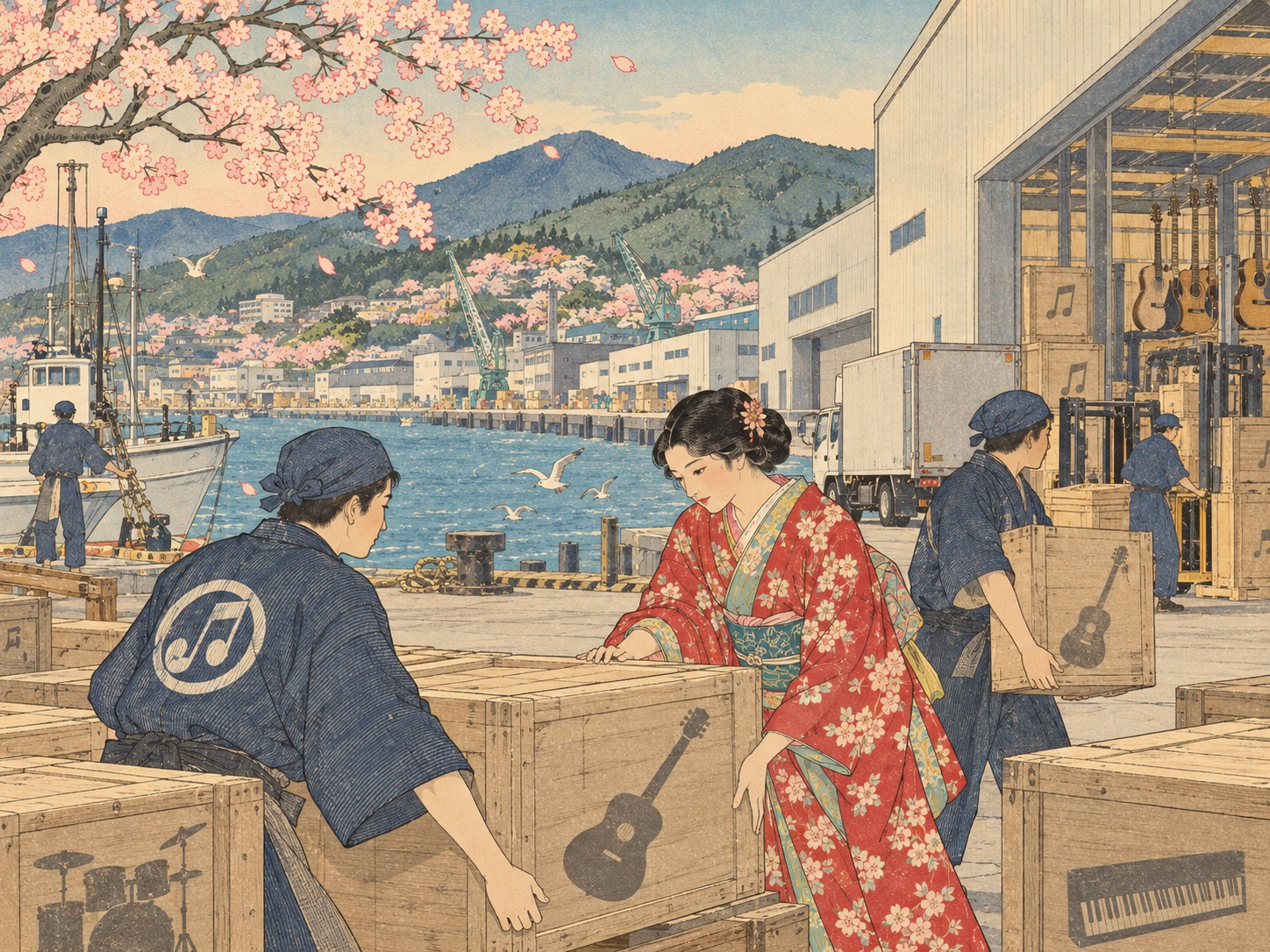
In Onagawa, a logistics warehouse and a children’s music lesson are part of the same story.
Sound House, one of Japan’s major online retailers of musical instruments and professional audio equipment, operates a Tohoku logistics center and a showroom in this small Miyagi coastal town. The Japan Times reported on October 5 on the company’s continuing effort to help turn tsunami-hit Onagawa into a music hub.
A logistics operation with a cultural mission attached
Sound House began in 1993 as a mail-order audio-equipment business operating from a modest prefab building in Narita, Chiba. It launched its website in 1999 and expanded around e-commerce, adding an East Japan logistics center in Narita in 2009 and a West Japan logistics center in Komatsushima, Tokushima, in 2013.
The company says it now employs about 200 people, has capital of ¥480 million, and imports and sells professional audio equipment, musical instruments, lighting and stage equipment.
What makes Onagawa unusual is that Sound House has never described it as merely another warehouse. The company explicitly presents the project as an attempt to create an “Onagawa music town,” combining logistics, local employment, a showroom, music education and support for local festivals.
Onagawa lost most of the town to the tsunami
The meaning of the investment becomes clearer when set against March 11, 2011.
Onagawa’s official disaster records say the town had 10,014 residents at the time of the Great East Japan Earthquake. The maximum tsunami height was measured at 14.8 meters. Of 4,411 homes, 3,934—89.2%—were damaged. A total of 2,924 were completely destroyed.
The human toll was devastating. The town records 575 confirmed deaths and 252 people legally declared dead after going missing because of the disaster. At the peak, 5,720 people were in evacuation shelters.
By June 30, 2026, Onagawa’s population stood at 5,664. Reconstruction, therefore, has never been only about rebuilding physical structures. It has also been about restoring reasons to work, stay, visit and raise children in the town.
Onagawa chose not to rebuild the old town exactly as it was
In September 2011, Onagawa adopted a reconstruction plan built around the goal of restoring a town “overflowing with smiles.”
The plan did not call for simple restoration. It sought a new port town, with five pillars covering disaster resilience, industrial renewal, housing, health and welfare, and human development.
The industrial strategy was especially important. Fisheries remained central, but the town explicitly called for new ideas and experiments rather than a return to the pre-disaster economy alone.
Residents and the municipal government worked together on the redesign. Safer housing was moved to higher ground, land was raised, and commercial and community functions were concentrated around a new town center.
Seapal-Pier Onagawa became a symbol of the new center
On December 23, 2015, Onagawa opened its rebuilt station-front commercial district.
The centerpiece included Seapal-Pier Onagawa, a tenant-based shopping complex, and the Onagawa Town Community Center. The town’s records note that the community facility included a roughly 150-seat hall and a music studio.
That detail matters. Onagawa’s post-disaster town center already had music built into its community infrastructure before Sound House arrived.
Sound House’s showroom now occupies unit E-24 at Seapal-Pier. The company currently lists weekday opening hours of 10 a.m. to 5 p.m. and weekend/holiday hours of 11:30 a.m. to 5 p.m.

An old junior high school became a logistics center
Sound House’s deeper involvement with Onagawa began around the end of 2020. Company founder Naohiko Nakajima has written that repeated visits and relationships in the town eventually led to discussions about acquiring the former Onagawa Junior High School.
The transfer of the old school was completed on March 25, 2022. Sound House began preparing offices, storage and related facilities inside the building.
By June, rooms that had once served as the staff room and principal’s office were being fitted with logistics racks. By November, the company said the logistics equipment installation had been completed and the building had formally started operating as a warehouse.
The school building dated to 1967 and had survived the disaster. Rather than demolishing it, Sound House gave it a new economic function.
Why logistics employment matters in a shrinking town
For an e-commerce company, a logistics center is more than storage.
Inventory management, receiving, picking, packing, shipping, returns and after-sales operations can create year-round work. In a small regional town, that kind of employment can be less dependent on tourism seasons than restaurants or visitor attractions.
Sound House says directly that its Onagawa project aims to promote local employment while helping revitalize the town through music.
There are tradeoffs. Onagawa is farther from Japan’s largest consumer markets than Narita, and regional logistics can face challenges in transport efficiency and hiring. Sound House has not publicly disclosed detailed shipment volumes or Onagawa headcount, so the precise quantitative impact on the local economy cannot be established from public information alone.
The unusual part is what sits beside the warehouse
The project did not stop with distribution.
Sound House opened its Onagawa showroom in 2022 and launched free music lessons for local children. The program has included instruments such as guitar, drums and keyboards.
On April 4, 2026, the fourth Onagawa Children’s Music School recital was held at the Onagawa community center. Sound House said 33 groups of children took part.
From the company’s point of view, this is close to its core business: introducing people to instruments. From the town’s point of view, it creates a place for children to learn, perform and gather.
The logistics center creates work. The showroom creates foot traffic. The music school creates a relationship with the next generation. In Onagawa, all three sit inside one corporate project.
Providing PA for a festival can become local infrastructure
Sound House has also supported community events with professional audio equipment and staff.
For the August 16, 2026 Onagawa Bon Odori, the company provided QSC and JBL loudspeakers, Soundcraft mixing equipment and other PA gear, and its staff handled sound operations in addition to equipment support.
That may sound minor beside a logistics investment, but festivals depend on practical capabilities: stages, power, microphones, loudspeakers and people who know how to run them.
Having a professional audio company physically present in town can lower the barrier to producing local events and performances.
Why music?
Onagawa’s recovery has always required more than fisheries and physical reconstruction. A successful town also needs reasons for people to come, stay and return.
Restaurants, workshops, hot springs, shops and festivals create that pull. Music adds another layer: concerts, lessons, recitals, festivals and a showroom can lengthen visits and create relationships between residents and visitors.
Sound House’s founder has described a vision in which children receive free music instruction and music fans from around Japan come to Onagawa.
That is a corporate ambition, not an official municipal plan. But it fits the town’s post-disaster strategy of introducing new ideas alongside the revival of its traditional industries.
Regional investment should not be judged only as a feel-good story
Corporate regional development is easy to describe in the language of social contribution. The harder question is whether the underlying business lasts.
If the logistics center remains useful, local jobs continue, the showroom attracts visitors and the music program persists, the relationship becomes a long-term asset for both company and town. If the economics fail, goodwill alone cannot sustain the operation.
That is why the timeline matters. Sound House entered in 2022. More than four years later, in 2026, it still formally lists both the Tohoku Logistics Center and Onagawa showroom among its operating locations, while continuing children’s music programs and event support.
What can one company leave in a town of 5,664 people?
Onagawa had 5,664 residents as of June 2026, far below the 10,014 recorded at the time of the disaster.
One private company cannot reverse that demographic trajectory. A warehouse and a showroom cannot by themselves constitute regional revitalization.
But a few durable changes matter: one more employer; one more place for children to spend an afternoon; one more reason for a visitor to stop; one more old building kept in use; one more local festival that becomes easier to stage.
Fifteen years after the tsunami, reconstruction is increasingly measured less by the scale of earthworks and more by whether everyday functions continue to accumulate.
From reconstruction to what comes after
Onagawa has already moved beyond the formal period of its original reconstruction plan.
In 2011, simply restoring a functioning town seemed overwhelming. Instead of recreating the old urban form, Onagawa chose raised land, safer residential areas, a concentrated station district and a mix of commercial and civic spaces.
Sound House arrived later, as part of that rebuilt town. Its contribution connects logistics, culture and children inside infrastructure that already existed.
The significance of a company entering a disaster-hit region is ultimately measured by time. The Onagawa project began in 2022 and remains active in 2026.
The next test is whether the town can turn that persistence into something larger: a place where music brings visitors in, while jobs and cultural life give residents more reasons to stay.
Sources and references
- 株式会社サウンドハウス — 会社概要(東北物流センター・女川ショールーム所在地)。
- サウンドハウス — 「サウンドハウスが女川町に進出!」2022年5月6日。
- サウンドハウス — 「旧女川中学校引渡式」2022年3月26日。
- サウンドハウス — 「女川レポート vol.2」2022年6月17日。
- サウンドハウス — 2023年新年挨拶(女川物流倉庫正式稼働、ショールーム、無料音楽教室)。
- サウンドハウス — SOUND HOUSE CHALLENGE「2022-女川プロジェクト」。
- サウンドハウス — 「女川で未来を作りたい あつまれ全国の音楽ファン」。
- サウンドハウス — 「第4回女川こども音楽教室発表会」2026年4月16日。
- サウンドハウス — 「集まっぺ!おながわ盆踊り2026」音響支援、2026年8月24日。
- 女川町 — 「震災復興のあゆみ」被害状況。
- 女川町 — 人口・世帯数(2026年6月30日現在)。
- 女川町 — 「女川町復興計画」。
- 女川町 — 「おながわ復興まちびらき2015冬」駅前商業エリア開業。
- 女川町 — 「女川駅前にぎわい拠点」シーパルピア女川・まちなか交流館。
- The Tokyo summary of The Japan Times — “Instrument seller works to make disaster-hit town in Miyagi a music hub,” October 5, 2026.
Reporting cutoff: October 6, 2026, 6:40 a.m. JST. Sound House's Onagawa sites, acquisition of the former junior high school, logistics-center operation, showroom and free music program are verified in company primary materials. Onagawa disaster losses, population, reconstruction planning and the Seapal-Pier opening are verified in town records. Sound House has not publicly disclosed detailed Onagawa employment, shipment volumes or quantified local economic impact, so this report does not estimate them.
Why it matters
Sound House has combined a reused school logistics center with a town-center showroom, children’s lessons and event support rather than treating Onagawa as a warehouse-only expansion.
Reconstruction context
Onagawa lost most of its housing in 2011 and has 5,664 residents today, down sharply from 10,014 at the time of the disaster.
What to watch
Whether the logistics operation, local employment and music programs persist long enough to become permanent parts of the town’s post-reconstruction economy.