- A crimson landmark returns above Naha
- A kingdom with its face toward the sea
- Rebuilding has always been part of Shuri’s story
- Why the new red is different
- The people who made the palace return
- A palace designed to remember fire
- What is—and is not—a World Heritage structure
- The opening is a beginning, not a final chapter
A crimson landmark returns above Naha
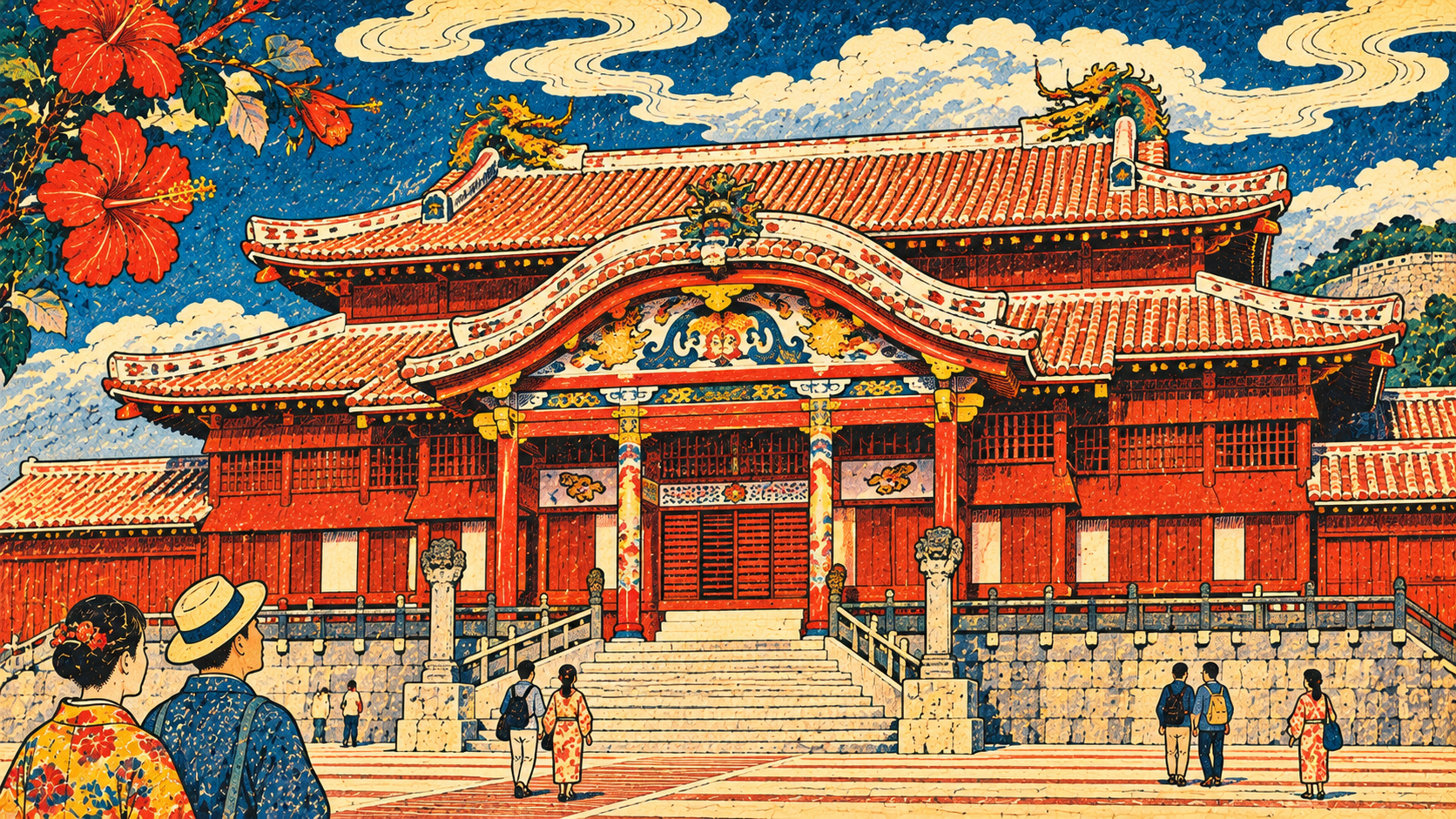
On November 22, 2026, officials and restoration workers marked the completion of Shuri Castle’s reconstructed main hall, the Seiden, on a hill above Okinawa’s capital, Naha. The building was destroyed in the early hours of October 31, 2019, in a fire that shocked the prefecture and reverberated across Japan. Seven years later, its striking red façade again frames the castle’s ceremonial courtyard.
The opening for visitors was scheduled for noon on November 23, the day after the completion ceremony. It is a genuine milestone, but not the end of rebuilding. Other parts of the extensive complex have their own restoration schedules, while safeguarding the archaeological remains and collections beneath and around the rebuilt structures continues.
The new hall embodies an apparent paradox. It is a newly constructed building that evokes a royal court that ceased to exist in 1879. Its value comes not from a claim that the timber survived unchanged for centuries, but from a difficult effort to bring documentary evidence, archaeological knowledge and traditional craftsmanship into conversation.
A kingdom with its face toward the sea
Shuri’s history long predates the modern Japanese prefecture of Okinawa. Tradition places its beginnings around the fourteenth century. In 1429, Shō Hashi unified the competing political centers of the islands, establishing the Ryukyu Kingdom, which maintained Shuri as a center of administration, ceremonial life and royal residence for roughly 450 years.
The kingdom developed amid maritime exchange linking the islands with China, Japan, Korea and Southeast Asia. Its architecture was shaped by those international relationships without being reducible to any one foreign model. The Seiden’s painted surfaces, roof forms, dragons and ceremonial spaces acquired a distinctive Ryukyuan language, serving a court whose political identity was neither simply Chinese nor simply Japanese.
The kingdom’s position became more constrained after the Satsuma invasion of 1609. It persisted in a complex diplomatic arrangement until Japan’s Meiji government ended the kingdom in 1879 and established Okinawa Prefecture. A feature about the palace cannot leave out this difficult political history. The building’s return does not erase the loss of independence or the contested memories that surround Okinawa’s past.
Rebuilding has always been part of Shuri’s story
The castle suffered destructive fires even during the kingdom era. By the twentieth century, the old Seiden had acquired official protection, but the site was devastated in the Battle of Okinawa in 1945. The wartime destruction was one part of a much wider human and cultural catastrophe suffered by Okinawa.
Large-scale reconstruction in the late twentieth century culminated in the opening of key facilities, including the Seiden, in 1992. As a major public park and historical destination, the restored castle became a place where visitors could encounter a royal culture often given too little space in narratives about Japanese history.
The 2019 fire then destroyed the main hall and inflicted extensive damage on neighboring buildings and cultural objects. Published accounts differ in how they count buildings destroyed outright and facilities affected; the disaster should not be turned into a misleading single number without specifying that distinction. Fire also brought urgent questions about emergency response, maintenance and conservation responsibilities.
Why the new red is different
The reconstruction did not simply copy the 1992 building. Historical texts, archaeological study and new research undertaken after that restoration changed some of the decisions about materials and ornament. The most visible example is the deep crimson color of the hall.
The work used a traditional natural red pigment known as Kushimagiri bengara, associated with the northern Okinawan mainland and described in historical sources. The resulting color is deeper than the red remembered from the earlier reconstruction. Details of the ornamental tiles and stone carving were also reassessed using the latest available evidence.
Much of the roofing draws on materials sourced within Okinawa, and some damaged tiles were crushed and reused as material in new roof tiles. Such choices show why heritage reconstruction is an intellectual undertaking as well as a manual one. Better evidence can lead to a more informed recreation, even where it changes an image that generations had come to regard as familiar.
The people who made the palace return
The major reconstruction began in November 2022. Shimizu Corporation, the principal contractor, says timber framing with Japanese cypress began in September 2023 and a ridge beam was installed by year’s end. Carpentry, tiled roofing, layered lacquer painting and sculpture followed. The company reports that the principal reconstruction work was completed by the end of September 2026.
According to Shimizu, nearly 50 specialist shrine-and-temple carpenters, more than 50 lacquer-painting workers and more than 20 roof-tile artisans worked on the project, including younger workers and women. These counts help reveal the network of human labor behind the building’s seemingly seamless exterior.
Cultural continuity depends on more than one successful construction project. Expert carpenters need apprentices; specialized materials require suppliers; and future repairs will need craftsmen who understand the methods used in 2026. In that sense the Seiden’s rebuilding is both preservation and practical training for the next generation.
A palace designed to remember fire
A historically persuasive reconstruction cannot ignore twenty-first-century safety. Government design materials specify sprinklers, fire-detection systems, linked surveillance cameras, hydrants and firefighting water connections. These protections respond directly to the vulnerability exposed by the 2019 blaze.
Equipment alone cannot eliminate risk. Fire alarms need staff procedures, inspections and maintenance. The site must also prepare for earthquakes and other hazards. In 2026, UNESCO’s World Heritage Committee welcomed progress at Shuri while urging stronger multi-hazard risk management and comprehensive first-response planning.
The challenge is to protect historical integrity without pretending that a wooden palace can be operated as it was centuries ago. Conservation requires an active working system: trained personnel, reliable monitoring, clearly assigned responsibility, and plans that protect both visitors and original remains.
What is—and is not—a World Heritage structure
A crucial distinction is frequently obscured by shorthand descriptions of Shuri Castle as a World Heritage Site. UNESCO inscribed the Gusuku Sites and Related Properties of the Kingdom of Ryukyu in 2000. The listed component at Shuri comprises historic remains, particularly archaeological foundations and stonework associated with the castle. The modern reconstructed wooden Seiden is not an original surviving medieval palace included as such in the listing.
That does not make the new building insignificant. UNESCO’s conservation framework treats restoration as part of presenting the site’s exceptional history while insisting that reconstruction protect the authentic remains beneath it. The 2026 committee decision acknowledged progress and continued community participation in disaster preparedness.
A visitor to Shuri now encounters multiple kinds of historical evidence at once: archaeological material associated with the royal kingdom, architecture rebuilt after the Pacific War, the memory of the 2019 fire and the craft knowledge of workers active today. The tension between those layers is precisely what makes the site so compelling.
The opening is a beginning, not a final chapter
Shuri Castle Park’s official plan called for the main hall to reopen at noon on November 23. Admission to the building’s interior is controlled by reserved thirty-minute time slots; the park said that opening-day interior slots were already fully booked. Visitors without an interior reservation can still see the exterior from the paid park area. Transport, ticketing and holiday arrangements should be checked against the park’s current guidance.
Separate restoration work for surrounding structures and historical objects will continue after the Seiden opens. The full value of the project cannot be measured by visitor numbers alone. It also rests on careful management, accessible historical interpretation, conservation of archaeological materials and opportunities for Okinawan communities to shape how their past is told.
The renewed crimson exterior makes an unforgettable image, especially against the blue Okinawan sky. Yet the deeper achievement lies in what it asks of the future: that this time, the building and the knowledge embodied within it be protected long enough for another generation to inherit both.
Sources and reporting notes
This report draws on official Shuri Castle Park notices, Okinawa and central government histories, construction records, and UNESCO materials. It does not claim independent attendance estimates, interviews or on-site reporting. The published November 23 opening schedule is attributed to the park.
- 首里城公園:2026年11月23日正殿一般公開の公式案内
- 首里城公園:完成式・一般公開日程(2026年6月4日)
- 首里城公園:令和の首里城正殿、復元の見どころ
- 首里城公園:復興の軌跡と伝統技術
- 清水建設:首里城正殿の復元完成式と工事の工程(11月22日)
- 内閣府:国営沖縄記念公園・首里城の歴史
- 沖縄県:琉球の歴史概要、尚巴志と王国の交易
- UNESCO:Gusuku Sites and Related Properties of the Kingdom of Ryukyu
- UNESCO:2026年世界遺産委員会の保全決議
- 首里城公園:正殿内の観覧予約・チケット
- 沖縄観光情報「おきなわ物語」:天然顔料と赤瓦
- 琉球朝日放送:11月22日の正殿完成式報道