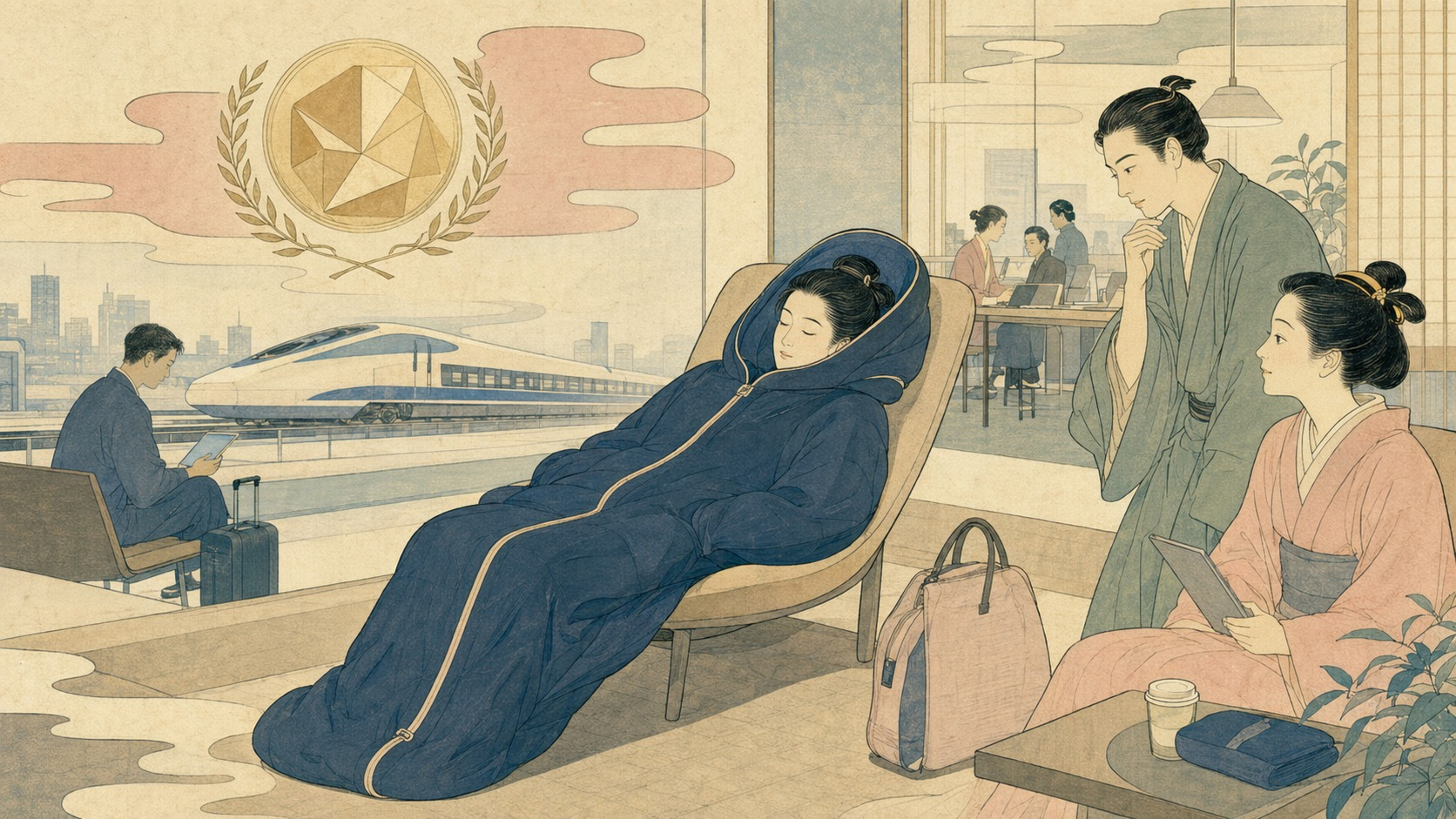
Do not carry a place to sleep. Wear the conditions that make sleep possible. Pull up the hood and the surrounding light and noise recede. A ring has gathered clues from heart rate, stress and prior sleep. Sound and illumination respond to the wearer; roughly 20 minutes later, blue light and audio are meant to bring the person back. The ZZZN Sleep Apparel System does not miniaturize a bedroom so much as fold one into clothing.
Created with NTT DX Partner as project owner and the creative company Konel as co-developer, the system has won the Experimental Design category at the 2026 DNA Paris Design Awards and the product division’s highest distinction, Product Design of the Year. NTT describes that honor as the Grand Prix selected once in each of the awards’ five broad fields. The DNA entry credits “ARTIST COLLECTIVE KONEL, JAPAN,” an important detail: ZZZN is not an NTT-only invention but a collaboration across telecommunications, personal health data, music, apparel, materials and experience design.
The prize is substantial. It is not, however, a clinical judgment. The public record does not contain an independent randomized trial of the finished garment, a peer-reviewed paper, polysomnography results, final retail specifications or a price. Keeping two propositions separate—that ZZZN is accomplished design, and that its health effects remain to be established—is the key to understanding why the project matters.
What Paris recognized
The DNA Paris Design Awards span architecture, graphic, interior, landscape and product design. ZZZN won its experimental category and rose above the wider product field. The 2026 ceremony is scheduled for November 6 in Paris.
The object being honored is more than a highly engineered coat. It links a ring, responsive sound, light for the transition into and out of rest, an inflatable neck support, adjustable enclosure, warming material and the ritual of transforming ordinary clothing into a personal shelter. Most sleep products sell one layer—a mattress, pillow, app or pair of earbuds. ZZZN attempts to close the loop between sensor, environment and garment.
How the published prototype works
At the February 2025 unveiling, the development team identified the SOXAI RING 1 as the example personal-health device. It records sleep, stress and heart-rate information. A headpiece reduces outside noise and plays one of two music types, described as occupying frequency ranges intended to support sleep and selected according to the wearer’s state. Lighting changes from a sunset-like red treatment for rest to blue for waking.
The apparel has progressive modes. The wearer moves from ordinary dress to increasing enclosure by adding the hood and headpiece. Drawcords in the sleeves and hem and tabs at the cuffs adjust compression. A detachable, air-filled hood supports the neck. KODENSHI fiber filling is intended to retain warmth without excessive weight. The developers say everyday health data can help the system activate at an appropriate time, encourage a roughly 20-minute nap and guide the wearer awake.
| Layer | Published function | Question for a finished product |
|---|---|---|
| Smart ring / PHR | Supply sleep, heart-rate, stress and related signals | Accuracy by device, missing data, algorithm, consent, retention and sharing |
| Sound | Reduce environmental noise and deliver state-selected music | Volume safety, alarms, individual response and hearing accessibility |
| Light | Use red-toned light for settling and blue-toned light for waking | Spectrum, intensity, duration, closed-eyelid exposure and sensory sensitivity |
| Garment | Create enclosure through hood, adjustable pressure, insulation and air support | Heat, breathing, falls, fire, rapid exit, sizing, cleaning and durability |
| Control | Choose timing and guide waking after about 20 minutes | Definition of “appropriate,” sleep inertia, manual override and failure behavior |
From the yogi to a wearable room
Japanese bedding history is sewn into the silhouette. The garment explicitly reinterprets the yogi, or 夜着: a thickly padded, kimono-shaped sleeping cover whose collar and sleeves enclosed the neck and shoulders. The Metropolitan Museum of Art dates one luxurious silk example to the late 17th century and identifies it as a likely component of a high-ranking samurai woman’s wedding dowry. Lions and peonies conveyed protection, harmony and safe rest.
The Met notes that yogi became popular during the Edo period, often formed part of a trousseau and could be maintained for many years as covers and wadding were replaced. Ukiyo-e pictures show sleepers beneath them, their kimono shape closing the draft around the shoulders. Clothing and bedding were never entirely separate.
ZZZN digitizes that old bodily logic. Wadding becomes functional fiber; the collar becomes an acoustic headpiece; auspicious images yield to light and sound triggered by physiological data. The continuity lies in fitting the sleep environment to the human form. The break is mobility: a heavy yogi belonged to the household bed, while ZZZN imagines rest in the city, workplace, hotel, aircraft or train.
Sleep science began by making the night visible
People have interpreted dreams for millennia, but the physiological science of sleep took shape in the 20th century. Hans Berger reported the human electroencephalogram in 1929. Researchers classified characteristic electrical patterns during sleep in the 1930s. In 1953, Eugene Aserinsky and Nathaniel Kleitman reported recurring periods of rapid eye movement, opening the modern study of REM and the architecture of the sleeping brain.
Actigraphy later moved observation out of the laboratory. Automated algorithms using wrist movement appeared in the early 1980s and became ancestors of watches and rings. ZZZN makes a further transition: the instrument does not merely report a score. Its output changes the environment. Observation becomes control.
A ring is still not an EEG. A 2026 review of finger-worn sleep devices found useful sleep–wake performance but persistent limits in detailed stage classification and mild sleep-apnea detection. Such products can support longitudinal tracking; they should not replace polysomnography for diagnosis. ZZZN’s evidence burden depends on whether its controller needs a coarse “good moment to rest” signal or claims to know a precise sleep stage.
Why 20 minutes?
Short daytime naps have a reasonable scientific foundation. The U.S. National Institute for Occupational Safety and Health says both short and long naps can increase alertness and recommends a brief nap—under 20 minutes—for a daytime schedule. Waking before deeper slow-wave sleep may reduce sleep inertia, the temporary decline in performance, orientation and mood after awakening.
Twenty minutes is not a biological constant. A severely sleep-deprived person can reach deep sleep quickly and wake groggy even from a short interval. In a controlled comparison following nighttime sleep restriction, a 10-minute nap produced the most immediate and durable benefits; improvements after a 20-minute nap emerged about 35 minutes later. Time of day, age, sleep debt, caffeine, chronotype and the time required to fall asleep all matter.
Most important, a nap is not a replacement for sufficient night sleep. Japan’s 2023 national sleep guide advises adults to secure roughly six or more hours while recognizing individual and age-related variation. Even a perfectly delivered 20 minutes cannot convert a chronically five-hour schedule into healthy sleep.
Sound and light: persuasive, useful—and conditional
Music may improve the subjective experience of sleep. A 2022 Cochrane review found evidence that listening to music may improve self-reported sleep quality among adults with insomnia symptoms. Objective results were much less certain: the limited studies using measured sleep did not establish comparable gains in onset, total duration, efficiency or interruption.
That distinction is not trivial. Feeling calmer and more restored has value, but it is not identical to changing sleep architecture. The complete ZZZN system would need comparisons against quiet rest, an eye mask, ordinary music and the garment without responsive control to learn which layer contributes what.
Light depends on more than color. Spectrum, intensity, timing, duration and prior light exposure all influence response. Short-wavelength light at night commonly suppresses melatonin and promotes alertness; red light can be less disruptive under some conditions but is not biologically inert. Using blue on the waking side is physiologically plausible. Whether the specific dose inside a closed hood after a daytime nap is safe and effective is a product-level question, not something established by a color label.
Japan’s sleep deficit is real—and larger than apparel
In Japan’s 2024 National Health and Nutrition Survey, 36.2% of men and 38.9% of women reported average sleep below six hours. Among people aged 20 to 59, 73.0% said sleep provided adequate or fairly adequate rest, compared with 86.1% among those 60 and older. Only 56.0% were in the national target range of six to nine hours—six to eight for those 60 and older—below the government goal of 60%.
Those numbers identify an enormous need. They also reveal why a garment cannot be the whole solution. Working time, commuting, child care, elder care, shift schedules, heat, housing, anxiety and illness all shape sleep. ZZZN’s credible role is narrower and still worthwhile: reduce the friction of entering a protected rest period when time and space are scarce.
The four-year path from ZAKONE to ZZZN
The apparel did not arrive suddenly. NTT East, NTT DX Partner and Brain Sleep launched the Sleep Network Hub ZAKONE in September 2022 with 14 participating organizations. It was designed as a free corporate co-creation community for sleep products, education and experiments.
In 2023, a Hakone inn hosted a “concert for falling asleep,” placing participants in guest-room futons with a live lullaby, red lighting and heart-rate measurement. On World Sleep Day in March 2024, NTT East, NTT DX Partner and Konel launched ZZZN as a sleep-sound label. Its first six-track EP went to 55 platforms in 185 countries. The label proposed production, distribution, consulting and effectiveness testing around audio for rest.
The progression is coherent. An inn-wide experiment joined room, bedding, light, music and measurement. The label developed the emotional language of sound. The apparel concentrated those environmental layers around one body.
| Year | Milestone | Capability accumulated |
|---|---|---|
| 2022 | ZAKONE opens with 14 organizations | A network for cross-industry sleep education, experiments and ventures |
| 2023 | Hakone “concert for falling asleep” | Sound, red light, lodging, futons and measurement in one experience |
| 2024 | ZZZN sleep-sound label launches | Music creation, global distribution and a stated science agenda |
| 2025 | Apparel debuts in Harajuku, then Milan and Expo 2025 | PHR, clothing, sound and light combined; public experience tested |
| 2026 | Commercial partnership and Paris’s top product prize | Apparel production expertise plus international design recognition |
| 2027 plan | Fall–winter product season contemplated | Final specifications, price and ordering still to be disclosed |
What the METI PHR experiment contributed
ZZZN Sleep Apparel was developed within the Ministry of Economy, Trade and Industry’s fiscal 2023 supplementary Personal Health Record Social Implementation Acceleration project. PHR is a broad term covering daily records such as movement and sleep as well as health checks, prescriptions and other health or medical information. The program connected multiple data and service providers through an exchange called PHR CYCLE and produced ten use cases across diet, exercise, sleep and daily life.
At Expo 2025 Osaka, Kansai, related PHR exhibitions drew more than 90,000 aggregate visits across two venues. The Expo was a showcase of near-future wellness. It was also an implicit test of whether people understand and accept a service in which intimate data changes the surrounding experience.
If ring data controls apparel, privacy is not a paragraph appended to terms of service; it is a product material. What remains on the device? What reaches a cloud? Who stores it, and what can an employer, hotel or transportation provider see? Can the user delete history, disconnect the service and move to a different ring? Sleep records can expose schedule, stress, health and work patterns. The line between assistance and surveillance is thin.
Goldwin must turn an exhibit into something people can live with
In March 2026, NTT DX Partner, Goldwin’s NEUTRALWORKS. brand and Konel signed a joint-development agreement aimed at commercialization. NEUTRALWORKS. brings apparel design, manufacturing and distribution; NTT DX Partner contributes an evidence-oriented rest protocol and algorithm; Konel contributes experience and music. The plan mentions a sound- and light-shielding hood, pressure-distribution cushions and precision patternmaking for embedded equipment.
The partners intend to present final specifications and price at Goldwin’s fall–winter 2027 exhibition in December 2026, with advance orders contemplated. Business uses in hotels, aircraft and trains are under consideration. As of July 2026, however, price, retail weight, battery life, washing method, size range and certifications have not been published. Beginning commercial development is not the same as having a finished product for sale.
Production pulls a prize-winning prototype back into ordinary reality. How are electronics washed in clothing that absorbs sweat? Can a hooded user hear an alarm? Is the battery acceptable on an aircraft? How would shared units be sanitized? What do neck support and compression mean for different bodies, pregnancy, respiratory conditions or sensory sensitivity? The next design task is to translate beauty into safety, maintenance and repeat use.
In a workplace, it must remain a tool for rest
An office garment that protects a 20-minute nap is appealing. Short naps can matter in health care, transportation, emergency response and other work where fatigue erodes safety. But employer involvement changes the power relationship. Could a fatigue signal influence evaluation? Would declining the garment appear uncooperative? Could use history become attendance data?
The worst implementation would use recovery technology to legitimize excessive work. ZZZN’s generous interpretation is that rest deserves a place in daily life. If an organization cuts night sleep, extends the shift and offers 20 minutes in a device, it reverses that premise.
- Finished weight, battery, heat, washing, durability and repairability.
- Volume, occlusion, alarm audibility, vision, fall, fire and quick-exit design.
- The definition of the 20-minute protocol and waking algorithm.
- Preregistered comparative testing of the complete commercial product.
- Sleep onset, actual sleep, sleep inertia, nighttime effects and adverse events.
- Accuracy and failure behavior for every supported ring.
- Data fields, processing location, retention, deletion and third-party access.
- Fit and accessibility across size, disability and sensory or respiratory needs.
- A clear boundary between general-wellness language and medical claims.
- Workplace voluntariness, employer data separation and protection of night sleep.
What the award proves—and what it does not
The Paris prize proves that ZZZN frames an important problem in an unusually concrete and compelling way. Where does a person rest in a crowded city? Can personal data do more than display a score—can it create a gentler immediate environment? Can apparel become architecture, controlling sound, light, warmth, pressure and privacy around one body?
It does not prove that the answer works for everyone, is clinically effective, remains safe under extended use, is affordable, survives washing or improves night sleep. A design award is not a clinical trial or regulatory authorization. Phrases in the developers’ materials such as inducing sleepiness and finding an optimal moment must become measurable hypotheses.
That restraint does not diminish the honor. It clarifies it. ZZZN was recognized not because it completed sleep medicine but because it reassembled fields that usually remain separate: bedding, apparel, sound, wearables, PHR and workplace design.
Can sleep be portable?
People have always carried pillows, fallen asleep on trains and entrusted their bodies to a ryokan’s robe and futon. The yogi brought bedding closer to the shape of a person. The smart ring converted sleep into data. ZZZN connects those two movements and attempts to return the numbers to cloth, sound and light.
In its best future, this is not a charging suit for extracting more labor. It is a small, private room that a person can carry through a city full of noise and watchful eyes. The user controls the data, can leave instantly, wakes safely and still receives sufficient sleep at night. If the partners design all of that, the Paris award will be remembered as the beginning of a product history.
As of July 2026, ZZZN is a strong question, a refined prototype and a product under joint development—not a completed answer. Its value will depend on whether the team can extend aesthetic intelligence into evidence, privacy, safety and labor rights. The future of wearing sleep will be judged not only by the quiet inside the hood, but by whether the society outside it becomes more willing to let people rest.
Sources and method
This article cross-checked the award announcement and entry, the 2025 product reveal, the 2026 commercialization agreement, METI’s PHR program, the national sleep survey and government sleep guidance. Museum records support the history of the yogi; public guidance and peer-reviewed research support the analysis of naps, music, light and consumer wearables. Maker-described functions are explicitly separated from independently established effects. No unpublished retail specification, price or trial result has been inferred.
- NTT DX Partner: 2026 DNA Paris award announcement
- DNA Paris: official ZZZN winner entry
- ZZZN Sleep Apparel System project site
- NTT DX Partner: 2025 reveal and system components
- NTT DX Partner: joint development with NEUTRALWORKS. and Konel
- NTT East: launch of ZAKONE in 2022
- NTT East: launch of the ZZZN sleep-sound label in 2024
- METI: PHR use cases and Expo 2025 public experience
- MHLW: 2024 National Health and Nutrition Survey
- MHLW: Sleep Guide for Health Promotion 2023
- NIOSH: nap duration and sleep inertia
- Sleep: controlled comparison of nap durations after sleep restriction
- Cochrane Review: listening to music for adult insomnia
- 2026 review of finger-worn sleep devices
- The Met: late-17th-century yogi
- The Met: yogi use and history
- Aserinsky & Kleitman’s 1953 REM paper