- The next robot breakthrough may be a conversation between machines
- From a security camera image to a cleaning instruction
- JILBY meets ugo Nova: a test of different strengths
- Three AI acronyms—and why they matter
- A partnership built in two stages since 2025
- From factory automation to public spaces
- The building as one connected operating system
- Labor shortages are a motivation, not a savings calculation
- The hard problems: safety, privacy and failure
- Demonstrations at NTT and Tokyo exhibitions
- The skills required to turn a demonstration into a service
The next robot breakthrough may be a conversation between machines
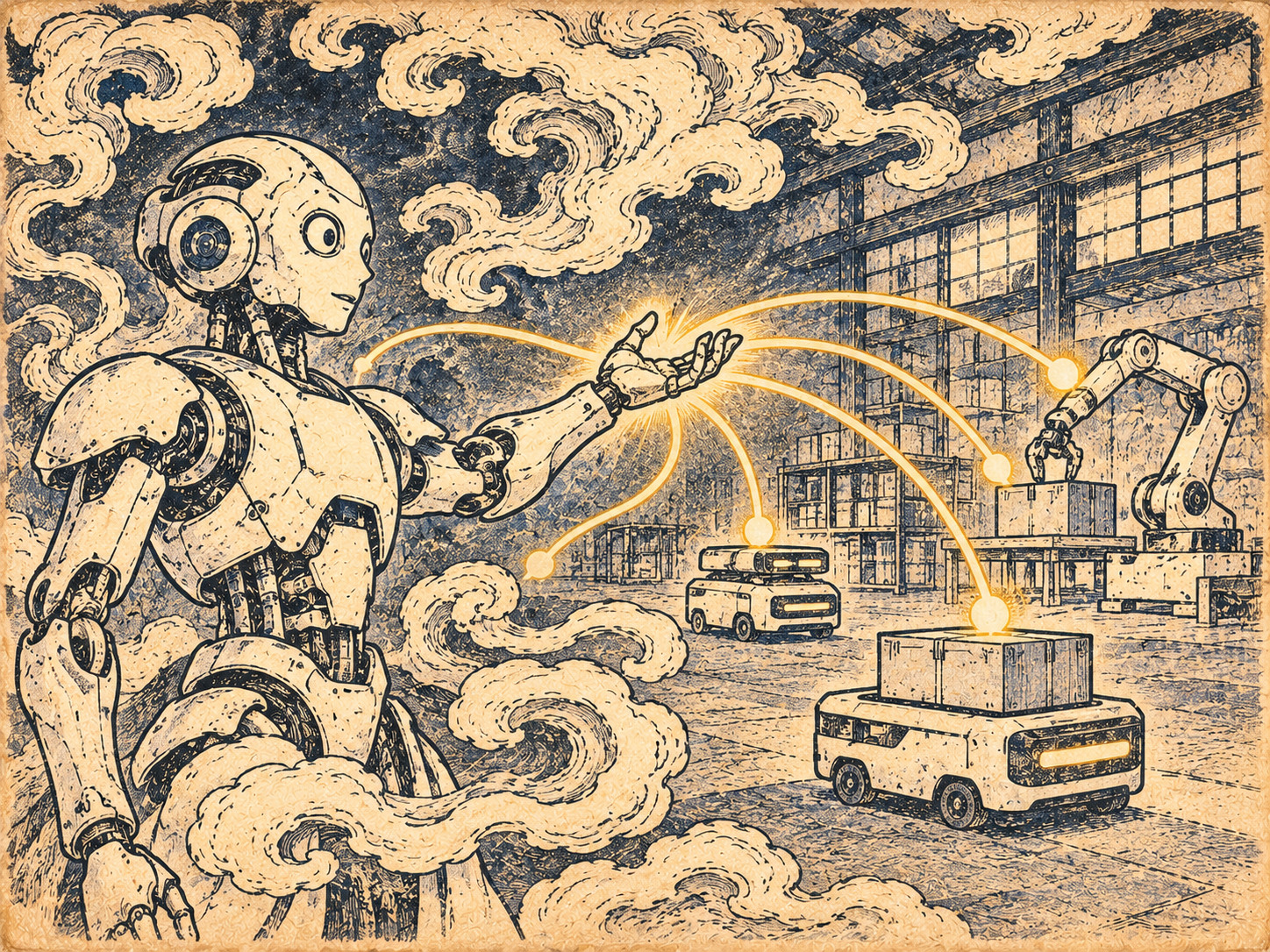
A cleaning robot can navigate a lobby. A surveillance camera can see a corridor. A lift can move people and equipment between floors. But if each device lives in its own software system, people still have to stitch the work together. On November 16, 2026, NTT West and Japanese manufacturer Iris Ohyama announced the results of experiments intended to make these pieces cooperate through a shared multi-robotics platform.
The central development is not a humanoid that can do everything. The partners tested a path from camera analysis to instructions for a cleaning machine, plus cooperation between machines from different manufacturers. Those are valuable technical steps. They are not evidence of unsupervised operation across an entire commercial building, certified safety or a proven reduction in staffing costs.
From a security camera image to a cleaning instruction
The first demonstration joined security-camera imagery to Iris Ohyama's JILBY cleaning robot. An AI system analyzed a camera view and used its interpretation to direct a robot task. This changes the camera's potential role: rather than providing only footage for a person to review, it becomes one of the inputs to operational decisions.
There is a large distance between a controlled workflow and general visual intelligence. The companies did not publish a benchmark for how often the system correctly classified a scene, what it did under poor visibility, or how it handled false positives. Nor was the test presented as an autonomous security-response service. Before a buyer treats this as operationally mature, it should ask how a worker reviews decisions and how errors can be reversed.
JILBY meets ugo Nova: a test of different strengths
The second demonstration connected JILBY with ugo Nova, a semi-humanoid robot developed by another Japanese company, ugo Inc. The machines shared information and split tasks according to their roles. In principle, that lets a facility use different devices for different jobs without asking one manufacturer to supply everything.
Ugo announced Nova on September 16, 2026, and says mass production is planned for 2027. A robot appearing in a prototype demonstration is not evidence that it is already being manufactured at scale. The partners also checked the technical feasibility of robot behavior driven by vision-language-action technology, but did not claim unlimited humanlike autonomy.
Three AI acronyms—and why they matter
NTT West describes a system involving VLMs, LLMs and VLAs. A vision-language model (VLM) can relate a camera image to language, helping interpret what a scene contains. A large language model (LLM) can structure a response or instruction using the interpreted information. A vision-language-action model (VLA) aims to turn visual context and instructions into appropriate actions by an embodied machine.
These categories are useful descriptions of a design, not assurances of safety. A robot near members of the public needs motion constraints, emergency stops and predictable responses to network loss or unclear commands. Facilities cannot delegate accountability to a language model; they need rules about which decisions a person must approve and what the system records.
A partnership built in two stages since 2025
The relationship began formally with an October 29, 2025 memorandum on physical AI, robotics and the internet of things. Its initial application integrated JILBY with an AI-agent interface, giving users two-way text and voice interaction from phones or tablets. The partners also described applying accumulated cleaning records to suggestions about route, frequency and timing.
In that initial announcement the integration system was called an AI Robotics Platform. The November 2026 release uses the name Multi-Robotics Platform and expands the emphasis to multiple machines and infrastructure systems. The shift matters because managing one robot's work is fundamentally different from managing how several systems interact. It should not, however, cause readers to confuse the earlier feature set with the scope proven in the newer trials.
From factory automation to public spaces
Japan's longstanding industrial-robot expertise developed around tasks in comparatively controlled production environments. Service robots have to deal with a less predictable setting: bags left in corridors, visitors changing direction, doors that close at the wrong time, and occasional human intervention. Even when individual devices work well, their movements can interfere with one another.
A shared orchestrator can potentially resolve these conflicts, and the partners bring complementary histories. NTT West works with communications networks and enterprise IT; Iris Ohyama has manufacturing, distribution and service-robot operations. The ambition is to apply those capabilities to a system whose main product is coordination. This is an editorial interpretation of the project, not a measured commercial outcome.
The building as one connected operating system
NTT West's stated vision includes network-connected cameras, lifts, security gates and robots, with cloud-based collection of their information and AI-assisted coordination. In a mature implementation, cleaning, patrol and transport could be planned using common knowledge of how a building is being used.
Yet the newly disclosed trials focused specifically on camera-to-JILBY interaction and JILBY-to-ugo-Nova cooperation. The release does not show that every elevator, access gate and robot function is fully integrated at a customer site. Compatibility lists, connection standards, maintenance accountability and vendor access would be essential details for a real procurement decision.
Labor shortages are a motivation, not a savings calculation
Japan's aging workforce makes facility cleaning, security and transport attractive settings for automation. But the economics are not determined by the price of a robot alone. Batteries, spare parts, wireless coverage, training, periodic maintenance and human supervision all contribute to cost. Robots may reduce routine movements while increasing the importance of technicians who can manage exceptions.
If robots cooperate instead of duplicating tasks, the building may be able to use them more efficiently. The partners have not disclosed audited reductions in labor hours, operating expense or payback time from this trial. A credible future assessment should compare equivalent buildings and count completed tasks, human interventions, downtime, safety incidents and the complete cost of ownership.
The hard problems: safety, privacy and failure
Cloud-connected visual systems raise cybersecurity and privacy questions. Images from public buildings may contain identifiable people. A control platform becomes a central point where multiple physical machines can receive commands, making access control, change management and incident response critical.
The serious test is what happens when the camera misreads the scene, the wireless network goes down or one robot gets stuck in a doorway. Safe stop behavior, overrides, logs and shared responsibility among vendors need to be designed before deployment. The November announcement does not provide third-party safety-certification results or a full set of security benchmarks; those are questions for later reporting, not evidence that the system is unsafe.
Demonstrations at NTT and Tokyo exhibitions
The companies scheduled demonstrations at NTT R&D Forum 2026 at the NTT Musashino R&D Center on November 18–20 and 24–25, and at the Building Maintenance Human Fair & Clean Expo at Tokyo Big Sight on November 18–20. The former is intended to show JILBY cooperating with a humanoid and autonomous behavior; the latter focuses on the camera-to-cleaner workflow. Additional appearances were announced for December.
The scheduled demonstrations provide an opportunity for independent observers to assess the system, but a few exhibition sequences cannot stand in for months of facility operations. The companies say they will evaluate technical conditions and customer requirements before considering commercialization. As of the reporting cutoff, we have not independently attended an exhibition or tested the software.
The skills required to turn a demonstration into a service
On November 13, NTT West separately announced strengthened collaboration with Kyoto University around practical education for physical AI. The program emphasizes cross-disciplinary skills that span computer vision, learning systems, motion control and implementation with real hardware. It is not the same project as the Iris Ohyama demonstration, but the need it describes is closely related.
Japan may find more value in training people who can make existing machines cooperate than in waiting for a universal robot. The JILBY–ugo Nova experiment provides a concrete glimpse of that approach. Its lasting significance will depend on published reliability, transparent costs, secure integration and whether building staff can trust the system on ordinary days—not just under the lights of a trade show.
Sources and reporting limitations
This independently written report is based on corporate primary sources and technology reporting available by November 16, 2026. We did not attend a demonstration, operate the machines or audit customer facilities. Safety certification, cross-vendor compatibility specifications, costs, detection accuracy, labor savings and a commercial release date have not been independently established.