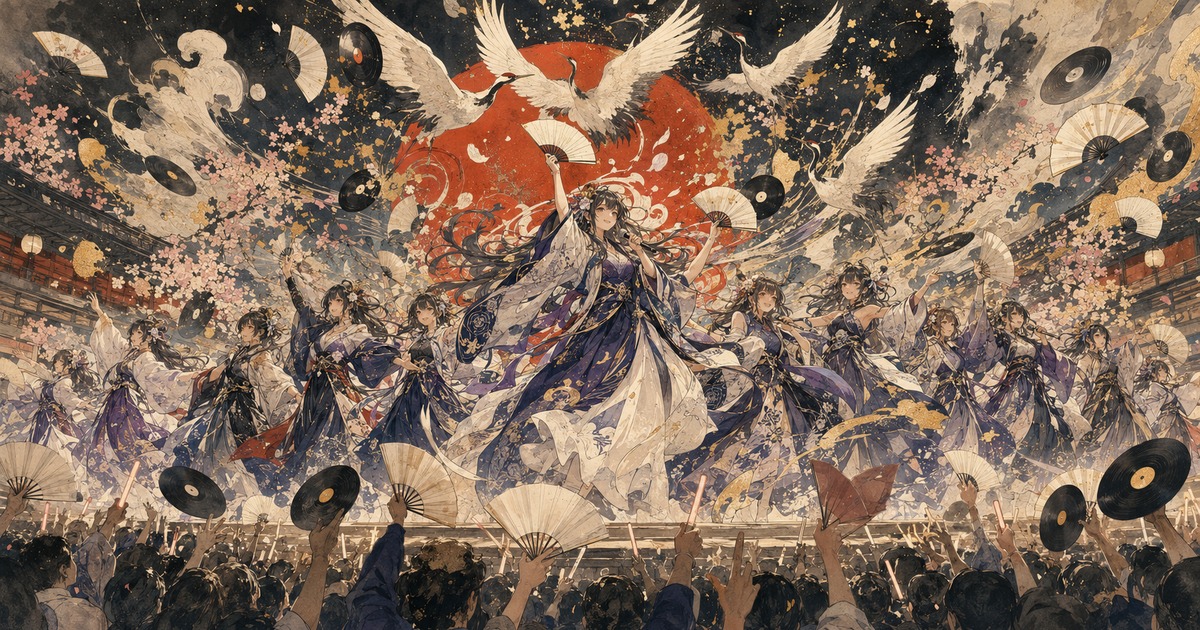
Nogizaka46’s 42nd single, “Zehi ni Oyobazu,” sold 756,354 physical copies in its first week and entered Billboard Japan’s Top Singles Sales chart at No. 1. The tracking period ran from July 20 through 26 around the single’s July 22 release. Its total was roughly four times the 187,422 copies credited to the second-place record, DXTEEN’s “Wanna.” It also gave Nogizaka46 a 37th consecutive No. 1 on that physical-sales chart, a streak extending back to the group’s sixth single, “Girls’ Rule,” in 2013.
Then another authoritative total arrived. Oricon’s weekly singles ranking, announced July 28, credited “Zehi ni Oyobazu” with 510,000 copies. It was still No. 1—Nogizaka46’s 41st consecutive and 41st total chart-topping single. It was the group’s fourth consecutive release above half a million in an Oricon opening week, beginning with “Same numbers” in 2025, and its 29th such title overall.
One record, one week, two totals separated by about 246,000 copies. Neither figure should be quietly substituted for the other, and neither makes the other fraudulent. Billboard Japan bases Top Singles Sales on SoundScan Japan data. Oricon uses its own participating retail network and rules. Differences in store coverage, collection and estimation produce different answers. The “756,000” in this headline is Billboard Japan’s estimate of physical units. It is not 756,354 distinct purchasers, and it is not a composite of streams, downloads and radio play.
Two cameras at the same finish line
A music chart is not the market itself. It is an instrument pointed at the market. No chart company literally watches every Japanese cash register and every e-commerce parcel. Each decides which retailers and transaction types it can see and how to turn those observations into an industry figure. Billboard Japan has explained that SoundScan totals may differ from those issued by other companies because collection systems and coverage differ.
| Measure | This week | What it says |
|---|---|---|
| Billboard Japan Top Singles Sales | 756,354 | SoundScan-based physical single sales; the source of the “756,000” headline. |
| Oricon Weekly Singles | 510,000 | Oricon’s separate physical-sales estimate; the basis for the 41-consecutive-No. 1 record. |
| Billboard Japan Hot 100 | A different chart | A composite using CD sales and digital behaviors such as downloads, streams, radio, video and karaoke. |
| Unique buyers | Not disclosed | Neither physical-sales total means that every unit went to a different person. |
The 246,354-copy gap is therefore not a warehouse of “missing” CDs. It is what two cameras with different positions and lenses saw at the same finish line. The useful conclusion is the one on which both instruments agree: “Zehi ni Oyobazu” dominated Japan’s physical single market during its release week.
When a CD becomes a relationship
The release has five physical editions. Four first-run Type A–D packages cost ¥2,000 each and contain a CD and Blu-ray. Each includes an event-application serial code and one randomly selected member photograph from 32 possibilities specific to that Type. A ¥1,200 regular edition contains the CD. All five share the title song and “Kokuhaku Shitai Byō,” while the third song changes by edition. Each limited-edition Blu-ray also carries a different set of live performances from “Nogizaka46 Coupling Collection 2022–2025.”
A single disc is consequently asked to do several jobs. It owns the song. It completes a set of coupling tracks. It stores concert footage that a stream may not preserve forever. It provides a chance to find a favored member’s photograph. Its serial number opens an application route to in-person and online meet-and-greets, autograph events and signed photographs. Buying the object can also become a direct, countable expression of support for one member.
The official application design does not conceal the incentive to buy more than one. One serial code can enter an individual talk-event lottery. Three are required to apply for an individual in-person autograph session. Four are required for the October 4 event at Makuhari Messe at which 100 winners can meet the participating membership and receive signatures from the group. Four limited editions at list price cost ¥8,000. That purchases eligibility for a lottery, not guaranteed access.
| Edition | List price | Distinct content |
|---|---|---|
| Type A | ¥2,000 | Under-member song “Fortissimo”; six Coupling Collection live videos |
| Type B | ¥2,000 | “Kiss no Timing”; a different group of seven live videos |
| Type C | ¥2,000 | “Hitotsu Temae no Interchange”; six different live videos |
| Type D | ¥2,000 | “Omaera”; six different live videos |
| Regular | ¥1,200 | Sixth-generation song “Inochi no Iro”; forTUNE music purchases also support individual online talk events |
It would therefore be inaccurate to translate the total into “three-quarters of a million people loved the song enough to buy it.” It would be equally crude to dismiss the result as nothing but fans purchasing handshakes. Buyers are paying for music, collectibility, an archive, a vote of confidence in a favored performer, and the possibility of a brief encounter. In Japan’s idol economy, the physical record has survived partly by ceasing to be only a container for sound.
A title from the burning of Honnō-ji
“Zehi ni Oyobazu” sounds startlingly old. Zehi is the judgment of right and wrong, good and bad; oyobazu suggests there is no longer any point in reaching that judgment. The phrase is commonly understood as accepting a situation that cannot be avoided or undone—something close to “there is no use debating it now.”
Its most famous association is the Honnō-ji Incident of 1582. The warlord Oda Nobunaga, told that the force surrounding him belonged to his retainer-turned-rebel Akechi Mitsuhide, is said in the chronicle Shinchō Kōki to have answered, “Zehi ni oyobazu.” The line has been reenacted through decades of historical dramas, including many NHK Taiga series. It should not, however, be treated as a recording of Nobunaga’s last breath. It comes to us through a later written source, and both its historical certainty and emotional meaning remain debated. Historians have read it as resignation, cool recognition of reality, or a decision to fight.
Nogizaka46’s song moves that martial echo into the present rather than staging a Sengoku-period costume drama. Its lyrics concern the moment after a mistake, when excuses cannot reverse what happened and the only useful question is what to do next. The copyrighted lyrics need not be reproduced at length to identify the center of gravity: not surrender to fate, but action after accepting a point of no return.
That makes the phrase unusually apt for a 15-year-old idol group. Graduated founders cannot be restored. The atmosphere, hierarchy and popularity of an earlier lineup cannot be frozen. Debating forever whether the past was better does nothing for the people now required to stand onstage. The archaic fatalism of the title becomes a contemporary instruction for generational change.
Miku Ichinose opens a new door
The center of the title track is fifth-generation member Miku Ichinose. She joined in 2022; this is her first center on a Nogizaka46 title song and, according to the group’s song database, makes her the 20th person to occupy that position. The selected lineup has 18 members. Fourth-generation star Haruka Kaki, Ichinose and sixth-generation member Mitsuki Setoguchi form the front row—a picture of continuity, present leadership and anticipated future rather than a coronation of one person alone.
Director Nao Watanabe’s music video, released June 28, uses a retro-textured camera, scrap-filled spaces and punk force. By the finale, the members dance as if discharging emotion inside the wreckage. In the group’s official announcement, Ichinose said the work allowed her to show expressions and an atmosphere she had not shown before; it felt as if she had opened a new door.
The familiar shorthand for Nogizaka46 is elegance: white and purple, uniforms, restraint, a cultivated quiet distinct from AKB48’s extroverted variety-show energy. The heavy four-beat attack and rock-punk face of “Zehi ni Oyobazu” push outside that frame. But difference is not necessarily betrayal. In an interview with Stream, Ichinose, captain Satsuki Sugawara and previous center Teresa Ikeda argued that the ability to attempt something new after 15 years—and turn even the challenge itself into Nogizaka46’s color—is a strength of the present group.
A fifth-generation captain and a sixth-generation front row
Two months before the single’s release, Nogizaka46 held its 14th Year Birthday Live across three nights at Tokyo Dome, drawing a reported 140,000 people. The final performance on May 21 was also third captain Minami Umezawa’s graduation concert. After nine years and eight months in the group, the third-generation member passed the captaincy to fifth-generation Satsuki Sugawara.
“Zehi ni Oyobazu” is the first major commercial answer from that new arrangement. Ichinose, a fifth-generation member, is center. Sugawara, from the same generation, is the fourth captain. Sixth-generation Mitsuki Setoguchi stands in the front row, while Hinano Ōkoshi and Urumi Morihira enter the selected lineup for the first time. The regular edition carries the sixth-generation song “Inochi no Iro.” Type A gives the Under lineup its own center narrative through Aya Ogawa and “Fortissimo.” Units on the other editions distribute still more combinations of names and voices.
Generational succession in an idol group is harder than corporate succession. The songs and trademarks stay, but the faces through which the audience first loved them leave. New members must inherit old repertoire without becoming museum guides, and they also need songs in which they are not impersonating their predecessors. Nogizaka46 uses the center, selected lineup, Under system, generation songs and annual birthday concerts as overlapping stages. The continuing question is not only who has gone, but who can make the name mean something next.
From “official rival” to a 15-year institution
Nogizaka46 was formed on August 21, 2011, as AKB48’s “official rival,” jointly produced by Sony Music Entertainment and Yasushi Akimoto. Thirty-six first-generation members were chosen from 38,934 applicants. The group debuted on February 22, 2012, with “Guru Guru Curtain.” Contemporary Oricon reporting credited it with 136,000 copies in its opening week and a No. 2 debut—an impressive beginning, but not an instant conquest.
The third single, “Hashire! Bicycle,” produced the group’s first Billboard Japan Hot 100 No. 1. The physical-sales streak measured in today’s announcement began with the sixth, “Girls’ Rule,” in 2013. “Influencer” won the Japan Record Award in 2017, and “Synchronicity” repeated the victory in 2018, making Nogizaka46 only the second women’s group to win the grand prize in consecutive years.
The better test of durability came later. By 2023, every first- and second-generation member had graduated. Yet songs built around newer members continued to top the composite Hot 100: “Monopoly” in 2023, “Hodōkyō” in 2024, “Navel Orange,” “Same numbers” and “Biryani” in 2025, and “Saigo ni Kaidan o Kakeagatta no wa Itsuda?” in spring 2026. Billboard Japan counted 32 Nogizaka46 Hot 100 No. 1 songs as of July 11, 2026.
| Year | Milestone | Meaning |
|---|---|---|
| 2011–12 | Formation and “Guru Guru Curtain” | A new identity begins through comparison with AKB48 |
| 2013 | “Girls’ Rule” | Starting point of the 37-release Billboard physical-sales No. 1 streak |
| 2017–18 | Two consecutive Japan Record Awards | The “rival” concept grows into a national pop institution |
| 2023 | All first- and second-generation members have graduated | The brand must survive without its founders |
| May 2026 | Three Tokyo Dome nights; Umezawa graduates | Captaincy moves from a third- to fifth-generation member |
| July 2026 | “Zehi ni Oyobazu” | First fifth-generation center, sixth-generation front row, 756,354 physical copies |
Physical strength is not the same as a song’s reach
The Recording Industry Association of Japan now publishes estimates that combine physical and digital recorded-music sales, drawing on member-company reports and market-share information to include nonmembers. That combined view matters. Physical formats retain unusual weight in Japan, but streaming measures a different route by which songs enter daily life. Neither side alone is the whole market.
Nogizaka46’s most visible strength appears in the release week of a physical single. That should not be confused with proof that the title was the song most continuously heard by the broadest public. Billboard Japan’s Hot 100 combines CD purchases with downloads, streaming, radio, video and karaoke precisely because ownership, repeated listening, exposure and singing are different behaviors.
The reverse is also true. A monthly streaming-listener figure cannot show the intensity with which a fan preserves concert footage, collects member photographs, chooses one member’s application lane and schedules a talk months after release. “Zehi ni Oyobazu” tells us more directly about the mobilization of an organized fan community than about the passive size of the song’s audience.
What deserves criticism—and what should not be dismissed
Multiple editions, randomized photographs and application serials apply pressure toward repeat buying. For younger fans, that can become a financial burden. Large numbers of discs containing the same core recording also raise an environmental question. Treating unit sales as a direct count of people or as proof of universal musical affection would be misleading. The industry could offer greater transparency about unique purchasers, the edition mix and the relationship between ordinary ownership and event-driven orders.
But it is also a mistake to decide that fans are irrational simply because the value they seek is social or symbolic. People buy theater programs, football shirts, shrine stamps and limited-edition books to make an experience tangible. A photograph or a conversation lasting seconds may appear small outside the relationship; inside years of support, it can be specific and memorable.
The fair reading has two steps. First, say plainly that 756,354 is a physical-unit estimate shaped by a system that encourages multiple purchases; it is not a head count. Second, recognize what remains remarkable: a 15-year-old group, after losing every founding-generation member, can still generate participation at this scale. Criticism and astonishment can coexist.
What 756,000 copies are really selling
“Zehi ni Oyobazu” is a new record and an edited history of Nogizaka46 at the same time. The Blu-rays bring 2022–25 coupling songs back into the present. A fifth-generation center and captain demonstrate that people who did not create the group can now carry it. Sixth-generation positions and songs reserve space for a future still being formed. Fans participate in that story by choosing an edition, deciding where to spend a serial code and turning preference into a measurable action.
This is not a simple story of the CD coming back from the dead. It is the result of giving the disc a new job when the sound itself can be streamed almost frictionlessly. The physical release preserves memory, unlocks a lottery, counts support and, for a few winners, temporarily shortens the distance between audience and performer.
Fifteen years ago, Nogizaka46 was explained through another giant idol group: AKB48’s official rival. The central question in 2026 is no longer whether it defeated that rival. It is whether Nogizaka46 can remain Nogizaka46 without the members who founded it. The opening week of “Zehi ni Oyobazu” is a forceful answer from the market, even after every qualification is attached.
The past cannot be restored. There is no use debating that point. What happens next is still a choice. Miku Ichinose’s harder gaze, Satsuki Sugawara’s new captaincy, the movement of Mitsuki Setoguchi and her sixth-generation peers toward the front, and the enormous totals left by two separate charts all point in the same direction. Nogizaka46 is not merely preserving nostalgia. It has made succession itself into a story the audience can enter.
Sources and further reading
Billboard Japan and Oricon sales are identified separately throughout this article. Edition details, prices, tracks, serial codes and event requirements come principally from Nogizaka46’s official announcements. The historical phrase “Zehi ni oyobazu” is reported as a line transmitted through Shinchō Kōki, not as an unquestionably verified recording of Nobunaga’s final words.
- Billboard Japan: 756,354 copies and No. 1 on Top Singles Sales
- Oricon: 510,000 copies and a 41st consecutive No. 1
- Billboard Japan: 602,336 copies through the early store-arrival day
- Billboard Japan: chart and SoundScan methodology explainer
- Nogizaka46: official 42nd-single page, five editions, prices and tracks
- Nogizaka46: serial-code lotteries, meet-and-greets and autograph events
- Nogizaka46: music video, director Nao Watanabe and Miku Ichinose’s comment
- Nogizaka46: coupling songs and performing members
- N46DB: independently compiled title-track center and selected-member history
- Stream: interview with Miku Ichinose, Satsuki Sugawara and Teresa Ikeda
- Billboard Japan Archive: Nogizaka46 from formation to 32 Hot 100 No. 1s
- Oricon: the 136,000-copy debut week of “Guru Guru Curtain” in 2012
- Nogizaka46: three Tokyo Dome dates and Minami Umezawa’s graduation concert
- Recording Industry Association of Japan: combined physical and digital market estimates
- Oggi.jp: meaning of “Zehi ni oyobazu” and uncertainty around Nobunaga’s last words
- Serai.jp: Shinchō Kōki and the phrase’s repeated use in historical television drama