- The missing link between a bicycle route and a local economy
- From steam railway to coastal greenway
- Why the source of the wood matters
- A network of places to stop
- Combining bicycles with regional rail
- What international visitors need beyond scenery
- A coastline that demands seasonal care
- Measuring success in stops, not just kilometers
The missing link between a bicycle route and a local economy
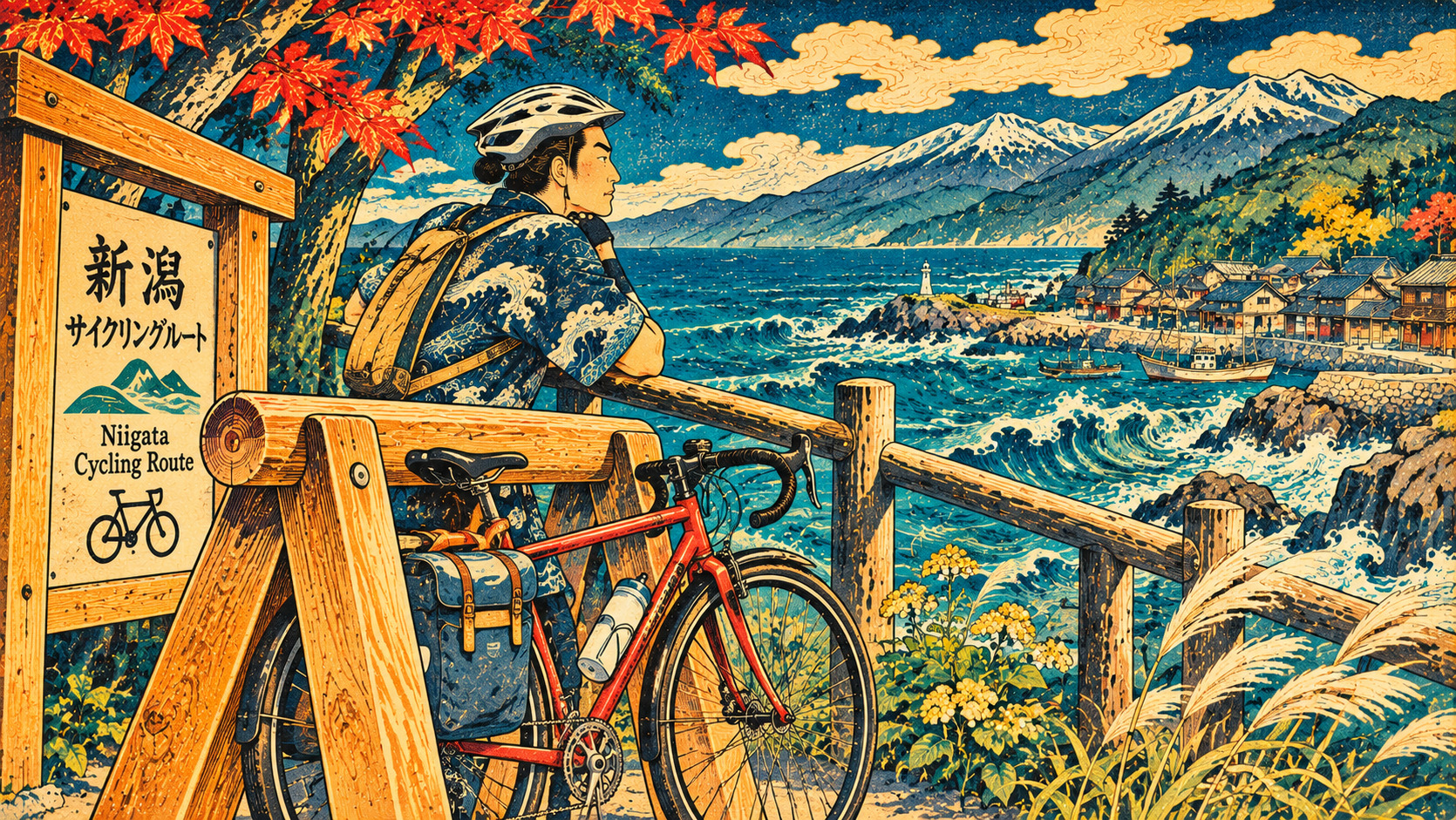
A spectacular coastal trail can bring cyclists past a village without bringing a single customer through its shop doors. Riders need somewhere to leave a bicycle before buying lunch, visiting a museum or spending the night. In western Niigata, businesses are addressing that practical gap with a modest piece of infrastructure made from local wood. On November 24 the prefecture published its account of a November 12 workshop at the Rurban Center in Joetsu. Businesses from Itoigawa, Joetsu and Myoko worked under instructor Ryohei Oguchi, using timber sourced in Joetsu.
The workshop invitation set a participation fee of ¥10,000 including materials and envisaged the finished stands being used at participants’ premises. The prefecture also reports that stands made in the previous year are in use. The initiative joins two objectives that are often pursued separately: making visitors feel welcome and creating demand for regional forest products. Its organizers describe cooperation between participants as another benefit.
There are no published figures in the workshop account for this year’s stand count, installation locations, additional visitors or sales. The project is therefore best understood as an investment in the conditions for tourism rather than proof that tourism revenue has risen.
From steam railway to coastal greenway
The Kubiki Cycling Road runs for approximately 32 kilometers between Mushuiwato in Joetsu and Nakajuku in Itoigawa. It follows the coastal corridor once occupied by the Japanese National Railways Hokuriku Main Line. The name Kubiki refers to the historic region encompassing the three participating municipalities. The present trail is reserved for bicycles and pedestrians.
The old railway alignment explains much of its appeal. Brick tunnels and surviving bridge structures are reminders of the steam age, when the railway connected communities constrained by mountains and sea. On clear days the route offers views toward Sado Island and the Noto Peninsula. The reuse of transport infrastructure gives the landscape a historical dimension that a newly constructed recreational road might lack.
Rail-to-trail conversion also changes the speed at which travelers experience a place. A cyclist can pause at a harbor or shop rather than pass it behind a train window. That opportunity is precisely what the workshop seeks to turn into a practical connection with local businesses.
Why the source of the wood matters
The prefectural forestry office reports 88,243 hectares of forest in Joetsu and Myoko combined, including 16,300 hectares of privately managed planted forest. These figures do not include Itoigawa. Forest management is a continuing economic activity, and the region has been adopting mechanized harvesting and thinning practices.
A bicycle stand will not transform the timber market by itself. But small, visible uses of local wood can help connect the forest economy with hospitality businesses and visitors. A locally made object can be repaired by a local workshop, and its origin can become part of a destination’s story. Those are opportunities rather than verified outcomes of this particular project.
Environmental claims require more evidence. The species used, harvesting practices, processing energy, service life and replacement frequency all matter. The report identifies the timber’s origin but does not establish a carbon footprint or disclose forest certification. Durable design and responsible sourcing are more meaningful than a generic claim that all wooden products are sustainable.
A network of places to stop
Tourism planners often focus on attractions and route maps. For cyclists, ordinary services can be equally decisive: water, toilets, a pump, basic repair tools and a place to rest. Niigata’s published inventory counted seven designated cycle stations along the Kubiki corridor as of April 2024. They include convenience stores, roadside stations and other established visitor facilities.
The value of such a network lies in predictability. A rider does not need every business to become a specialist bicycle shop. A few shared standards, visible signage and dependable services can make the whole corridor easier to explore. The prefecture also describes shared cycle-station branding with the neighboring Hakuba Valley area in Nagano.
The wooden stands can complement these existing facilities, but a stand should not be assumed to provide secure locking or all-weather storage. Businesses need to consider stability, pedestrian access, maintenance and clear instructions. A welcoming amenity should not create a new obstruction for residents.
Combining bicycles with regional rail
One of the biggest advantages of a cycle train is the option to ride in one direction and return by rail. Echigo Tokimeki Railway announced its 2026 bicycle-carrying program for April 20 through November 30 on the Nihonkai Hisui Line and Myoko Haneuma Line. Eligible services allow bicycles aboard without disassembly, subject to the operator’s conditions. Some stations are excluded and others have stairs.
That flexibility is especially useful for less experienced riders or parties with different fitness levels. A rail connection can also extend the economic reach of a route by letting visitors stay in one town and explore another. However, the published seasonal program should not be mistaken for unrestricted year-round access.
Niigata separately promotes a 41.5-kilometer route linking the Myoko foothills and Naoetsu. It is not the same as the 32-kilometer Kubiki trail. Together these routes illustrate the possibility of a broader mountain-to-sea tourism network, provided connections and services are clearly described.
What international visitors need beyond scenery
Japan’s government adopted its third Bicycle Utilization Promotion Plan in May 2026, setting objectives through fiscal 2030. Tourism development is one of its priorities. The national cycle-route framework emphasizes not just attractive landscapes but safe travel, rest facilities, accommodation, repair assistance and accessible information. Kubiki itself is not on the national designation list.
An international rider may have questions that a local cyclist takes for granted. Where can a bicycle be rented? Is it possible to take it on the train? What happens if a tire fails? Are shops open on the day of the visit? Bilingual information and consistent signage can be as valuable as a new physical amenity.
Local businesses could use simple English descriptions of parking, opening times and payment methods. Regional tourism organizations could maintain a shared, dated inventory rather than expecting each small shop to operate an elaborate multilingual website. These are practical possibilities for the region, not services confirmed by the November workshop.
A coastline that demands seasonal care
The Sea of Japan is not a static backdrop. Coastal wind, winter precipitation and construction can interrupt a journey. A prefectural notice dated November 9 states that a section at No–Taiheiji in Itoigawa is subject to daytime closure between 8 a.m. and 5 p.m. through November 30, with a detour. Riders should verify the latest notice before traveling.
The seasonal cycle train is also scheduled to finish on November 30. Visitors should check weather, transport rules and facility operating dates rather than treating a promotional route map as a guarantee of access. On the shared walking and cycling trail, tunnel lighting and consideration for pedestrians matter.
The same climate makes maintenance an important part of the woodworking initiative. Salt air, moisture and snow can affect timber and fasteners. An inexpensive initial purchase does not eliminate future inspection and replacement costs. A successful network must remain dependable after the publicity surrounding its launch has passed.
Measuring success in stops, not just kilometers
The workshop fee provides an indication of the entry cost for participants, not the full cost of installing or maintaining the equipment. A serious assessment would compare stand usage, cycling-related customer visits, local spending and maintenance expenses over several seasons. Weather, holidays and changes in visitor numbers would need to be considered before attributing results to the stands.
Tracking where timber was purchased and where fabrication and repairs were undertaken would also clarify how much economic activity remains in the region. Simple records shared between participating businesses could be more useful than an expensive one-off promotional campaign. No such evaluation has yet been published in the workshop report.
The deeper lesson of Kubiki is that a destination consists of more than its headline attractions. A former railway, working forests and small businesses can become parts of a connected visitor experience. A wooden stand is not a solution to rural economic decline, but it can create a place where a passing traveler becomes a customer, a conversation begins, and a region becomes more than scenery.
Primary sources and references
- Niigata Prefecture — workshop report, November 24
- Niigata Prefecture — workshop announcement
- MLIT Takada office — Kubiki route history
- Niigata Prefecture — regional forest management
- Niigata Prefecture — cycle stations
- Echigo Tokimeki Railway — 2026 cycle train
- Niigata Prefecture — cycling tourism routes
- MLIT — Bicycle Utilization Promotion Plan
- MLIT — National Cycle Routes
- Niigata Prefecture — November road closure
- Joetsu official tourism — Kubiki cycling route