One thoughtful itinerary could devote a morning to the Chieko sites, an afternoon to the castle and its chrysanthemums, and a separate visit to Dake Onsen and the mountain foothills. Exhibition and festival dates end in late November, while the wider town remains worth exploring throughout the year. Nihonmatsu’s appeal is not that it offers a flawless escape into an imaginary old Japan. It is that artists, farmers, innkeepers and preservation workers continue to give meaning to the same landscapes that shaped its history.
Plan for attention, not a checklist
The city’s Oyama Chūsaku Museum is devoted to an important Nihonga painter born in Nihonmatsu. For autumn 2026, it is participating with the Chieko Memorial Museum and the city history museum in a three-museum stamp rally through November 23. That connection broadens the visit beyond a single biography. The museum has also warned that exterior works may obstruct views from its observation lounge, illustrating why practical details deserve a final check before travel.
Another artist, another way into the city
Nihonmatsu’s food story extends beyond traditional inns. In an October 27 feature, Fukushima TV introduced Maruna Café, operated by strawberry farm Marunaka Farm. Its seasonal offerings included a salsiccia-style hamburger steak with a strawberry sauce made from the farm’s fruit, as well as strawberry pancakes. It is a modest but revealing example of local agriculture moving from production into direct hospitality. Menus, prices and hours were reported at the time of broadcast and may change.
A farm café with an unexpected ingredient
Mount Adatara rises to about 1,700 meters and attracts autumn hikers, but late-season conditions can be harsher than the views suggest. The Dake Onsen association lists special autumn buses through November 3. It also notes the continuing closure of the Adatara Valley nature trail after earlier damage and the temporary closure of Kurogane Hut during rebuilding. Before setting out, travelers should verify transport and trail notices and prepare for changing mountain weather.
The mountain is not a static backdrop
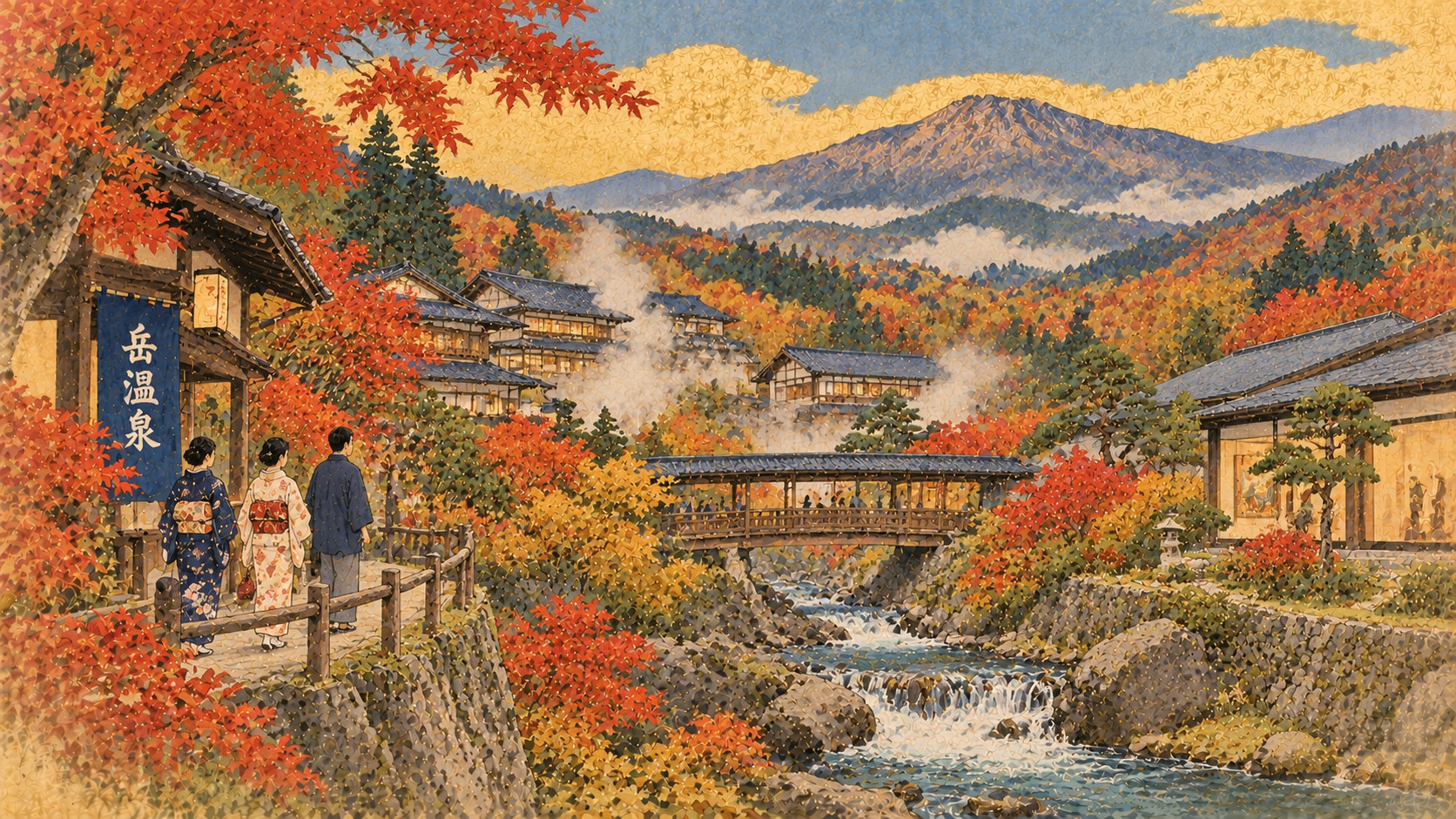
Dake Onsen is celebrated for its strongly acidic hot spring, with the tourism association reporting a pH of around 2.5. Its engineering history is just as distinctive: spring water travels roughly eight kilometers from a source high on Mount Adatara to the inn district, a journey of about 40 minutes. Workers known as yumori maintain the source, conduits and mountain access routes. The cloudy-water “Milky Day” phenomenon is associated with flushing deposits from the supply system. Promotional wellness claims should not be taken as universal medical outcomes.
Eight kilometers of mountain water
Nihonmatsu Castle is not merely an attractive backdrop. During the Boshin War, the castle fell on July 29, 1868. The city’s historical chronology records 337 deaths on the domain side, including 14 boys aged 13–17 by traditional counting. The story of the Nihonmatsu Youth Corps remains important to the city’s historical memory. Walking among the gardens and stonework today means acknowledging that the same ground has been a place of conflict, loss and commemoration.
The castle’s darker history
At Kasumigajō Park, the ruins of Nihonmatsu Castle host the 70th Nihonmatsu Chrysanthemum Doll Festival from October 10 to November 23. The 2026 theme links the Toyotomi and Niwa families. Festival organizers trace the town’s chrysanthemum culture to the domain era and early twentieth-century displays, while the modern festival dates to 1955. Flower-covered figures and precise gardening become a form of public historical theater framed by castle walls. The announced general admission is ¥1,000, and opening hours are 9 a.m. to 4 p.m.
Seventy seasons of chrysanthemum figures
Chieko’s childhood home was part of the Naganuma family’s sake-brewing business. City records identify its merchant name as Komeya and its sake label as Hanagasumi. The house preserves the character of the late-nineteenth-century household, including a cedar-ball sign associated with sake brewing. An anniversary program offers special access to Chieko’s upstairs room on specified dates. The house connects the artistic biography to the regional trades, domestic life and social expectations of Meiji Japan.
A preserved family brewery
A companion exhibition, Chieko’s Art, occupies the Nihonmatsu History Museum on the first floor of Nihonmatsu Jōhōkan from October 3 through November 23. It presents original paper works and historical materials. Chieko created striking paper compositions during a period of illness and hospitalization, and the fragile material demands careful handling. The city normally limits the exposure of original works to protect them. Visitors should consult the museums’ current notices rather than assume that all objects are continuously on display.
Why the paper works matter
Nihonmatsu City’s anniversary program at the Chieko Memorial Museum runs from October 1 to November 24. The municipality says it is presenting all three known surviving oil paintings, including Kusunoki, a work from the Kiyoharu Shirakaba Museum in Yamanashi that has not previously been exhibited in Nihonmatsu. It is an unusual chance to look closely at a painter whose reputation is frequently mediated through poetry and personal biography. The claim concerns known surviving works, not proof that Chieko painted only three canvases.
Three rare oil paintings return to public view
The phrase “real sky” is associated with Kōtarō Takamura’s poetry about his wife Chieko and the landscape of her hometown. But Chieko Takamura, born in what is now Nihonmatsu on May 20, 1886, deserves to be encountered as a creative individual, not simply as a figure in her husband’s literature. She studied Western-style painting and later produced delicate works made from cut and arranged paper. This autumn’s municipal exhibitions ask visitors to consider her artistic life and the changing circumstances of women pursuing art in modern Japan.
The woman behind the “real sky”
Nihonmatsu, a castle town below Mount Adatara, is making a compelling case for travelers to spend more than an afternoon in Fukushima Prefecture. Autumn 2026 brings the 140th anniversary of the birth of artist Chieko Takamura, a rare presentation of her surviving paintings and paper art, the 70th edition of the town’s chrysanthemum festival and a hot-spring district sustained by an extraordinary mountain pipeline. Together they offer a more layered portrait than the familiar postcard of red leaves and mountain inns.
A different kind of autumn in Fukushima
Sources and reporting notes
Based on city and tourism-association primary sources and local reporting from October 27. No original on-site interviews were conducted.