- A permit for the ground network—not an operational third runway
- What the new apron means for Japan’s cargo gateway
- Two runway projects, two very different clocks
- Narita’s history explains the importance of this moment
- The unresolved land question
- An airport-city strategy with global stakes
- What to watch between now and 2034
A permit for the ground network—not an operational third runway
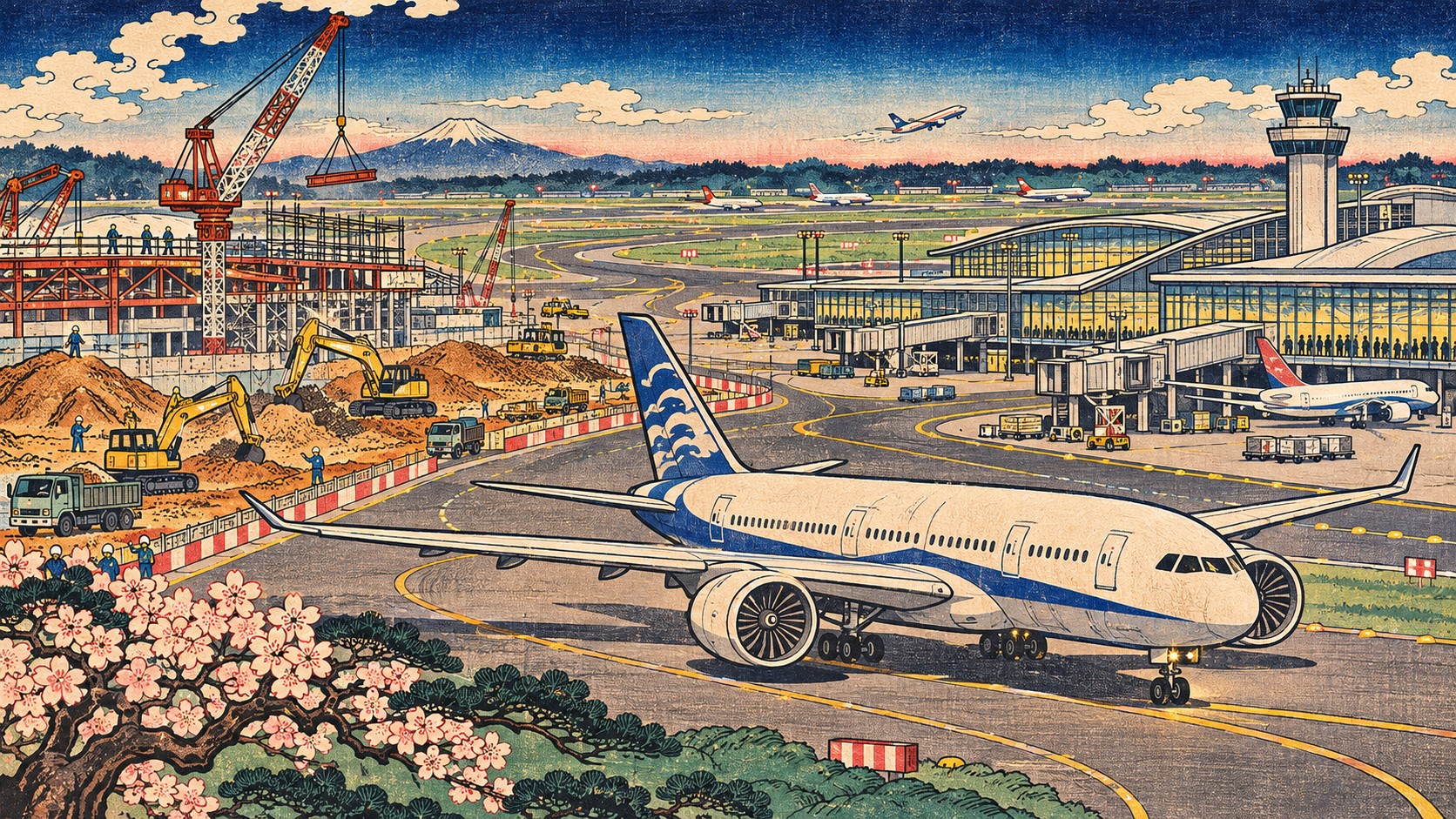
Japan’s Ministry of Land, Infrastructure, Transport and Tourism (MLIT) approved a facilities-change application for Narita International Airport on November 20, 2026. The decision covers 7,044 meters of new taxiways, 23 meters wide, and 823,664 square meters of new aircraft apron, with a stated construction-completion deadline of December 31, 2034. Narita International Airport Corporation, known as NAA, submitted the application on October 19 under Article 43 of Japan’s Civil Aeronautics Act. The ministry’s Japanese announcement sets out those quantities and dates.
The distinction matters. A taxiway allows aircraft to move between runways and their parking positions; an apron provides room for parking, loading, unloading and servicing. Neither is a runway, and approval to build them does not constitute an announcement that the planned C runway is complete. Yet airports can only translate theoretical runway capacity into actual traffic if aircraft can move efficiently on the ground. The less glamorous infrastructure may therefore be among the most consequential elements of the expansion.
What the new apron means for Japan’s cargo gateway
The works are tied to the planned C-runway area and a reorganized cargo district. NAA describes its wider initiative as the second opening of Narita Airport, a phrase that acknowledges how extensive the planned transformation is. In its October 19 statement, the airport operator links the new taxiways and apron with the cargo district and runway program.
An apron measuring 823,664 square meters occupies roughly 0.824 square kilometers. That is an area measure, not a count of aircraft stands or a guaranteed increase in freight throughput. The number of aircraft it can serve depends on detailed geometry, aircraft sizes, ground-handling requirements and operating rules that are not fully specified in the permit announcement.
For shippers, the question is less about the striking size of the apron than how the airport will connect cargo aircraft, handling buildings, customs processes, trucks and warehouses. Better connections could reduce ground movement and the complexity of dispersed operations. Those are plausible objectives, not measured benefits already delivered. Any claim of faster cargo clearance or lower costs will need operational evidence once the facilities open.
Two runway projects, two very different clocks
Narita currently operates its 4,000-meter A runway and 2,500-meter B runway. The broader program envisions extending B by 1,000 meters and constructing a new 3,500-meter C runway, giving Narita three runways in all. NAA’s project overview illustrates that configuration. But older project pages sometimes preserve dates that have since been overtaken by land-acquisition difficulties.
In July 2026, a four-party meeting involving MLIT, NAA, Chiba Prefecture and the municipalities around the airport confirmed an aim of putting the B-runway extension into service during Japan’s fiscal year 2029, ahead of C. The C-runway area remained short of the necessary land, with voluntary negotiations continuing and land-acquisition procedures also under consideration.
In October, NAA gave December 31, 2034 as the planned completion deadline for C-runway-related works, and for the newly proposed taxiways and apron. Both the airport operator and the ministry simultaneously described an ambition to begin operations in the C-runway area in the early 2030s. Those are not identical definitions of timing. It is not yet clear from these announcements precisely which facilities could enter service in stages before the formal project completion deadline.
Narita’s history explains the importance of this moment
Narita opened on May 20, 1978 under the name New Tokyo International Airport, with its 4,000-meter A runway and first passenger terminal. According to the airport’s official historical timeline, a provisional 2,180-meter B runway began operating in 2002 and was extended to 2,500 meters in 2009. The airport adopted its present name in 2004, when Narita International Airport Corporation was established. Its railway connections and terminal development also changed the way it served Tokyo and the wider region.
Those milestones sit alongside a profoundly contested history of airport development and land acquisition. Expansion at Narita has never been only an engineering puzzle. Its progress has been shaped by the relationship among national transport priorities, farms and private property, local livelihoods and the concerns of surrounding communities. The original airport’s protracted construction struggle is indispensable context for the current phase, but it should not erase the present-day variety of local views.
This makes a new construction permit important without making it the end of the story. Building infrastructure is one test; maintaining public trust while doing so is another.
The unresolved land question
Chiba Prefecture’s account of the July 10, 2026 four-party discussions records an overall land-securement rate of 89.7 percent at the end of March. The B-runway extension area stood at 99.5 percent, while the C-runway area was at 88.7 percent. These are March 2026 figures reported at a later meeting; they should not be misrepresented as a freshly measured November position.
The participating authorities accepted that use of Japan’s land-expropriation system might become unavoidable for C, while emphasizing continued voluntary negotiations and careful explanations to remaining landowners. Legal procedures and genuine local agreement are different things. Even where regional authorities support expansion, households and businesses can confront relocation, compensation questions and the possibility of continuing disruption.
The airport’s future will be judged partly on these outcomes. The jobs and commercial activity that may follow expansion cannot simply be used to dismiss residents’ interests, just as the complexity of land negotiations does not remove the strategic importance of international connectivity.
An airport-city strategy with global stakes
NAA has presented a broader airport city vision that would link airport infrastructure with surrounding economic activity. That vision reflects a global reality: airports compete on cargo handling, transfers, reliability, surface transport and their ability to support local commerce—not runway length alone.
If the new cargo district performs as intended, freight companies may gain a more coherent hub linking aircraft operations with land transport. International businesses may find additional capacity in an important Japanese market. But a permit does not by itself establish when those benefits will materialize or their economic value. Published projections, if used, must be distinguished from observed traffic.
The November approval comes after NAA advanced major construction work in 2025 and reset its timetable in 2026. It suggests that the airport is moving ahead with detailed enabling infrastructure even as some of the project’s most difficult questions remain open.
What to watch between now and 2034
Four issues deserve sustained reporting. First is the precise phasing of the cargo district and its links to the new runway. Second is whether the early-2030s service ambition can be reconciled with the December 2034 construction deadline. Third is the outcome of land negotiations and any compulsory-acquisition procedures, including how affected residents are treated. Fourth is the environmental and transportation impact of construction and the airport’s eventual growth.
A new runway can expand opportunity, but concrete benefits depend on operational performance and the people who live around it. Narita’s November 20 decision is a meaningful procedural advance: seven kilometers of taxiways and a large new aircraft apron have received official permission. What remains to be demonstrated is how that permission becomes an effective, responsible gateway for the coming decades.
Primary sources and further reading
The numerical approvals and dates were checked against Japanese primary sources. The article does not treat projected economic benefits or prior land-acquisition measurements as established current outcomes.
- MLIT: airport facilities-change permit, November 20, 2026
- Narita International Airport Corporation: application, October 19, 2026
- Chiba Prefecture: four-party airport talks, July 10, 2026
- Narita International Airport: official history
- Narita International Airport: expansion overview
- NAA: C-runway-area construction briefing, 2026
- Narita International Airport Corporation: corporate chronology