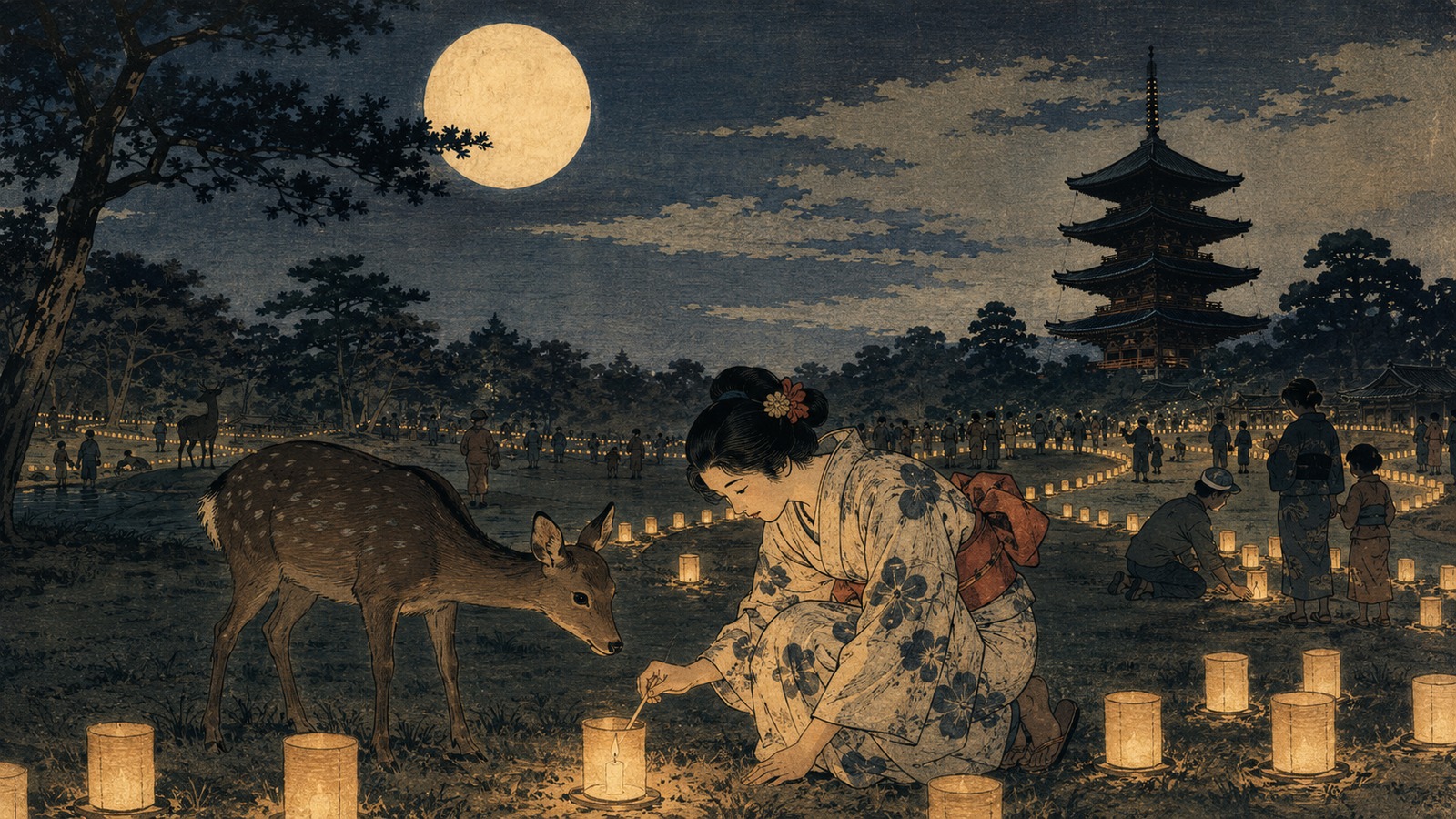
When the sun falls behind Mount Wakakusa, Nara Park first turns blue. The last glow leaves the golden ornaments on Tōdai-ji’s roof, and the lawns and trees settle into darkness. Then a point of fire appears at ground level. Another follows beside it, then another. Flame passes from hand to hand until a river of stars seems to have descended onto the grass.
Electric lights could make a nightscape at the touch of a switch. Nara Tokae deliberately does something slower. People place candles, crouch down, transfer fire, shield the wicks from wind, extinguish everything at closing time and retrieve the cups. The repetitive labor behind the view is as important to the festival’s meaning as the beauty visitors come to see.
The 28th Nara Tokae opens on August 5, 2026. For ten nights, distinct candle landscapes extend through Ukigumo and Kasugano lawns, Asajigahara, Ukimido, Sarusawa Pond and the 52 Steps, the garden of the Nara Kasugano International Forum Iraka, Kōfuku-ji and the grounds around the Nara National Museum. Tōdai-ji joins only on August 13 and 14; Kasuga Taisha only on the 14th.
The word tōka refers to the flower-like cluster that can form at the end of a burning wick. Its appearance has traditionally been regarded as auspicious. The event’s name carries a wish that each candle, lit individually, will bring happiness to those who visit. The lights on the ground are therefore more than illumination. The imagination that sees a flower in a wick turns the park into a garden for one night.
A young festival that looks ancient
Heijō-kyō became the Japanese capital in 710. Until 784, the Nara period consolidated state government while Buddhism, architecture, writing and art transmitted through continental Asia took distinctly Japanese forms. The “Historic Monuments of Ancient Nara”—including Tōdai-ji, Kōfuku-ji, Kasuga Taisha and the Nara Palace Site—were inscribed on UNESCO’s World Heritage List in 1998.
Nara Tokae began the following year. It was not the revival of a lost ritual recorded in an eighth-century text. It was a civic effort to create a new summer tradition suited to Nara’s history and natural setting. The Nara Tokae Association was established in 2000. The organization later joined exchanges among illumination events, carried candle installations to other locations and brought students into the volunteer workforce.
Its stated hope is that Tokae will become “a Nara treasure lasting 100 years.” Tradition is not determined by age alone. It is made when people return in the same season, learn the same work and hand it to another generation. Each night of Tokae makes that process visible.
710: The capital moves to Heijō-kyō; Nara becomes the center of government and culture.
Eighth century: Tōdai-ji’s bronze octagonal lantern is created during the temple’s founding era.
From the late Heian period: Nobles, warriors and commoners donate lanterns to Kasuga Taisha with prayers.
1998: The Historic Monuments of Ancient Nara enter the World Heritage List.
1999: Nara Tokae begins.
2000: The Nara Tokae Association is established.
2026: The 28th edition introduces an opening ceremony joining flames from three sacred institutions.
In 2026, fire arrives from three sacred places
This year’s opening adds a new ceremony. At 6:30 p.m. on August 5 in the garden of the Nara Kasugano International Forum Iraka, three children in ceremonial dress are scheduled to carry lights received from Kasuga Taisha, Tōdai-ji and Kōfuku-ji and hand them to guests. At about 7:00 p.m., those flames will connect to the festival illumination.
This is a 2026 addition, not an ancient rite preserved unchanged. Yet the image of fire traveling from a shrine and two temples into a civic festival captures Nara unusually well. Shrine and temple occupy the same nightscape. Religious institutions, parkland, a museum, civic organizers and visitors form one walkable circuit. In Nara, belief and urban life, nature and cultural property have long existed side by side.
The Iraka garden also hosts the “Honokari Live” performances on August 6 and 7. Saxophonist Kayo Umemoto appears on the 6th, and healing-music performer Kōzō Aiba on the 7th, each with sets at 7:15 and 8:15 p.m. Candlelight becomes more than a static display; music, movement and the time people spend in the garden become part of the space.
Not one festival view, but many
Nara Tokae cannot be understood from a single photograph because each site makes a different relationship between light and history. On Kasugano Lawn, the great field of candles opens beneath Mount Wakakusa and Tōdai-ji’s Great Buddha Hall. On Ukigumo Lawn, lines of candles resemble the Milky Way laid across the earth.
At Asajigahara, trees and bamboo create layers of shadow. At Ukimido, Sagi Pond reflects each flame so the lights appear twice. Sarusawa Pond and the 52 Steps lead the eye upward toward Kōfuku-ji. Iraka’s Japanese garden uses curves and empty space, while the Nara National Museum area places warm, temporary candlelight against modern architecture and a city devoted to Buddhist art.
| Area | What the light reveals | 2026 note |
|---|---|---|
| Kasugano and Ukigumo lawns | Large fields of light and an earthbound Milky Way | Open throughout; One Visitor, One Light moved to east Ukigumo |
| Asajigahara and Ukimido | Trees, bamboo and candle reflections on water | Expect lawns, gravel, darkness and uneven footing |
| Sarusawa Pond, 52 Steps and Kōfuku-ji | Water, stone steps and the elevation of the temple precinct | Do not block narrow routes for photographs |
| Iraka and Nara National Museum | Garden design, music and modern architecture | Live performances August 6 and 7 |
| Tōdai-ji | The Great Buddha Hall and lights near Mirror Pond | Tokae area open August 13 and 14 only |
| Kasuga Taisha | A prayer landscape of approach roads and historic lanterns | Tokae area open August 14 only |
Rushing to check off every location can defeat the experience. The venues cover a broad area, and Nara’s heat and humidity remain intense after dark. Choosing two or three landscapes—and watching one change from sunset through blue hour into full night—reveals more than sprinting between every candle field.
One Visitor, One Light
The festival’s philosophy is clearest in Ikkaku Ittō, “One Visitor, One Light.” A visitor makes a contribution and lights one candle by hand. In an official update on August 3, organizers moved the 2026 reception point to the east side of Ukigumo Lawn. Older listings may still identify the Iraka garden, so visitors should use the newest official map.
One flame cannot be seen from far away. Placed beside another person’s flame, and another, it becomes a pattern. For a few seconds, the distinction between spectator and maker disappears. The contribution helps pay for the following year’s candles, allowing one evening’s experience to support the next year’s light.
The arrangement reduces a large festival to its smallest civic unit: one person, one act. Tokae’s scale is the sum of anonymous, modest gestures.
The invisible protagonists arrive before lighting—and remain after dark
The 2026 supporter program sought 200 volunteers per day. One shift runs from about 5:00 to 10:00 p.m.; a second from about 8:00 to 10:00. Their work does not end when the photographs do. After the public lighting closes at 9:30, volunteers extinguish the candles, collect the cups and return the grounds to a public park.
Handling so many open flames in a park containing cultural properties, trees and wildlife makes safety and cleanup more important than spectacle. Wind can extinguish candles; severe weather requires cancellation. Routes must remain safe underfoot. Nothing can be left in the habitat where Nara’s deer live, and the lawns must be ready for ordinary public use the next morning.
Candles are less reliable than bulbs. That is why they require people: someone to set them out, someone to watch them, someone to extinguish them and someone to collect what remains. Preserving that inconvenience is part of what keeps Tokae a civic event rather than merely an illumination product.
How light became prayer in Nara
Tokae may be young, but devotional light in Nara is ancient. The National Treasure octagonal lantern before Tōdai-ji’s Great Buddha Hall dates to the temple’s founding period in the eighth century and survived repeated warfare. Its panels show musical bodhisattvas and lions running through clouds; its shaft carries scriptural passages on the merit of offering light. Illumination itself was understood as a virtuous act.
Kasuga Taisha contains roughly 2,000 stone lanterns and 1,000 hanging bronze lanterns. From the late Heian period onward, nobles, warriors and ordinary people donated them with wishes for family safety, business prosperity, victory, and the repose of ancestors. On August 14 and 15, the Chūgen Mantōrō rite lights all 3,000 to pray for the fulfillment of people’s wishes. Tokae’s one-night Kasuga area on the 14th therefore meets a much older lantern tradition.
On August 15, the night after Tokae ends, Tōdai-ji holds its separate Mantō Kuyō-e memorial observance. Established in 1985 for people unable to return home during Obon and for the repose of all spirits, it places about 2,500 lanterns along the approach and around the hall. The Great Buddha’s face becomes visible through the opened front window.
- Nara Tokae: A civic summer festival founded in 1999; in 2026, August 5–14.
- Kasuga Taisha Chūgen Mantōrō: A shrine rite lighting roughly 3,000 donated lanterns and praying for wishes; August 14–15.
- Tōdai-ji Mantō Kuyō-e: A temple memorial using about 2,500 lanterns for ancestors and other spirits; August 15.
The events do not share one origin, organizer or religious meaning. Yet the 2026 calendar makes them look like a relay. Tokae’s final night overlaps with the first night of Kasuga’s rite; Tōdai-ji’s memorial follows the next evening. The modern civic festival does not replace the sacred calendar. It pauses at its threshold.
Deer, darkness and the view beyond the photograph
Nara Park is also habitat. Its deer are not props in a light show. Visitors should leave no food or litter, avoid pushing animals into a photograph and keep them away from flames and candle cups. A beautiful human scene is not automatically a safe animal environment.
Modern phones brighten darkness automatically. Tokae’s beauty, however, depends on how little light there is: a flame barely strong enough to show the path, a temple at a distance, black water around a reflection, faces appearing and disappearing. Photographers should keep circulation routes open and avoid tripods or long stops that turn a shared path into a private set.
Wheelchairs and strollers can circulate through the festival, but some routes cross grass, gravel, steps and dark ground. Arriving near the opening, before the heaviest crowds, and choosing a limited route can make the visit safer. There is no festival parking. Kintetsu Nara Station is about a five-minute walk from the park; JR Nara Station roughly 20 minutes.
A practical guide to the ten nights
| Item | 2026 information |
|---|---|
| Dates and hours | Wednesday, August 5–Friday, August 14; 7:00–9:30 p.m. |
| Admission | General viewing is free; some activities, including lighting participation, require a contribution |
| Access | About 5 minutes from Kintetsu Nara Station or 20 minutes from JR Nara Station; no dedicated parking |
| Weather | Light rain may be acceptable; severe weather or strong winds can cause partial or total cancellation |
| Limited areas | Tōdai-ji on August 13–14; Kasuga Taisha on August 14 only |
| Latest change | One Visitor, One Light reception is on east Ukigumo Lawn; check traffic controls and official alerts |
A rewarding plan is to arrive in the 6:00 p.m. hour, learn the route while it is still light, then stay with one area through the 7:00 lighting, twilight and full darkness before walking to a second location. Carry water, wear shoes made for distance and uneven ground, and consider insect repellent. Heat illness remains a concern on summer nights.
August 13 and 14 bring Tōdai-ji into the festival, while the 14th overlaps with Kasuga Taisha’s Chūgen Mantōrō. Those nights offer exceptional scenes but heavier crowds. Earlier weekdays may be better for quiet; the closing nights for visitors who want to witness the transition into Nara’s religious lantern calendar.
Toward the “old festival” of 2126
A historic city cannot live by preservation alone. It must protect buildings and transmit rituals, but people living now must also form new relationships with the place or history recedes behind glass. Nara Tokae is not merely decorative lighting aimed at a World Heritage backdrop. It gives the present a way to place one small flame inside the ancient capital’s darkness.
That flame is weak and can be erased by wind. It must be remade every evening. In that impermanence it contrasts with Nara’s surviving stone and bronze lanterns. Enduring vessels and one-night fire; cultural treasures and volunteers; the Nara inherited from the past and the Nara being sent forward appear in the same frame.
At 9:30 p.m., the final flames are put out. After the visitors leave, supporters collect the cups and return the field to darkness. By morning it is again a park shared by deer and people. At evening, the work begins again with the first candle.
A treasure lasting 100 years is not ancient at the moment it begins. It becomes ancient because someone decides, year after year, to carry the fire onward. The ten nights of 2026 are only the 28th light in that longer passage.
Reporting notes and principal sources
Current hours, venues and changes are based on the organizer and public tourism authorities. Kasuga Taisha and Tōdai-ji observances are identified as separate events with distinct histories and organizers.
- Official Nara Tokae website: 2026 information
- Official Tokae history and meaning
- Official 2026 area information
- Official 2026 supporter program
- Official Nara Prefecture tourism listing
- Kasuga Taisha: August rites and Chūgen Mantōrō
- Tōdai-ji: Mantō Kuyō-e
- Tōdai-ji: National Treasure octagonal lantern
- UNESCO: Historic Monuments of Ancient Nara