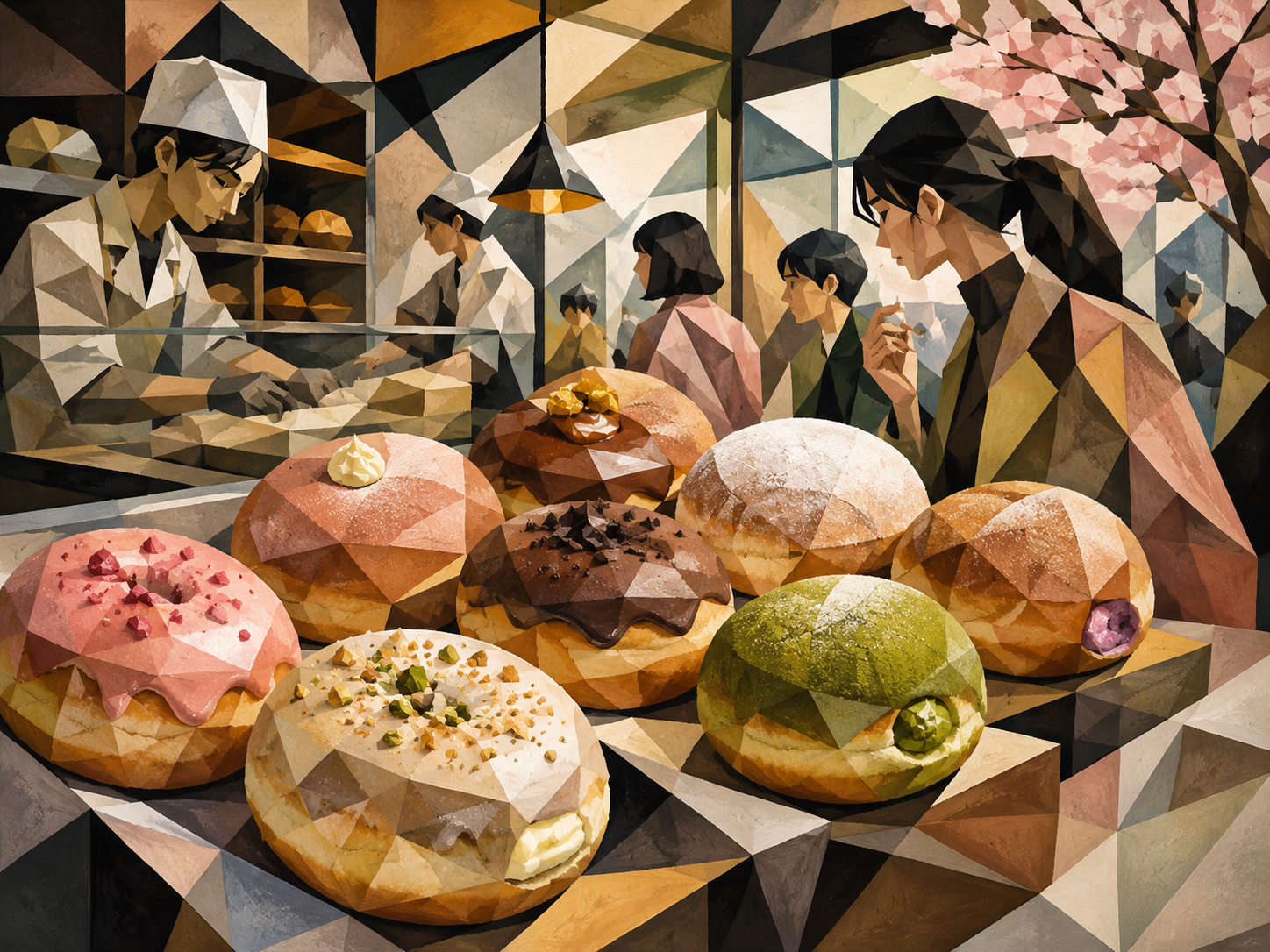
Japan’s latest doughnut story is not really about the hole. It is about texture. The nama donut — soft, moist, airy, sometimes cream-filled, sometimes made with a brioche-like dough — has turned a familiar Western sweet into a very Japanese kind of food trend. The word nama can literally mean raw or fresh, but in Japanese food marketing it often means something more subtle: fresh-feeling, tender, creamy, melt-in-the-mouth, and close to the sensation of something just made.
Web Japan described the nama donut boom in 2026 as a case of Japan reinventing a Western classic. Customers are drawn to the cloudlike softness, the cute designs, and the social-media-friendly presentation. But the story runs deeper than a pastry fad. Nama donuts sit at the meeting point of Japan’s long obsession with texture, its convenience-store dessert culture, its department-store food halls, its bakery creativity, and its growing ability to export everyday pop food as global culture.
One symbol of the moment is I'm donut ?, the Tokyo-born shop that opened in Nakameguro in 2022 and later expanded overseas to Times Square in New York. Reports describe its signature nama-style doughnuts as using a brioche-like dough with kabocha squash to create a chewy, moist, light texture. A Japanese line sweet had arrived at one of the most visible tourist crossroads in the world.
The nama donut boom in numbers
Doughnuts came from America, then Japan made them its own
To understand nama donuts, start with Mister Donut. The chain began in the United States, but in Japan it took on a life of its own after Duskin introduced the brand and opened the first Japanese shop in Minoh, Osaka, in 1971. In the high-growth era, doughnuts and coffee suggested modern family leisure, student hangouts, and a friendly version of American-style consumption.
In the United States, much of the Mister Donut system eventually disappeared into Dunkin' Donuts. In Japan, the opposite happened. Mister Donut became a domestic institution by continuously localizing itself: seasonal flavors, matcha, sakura, kinako, brown sugar, character collaborations, lucky bags, and above all, new textures.
The 2003 debut of Pon de Ring matters because it trained Japan to talk about doughnuts through mouthfeel. The product was not only sweet; it was mochimochi — chewy, bouncy, and memorable. Nama donuts belong to the same genealogy. They are the next step in a culture that makes texture a headline.
What “nama” really sells
In Japanese food language, nama does not always mean raw in the literal sense. Nama chocolate is not eaten as raw cacao; it is valued for creaminess. Nama caramel is about softness. Nama shokupan is baked bread, but it promises moistness and tenderness. Nama is a sensory word. It tells the buyer to expect something fresh, delicate, and soft.
That language fits Japan’s older sweets culture. Mochi, gyuhi, warabi mochi, yokan, kuzumochi, anko, and namagashi all ask the eater to notice texture as much as flavor. When Western desserts entered Japan, consumers did not simply ask whether they were sweet. They asked whether they were light, heavy, crisp, chewy, moist, creamy, or melting.
The nama donut sits between a fried sweet, a bakery item, a cream bun, and a small cake. It may not have the classic American ring shape. It may be round, filled, or shaped for a photo. Its appeal is that it feels familiar and unfamiliar at the same time.
I'm donut ? and the design of a line
I'm donut ? shows that the boom is not only culinary. It is experiential. The Nakameguro address, the minimalist store design, the carefully staged product display, the limited-feeling menu, the box-opening moment, and the line outside all become part of the product. In Japan, waiting often becomes a proof of value. A line is inconvenient, but it also tells a story that can be photographed and shared.
Food & Wine described the New York opening as the first international location for a Tokyo pastry chef’s brand, with nama-style doughnuts made with kabocha and a variety of sweet and savory flavors. The New Yorker treated I'm donut ? as an example of the appeal of international chains and experience-based food culture, not merely as a dessert shop.
The overseas reaction has not been universally gentle. Some New York coverage criticized high prices and odd savory experiments. But even the criticism matters. A Japanese doughnut shop had entered the public conversation of a major global food city. That is no small thing.
Convenience stores and depachika prepared the market
The nama donut did not come from nowhere. Japan’s convenience stores spent decades teaching consumers to expect high-quality, affordable, rotating sweets: cream puffs, roll cakes, puddings, cheesecakes, mont blanc cups, mochi desserts, and seasonal limited editions. New sweets became something to try casually, photograph, compare, and discuss.
Department-store food halls — depachika — also shaped the logic of the boom. They turned sweets into gifts, status signals, regional discoveries, seasonal markers, and line-worthy events. Nama donuts fit that world perfectly: they have a visible cross-section, a short freshness window, limited flavors, and a sense of being both everyday and special.
Japan’s bakery culture added the final foundation. Japanese bakeries have long adapted French, German, American, and local forms into sweet buns, savory breads, curry pan, an-butter sandwiches, premium shokupan, and seasonal pastries. A nama donut is easy for Japanese consumers to understand because it lives between bread and dessert.
Why softness now?
Food trends often mirror the mood of a country. Japan’s recent sweets language has leaned toward fuwafuwa, torotoro, mochimochi, and shittori — fluffy, melty, chewy, moist. These are comfort words. In a busy, aging, price-sensitive urban society, a small soft sweet can function as an affordable reward.
Nama donuts work because the experience has several stages: anticipation in line, choosing the flavor, opening the box, photographing the surface or cross-section, smelling the dough and cream, then feeling the texture disappear. That gives the product more life than a simple sweet snack.
They also travel well as an idea. A visitor does not need to understand Japanese culinary history to understand a doughnut. But when that doughnut is softer, prettier, less cloying, and more carefully packaged than expected, it becomes a travel memory.
The global return trip of a Western sweet
The Times Square debut of I'm donut ? is symbolically powerful. A doughnut, once understood globally as an American mass-market sweet, was taken up by Japan, redesigned through texture, and returned to New York as a premium line-forming dessert. That is cultural circulation in edible form.
Japan’s food exports have moved well beyond sushi and ramen. Matcha desserts, cheese tarts, soufflé pancakes, Japanese-style curry, premium convenience foods, and bakery concepts now travel. Nama donuts belong to that wave. They are not traditional washoku, but they are deeply Japanese in method: take a known thing, refine texture, stage the experience, and make it seasonal.
Challenges remain. Nama donuts depend on freshness and mouthfeel, so they are harder to scale than packaged snacks. Rent, labor, line management, local sweetness preferences, and price expectations all matter. If the format succeeds globally, it will be because operators preserve the texture while adapting the experience.
Japan.co.jp view
The nama donut is interesting because it is not a grand invention. It is a careful re-editing of something the world already knew. Japan changed the texture, the shape, the line, the photo, and the language around the product. That is one of Japan’s quiet strengths: not always inventing a category, but making a familiar category feel new.
This small sweet also reflects the present economy. A weak yen makes domestic treats feel more attractive to some Japanese consumers and makes Japan’s food experiences feel more accessible to visitors. Social media turns a soft pastry into a destination. Pastry chefs cross the borders between bread, cake, wagashi, and savory food.
Nama donuts will not change Japan by themselves. But they help explain Japan. They show how the country turns texture into language, language into product, product into line, and line into culture. A fluffy doughnut can be a surprisingly sturdy export story.
Reader guide
| Question | Answer |
|---|---|
| What is happening? | Nama donuts have become a major Japanese sweets trend and are beginning to travel overseas. |
| What does “nama” mean here? | Not raw dough. It signals freshness, softness, moisture, tenderness, and melt-in-the-mouth texture. |
| What is the history? | Mister Donut, Pon de Ring, convenience-store sweets, depachika food halls, and Japanese bakery culture all prepared the ground. |
| Why is it spreading? | Texture, visual appeal, lines, limited flavors, tourist curiosity, and global familiarity with doughnuts. |
| Japan.co.jp view | Nama donuts show Japan’s ability to re-edit a global standard through texture, experience, and seasonal storytelling. |
Sources and references
This article draws on Web Japan, Japan Travel, Food & Wine, The New Yorker, Voyapon, Mister Donut information, JETRO food-export context, and public materials on Japanese sweets and bakery culture. Shop counts, menus, prices, and expansion plans may change.
- Web Japan: From Fluffy to Famous: Japan's Nama Donut Craze.
- Japan Travel: I'm Donut?: Japan's Viral Donut Sensation.
- Food & Wine: What to Get at NYC's Japanese doughnut shop.
- The New Yorker: I'm Donut? and the allure of the international chain.
- Voyapon: How Mister Donut won over Japan.