A painter who made one subject take over the room
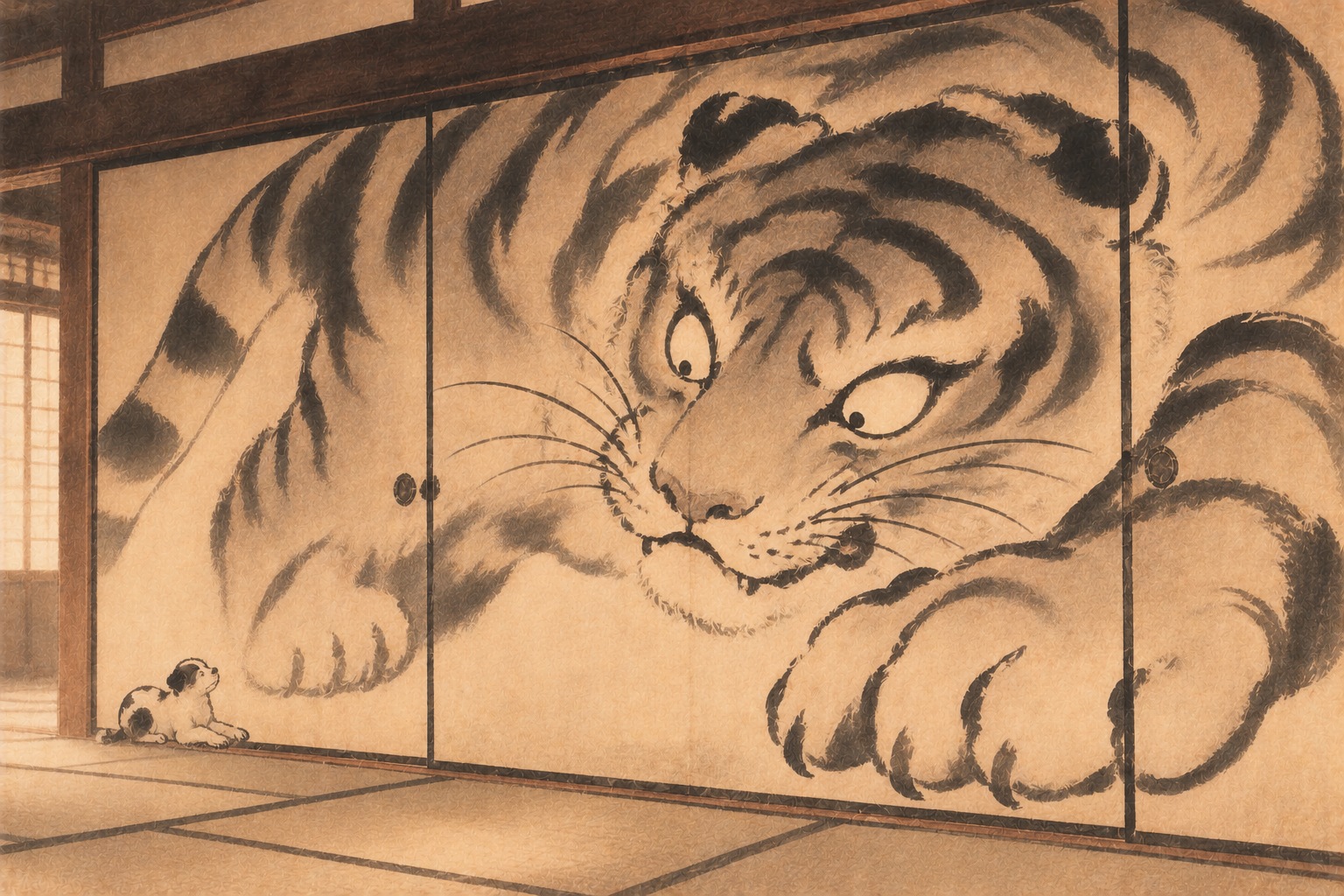
Some painters fill a picture. Nagasawa Rosetsu often let a picture be taken over. A tiger is not merely present: it lunges into the architecture. An elephant is not simply large: it seems to exceed the screen that contains it. A puppy does not politely decorate the foreground: it destabilizes the dignity of the entire scene. In Rosetsu’s art, scale is a dramatic instrument, and single-subject dominance becomes a way of thinking.
That quality is why Rosetsu feels unexpectedly contemporary. He understood how to seize attention with one commanding form while leaving the surrounding space emotionally charged. The result is not emptiness in the minimalist sense. It is pressure, suspense and wit.
From Ōkyo’s studio to a style of his own
Tokyo Fuji Art Museum summarizes Rosetsu in a way that captures both his pedigree and his rebellion. Born in Tanba Sasayama in 1754, he became an adopted son of the Nagasawa family after being born into the Kataoka family, studied under Maruyama Ōkyo, and developed a bold manner marked by large-scale forms, daring composition and inventive wit. The museum notes that he is often grouped with Soga Shōhaku and Itō Jakuchū as one of the so-called “eccentric painters.”
That label is useful but incomplete. Rosetsu’s work makes little sense unless one also sees how deeply he absorbed Ōkyo’s discipline. The Maruyama school prized observation, structure and technical precision. Rosetsu inherited all of that. What changed was what he did after mastering it. Instead of simply making realism more persuasive, he made it more theatrical.
In other words, Rosetsu’s originality does not come from ignorance of convention. It comes from confidence inside convention. He knew how to paint persuasively enough that he could afford to distort scale, pull an animal close, or turn a screen into a stage.
Why Rosetsu’s animals do not sit still
Animals are among the clearest paths into Rosetsu’s world because they reveal his emotional range. They can be ferocious, vulnerable, comic and watchful at once. Even when he paints a beast of great force, he rarely gives viewers only awe. He complicates the mood with affection or visual surprise.
This is one reason Rosetsu remains so easy to love. He did not paint animals as stock symbols. He treated them as pictorial personalities. A tiger can feel dangerous without losing a strange lovability. A puppy can feel cute while also acting as a compositional prank. That doubleness is one of his signatures.
The southern journey that changed everything
The decisive episode in Rosetsu’s career came in 1786 and 1787, when he traveled to what is now Wakayama Prefecture. Kushimoto Town explains that Muryōji had been destroyed by the 1707 tsunami and rebuilt in 1786 under the monk Gukai. Maruyama Ōkyo had earlier promised to paint for the temple when the opportunity arose; when the rebuilt temple requested screens and fusuma, Ōkyo sent twelve panels and entrusted the delivery to Rosetsu. Once in Kushimoto, Rosetsu stayed on and produced a large body of work of his own.
The surviving record is extraordinary. Kushimoto says works remain not only at Muryōji but also at Jōjuji and Sōdōji, leaving a total of 180 barrier-painting panels in those three temples. Muryōji’s own account goes even further, stating that Rosetsu painted more than 270 works during a stay of about ten months and that this period marked the high point of his life.
Wakayama Prefectural Museum’s 2026 special exhibition underscores the scale of this achievement. It brought together barrier paintings connected with five temples and stated that the display included 32 barrier-painting works totaling 180 panels. For art history, the Nanki stay is not a side story. It is where Rosetsu’s pictorial nerve became impossible to miss.
The tiger that still startles viewers
Rosetsu’s famous tiger images at Muryōji are not “tiger pictures” in any merely descriptive sense. They are acts of visual occupation. The animal crowds the viewer, bends space around itself and turns painted paper into a zone of encounter. Fuchu Art Museum used one of these tiger fusuma as the emblematic image of its 2026 Rosetsu exhibition, a sign of how central the work has become to Rosetsu’s modern image.
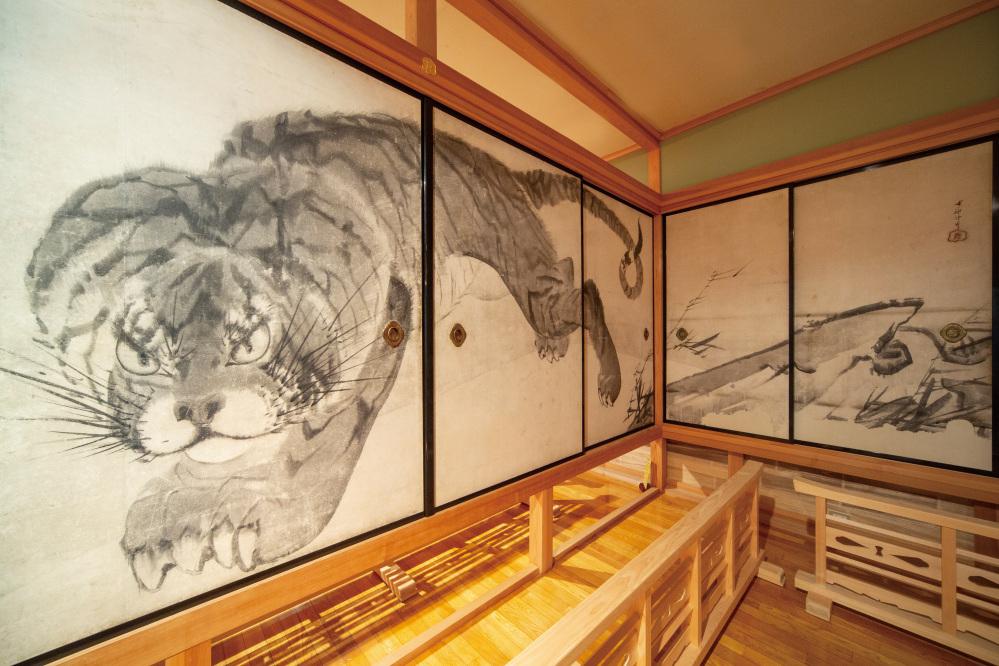
The tiger works because it operates on several levels at once. It is large, but size alone is not the point. It is expressive, but expression alone is not the point either. What makes it memorable is the joining of force and instability: the tiger feels both immediate and slightly uncanny, as if Rosetsu had painted not an animal in nature but the experience of suddenly confronting one.
Elephant and bull: wit on a monumental scale
If the tiger shows Rosetsu’s sense of psychological pressure, White Elephant and Black Bull Screens shows his play with contrast and wit. Canon’s Tsuzuri Project describes the six-panel pair, now in the Los Angeles County Museum of Art, as one of Rosetsu’s masterpieces. The work stages vast animals that almost overrun the surface, while smaller creatures—a black crow and a white puppy—sharpen the contrast of scale, tone and mood.
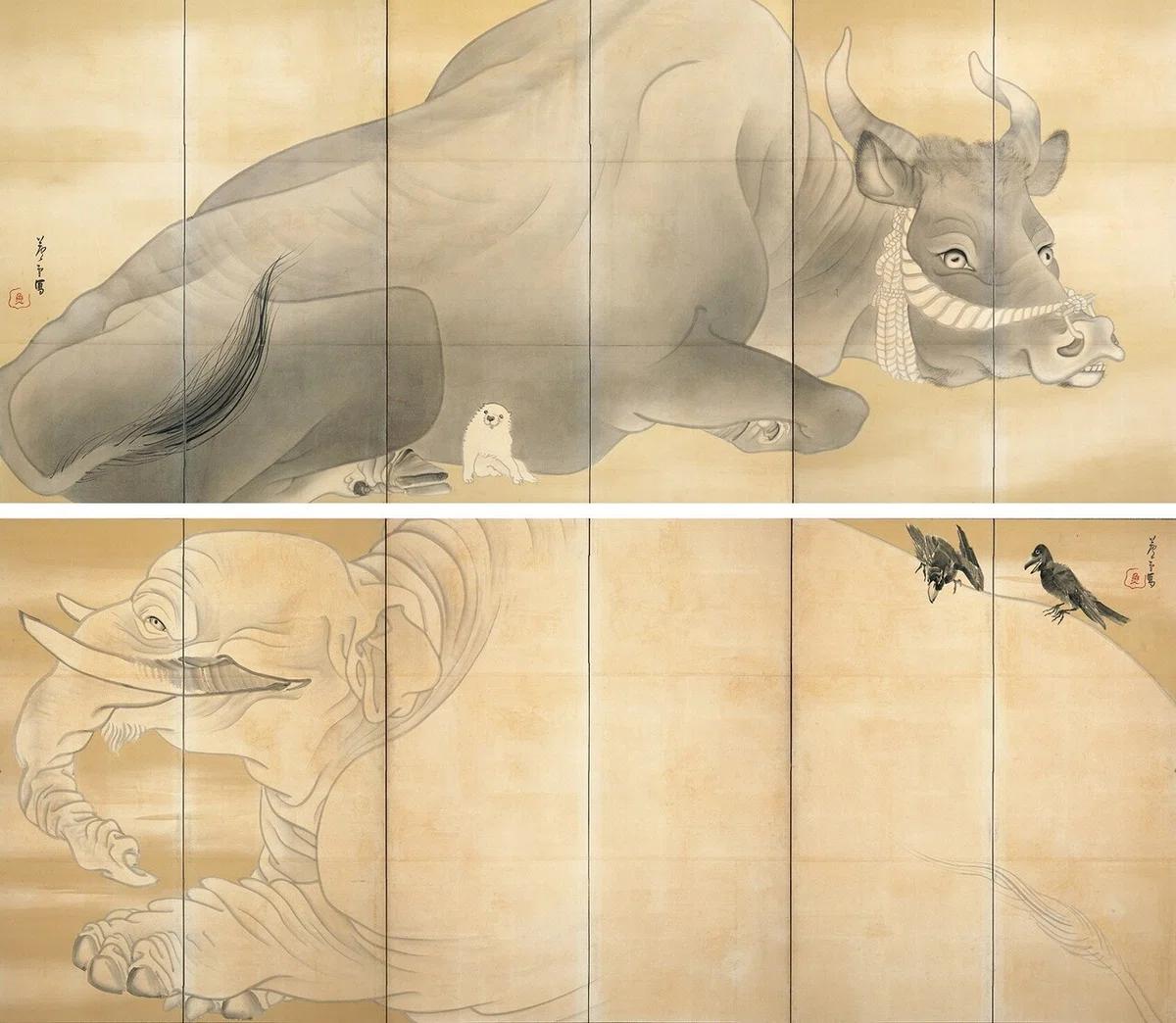
What is striking here is how sophisticated the joke is. The picture is funny, but its humor is inseparable from formal intelligence. The tiny dog does not merely amuse. It measures the elephant. The crow does not merely decorate. It activates the bull. Rosetsu turns comedy into composition.
Humor, puppies and the refusal of solemnity
Many discussions of Rosetsu emphasize the word “eccentric,” but another word matters just as much: generosity. His art often makes room for surprise, lightness and visual pleasure even when the subject could be treated gravely. Puppies, children and exaggerated poses interrupt stiffness. That is not triviality. It is an insistence that life exceeds decorum.
This matters especially in the context of temple commissions, where solemnity might have seemed obligatory. Rosetsu did not mock sacred settings. He refreshed them. He brought living movement into spaces of ritual, and in doing so made the spiritual world feel inhabited rather than merely revered.
Rosetsu beyond “eccentricity”
Modern art history often groups Rosetsu with Jakuchū and Shōhaku as painters of “eccentricity.” The category has helped restore neglected artists to public attention. Yet Rosetsu’s achievement is richer than the label suggests. His pictures are not odd for oddness’ sake. They are carefully built inventions that test how far observation, design and temperament can be pushed before they stop feeling natural.
Seen this way, Rosetsu is less a curiosity and more a major thinker in paint. He asked how a painting can intensify presence. He asked how a single animal might carry an entire room. He asked how seriousness can coexist with humor without weakening either one.
Why museums keep returning to him
The answer can be seen in the 2026 exhibitions. Fuchu Art Museum described Rosetsu as a late-eighteenth-century Kyoto painter whose works move from fantastic scenes and delightful animals to more willful, contrary and joyous pictures, and noted that its exhibition was Tokyo’s first major Rosetsu show in 64 years. Wakayama Prefectural Museum devoted a special exhibition to the Nanki works. The dual emphasis is revealing: one show reintroduced Rosetsu to metropolitan audiences, while the other re-centered the temple paintings that made his legend.
Museums return to Rosetsu because he satisfies two different publics at once. Specialists find structure, art-historical importance and technical command. General viewers find pictures that communicate instantly. One does not have to be a scholar of Edo painting to understand that his tiger means business.
What Tokyo Fuji Art Museum preserves
Tokyo Fuji Art Museum’s collection page lists four Rosetsu works in its holdings: Rabbits in Snow with a Nandina Bush, Aronia and Sparrows, Sparrows and Roses and Bird and Flowers. These are not the monumental tiger or elephant images most people first associate with him, and that is precisely why they are important. They show Rosetsu’s range.
The museum’s summary emphasizes that he did not merely seek shock. He was capable of delicacy, charm and attentive observation. The same painter who could let a tiger dominate a room could also produce refined smaller works whose intelligence lies in restraint rather than eruption.
Why Rosetsu fits JAPAN.co.jp’s visual direction
For the November 8 edition, Rosetsu is more than a historical subject. He is a visual guide. JAPAN.co.jp’s recent image direction has favored one dominant subject, theatrical asymmetry and a refusal to clutter a scene with too many equal points of attention. Rosetsu offers all of that, but with authentic Japanese precedent.
His method also travels well across subject matter. A footballer in motion, a solitary sea otter, an immense telescope, or a semiconductor object surrounded by force-lines can all borrow from Rosetsu’s logic: one form, strong silhouette, charged emptiness, and a touch of pictorial audacity. He is not modern because he predicted our media. He is modern because he still teaches how to look.
The enduring shock of being looked at
Rosetsu’s art lasts because it reverses the usual direction of observation. We go to look at the tiger, but the tiger seems already to be looking at us. We smile at the puppy, but the puppy has already loosened the painting’s hierarchy. We admire the technical control, then discover that the control is in service of freedom.
That is why Rosetsu deserves a full feature of his own and why he was such a persuasive choice for November 8. He represents an eighteenth-century master who can still feel startlingly present: trained, funny, disciplined, audacious, and wholly unafraid of letting one subject dominate the world around it.