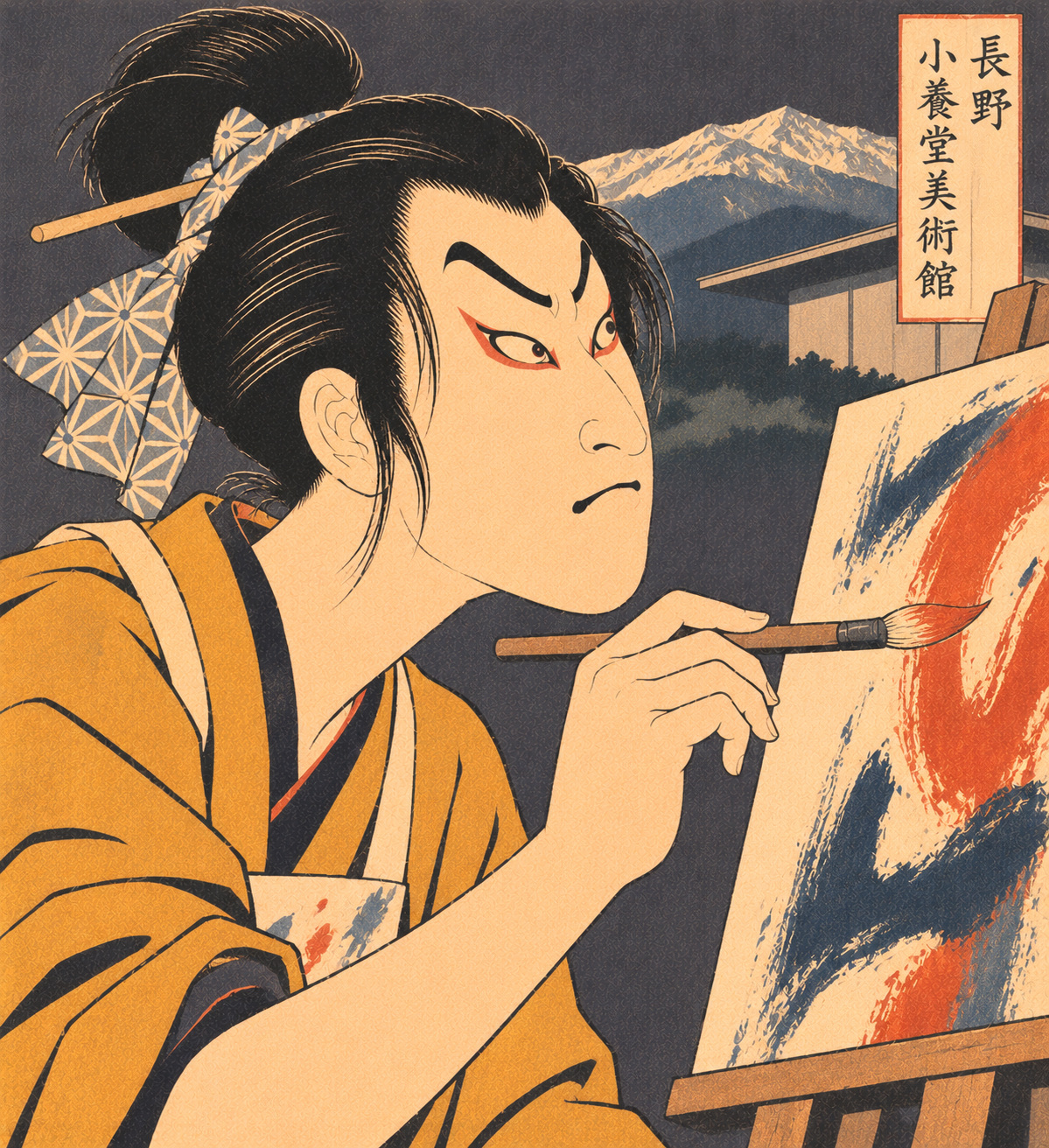
- A small museum in Nagano asks who gets to shape the next art history
- A grand prize that turns recognition into a museum acquisition
- Why buying a work matters more than a prize-night photograph
- An anniversary with two starting dates
- A regional art institution with an Asian horizon
- The intellectual ambition—and limits—of an Asian art narrative
- Three curators, several art worlds
- What a visitor can see before November 29
- After the exhibition: the real test of a discovery program
A small museum in Nagano asks who gets to shape the next art history
Far from the major galleries of Tokyo, the Koyodo Museum of Art sits among the trees of Nagano’s Tateshina Highlands. This autumn, visitors encounter neither a conventional blockbuster retrospective nor a celebration confined to a museum’s established collection. Instead, 36 newly selected works form a proposal about what Japanese and Asian art might become.
The Kyoto University of the Arts–affiliated museum is celebrating 20 years under the university’s stewardship. Its anniversary exhibition opened October 1 and continues through November 29. In an announcement dated November 17, 2026, the university said the open competition attracted more than 360 applicants from Japan and overseas. An awards ceremony had taken place on October 18.
That chronology matters. November 17 was not the exhibition’s opening, and the selection was not made this week. The news is the university’s account of an ongoing anniversary project and the artists it has chosen to support. The more interesting question is why a forest-surrounded regional museum is committing collection resources to creators whose reputations have yet to be settled.
A grand prize that turns recognition into a museum acquisition
The Grand Prize went to the artist identified in the Japanese official materials as 陳柏欣, for a work titled *南国のドラァグクイーン*—a title that can be understood as “Southern Drag Queen,” although the museum’s Japanese title should be preserved as authoritative. The ¥3 million award is structured as a purchase payment for the work, not merely an unrestricted cash trophy.
Three Jury Prizes, carrying ¥1 million purchase awards apiece, went to 林銘君 for *暗礁域 (Reef Zone)*, 霧生まどか for *Full dress*, and 李丹 for *夜の移ろいに立つ*. Three further works received newly introduced honorable mentions: 白簱花呼’s *これの名前は?*, ムシスミ’s *swaying trees II*, and Misato Sakai’s *Unnatural*. The university says the honorable mentions do not carry the same acquisition payment.
The titles suggest very different concerns, but a title is not enough evidence to describe an artist’s intentions, working method or cultural background. Rather than invent curatorial interpretations, the meaningful confirmed fact is institutional: the grand and jury prizes explicitly connect the public recognition of emerging artists with the museum’s future holdings.
Why buying a work matters more than a prize-night photograph
The competition accepted applications from December 2025 through January 2026. A documentary first review narrowed the pool to 36 artists, whose physical work was examined at Kyoto University of the Arts’ Galerie Aube in July. All 36 were included in the autumn presentation in Nagano, according to the organizers.
The jury comprised Koyodo director and painter Hiroshi Senju, Nagano Prefectural Art Museum director Michiko Kasahara, and Akiko Miki, director of the Naoshima New Museum of Art. Seeing the objects themselves rather than judging only digital reproductions allowed the panel to consider scale, material behavior and physical presence. The university has not published a complete account of the individual deliberations.
A museum acquisition can outlast an award announcement. It creates obligations to catalogue, conserve, research and potentially exhibit a work long after a competition ends. Acquisition also gives future scholars and audiences an opportunity to reconsider an artist whose contemporary reputation may change. Whether Koyodo’s long-term care and public access will realize that potential remains a question for the years ahead.
An anniversary with two starting dates
Koyodo’s history begins before the twentieth anniversary now being celebrated. It opened in July 2001 as a private art museum founded around the collection of Yasuo Satori (佐鳥康郎), former chairman of Satori Electric. Its home in Chino, near the foot of the Yatsugatake range, is set within roughly 6,000 tsubo of woodland—nearly 20,000 square meters.
After the founder’s death in 2004, the institution and collection were donated to what was then Kyoto University of Art and Design in 2005. Hiroshi Senju became director, and the museum reopened as a university-affiliated institution in April 2006. The year 2026 therefore marks 20 years of its university-affiliated phase, not 20 years since the original 2001 opening.
The university’s current facilities description says the holdings comprise roughly 370 works spanning modern and contemporary Japanese painting, oils, watercolors and prints. The museum has also served art education: professional museum-training placements and landscape drawing courses connect the university to the highland setting. Its identity is both that of a collection and a teaching institution.
A regional art institution with an Asian horizon
For much of modern art history, attention and infrastructure have clustered in large cities. Galleries, curators, specialist critics and buyers can be difficult for artists outside those networks to reach. A museum in a regional setting can provide a different gateway: a serious encounter with a juried work, visible to the public, with the possibility that it will enter a permanent collection.
Koyodo’s competition sought future contributors to art in Japan and across Asia. Yet the rules did not restrict eligibility to applicants of a particular nationality or age. Applications could be submitted in Japanese or English, and there was no entry fee. Those conditions widened the nominal pool while leaving practical barriers: entrants advancing to the physical review were responsible for shipping, installing and removing their works.
This distinction between formal openness and actual access is important. An artist may be free to enter and still face substantial transport expense, language challenges or professional obligations. A durable emerging-artist program has to be judged not only by how many applications arrive, but by whose work can realistically be considered and supported.
The intellectual ambition—and limits—of an Asian art narrative
The competition’s conceptual statement invokes Tenshin Okakura, the Japanese art thinker associated with reintroducing Japanese art to international audiences at the turn of the twentieth century. It draws on his concern for relationships among individuals, communities and the natural world, asking whether Asian artistic perspectives can offer something distinctive at a time of polarization.
That is the organizers’ framework, not an artistic manifesto confirmed to be shared by all 36 exhibitors. Asian artists work in many languages, styles and cultural conditions; treating them as the representatives of a single coherent tradition would flatten the very diversity the competition says it wants to discover.
Okakura’s legacy is itself historically complex. His ideas helped shape modern institutions and cross-border conversations about Japanese art, while his language of cultural unity should be read within the politics of his age. The most rewarding use of that history is not to confine contemporary artists to a predefined “Asian” identity, but to give viewers a more searching set of questions.
Three curators, several art worlds
Hiroshi Senju, the museum’s director, is widely known for his waterfall paintings and was honored at the 1995 Venice Biennale. Fellow jurors Michiko Kasahara and Akiko Miki lead museums with distinct collections and audiences. Their presence gives the anniversary competition links to the prefectural museum system and to Naoshima’s contemporary-art landscape.
Such a panel may broaden the range of perspectives brought to selection, but names alone do not demonstrate that every medium or approach received equal consideration. The organizers describe a two-stage review but have not released a detailed public scorecard or full transcript of how the winners were chosen.
Nor does a shortlist establish a universal hierarchy of talent. Selection reflects the objectives and constraints of one institution at one moment. The value to visitors lies in seeing the choices—sometimes agreeing, sometimes disputing them—and discovering artists they may not otherwise encounter.
What a visitor can see before November 29
The exhibition is at the Koyodo Museum of Art, 4734-215 Toyohira, Chino, Nagano. The university lists opening hours as 10 a.m.–5 p.m., last admission 4:30 p.m., and a general admission charge of ¥300. Junior-high-school students and younger visitors, as well as Kyoto University of the Arts students, are admitted free.
Regular closures are Mondays, with the following Tuesday substituted when a Monday is a public holiday, and the second and fourth Tuesdays. Visitor information published by the university and participating artists identifies the Togariishi Jomon Archaeological Museum-mae bus stop as a nearby access point from JR Chino Station, but schedules and seasonal service should be checked before traveling.
The current event is scheduled to close November 29. Nothing in the reviewed release establishes that all 36 works will remain continuously on public view afterward. A collection acquisition is not the same as a promise of permanent display.
After the exhibition: the real test of a discovery program
The appeal of an emerging-artists competition is easy to grasp. A museum finds creators who have not yet entered its own collection, gives them a public platform, and may provide funds that help make the next work possible. Harder to establish is whether the effect endures once the show closes.
The November university announcement confirms the shortlist, prizes, October ceremony and exhibition schedule. It does not detail the future conservation program for the acquired pieces, prospective touring displays, or binding multi-year commitments to individual artists. Those remain appropriate questions for subsequent reporting rather than achievements to announce prematurely.
Koyodo began as a privately assembled collection in the highlands, became a university museum, and has now used an anniversary to invite new voices into its holdings. That sequence carries a quiet but important idea: a museum’s history is not only what it has preserved, but what it chooses to preserve next.
Primary sources and reporting limits
Independently composed from university, museum and regional cultural-institution materials. No original interviews with artists or jurors, on-site review of the works, or independent verification of unpublished jury deliberations was undertaken.
- Kyoto University of the Arts — Competition, prizewinners and rules
- Kyoto University of the Arts — November 17 exhibition announcement
- Kyoto University of the Arts — Museum facilities and collection
- Kyoto University of the Arts — University history and 2005 donation
- Hachijuni Cultural Foundation — Museum history and access
- Artist Erina Miyamoto — Exhibition and visitor information