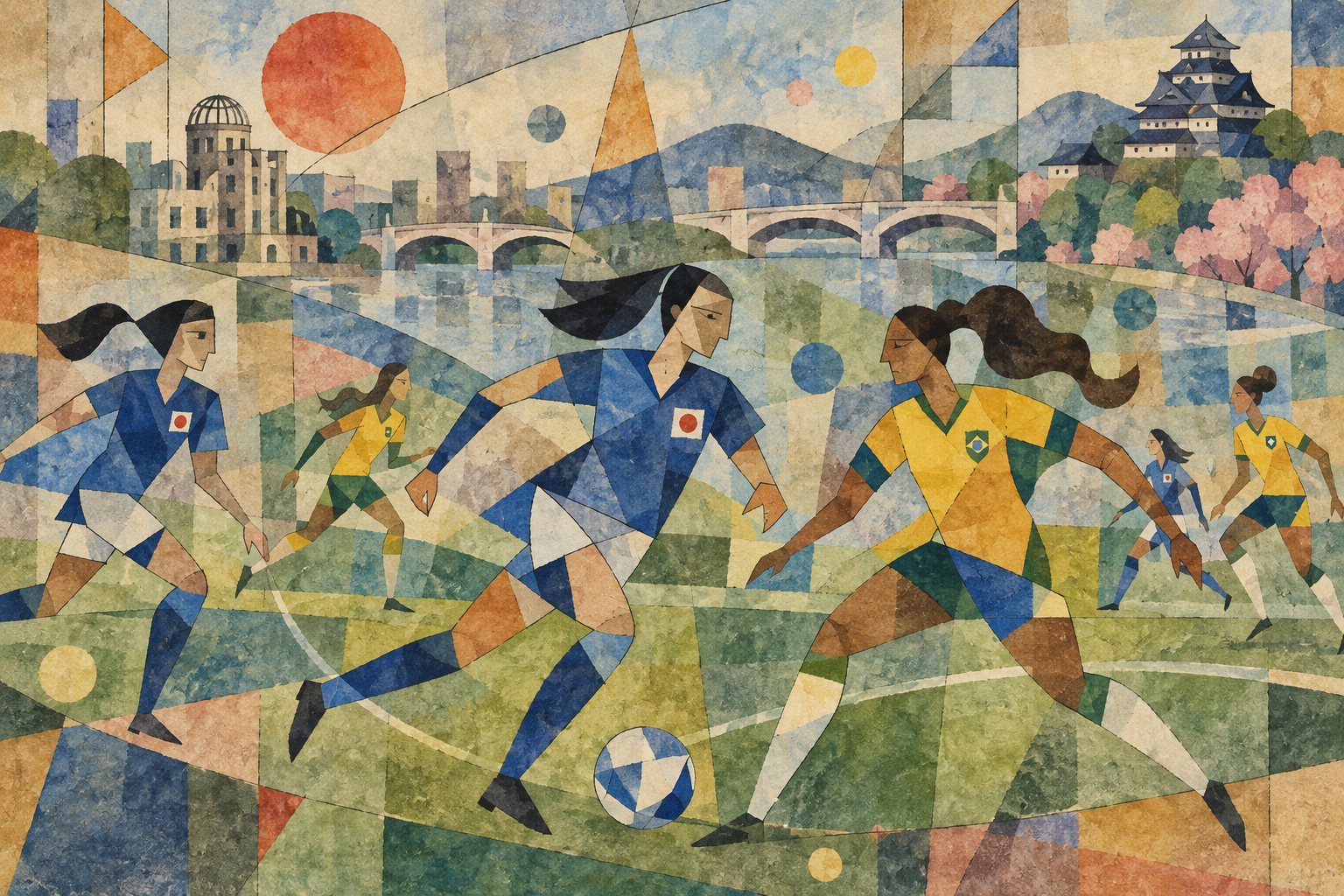
For Japan’s women’s national team, the road toward the next World Cup will include two home encounters with Brazil. For supporters in Hiroshima and Okayama, the same fixtures offer something more immediate: a chance to watch international football close enough to follow the movement that a television camera often leaves outside its frame.
The Japan Football Association confirmed Brazil as the opponent on September 17. The games will be played on November 29 and December 5, under the title “MIZUHO BLUE CHALLENGE NADESHIKO 2026 青さで、挑め。” These are late-year fixtures; the reason to start planning in September is the imminent opening of ticket sales. Hiroshima’s general sale begins September 19, with Okayama following the next day. Both start at 10 a.m. Japan Standard Time. [1][2][3][4]
Two cities, two different milestones
Hiroshima hosts the first match at Edion Peace Wing Hiroshima, with kickoff scheduled for 1:55 p.m. on Sunday, November 29. JFE Harenokuni Stadium in Okayama hosts the second at 3 p.m. on Saturday, December 5. All times in this report are JST. [3][4]
JFA describes the Hiroshima game as Nadeshiko Japan’s first at that stadium. The Okayama fixture is its first anywhere in the prefecture. That distinction matters: one introduces the national side to a particular venue, while the other brings a first senior women’s national-team match to an entire prefecture. [2]
The opportunity is not simply to see familiar players at shorter range. From the stands, spectators can choose where to look. A forward may drag a defender away without touching the ball. A midfielder may spend several seconds checking her surroundings before receiving a pass. A defender may prevent a counterattack through positioning rather than a conspicuous tackle. Such actions make live football an education in the work behind a highlight.
For regional organizers, the longer-term question is what follows the final whistle. A national-team appearance can create an opening for interest; lasting participation needs places to play, people to coach and further matches to attend. Neither attendance growth nor a local economic windfall can be assumed from the fixture announcement alone.
The history supporters bring with them
Japan’s 2011 Women’s World Cup victory remains a defining point of reference. In the final in Germany, the team twice recovered from behind against the United States before winning the penalty shootout. JFA’s Hall of Fame account places the achievement in the context of a country devastated by the earthquake and tsunami earlier that year. [7]
Japan returned to the World Cup final in Canada in 2015 and finished runner-up. The record matters because it establishes that the ambition to compete at the highest level rests on demonstrated achievement, rather than a distant aspiration. [8] But history cannot make the next pass or defend the next transition. Each generation has to find methods that work against the opponents in front of it.
That is also why bringing the current team to new audiences has value. Some young spectators will know 2011 through recordings and stories. A match they attend themselves offers a different relationship with the national side: an encounter with a living team whose decisions, setbacks and successes are still unfolding.
Brazil supplies a demanding reference point
The recent meetings offer no simple hierarchy. Japan beat Brazil 2–1 at the Paris Olympics in 2024, then lost the two 2025 friendlies 1–3 and 1–2, according to the results listed in JFA’s September announcement. Head coach Michihisa Kano describes Brazil’s technique and strength in individual defensive duels as challenges, and frames the fixtures as preparation for the 2027 Women’s World Cup. [1][11]
The useful question for spectators is how those challenges appear in play. The following is Japan.co.jp’s tactical analysis, not a disclosure of the coaching staff’s match plan. Against close marking, a player’s skill on the ball is only one part of an attack. Teammates must create passing options before she is trapped. Movement toward the ball, a run beyond the defender and an available outlet on the opposite side can change what initially looks like an individual contest.
Watch, too, what happens immediately after possession is lost. Does the nearest player press the opponent while others cover the space behind her? Or does the team retreat together to restore its defensive shape? Neither response is automatically correct. The location of the turnover, the numbers available and the distance between teammates determine the risk.
This gives supporters a more revealing vocabulary than effort alone. A conceded chance may arise because players made different decisions at the same moment, rather than because nobody was working hard. Equally, an attack that appears cautious may be creating the conditions for a faster move a few passes later.
Why the second game deserves its own attention
The six days between fixtures create room to respond to the first encounter. Facing the same opponent again gives the second match a particular interest: spectators can look for adjustments, while recognizing that different lineups, physical condition and match situations prevent a controlled comparison.
If Japan struggles to progress through the middle in Hiroshima, does the spacing change in Okayama? If a particular passing route works in the first match, how does Brazil close it in the second—and what does Japan do next? The contest is not simply over who has the better opening idea. It is also over who can recognize a problem and change the game while it is happening.
Selection will shape that story. The September fixture announcement does not establish who will start or guarantee any individual’s appearance. It would be premature to sell the games as a confirmed meeting of particular stars. The attraction already supported by the evidence is a strong international opponent and two opportunities to examine Japan’s development.
Results still matter. Playing at home carries an understandable desire to reward the crowd with a win. Yet two friendly victories would not certify that every World Cup problem had been solved, just as two defeats would not explain everything that went wrong. Good evaluation asks which actions can be repeated under pressure, and where the team still depends on a moment of individual rescue.
Planning a visit: the details are not identical
| Venue and match date | Kickoff and general ticket sale |
|---|---|
| Edion Peace Wing Hiroshima · Sunday, November 29 | 1:55 p.m. kickoff / September 19, 10 a.m. sale |
| JFE Harenokuni Stadium · Saturday, December 5 | 3 p.m. kickoff / September 20, 10 a.m. sale |
A category-four combined ticket covers both cities. JFA’s Hiroshima ticket guide says the same paper ticket is used at both matches, so it must be retained after the first game. There is no refund for the unused match if a holder attends only one, and the combined ticket is excluded from resale. [5] These conditions make the decision about attending twice more than a choice of seat.
The ticket pages also give a separate timetable for BLUE DREAM SEAT wheelchair seating and seating for people with intellectual or developmental disabilities: sales are planned from mid-October. Supporters needing these arrangements should follow the relevant official page rather than assume that the September general sale covers every seating category. [5][6]
For international customers, the Okayama guide identifies English-language purchasing through AXS, with category four listed for that outlet. The available categories and purchase conditions vary between sellers; the official ticket guide is the starting point for choosing a route. [6] A sale opening is not a statement about remaining inventory or a guarantee of purchase.
For families and groups, planning should extend beyond kickoff. Agreeing on arrival time, meeting points, breaks and the return journey can make the day easier. Anyone requiring specific assistance should check the arrangements for their actual seat and venue rather than infer them from the existence of an accessibility program.
A national audience, a local experience
The Hiroshima match is scheduled for live nationwide coverage on the Nippon TV network and live streaming on TVer. Broadcast arrangements for Okayama were still being coordinated in JFA’s September 17 announcement. Supporters watching from elsewhere should check the official match pages again nearer the dates. [9][10]
Television can carry a match far beyond its host city. Hosting it gives local spectators another kind of access: the chance to notice an unfamiliar player, discuss a decision with the person beside them and leave with a reason to watch again. The most durable consequence may be modest—a child joining a session, a family attending another game, a supporter following a player’s club career.
None of those outcomes is assured. What the fixtures provide is the opportunity. Hiroshima and Okayama will be places where Japan tests its football against Brazil, and where new supporters can begin to make that football part of their own lives.
- JFA: Brazil fixtures and broadcast announcement, September 17
- JFA: series announcement and regional firsts, September 8
- JFA: Hiroshima kickoff and general sale, September 15
- JFA: Okayama kickoff and general sale, September 15
- JFA: Hiroshima ticket categories and conditions
- JFA: Okayama ticket categories and conditions
- JFA Hall of Fame: Japan’s 2011 Women’s World Cup team
- JFA: FIFA Women’s World Cup Canada 2015 archive
- JFA: Hiroshima match and broadcast information
- JFA: Okayama match and broadcast information
- JFA: 2026 player and staff archive, name verification
Fixture and sale details reflect announcements checked through September 17. Tactical interpretation and discussion of regional impact are Japan.co.jp analysis.