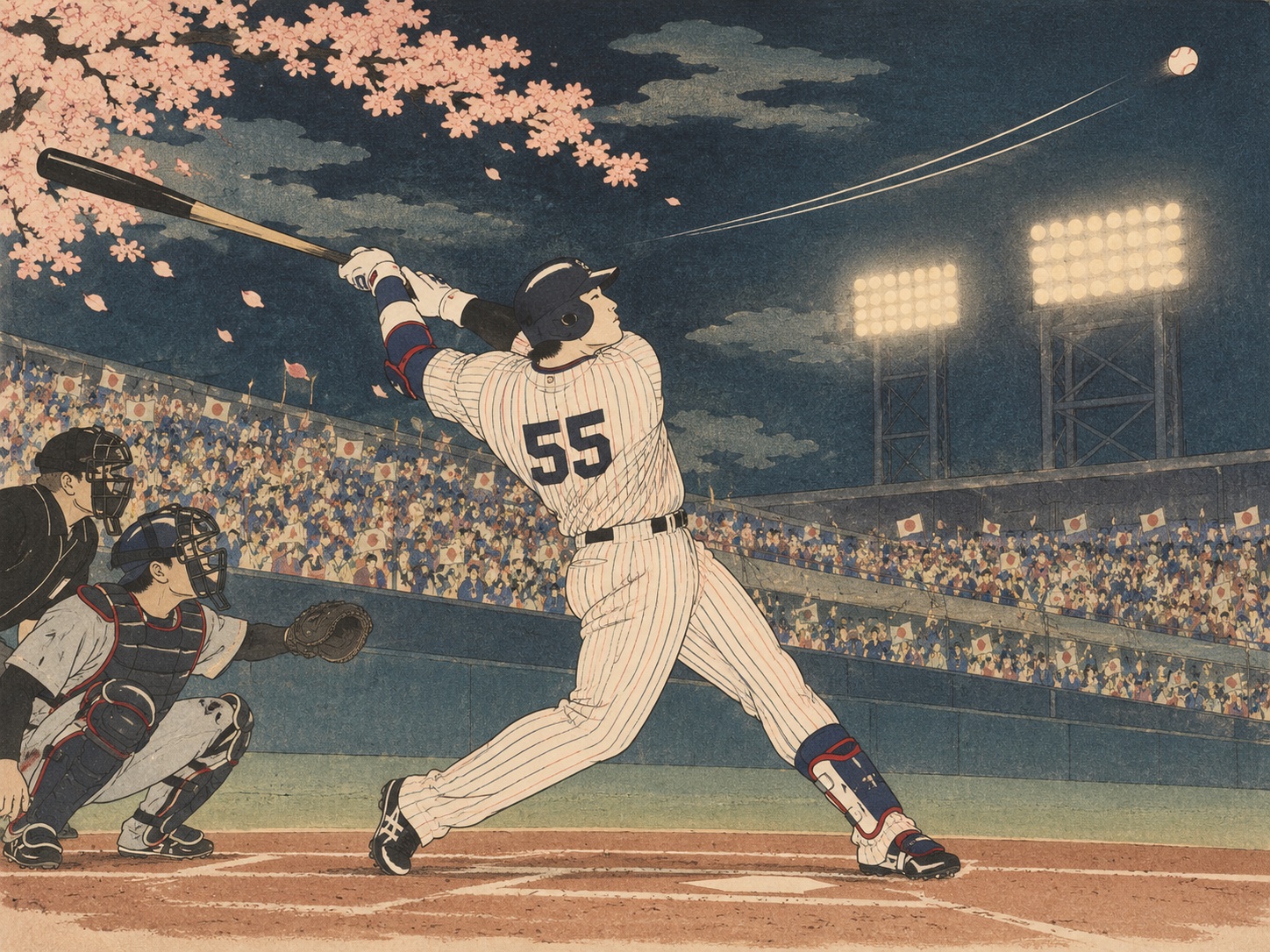
Munetaka Murakami finally produced the kind of October swing that made him famous in Japan.
In the fourth inning of Game 1 of the American League Division Series at Progressive Field on October 3, the Chicago White Sox slugger attacked the first pitch he saw from Cleveland left-hander Parker Messick and sent it deep into the right-field seats.
The two-run homer broke a scoreless tie. Statcast projected it at 440 feet with an exit velocity of 112.2 mph. Chicago went on to win 3–0 and take the opening game of the series on the road.
He entered the ALDS after a quiet Wild Card round
Murakami did not enter the Division Series on a hot postseason streak.
MLB.com noted that Murakami and Miguel Vargas, two of Chicago’s middle-of-the-order hitters, combined to go 1-for-17 without an extra-base hit in the White Sox’s two Wild Card Series victories over Houston.
That changed quickly in Cleveland.
He did not wait around
The score was 0–0 in the top of the fourth when Vargas singled to left.
Murakami stepped in against Messick and attacked the first pitch, a sinker that leaked inside and up.
He drove it to right with enough force that there was little uncertainty about the result.
In October baseball, when pitchers can shape an entire game plan around one hitter, the ability to punish the first hittable pitch matters. Murakami never gave Messick the chance to reach a favorable count.
The fourth White Sox rookie to homer in the postseason
MLB.com noted that Murakami became the fourth White Sox rookie to hit a postseason home run.
The others were Gavin Sheets in the 2021 ALDS, Luis Robert Jr. in the 2020 Wild Card round and Tadahito Iguchi in the 2005 ALDS.
Iguchi’s name gives the milestone particular resonance in Japan.
The 2005 White Sox won the World Series, ending an 88-year championship drought. Iguchi was their regular second baseman and an important postseason contributor.
Twenty-one years later, another Japanese infielder homered for Chicago in the Division Series.
From Kumamoto to Jingu Stadium to Chicago
Nippon Professional Baseball’s official records list Murakami as born on February 2, 2000. He attended Kyushu Gakuin High School in Kumamoto and was selected by the Tokyo Yakult Swallows in the first round of the 2017 draft.
He made his top-team debut in 2018.
By 2019, at 19, he hit 36 home runs and drove in 96 runs. In 2021 he hit 39 homers with 112 RBIs and helped Yakult win the Japan Series.
The 2022 season changed his place in Japanese baseball
Murakami’s defining NPB season came in 2022.
Official NPB records show a .318 batting average, 56 home runs and 134 RBIs. He led the Central League in all three categories and won the Triple Crown.
The 56 home runs also pushed him past Sadaharu Oh’s iconic 55-homer mark for a Japanese-born player in a season.
At 22, Murakami was no longer simply a young star. He had become the most closely watched Japanese power hitter of his generation.

The posting move finally came after the 2025 season
On December 22, 2025, Yakult officially announced that Murakami had reached an agreement with the Chicago White Sox through the posting system.
MLB reported the contract at two years and $34 million.
Murakami’s own message through the Swallows said that he finally felt he had reached the “starting line.”
He left NPB after eight seasons with 246 home runs and 647 RBIs in 892 games.
Thirty-six regular-season homers answered one question
Murakami’s first MLB season tested whether his Japanese power would survive against major-league velocity, breaking balls and a 162-game schedule.
MLB’s ALDS coverage placed his postseason homer in the context of a rookie season in which he hit 36 home runs.
The concerns that followed him from Japan did not disappear. His swing-and-miss rate and strikeouts remained part of the evaluation.
But the power clearly translated.
The quality of contact is the point
The 440-foot distance was dramatic. The 112.2 mph exit velocity may be even more revealing.
Murakami’s value has always been tied to what happens when he squares the ball. He can change a game with one swing.
That makes his offensive development a balancing act. Reduce the empty swings without sacrificing the bat speed and impact that make pitchers afraid to enter the zone.
If that balance improves, he can become more dangerous in MLB. If he chases power at the expense of strike-zone control, postseason pitching staffs will exploit it quickly.
October changes the meaning of one swing
A regular season gives a hitter hundreds of plate appearances to correct a bad week.
A postseason series may be over before the adjustment arrives.
Opponents build detailed plans around weaknesses. A hitter who struggles for two games can quickly become a story.
Murakami’s quiet Wild Card series was already being noticed in both Chicago and Japan.
That is why the 440-foot homer mattered beyond the two runs. It was the first direct answer to a different question: could his power appear in October?
The homer mattered to the White Sox rebuild, too
Chicago’s recent history makes the moment larger.
The White Sox lost 121 games in 2024, one of the worst seasons in modern MLB history. They improved in 2025 and returned to the postseason in 2026.
Murakami was signed during that rebuilding period as a 25-year-old international power bat rather than as a finishing piece for an established contender.
Now that player had delivered the decisive swing in the first game of a Division Series.
Chicago’s pitching made the two runs stand up
Murakami’s homer did not win the game by itself.
Starter Hagen Smith worked into the third, and Chicago’s bullpen carried the shutout the rest of the way.
Grant Taylor recorded a rare save of four-plus innings. MLB noted that it was only the sixth postseason save of at least four innings in the divisional era and the first since Lance McCullers Jr. in Game 7 of the 2017 ALCS.
Murakami created the lead. The pitching staff preserved it.
Why the swing became immediate news in Japan
MLB.com opened its story by noting how heavily Murakami’s performance would be covered in Japan. Former major leaguer Kazuo Matsui called it “Huge in Japan.”
The interest is about more than nationality.
Murakami came to MLB after winning a Triple Crown and hitting 56 home runs in NPB. He arrived carrying an implicit test of Japanese offensive quality.
Would a hitter who had overwhelmed Central League pitching still produce impact contact against MLB postseason pitching?
One swing cannot settle that question. But it can make the answer more interesting.
A Japanese White Sox lineage
Murakami is one of only a small group of Japanese players to wear a White Sox uniform.
MLB.com lists Shingo Takatsu, Tadahito Iguchi and Kosuke Fukudome before him.
Iguchi remains the defining Japanese figure in White Sox history because of 2005.
It is far too early to compare Murakami’s October to that championship run. But a Japanese infielder once again hitting a Division Series home run for Chicago creates a genuine historical echo.
One home run does not end the evaluation
A first postseason home run is a milestone, not a final judgment.
Cleveland and every future opponent will adjust. Pitch locations change. Breaking-ball usage changes. The next at-bat will be informed by the last one.
For Murakami to become a proven postseason hitter, he will need to keep making those adjustments as the series evolves.
But the first one is now permanent
Murakami hit 246 home runs in NPB before crossing the Pacific.
He hit 56 in one Japanese season. He won a Triple Crown. He played on a World Baseball Classic champion.
None of those accomplishments put a run on an MLB postseason scoreboard.
In the fourth inning in Cleveland, Murakami turned that postseason total from zero to one.
Four hundred forty feet. 112.2 miles per hour. Two runs.
The first October homer of his major-league career was finally real.
Sources and references
- MLB.com — “Murakami’s 1st postseason HR? A 440-foot moonshot in Game 1 of ALDS,” October 3, 2026.
- MLB.com — White Sox win ALDS Game 1, October 3, 2026.
- MLB — White Sox at Guardians Game Story, October 3, 2026.
- 日本野球機構 — 村上 宗隆(むらかみ・むねたか)個人年度別成績。
- 東京ヤクルトスワローズ — 「村上宗隆選手について」2025年12月22日。
- MLB.com Japan — 村上宗隆、ホワイトソックスと2年3400万ドルで契約、2025年12月。
- MLB.com Japan — 村上宗隆ホワイトソックス入団会見。
Reporting cutoff: October 6, 2026, 8:05 a.m. JST. The homer’s inning, 440-foot distance, 112.2 mph exit velocity, 3–0 final and Murakami’s 2-for-4, two-RBI line are verified through MLB. His Japanese name/reading and NPB career totals are verified through NPB, while Yakult’s official release confirms his posting-system move to the White Sox.
Why it matters
Murakami’s first MLB postseason homer was a 440-foot, two-run shot that supplied the decisive runs in a 3–0 ALDS Game 1 win.
Historical bridge
He came to MLB after a 56-homer Triple Crown season in 2022 and eight NPB seasons with Yakult.
What to watch
How pitchers adjust to him, whether he can reduce swing-and-miss without losing impact, and whether the October power continues.