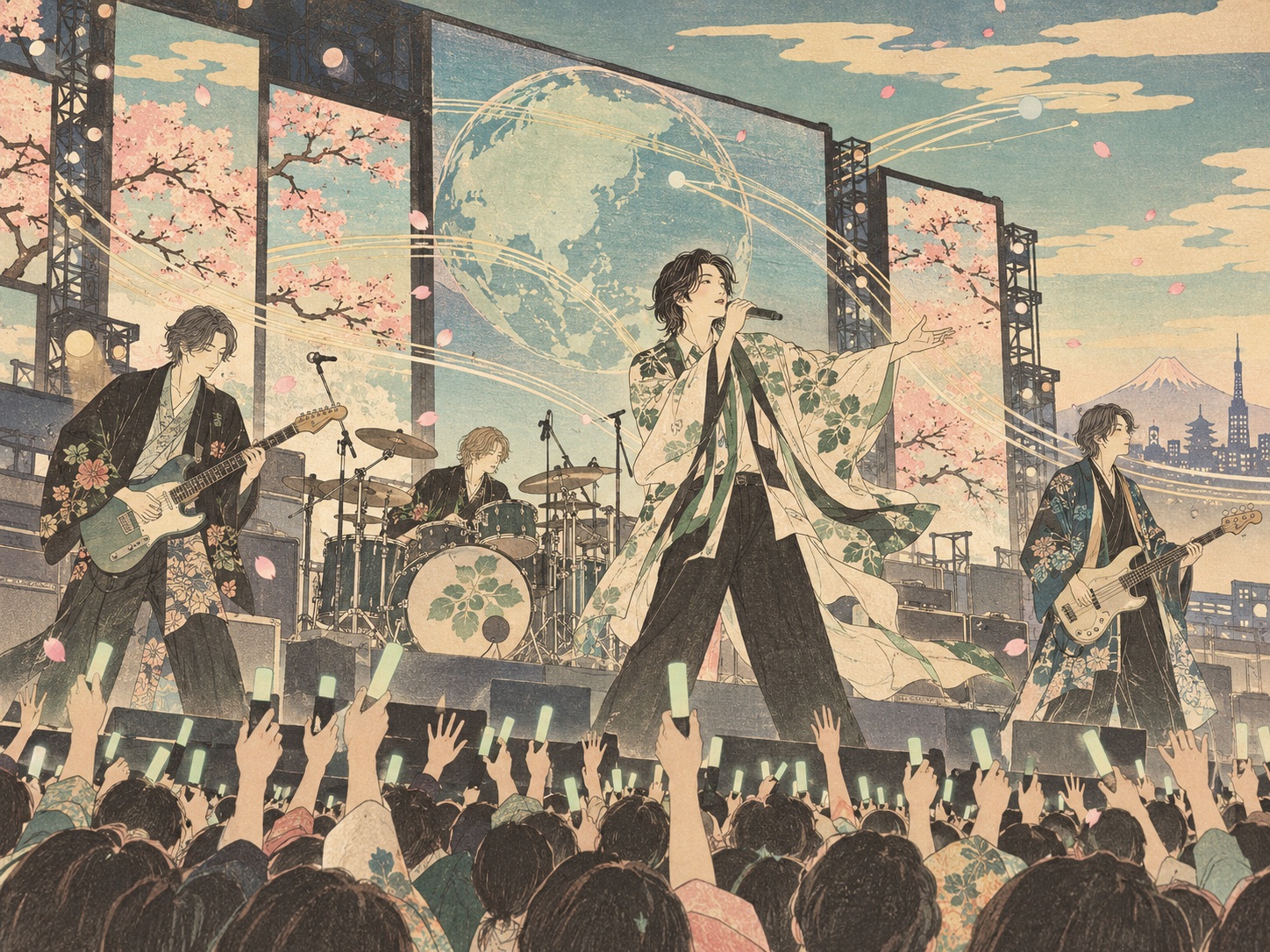
The scale of a J-pop hit is changing.
By August 2026, Mrs. GREEN APPLE had passed 18 billion cumulative streams across its catalog in Billboard Japan’s domestic streaming measurement. Three songs—“Ao to Natsu,” “Lilac” and “Tenbyo no Uta feat. Sonoko Inoue”—had crossed one billion plays.
Then, on September 30, the band released “POPS,” its first original full-length album in roughly three years. Billboard Japan reported 638,788 first-week physical sales, enough to top its album-sales chart and set a new high for a Mrs. GREEN APPLE original album.
“Ao to Natsu” took eight years to become a billion-stream song
In January 2026, the 2018 single “Ao to Natsu” became Mrs. GREEN APPLE’s first Billboard Japan billion-stream track.
The song was written for the film “Ao-Natsu: Kimi ni Koishita 30-nichi” and began streaming in July 2018.
It did not simply explode and disappear. Billboard Japan records show it returning to the top 10 of the streaming chart during successive summers: No. 6 in 2023, No. 4 in 2024 and No. 5 in 2025.
By August 2026, it had passed 1.1 billion plays.
The catalog, not one song, is the real story
Mrs. GREEN APPLE’s strength is the breadth of its streaming catalog.
By January 2026, Billboard Japan counted 32 songs above 100 million streams, the most for any artist at that point.
Alongside “Ao to Natsu,” listeners continue to stream “Tenbyo no Uta,” “Dance Hall,” “Lilac,” “Que Sera Sera,” “Soranji,” “Inferno,” “Boku no Koto,” “Magic” and songs from very different periods of the band’s career.
Streaming changes catalog economics. A new hit sends listeners backward into older music. Seasonal songs return every year. Karaoke, film, television and social media can revive tracks long after release week.
Formed in 2013, major debut in 2015
The band’s official biography says Mrs. GREEN APPLE formed in 2013 and made its major-label debut in 2015 on EMI Records with the mini-album “Variety.”
The group released albums steadily and expanded its live audience. Its first nationwide arena tour, “Eden no Sono,” sold out its major-city dates immediately.
From the beginning, songwriter and vocalist Motoki Ohmori favored songs that could move through rock, pop, orchestral color, electronic production and theatrical shifts inside a single arrangement.
In 2020, the band stopped while momentum was still rising
On July 8, 2020, Mrs. GREEN APPLE released its first best-of album, “5,” then announced that “Phase 1” was complete and suspended activity.
The official history places the announcement immediately after the release of the “Theater” music video.
It was a counterintuitive decision. Most acts try to protect momentum. Mrs. GREEN APPLE interrupted it.
Phase 2 returned as a trio
After about one year and eight months away, the band resumed activity in March 2022.
The lineup was now Ohmori, Wakai and Fujisawa, and the band called the restart “Phase 2.”
What followed included “Dance Hall,” “Soranji,” “Que Sera Sera” and “Lilac,” songs that became long-lived streaming staples rather than short release-week events.
Phase 2 was not merely a comeback. It was a redesign of the band’s sound, visual identity, live presentation and public profile.

Phase 3 began in 2026
In October 2025, the official site announced that the period from March 18, 2022 through December 31, 2025 would be defined as Phase 2, with Phase 3 beginning January 1, 2026.
The terminology gives fans a way to understand the band as an evolving story rather than a sequence of unrelated releases.
“POPS” is the first major full-length album statement of that new phase.
“POPS” contains 16 tracks
Universal Music Japan lists 16 songs on the album.
Seven had been released before the album, including “Brand New,” “GOOD DAY,” “lulu.,” “Kaze to Machi,” “Carrying Happiness,” “Natsu no Kage” and “Variety.” Nine were new.
Billboard Japan reported 638,788 sales in the September 28–October 4 tracking week, placing “POPS” at No. 1.
The result is notable because this is not a band choosing between physical ownership and streaming. It is succeeding at both.
A streaming giant that still sells physical albums
That duality is central to Mrs. GREEN APPLE’s commercial position.
Its songs circulate continuously through subscription platforms, yet fans still buy physical albums at very high volume.
“POPS” was offered in a standard version as well as limited editions with Blu-ray or DVD content and premium boxed editions containing merchandise.
Japan’s music market has often preserved physical purchasing longer than Western markets. Mrs. GREEN APPLE shows how physical and streaming demand can reinforce each other rather than operate as substitutes.
Why the band has become part of everyday life
Mrs. GREEN APPLE songs enter listeners’ lives through many doors.
They appear in films, television dramas, anime, commercials, television programming, karaoke rooms, school events and social media.
Billboard Japan notes that “Tenbyo no Uta feat. Sonoko Inoue” has remained unusually durable in karaoke rankings as well as streaming.
A streaming total is therefore not simply a measure of dedicated fans replaying a track. It can reflect repeated rediscovery through seasons, screen placements, karaoke and social use.
Huge in Japan is not automatically huge worldwide
The numbers require discipline.
Billboard Japan’s 18 billion figure measures listening in Japan across participating services. Spotify and Apple Music are included in that ecosystem, but the number is not a global total.
Being one of Japan’s largest streaming acts and being a similarly large global act are different achievements.
International growth depends on overseas playlists, social platforms, anime and film exposure, touring, local media and fans who translate not only lyrics but context.
The international doors are opening
Mrs. GREEN APPLE played its first solo concert in South Korea in 2025 as part of its 10th-anniversary period.
The band has also been appearing more frequently in English-language coverage. In an October 5 interview, The Japan Times presented Ohmori’s approach as a useful entry point for understanding contemporary J-pop.
For overseas listeners, one of the band’s advantages may be that it does not hide the density associated with Japanese pop arrangement.
Instead of simplifying itself into a generic international sound, Mrs. GREEN APPLE often leans into abrupt structural changes, layered instrumentation and melodic excess.
Ohmori’s refusal to obey one set of pop rules
The Japan Times described the group’s songs as exercises in maximalism, capable of moving from driving rhythm to ballad-like space, octave jumps and orchestral color within the same track.
That unpredictability can make the band harder to categorize—and easier to recognize.
What looks excessive against one pop tradition may become a signature in another market.
The “Phase” system turns a career into a long story
Mrs. GREEN APPLE does not present activity as an endless line of singles.
Phase 1, hiatus, Phase 2, the 10th anniversary and now Phase 3 form chapters.
That matters in a streaming environment where thousands of new releases appear every week. A fan who follows the band is following not just songs, but an unfolding identity.
What this says about Japan’s music business
Mrs. GREEN APPLE’s numbers have implications beyond one act.
Japan was long described as a market where physical CDs remained unusually strong and streaming adoption lagged North America and Europe.
Now a Japanese act can accumulate tens of billions of domestic streams while selling more than half a million copies of a new album in a week.
The emerging model is not physical versus digital. It is scale across both.
The next challenge is translation, not export
For J-pop, international growth is often described as “exporting” Japanese music.
A better question is translation.
How does a listener in another country encounter the song? Through anime? TikTok? A concert clip? A playlist? A friend? Can the sound work before the lyrics are understood? Does understanding the words deepen the attachment later?
Mrs. GREEN APPLE is already enormous inside Japan.
The next phase is not to duplicate that domestic scale mechanically overseas. It is to build enough entry points that listeners in different cultural contexts can discover what Japanese audiences already hear in the catalog.
Eighteen billion is a foundation, not a finish line
Streaming totals will continue to rise.
The more important fact is the cycle underneath the number.
A 2018 song still surges in 2026. New releases send listeners into the back catalog. Old songs return through seasons and karaoke. A new album sells more than 600,000 physical copies while its songs circulate digitally.
Mrs. GREEN APPLE has already shown how large a Japanese pop band can become in the streaming era.
Now it has to show what that scale can mean outside Japan.
Sources and references
- Billboard JAPAN — 「Mrs. GREEN APPLE『青と夏』ストリーミング累計11億回突破」2026年8月12日(全楽曲累計180億回超)。
- Billboard JAPAN — 「点描の唄 feat.井上苑子」10億回突破、2026年8月5日。
- Billboard JAPAN — 「青と夏」10億回突破、2026年1月21日。
- Billboard JAPAN — 『POPS』638,788枚でTop Albums Sales首位、2026年10月5日。
- Mrs. GREEN APPLE OFFICIAL SITE — PROFILE。
- Mrs. GREEN APPLE OFFICIAL SITE — HISTORY OF PHASE1 2013-2020。
- Mrs. GREEN APPLE OFFICIAL SITE — 2026年1月1日「フェーズ3」開幕告知。
- Universal Music Japan — 6th album『POPS』通常盤、収録曲・発売情報。
- Universal Music Japan — 6th ORIGINAL FULL ALBUM『POPS』特設サイト。
- The Japan Times — “Mrs. Green Apple doesn’t want to play by ‘the rules’,” October 5, 2026.
Reporting cutoff: October 6, 2026, 8:05 a.m. JST. The 18 billion domestic catalog-stream figure, billion-stream songs and 638,788 first-week album sales are from Billboard Japan. Members, career phases and “POPS” track information are verified through official band and Universal Music Japan materials. The 18 billion figure is a Japan chart metric, not a global streaming total; this report does not invent an international total.
Why it matters
Mrs. GREEN APPLE has surpassed 18 billion catalog streams in Billboard Japan’s domestic measurement, with three billion-stream songs.
A hybrid market
“POPS” also sold 638,788 copies in its first chart week, showing physical and streaming scale can coexist.
What to watch
Whether the band can translate its enormous Japanese catalog audience into durable overseas listening, touring and fandom.