- A universe assembled grain by grain
- The design is not an arbitrary pattern
- Why Japanese and Tibetan esoteric Buddhism meet here
- An island with a layered sacred history
- The visit in 2006 that began a new chapter
- A month of measured work, and a structural problem
- Must a sand mandala be destroyed?
- What a visitor can—and cannot—see
- The word “peace” in Hiroshima carries particular weight
- The evidence still needed for November 22
A universe assembled grain by grain
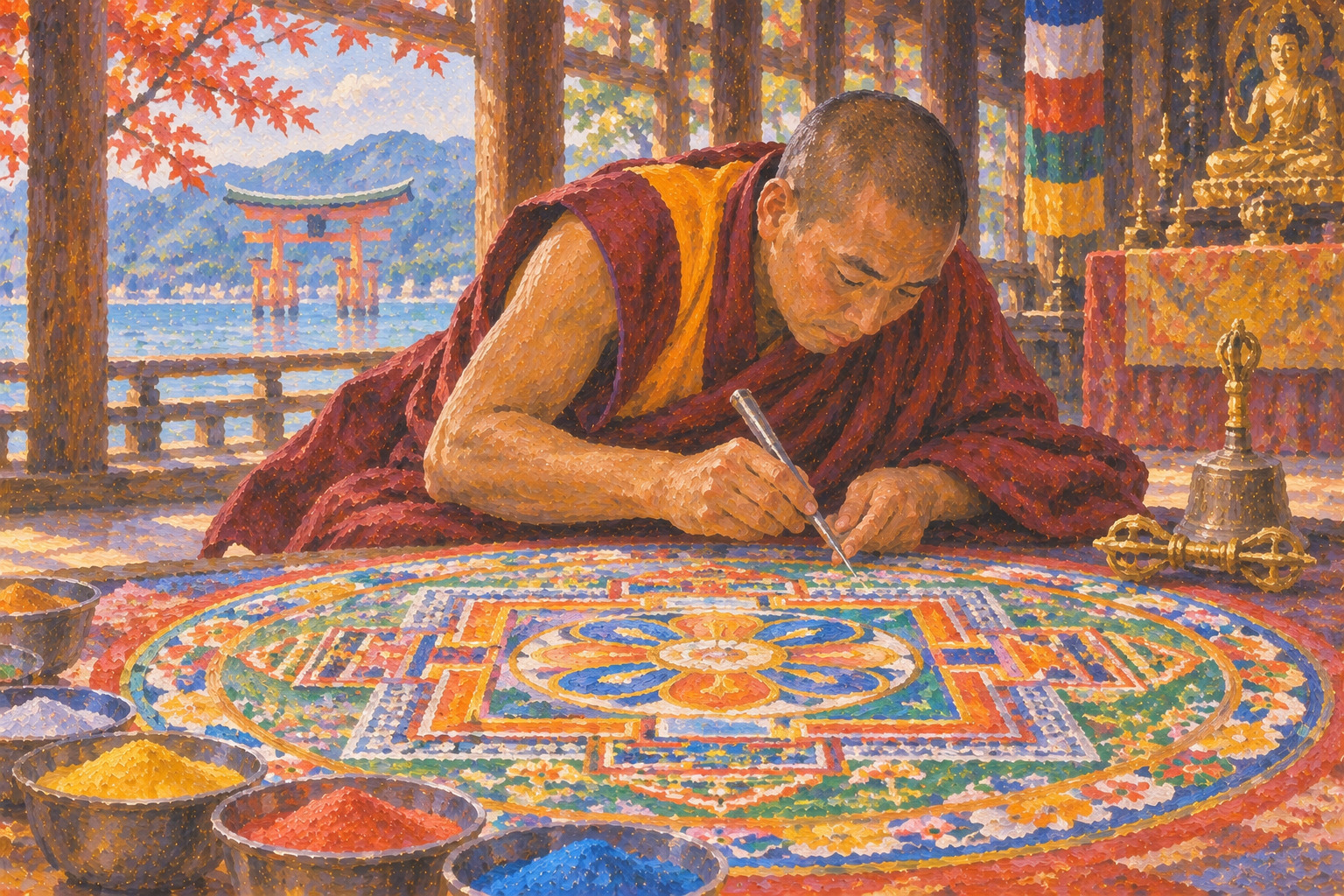
On the wooded island of Miyajima, where most visitors come for the famous torii standing in the sea, another sacred landscape is taking shape indoors. Tibetan monks at Daishō-in are assembling an extraordinarily intricate sand mandala in the temple's Henjōkutsu hall. The work marks twenty years since the 14th Dalai Lama visited the temple, and it is conceived as a ritual construction rather than simply an exhibition piece.
Organizers scheduled its completion rite for 11 a.m. on Saturday, November 21. This article was prepared from records available through November 19; the ceremony's successful completion must be checked against a subsequent announcement before the Sunday edition treats it as a completed event. What is already documented is the construction itself, the rite's purpose and the remarkable history connecting two Buddhist institutions.
The design is not an arbitrary pattern
The construction is formally described by its organizers as a Great Compassion Womb Realm mandala incorporating 117 sacred figures. At its center is Mahāvairocana, known in Japanese as Dainichi Nyorai, within a precisely ordered sacred palace. The iconography is drawn from the Mahāvairocana Sutra and related ritual prescriptions. Specific placements and colors are religiously meaningful, not decorative choices freely improvised by an individual painter.
Monks use specialized instruments, including the chakpur, to dispense tiny amounts of colored grains. The task demands close attention to boundaries, proportions and an inherited visual grammar. That is why the word 'artwork' by itself is insufficient: the painstaking object is also a site of prayer, disciplined practice and transmitted knowledge. The sponsoring association describes extremely fine grains, though its numerical estimate of their total is not an independent scientific count.
Why Japanese and Tibetan esoteric Buddhism meet here
Japanese Shingon Buddhism and Tibetan Buddhism are separate living traditions, with distinct lineages, texts and institutions. Yet they share important ancestry in Buddhist esoteric teachings, often identified internationally with Vajrayāna. Shingon's two great symbolic worlds—the Womb Realm and Diamond Realm—provide one context for understanding why this new mandala is so significant at Daishō-in.
It would be misleading to imply that the monks merely borrowed a pattern from Japanese art or that the two schools practice an identical ritual. Instead, this event is an unusually visible example of mutual study across lineages. The Drepung Gomang monks bring their own practice and discipline into a Shingon temple space, while the organizers explicitly connect the design to teachings transmitted in the 2006 ceremonies.
An island with a layered sacred history
Daishō-in occupies the lower slopes of Mount Misen on Miyajima, a place where Buddhist rites and shrine worship have shaped the island's identity for centuries. Temple tradition dates its origin to 806, when the monk Kūkai is said to have practiced on Mount Misen. Japan's Tourism Agency carefully distinguishes that traditional account from surviving written references to a major temple on the island beginning in the twelfth century.
The distinction matters. A religious community's origin story tells us how it understands itself; archival records establish a different kind of historical evidence. The temple's relationship to the Omuro school of Shingon and to Kyoto's Ninnaji, as well as the venerable pilgrimage traditions connected with Mount Misen, helps explain why a high-profile Tibetan ceremony could find a meaningful home here.
The visit in 2006 that began a new chapter
In 2006, the 14th Dalai Lama came to Daishō-in for ceremonies marking 1,200 years since the temple's traditional founding. The visit included the consecration of a Maitreya image and instruction connected with the two mandala realms. The Manjushri Mahayana Buddhist Association says institutional exchanges with Drepung Gomang Monastic College had been under way since 2000 and continued in the years that followed.
Tibetan monks accompanying the 2006 visit also made two sand mandalas for Daishō-in's Kannondō hall. According to the Japan Tourism Agency, those took three weeks to create and were preserved for visitors. The two works from 2006 are distinct from this year's new 117-deity construction in Henjōkutsu; combining them into one history would distort both.
A month of measured work, and a structural problem
The project began with preparations at the end of October. Organizers reported that the principal phase of placing colored grains began on November 3, with successive sections completed in the following days. A November 13 update described the completion of an outer section associated with 37 deities. The highly ordered plan makes the workflow itself part of the story: each region has to be finished with care before the larger world comes together.
A more unexpected detail emerged in a progress report: uneven weight on the platform threatened to cause the mandala base to bend and the sand structure to collapse. The team described the need for reinforcement. Behind the apparent serenity of the finished form lie engineering constraints, vulnerable materials and concentrated human labor—real-world challenges seldom visible in photographs of the final image.
Must a sand mandala be destroyed?
Images of Tibetan sand mandalas often end with a familiar gesture: once the ceremony is complete, the colored sand is swept together to symbolize impermanence. That association is legitimate, but it is not a universal rule governing every display. The Japan Tourism Agency specifically records that two mandalas created at Daishō-in in 2006 remained intact for later visitors.
The organizers also describe plans to display the new work after its November 21 rite. As of this article's research cutoff, the precise duration and conditions of viewing were not independently confirmed. The decision to preserve a ritual work can be understood as a way to share cultural and religious understanding; it need not erase the doctrine of impermanence that the wider mandala tradition explores.
What a visitor can—and cannot—see
Daishō-in is in Hatsukaichi City, at the foot of Mount Misen, within walking distance of the better-known Itsukushima Shrine. The compound contains multiple halls that express the island's mixed history of pilgrimage and devotional practice. Japan's Tourism Agency describes its Maitreya chamber and the older Tibetan sand mandalas as part of this cultural landscape.
A visitor approaching the November event should consult the temple or organizer for hours and access conditions, especially during ritual services. Photographs should not be assumed permissible without checking. The most worthwhile encounter is not simply to admire the precision of the design but to recognize that the people producing it are performing a religious duty within a living community, not demonstrating a craft for spectators alone.
The word “peace” in Hiroshima carries particular weight
The organizers state that the ceremony is dedicated to enduring world peace, the well-being of living beings and the flourishing of Buddhist teachings. On a visit to Hiroshima Prefecture, that aspiration inevitably resonates with the city's modern history. But resonance is not the same as documentary intent: the organizers do not present the artwork as an explicit depiction of the atomic bombing, and this report does not assign it a political message.
The deeper significance is persistence. Relationships between people practicing different forms of Buddhism have been sustained across decades, institutional changes and borders. The mandala is temporary in material and labor-intensive in method, yet it is also a visible record of continuity—of knowledge that survives because people keep practicing it together.
The evidence still needed for November 22
An accurate account of a religious event requires the same discipline as any other report. The November 21 completion rite is scheduled, not independently verified as having happened at the time of research. The construction and progress reports are documented; the final outcome, attendance, viewing arrangements and exact post-ceremony condition require a later source.
For JAPAN.co.jp's Hiroshima Special Edition, the story stands on established facts: a 117-deity Womb Realm design, a living exchange between Drepung Gomang and Daishō-in, and the twentieth anniversary of a major visit in 2006. Once the actual completion is confirmed, the opening and publication references can be updated. Until then, the correct journalistic verb is 'is creating,' not 'has completed.'
Primary sources and reporting limits
This report compares the organizer’s original schedule and workshop updates, Japan Tourism Agency historical material, records of the 2006 visit and November 19 local reporting. There was no direct interview or site visit. Completion and access arrangements after November 19 remain unconfirmed.